How Long Does Tirzepatide Take to Work? A Timeline
Tirzepatide is active within a day of the first injection, but the changes people wait for arrive in an order: appetite first, the scale over weeks, the big numbers over months as the dose steps up. This page lays that order out week by week, with every figure tied to the Zepbound or Mounjaro trial it came from, and explains why none of it is a promise for the compounded product PeRx prescribes.

In this article
Key Takeaways
- Tirzepatide reaches its peak blood level about a day after a dose and steady levels after four weekly doses, by the Zepbound label. Appetite usually changes before the scale does.
- Visible weight change takes weeks to months. In SURMOUNT-1, the 72-week Zepbound trial, the two higher doses were down 13.2 kg at week 20, and the three doses averaged 15.0%, 19.5% and 20.9% at week 72 against 3.1% on placebo.
- Loss slows and then levels. A post hoc analysis of the same trial put the median time to plateau at 24 to 36 weeks depending on starting BMI, with about nine in ten participants plateaued by week 72.
- Every timeline here comes from trials of Zepbound and Mounjaro. No trial has tested compounded tirzepatide, which is what PeRx prescribes, so the same speed or size of result cannot be promised for it.
Tirzepatide Timing: Facts Checked November 16, 2026
Active in the body
Within hours. The Zepbound label puts the median time to peak level at 24 hours after a dose (range 8 to 72 hours), with steady levels after four weekly doses.
Appetite
Usually first. In a six-week Nature Medicine trial, people on tirzepatide ate about 525 fewer calories at a test lunch by week 3 than people on placebo.
Weight
Weeks to months. In SURMOUNT-1 (Zepbound, 72 weeks) the two higher doses were down 13.2 kg at week 20; at week 72 the three doses averaged 15.0%, 19.5% and 20.9% loss against 3.1% on placebo.
Plateau
Months 6 to 9 for most. Median time to plateau in SURMOUNT-1 ran from 24 to 36 weeks by starting BMI; about 88% to 90% had plateaued by week 72.
Blood sugar
Mounjaro, 40 weeks. In SURPASS-1, A1C fell by 1.9 to 2.1 points and 31% to 52% of people reached the non-diabetic range. A1C reflects about three months of glucose, so it moves later than fasting readings.
What PeRx prescribes
Compounded tirzepatide with vitamin B12 from a state-licensed 503A pharmacy. Not Zepbound or Mounjaro, and not the product in any trial on this page.
How long does tirzepatide take to work? The medication is active within hours to days of the first injection, and the Zepbound label gives the time to peak level, but appetite changes usually come first and noticeable weight change takes weeks to months as the dose steps up. Every timeline below comes from trials of Zepbound and Mounjaro, the two FDA-approved tirzepatide products. Compounded tirzepatide, including tirzepatide at PeRx, has no trials of its own.
Read this first
Zepbound (weight management) and Mounjaro (type 2 diabetes) are FDA-approved tirzepatide products made by Eli Lilly. PeRx prescribes compounded tirzepatide with vitamin B12, prepared by a state-licensed 503A pharmacy against a licensed provider's prescription; it has not been through FDA review and was not the product in any trial here. Every figure below describes the approved brand, not the compounded product, and no figure is a weight-loss promise.
Tirzepatide Timeline at a Glance: How Long Does It Take for Tirzepatide to Work?
The tirzepatide timeline below puts each window next to what most people notice in it and where that observation comes from. "Trial result" means a number a published trial or its posted results reported at that time point. "Typical report" means a pattern patients and clinicians describe that no trial measured. The same table answers how long does Zepbound take to work, since Zepbound is the product the weight trials tested.
| Timeframe | What most people notice | Evidence source | Trial result or typical report |
|---|---|---|---|
| Days 1 to 7 | Little on the scale. The drug reaches peak level within about a day, and some people feel earlier fullness or mild nausea after the first dose. | Zepbound label, pharmacokinetics section | Label data for timing; typical report for how it feels |
| Weeks 1 to 4 | Appetite and "food noise" quieting. Early weight change is small, and part of it is water and digestion. | Nature Medicine 2025 six-week trial (energy intake at week 3) | Trial result for appetite; typical report for the scale |
| Weeks 5 to 12 | The first dose steps. Digestive effects shift with each step. Week 12 is where the trial analysts split early responders (5% or more lost) from late responders. | SURMOUNT-1 post hoc analysis (Ard 2025) | Trial result for the week-12 split; typical report for the step-by-step feel |
| Months 4 to 6 | Visible change. The two higher doses were down 13.2 kg at week 20 against 2.5 kg on placebo. Waist and clothing changes are what people describe. | SURMOUNT-1 posted results on ClinicalTrials.gov, week 20 | Trial result for the kilograms; typical report for clothing |
| Months 9 to 18 | Loss slows, then levels. Median time to plateau was 24 to 36 weeks by starting BMI. At week 72 the doses averaged 15.0%, 19.5% and 20.9% loss. | SURMOUNT-1 (NEJM 2022) and Horn 2025 plateau analysis | Trial result |
| Blood sugar (type 2 diabetes, Mounjaro) | Fasting glucose moves within weeks. A1C, which reflects about three months of glucose, fell by 1.9 to 2.1 points at 40 weeks in SURPASS-1. | SURPASS-1 (Lancet 2021), Mounjaro label, CDC | Trial result for A1C; the three-month lag is physiology |
Days 1 to 7
- What most people notice
- Little on the scale. The drug reaches peak level within about a day, and some people feel earlier fullness or mild nausea after the first dose.
- Evidence source
- Zepbound label, pharmacokinetics section
- Trial result or typical report
- Label data for timing; typical report for how it feels
Weeks 1 to 4
- What most people notice
- Appetite and "food noise" quieting. Early weight change is small, and part of it is water and digestion.
- Evidence source
- Nature Medicine 2025 six-week trial (energy intake at week 3)
- Trial result or typical report
- Trial result for appetite; typical report for the scale
Weeks 5 to 12
- What most people notice
- The first dose steps. Digestive effects shift with each step. Week 12 is where the trial analysts split early responders (5% or more lost) from late responders.
- Evidence source
- SURMOUNT-1 post hoc analysis (Ard 2025)
- Trial result or typical report
- Trial result for the week-12 split; typical report for the step-by-step feel
Months 4 to 6
- What most people notice
- Visible change. The two higher doses were down 13.2 kg at week 20 against 2.5 kg on placebo. Waist and clothing changes are what people describe.
- Evidence source
- SURMOUNT-1 posted results on ClinicalTrials.gov, week 20
- Trial result or typical report
- Trial result for the kilograms; typical report for clothing
Months 9 to 18
- What most people notice
- Loss slows, then levels. Median time to plateau was 24 to 36 weeks by starting BMI. At week 72 the doses averaged 15.0%, 19.5% and 20.9% loss.
- Evidence source
- SURMOUNT-1 (NEJM 2022) and Horn 2025 plateau analysis
- Trial result or typical report
- Trial result
Blood sugar (type 2 diabetes, Mounjaro)
- What most people notice
- Fasting glucose moves within weeks. A1C, which reflects about three months of glucose, fell by 1.9 to 2.1 points at 40 weeks in SURPASS-1.
- Evidence source
- SURPASS-1 (Lancet 2021), Mounjaro label, CDC
- Trial result or typical report
- Trial result for A1C; the three-month lag is physiology
Read top to bottom, the pattern is a staircase, not a slope: the body registers the drug in a day, appetite changes within weeks, the scale follows the dose steps, and the plateau arrives in the second half of the first year. Individual results vary widely around every one of those averages, which is why the weight loss peptides category page describes expectations rather than targets.
Tirzepatide
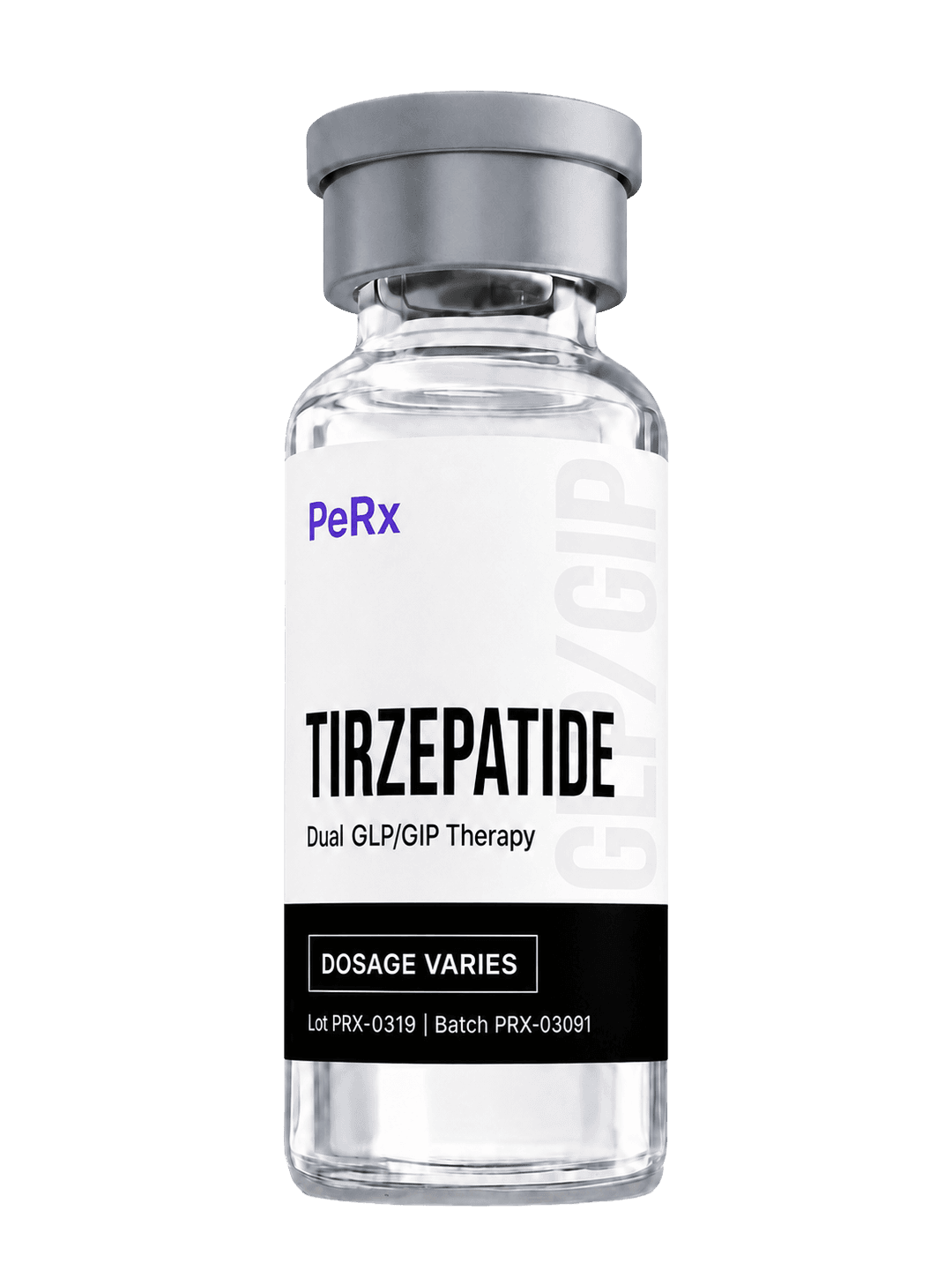
Available by prescription today. Tirzepatide at PeRx is compounded with vitamin B12 by a state-licensed 503A pharmacy, prescribed by a licensed provider after an eligibility check, and shipped as one ready-to-use vial per 28 days on a subscription you can cancel in one click. Plan-level prices are on the pricing page.
It is the dual GIP and GLP-1 option in the PeRx catalog. Compounded tirzepatide is not FDA approved and is not the product studied in the brand's trials, so the timeline on this page describes Zepbound and Mounjaro, not this vial.
Tirzepatide Before and After: Week-by-Week Results Timeline
A tirzepatide before and after, on this page, means the changes the trials measured over time, not photographs; PeRx shows no patient photos or testimonials for any product. Each window opens with a one-sentence answer and then the facts behind it, with the trial named. Searches for Zepbound before and after and Zepbound results land here because Zepbound is the product behind every weight figure.
Tirzepatide First Week: Days 1 to 7
In the tirzepatide first week, the drug is fully present but the results are not. The Zepbound label reports a median 24 hours to peak blood level after a dose, with a range of 8 to 72 hours, and a half-life of about five days, which is why one injection covers a week and why levels build over the first month rather than arriving all at once. Steady-state concentrations come after four weekly doses.
What people feel in week one is usually modest: a slightly earlier sense of fullness at meals, sometimes nothing. The early digestive effects the label lists, nausea, constipation and fatigue among them, can begin in this window and are the reason the label starts everyone on a low introductory dose. A pound or two on the scale in either direction is water and digestion, not fat.
Tirzepatide Weight Loss First Month: Weeks 1 to 4
The tirzepatide weight loss first month is designed for tolerability, not speed. The label holds the introductory dose for four weeks before any increase so the gut can adjust, which caps what can happen on the scale. What does change, for many people, is appetite: the quieting of "food noise," smaller portions feeling like enough, less interest in snacking between meals.
The best measurement of that early appetite effect is a six-week phase 1 trial published in Nature Medicine in 2025. Among 114 adults with overweight or obesity and no diabetes, people on tirzepatide ate about 525 fewer calories at a test lunch at week 3 than people on placebo, and reported less hunger and fewer cravings. One caution before reading its weight numbers as a first-month expectation: that study started participants above the label's introductory step and raised the dose again at week 3, so its six-week weight change, 7.0 kg on tirzepatide against 0.6 kg on placebo, describes a faster schedule than a first prescription follows. Early weight change on the label schedule is small.
Weeks 5 to 12: Dose Increases and Visible Results
Weeks 5 to 12 are when the dose starts to climb and the results start to show. The Zepbound label raises the dose in fixed steps no sooner than every four weeks, up to a maintenance level the prescriber selects on response and tolerability, and each step tends to bring a fresh round of appetite change and, for some, a fresh round of digestive effects that ease over the following days.
Week 12 is also the point the SURMOUNT-1 analysts used to sort participants. A 2025 post hoc analysis defined early responders as people who had lost 5% or more by week 12 and late responders as those who had not. The late group did not stay behind: 70% of them reached 5% by week 24, and 90% by week 72. At the trial's end the early responders averaged 22.5% loss and the late responders 11.0%, so a slow first twelve weeks predicted a smaller result, not a failed one. In people with type 2 diabetes, blood sugar markers may improve in this window too. Nausea in this stretch is common enough to have its own page on nausea on GLP-1s.
Months 4 to 6: Higher Doses and Visible Changes
By months 4 to 6, most people on a label schedule have reached or are approaching their maintenance dose, and the change is visible to other people. The nearest reported time point in SURMOUNT-1 is week 20, where the posted results on ClinicalTrials.gov show the two higher dose groups, pooled, down 13.2 kg from a starting weight near 105 kg, against 2.5 kg on placebo. In pounds that is roughly 29 against 5.
The trial measured kilograms. What people describe in this window is a belt notch or two, a clothing size, and the first comments from friends. Those are typical reports, not trial endpoints, and they arrive on different schedules for different bodies. The tirzepatide results timeline from here is the same effect continuing, not a new one.
Months 9 to 18: Peak Results and Plateau
Months 9 to 18 are where the trial endpoints sit and where most people level off. SURMOUNT-1 reported its primary result at week 72: mean weight loss of 15.0% on the lowest dose, 19.5% on the middle dose and 20.9% on the highest, against 3.1% on placebo, in 2,539 adults with obesity or overweight and no diabetes. The week-72 result is the trial's endpoint, not proof that weight stops falling at week 72.
For timing, the better source is a 2025 analysis of the same trial that defined a plateau as less than 5% change over a 12-week stretch and every stretch after it. Median time to plateau ran from 24.3 weeks in the overweight group to 36.1 weeks in the class II and III obesity groups, and by week 72 about 88% to 90% of participants had plateaued. Higher doses, younger age and female sex went with a later plateau. What to do at that point, including whether to step down, hold or stop, is a conversation with the prescriber; the GLP-1 maintenance and microdosing guide covers the options.
How Fast Does Tirzepatide Work? Appetite, Weight and Blood Sugar
How fast does tirzepatide work depends on which effect you are watching. Three run on three clocks: appetite in weeks, weight in months, and blood sugar on the timeline of the test used to measure it.
Tirzepatide Appetite Suppression and Food Noise
Tirzepatide appetite suppression is the first effect most people notice and often arrives before the scale moves. The Nature Medicine trial measured it directly: less eaten at a test meal by week 3, lower hunger ratings, fewer cravings and less pull from food in the environment, with brain imaging showing reduced activation to pictures of high-fat, high-sugar foods. Some people notice little until the first dose increase, which is normal; the introductory dose is chosen for tolerability rather than effect.
Tirzepatide and Blood Sugar: How Long Does Mounjaro Take to Work?
How long does Mounjaro take to work is a blood-sugar question, because Mounjaro is the tirzepatide product approved for type 2 diabetes. Fasting glucose and A1C move on different timelines: A1C reflects average glucose over roughly the previous three months, by the CDC's description of the test, so it lags the daily readings. In SURPASS-1, a 40-week trial of tirzepatide alone in adults with type 2 diabetes, A1C fell by 1.87, 1.89 and 2.07 points across the three doses against a 0.04-point rise on placebo, and 31% to 52% of people on tirzepatide reached an A1C below 5.7%, the non-diabetic range. A Mounjaro before and after is read in A1C at 40 weeks, not on a scale at week 4. PeRx does not run lab work; if you have diabetes, your own clinician's A1C testing is the measure that matters.
What Affects How Fast Tirzepatide Works?
The dose step-up schedule. Higher doses gave larger average results in every tirzepatide trial, and the label raises the dose in steps no sooner than every four weeks. How far and how fast to step is the prescriber's decision; at PeRx, dose steps are decided at each renewal check-in, not by the patient.
Consistency. A missed dose lowers drug levels, and the Zepbound label gives a four-day window to take a late dose before skipping it. Two doses in one week to catch up is never the answer.
Starting weight. The trials report percentages, and a percentage means more pounds at a higher starting weight; the 13.2 kg at week 20 in SURMOUNT-1 came from people who started near 105 kg. So how much weight can you lose on tirzepatide is best answered with the trial averages at set time points: about 13 kg for the two higher doses at week 20, and 15% to 21% at week 72, with wide spread around both. How long does it take to lose weight on tirzepatide is the same answer in reverse: the first meaningful change in weeks 5 to 12, most of the total by month 9. No trial reported a tirzepatide weight loss per week figure; any per-week number online is someone dividing an endpoint by a calendar.
Diet, protein and strength training. The drug lowers intake; it does not choose what is eaten. Enough protein and resistance work decide how much of the loss is fat rather than muscle, which keeping muscle on a GLP-1 covers.
Sleep and stress. Poor sleep raises hunger hormones and makes the appetite effect work against a headwind. Some people also report sleep changes on the drug itself, covered in sleep on tirzepatide.
Type 2 diabetes. Average weight loss is smaller in trials of people with type 2 diabetes. SURMOUNT-2, the 72-week trial in that population, reported 12.8% and 14.7% on the two higher doses against 3.2% on placebo, several points below the SURMOUNT-1 figures at the same doses.
Does Compounded Tirzepatide Work on the Same Timeline?
Nobody knows, because nobody has measured it. The timelines above come from trials of Zepbound and Mounjaro. No trial has tested compounded tirzepatide, so the same speed or size of result cannot be promised for it, and this page does not promise it. PeRx's compounded tirzepatide with vitamin B12 is prepared by a state-licensed 503A pharmacy, is not FDA approved, has not been through FDA review, and was not the product in any trial cited here. It is not equivalent to the brand and is not described as equivalent anywhere on this site.
What a patient can count on is the structure around the vial rather than a number: a licensed provider sets the starting strength, dose steps are decided at each renewal check-in, and the strength on the label can change between vials while the draw stays the same. Compounded tirzepatide results, for any one person, are whatever that person measures. For the differences between the compounded product and the brand pens, read compounded tirzepatide vs Zepbound; for the gap between a pharmacy product and an unregulated one, gray-market GLP-1s vs compounded.
What to Do If Tirzepatide Is Not Working
Tirzepatide not working is usually one of two things: it is early, or it has plateaued. Slow early results are common, which the late-responder analysis shows, and a plateau after steady loss is expected, which the time-to-plateau analysis shows. Neither means the drug has stopped doing anything. A tirzepatide plateau at month 7 is the trial's median, not an outlier.
Before deciding anything, run the checklist. Confirm no doses were missed or taken late. Ask the prescriber at the next renewal whether a dose change is appropriate, rather than changing anything yourself. Review protein, strength training, sleep and alcohol, the four inputs that move results without touching the dose. Track weight and waist over weeks, not days; daily readings swing with water. The general version of this checklist is in peptide not working, and tiredness that outlasts the first weeks has its own page on tirzepatide fatigue.
Contact the provider sooner than the next renewal if there is no appetite change after several dose steps, if side effects are severe or persistent, if weight changes rapidly in a way nobody planned, or if symptoms such as severe abdominal pain appear. Existing patients can message your care team at any time.
Getting Tirzepatide Through a Prescription
The path at PeRx is short: an eligibility check, a licensed provider's review of your health profile, a state-licensed 503A pharmacy that fills the prescription, and a check-in before each renewal where dose steps are decided. Compounded tirzepatide is not FDA approved. The full process, including what the provider reviews, is in how to get peptides prescribed online.
Ready to find out if tirzepatide fits?
New to PeRx: the eligibility check takes about a minute, and a licensed provider reviews every order before it ships. Already a patient: message your care team with questions about your prescription or your next renewal.
How Long Does Tirzepatide Take to Work? FAQs
Related Guides
Continue reading about peptides and protocols that pair well with this guide.
Tirzepatide Dosage Chart: Units, Strengths, Schedule
Every tirzepatide dosage chart online shows the same six numbers, 2.5 mg to 15 mg, because they all come from one FDA label. What none of them shows is how a compounded multi-dose vial carries those numbers. At PeRx the draw never changes: 50 units once a week, every cycle, while the provider changes the strength of the vial. This page lays out the label ladder, the six vial strengths that map onto it, the units arithmetic for any concentration, and the rules for escalation, maintenance and missed doses, as of October 2026.
Compounded Tirzepatide: The 2026 Rules, Explained
Compounded tirzepatide is the same active molecule as Mounjaro and Zepbound, drawn from a multi-dose vial a state-licensed pharmacy prepared for one named patient. Everything around the molecule is different: who checked it, what the law allows, what a court has said about how it is sold, and what the safety reports show. This page walks through all of it, dated.
Is NAD+ FDA Approved? Oral vs Injectable Explained
NAD+ occupies a unique regulatory space. It is a coenzyme your body produces naturally. Oral NAD+ precursors (NMN, NR) are sold as dietary supplements with no FDA approval needed. But injectable NAD+ is a compounded medication that requires a prescription. Same molecule, two completely different regulatory pathways depending on how it enters your body.
References and Review
Every figure on this page was checked against the source below on November 16, 2026. Trial results describe the approved products in the populations studied; they are not predictions for any individual and not claims about compounded tirzepatide. The page was reviewed by the clinician named in the byline.
Jastreboff AM, Aronne LJ, Ahmad NN, et al. Tirzepatide once weekly for the treatment of obesity (SURMOUNT-1). N Engl J Med. 2022;387(3):205-216. View study
Eli Lilly and Company. A study of tirzepatide in participants with obesity or overweight (SURMOUNT-1), NCT04184622: posted results, including change in body weight at week 20 (two higher doses pooled). ClinicalTrials.gov. View study
Ard J, Lee CJ, Gudzune K, et al. Weight reduction over time in tirzepatide-treated participants by early weight loss response: post hoc analysis in SURMOUNT-1. Diabetes Obes Metab. 2025;27(9):5064-5071. View study
Horn DB, Kahan S, Batterham RL, et al. Time to weight plateau with tirzepatide treatment in the SURMOUNT-1 and SURMOUNT-4 clinical trials. Clin Obes. 2025;15(3):e12734. View study
Martin CK, Carmichael OT, Carnell S, et al. Tirzepatide on ingestive behavior in adults with overweight or obesity: a randomized 6-week phase 1 trial. Nat Med. 2025;31(9):3141-3150. View study
Garvey WT, Frias JP, Jastreboff AM, et al. Tirzepatide once weekly for the treatment of obesity in people with type 2 diabetes (SURMOUNT-2). Lancet. 2023;402(10402):613-626. View study
Rosenstock J, Wysham C, Frías JP, et al. Efficacy and safety of a novel dual GIP and GLP-1 receptor agonist tirzepatide in patients with type 2 diabetes (SURPASS-1). Lancet. 2021;398(10295):143-155. View study
Zepbound (tirzepatide) injection, prescribing information, revised 08/2026. Eli Lilly and Company. DailyMed set id 487cd7e7-434c-4925-99fa-aa80b1cc776b. View study
Mounjaro (tirzepatide) injection, prescribing information. Eli Lilly and Company. DailyMed set id d2d7da5d-ad07-4228-955f-cf7e355c8cc0. View study
Centers for Disease Control and Prevention. Testing for diabetes and prediabetes: A1C. The A1C test reflects average blood glucose over the past three months. View study
Medical Disclaimer
The information provided on this website, including all articles, guides, and educational content, is for informational and educational purposes only and is not intended as medical advice, diagnosis, or treatment. Nothing on this site should be construed as a substitute for professional medical advice from a qualified healthcare provider.
The majority of peptides discussed on this site are not approved by the U.S. Food and Drug Administration (FDA) for the indications described. They are classified as bulk drug substances and are available only through a licensed prescribing provider and compounding pharmacy. All treatments require a valid prescription and provider oversight.
The majority of published research on peptide therapies has been conducted in preclinical (animal) models. While early human data is encouraging, comprehensive clinical trial data remains limited for most peptide compounds. Individual results may vary significantly based on health status, injury type, and other factors. No specific outcomes are guaranteed.
Certain peptides discussed on this site are classified as prohibited substances by the World Anti-Doping Agency (WADA) and are banned by major sports organizations including the NFL, NCAA, UFC, NBA, MLB, NHL, and PGA. If you are subject to anti-doping testing, consult your governing body before considering any peptide therapy.
Statements on this website have not been evaluated by the Food and Drug Administration. Products and therapies discussed are not intended to diagnose, treat, cure, or prevent any disease.
© 2026 Wellness MD Group PC DBA PeRx. All rights reserved.