Compounded Tirzepatide vs Zepbound: How They Differ
Same molecule, two very different products. Zepbound is an FDA-approved pen or vial from Eli Lilly; compounded tirzepatide is a multi-dose vial a state-licensed pharmacy prepares for one patient. This page sets them side by side on approval, dose format, how you get each, what each costs in November 2026, and what the first weeks look like.
In this article
Key Takeaways
- Zepbound and compounded tirzepatide are meant to contain the same active ingredient. Beyond that they are different products: Zepbound is FDA-approved and factory-made at six fixed doses; compounded tirzepatide is prepared by a pharmacy for one patient and has never been reviewed by the FDA or tested in a trial.
- Zepbound comes as a pen or vial with the dose built in. A compounded vial holds several weekly doses and asks you to draw each one with a syringe, which is where most of the FDA’s compounded-product error reports come from.
- Since the tirzepatide shortage ended in December 2024, a compounded copy of Zepbound may not be made routinely. What remains lawful is a prescription where the prescriber documents a change that makes a significant difference for that patient. Adding vitamin B12 does not by itself meet that test.
- On price the gap has mostly closed. Lilly’s self-pay vials run $299 to $449 a month by dose (read November 2026); PeRx charges $399 at every strength with the provider review, syringes and shipping included. Different products, so not a like-for-like comparison.
- At PeRx, compounded tirzepatide with vitamin B12 is prescribed after a provider review, compounded by a US-based, state-licensed 503A pharmacy, and shipped as one ready-to-use vial per 28 days. It is compounded, not an FDA-approved drug, and for some patients Zepbound is the right answer.
Compounded Tirzepatide vs Zepbound: Quick Facts
Same active ingredient
Both are meant to contain tirzepatide, a once-weekly dual GIP and GLP-1 receptor agonist. The brand is the reference; a compounded vial is supposed to match it.
Who makes it
Zepbound: Eli Lilly, in FDA-reviewed manufacturing. Compounded: a licensed pharmacy, per prescription, for one named patient.
FDA status
Zepbound is an FDA-approved drug (November 2023). Compounded tirzepatide is not FDA-approved and has never been reviewed for safety, effectiveness or quality.
Dose format
Zepbound: single-dose pen or vial, or a four-dose KwikPen or multi-dose vial, at six fixed strengths. Compounded: a multi-dose vial you draw from with a syringe.
Availability
Zepbound: any pharmacy with a prescription, or Lilly’s own self-pay pharmacy. Compounded: restricted since the shortage ended in December 2024; lawful per patient with a documented reason.
At PeRx
Compounded tirzepatide with vitamin B12 from a US-based, state-licensed 503A pharmacy. $399 per month at every strength on the public pricing page. Compounded, not FDA-approved.
If you are comparing compounded tirzepatide vs Zepbound, start with the one thing they share and the long list of things they do not. Both are meant to deliver tirzepatide, the molecule Eli Lilly sells as Zepbound for weight management and as Mounjaro for type 2 diabetes. Zepbound is an FDA-approved product made in an inspected factory at six fixed doses. Compounded tirzepatide is prepared by a pharmacy for an individual patient, almost always as a multi-dose vial, and has never been reviewed by the FDA or studied in a trial. This is the practical, decision-focused comparison; the compounded tirzepatide guide holds the full regulatory and litigation record.
Prices and FDA status checked on 2026-11-15
The Lilly prices and every regulatory statement on this page were read on the date above and are cited in the references with the date each source marks itself current. Both change. If you are reading this later, check the linked pages before relying on a number or a date.
Compounded Tirzepatide vs Zepbound: Side by Side
| Zepbound | Compounded tirzepatide | |
|---|---|---|
| Active ingredient | Tirzepatide, manufactured by Eli Lilly. | Tirzepatide from a bulk ingredient, prepared by a licensed pharmacy. Nobody outside the pharmacy verifies that a given vial matches the approved drug. |
| FDA status | FDA-approved drug, NDA 217806, approved November 8, 2023. | Not FDA-approved. The FDA does not review compounded drugs for safety, effectiveness or quality before they are dispensed. |
| Approved uses | Weight reduction and long-term maintenance in adults with obesity, or overweight plus a weight-related condition, with diet and activity; moderate to severe obstructive sleep apnea in adults with obesity. | None. A provider prescribes it at their own judgment. |
| Dose format | Single-dose pen or vial, 2.5 mg to 15 mg in 0.5 mL, plus a four-dose KwikPen and multi-dose vial. The dose is built in. | A multi-dose vial at the concentration the prescription specifies; you draw the dose in units. At PeRx: a 2 mL vial, four weekly doses of 50 units. |
| Other ingredients | Tirzepatide plus the inactive ingredients on the label. | Varies by pharmacy. Many add vitamin B12; some add niacinamide. PeRx’s product contains B12. |
| Quality oversight | FDA approval of the product and its manufacturing, ongoing inspection, mandatory adverse event reporting. | State board of pharmacy licensing and the pharmacy’s own lot testing. No FDA batch testing; a 503A pharmacy is not required to report adverse events. |
| Clinical trial evidence | Approval rests on trials of Zepbound itself. | None. No trial has tested a compounded tirzepatide product, so neither equivalence nor a difference can be claimed. |
| How you get it | Prescription from any licensed prescriber, filled at a retail pharmacy or through LillyDirect. | Prescription from a licensed prescriber who documents a patient-specific reason, filled by a 503A pharmacy. |
| Monthly cost (November 2026) | Self-pay through Lilly: $299, $399 or $449 by dose, needles extra. As little as $25 with commercial insurance and the savings card. | $399 at PeRx at every strength, with the provider review, syringes, swabs and shipping included. No insurance. |
Active ingredient
- Zepbound
- Tirzepatide, manufactured by Eli Lilly.
- Compounded tirzepatide
- Tirzepatide from a bulk ingredient, prepared by a licensed pharmacy. Nobody outside the pharmacy verifies that a given vial matches the approved drug.
FDA status
- Zepbound
- FDA-approved drug, NDA 217806, approved November 8, 2023.
- Compounded tirzepatide
- Not FDA-approved. The FDA does not review compounded drugs for safety, effectiveness or quality before they are dispensed.
Approved uses
- Zepbound
- Weight reduction and long-term maintenance in adults with obesity, or overweight plus a weight-related condition, with diet and activity; moderate to severe obstructive sleep apnea in adults with obesity.
- Compounded tirzepatide
- None. A provider prescribes it at their own judgment.
Dose format
- Zepbound
- Single-dose pen or vial, 2.5 mg to 15 mg in 0.5 mL, plus a four-dose KwikPen and multi-dose vial. The dose is built in.
- Compounded tirzepatide
- A multi-dose vial at the concentration the prescription specifies; you draw the dose in units. At PeRx: a 2 mL vial, four weekly doses of 50 units.
Other ingredients
- Zepbound
- Tirzepatide plus the inactive ingredients on the label.
- Compounded tirzepatide
- Varies by pharmacy. Many add vitamin B12; some add niacinamide. PeRx’s product contains B12.
Quality oversight
- Zepbound
- FDA approval of the product and its manufacturing, ongoing inspection, mandatory adverse event reporting.
- Compounded tirzepatide
- State board of pharmacy licensing and the pharmacy’s own lot testing. No FDA batch testing; a 503A pharmacy is not required to report adverse events.
Clinical trial evidence
- Zepbound
- Approval rests on trials of Zepbound itself.
- Compounded tirzepatide
- None. No trial has tested a compounded tirzepatide product, so neither equivalence nor a difference can be claimed.
How you get it
- Zepbound
- Prescription from any licensed prescriber, filled at a retail pharmacy or through LillyDirect.
- Compounded tirzepatide
- Prescription from a licensed prescriber who documents a patient-specific reason, filled by a 503A pharmacy.
Monthly cost (November 2026)
- Zepbound
- Self-pay through Lilly: $299, $399 or $449 by dose, needles extra. As little as $25 with commercial insurance and the savings card.
- Compounded tirzepatide
- $399 at PeRx at every strength, with the provider review, syringes, swabs and shipping included. No insurance.
Two rows do most of the work. FDA status is the legal difference: one product has been reviewed and the other never will be. Dose format is the safety difference: a pen measures for you and a vial asks you to measure. Everything else, including cost, sits closer together than it did two years ago.
What Is the Same
Both products are meant to contain tirzepatide, which acts on two gut-hormone receptors, GIP and GLP-1, rather than the one semaglutide acts on; the weight loss peptides page covers the mechanism. Because the molecule is the same, the expected effects are the same in kind: less appetite, earlier fullness, slower stomach emptying, and the digestive side effects that come with them. The Zepbound label lists nausea, diarrhea, vomiting, constipation and abdominal pain among its most common adverse reactions, and a compounded product with the same molecule should be expected to produce the same list. Both are injected under the skin once a week, both carry the boxed warning about thyroid C-cell tumors seen in rodents, and both are ruled out for anyone with a personal or family history of medullary thyroid carcinoma or MEN 2. The phrase to hold onto is "meant to contain." For Zepbound it is a guarantee backed by FDA review. For a compounded vial it is the goal of a legitimate prescription, checked by whatever lot testing the pharmacy performs.
What Is Different
Approval and the Label
Zepbound was approved on November 8, 2023, and on December 20, 2024 its label grew to cover moderate to severe obstructive sleep apnea in adults with obesity. The label, revised in August 2026, also sets the dose schedule: 2.5 mg once weekly for four weeks, then 5 mg, with increases of 2.5 mg after at least four weeks on a dose, a maintenance dose of 5, 10 or 15 mg, and a maximum of 15 mg. Compounded tirzepatide has no label, no approved use and no approved schedule. A prescriber writes it at their own judgment, and most follow the Zepbound steps because that is the only schedule anyone has studied.
Manufacturing and Testing
Zepbound is made in a standardized, inspected process, and Lilly must report adverse events to the FDA. A compounded vial is prepared by a pharmacist from a bulk ingredient under state board of pharmacy oversight. The FDA does not test compounded batches, and federal law does not require a state-licensed pharmacy that is not an outsourcing facility to report adverse events, which the agency says makes its compounded-product numbers an undercount. What stands in for federal review is the pharmacy’s own testing. PeRx’s pharmacy tests each lot for potency, sterility, endotoxins and pH, with a sample certificate on the quality testing page; ask any provider for the same. The 503A vs 503B pharmacy guide explains the two kinds of compounder.
Pen vs Vial
This is the difference you feel every week. A Zepbound single-dose pen or vial holds exactly one dose, and the four-dose KwikPen and multi-dose vial still fix the dose by the strength prescribed. Compounded tirzepatide comes as a multi-dose vial at a concentration the prescription sets, and you draw each weekly dose with an insulin syringe marked in units. The FDA’s adverse event file for compounded GLP-1s is heavy with dosing errors, which it attributes to patients measuring and self-administering incorrect doses. At PeRx the draw is the same for every patient at every step, 50 units, and the concentration of the vial changes between cycles instead; the tirzepatide dosage chart lays the six label steps against the vial strengths and shows the units math. The vial ships fully reconstituted and ready to use, with syringes and alcohol swabs in the box.
The Vitamin B12
Most compounded tirzepatide, including the PeRx product, is prepared with vitamin B12 in the same vial. The FDA has said that adding a vitamin does not by itself turn a copy of an approved drug into something else; the prescriber’s documented reason for the patient does. There is no trial of the combination, so no claim can be made that B12 improves the drug or its tolerability, and PeRx makes none. And in 2026 scientists employed by Lilly analyzed compounded tirzepatide and B12 products bought on the US market and reported an impurity formed by a reaction between tirzepatide and certain forms of B12. Its clinical significance is unknown, and the authors work for the maker of the approved product, which is a reason to read the paper carefully rather than dismiss it, and to ask a pharmacy which B12 form it uses and what it tests on the finished vial.
Evidence
The trials behind Zepbound tested Zepbound. No trial has tested a compounded tirzepatide product, and in April 2026 a federal court in California let Lilly proceed with false-advertising claims against a telehealth company that had cited the brand trial programs as proof its compounded vial was safe and effective. The court found it plausible that the FDA approves specific formulations rather than an ingredient, and that borrowing the trial record for a compounded product could mislead a reasonable consumer. Any page that says a compounded vial works as well as Zepbound, or better because of an additive, is making a claim nobody has tested.
Tirzepatide
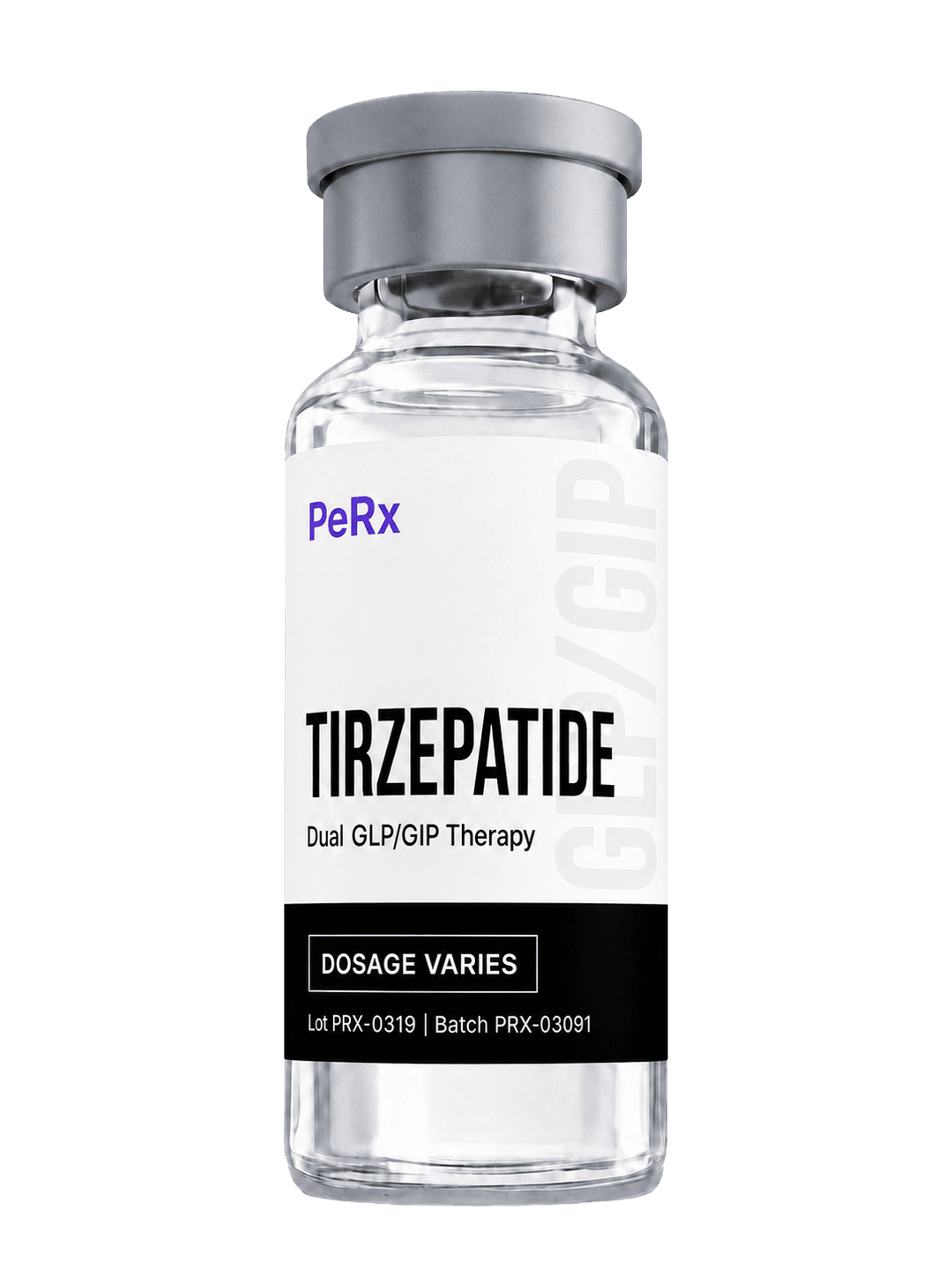
Compounded tirzepatide at PeRx is prepared with vitamin B12 by a US-based, state-licensed 503A pharmacy, prescribed by a licensed provider after an eligibility check, and shipped as one ready-to-use 2 mL vial per 28 days on a renewal you can pause, skip or cancel in one step from your account.
It is compounded, not an FDA-approved drug, and it is not Zepbound or Mounjaro. No clinical trial has tested it. The provider decides whether a compounded product is appropriate for you, and for some patients the approved product is the right choice.
How You Get Zepbound
Zepbound requires a prescription from a licensed prescriber, and then there are two routes. The insurance route runs through a retail or mail-order pharmacy with the single-dose pens; coverage for weight management varies widely, and Lilly’s savings program advertises a price as low as $25 a month for eligible patients with commercial coverage. The self-pay route runs through LillyDirect, Lilly’s own online pharmacy, which fills single-dose vials and the four-dose KwikPen at cash prices; you buy needles and syringes, or pen needles, separately. If you have no prescriber, Lilly’s site points to independent telehealth providers. Either way the result is an FDA-approved product with the dose built in.
How You Get Compounded Tirzepatide
Compounded tirzepatide also requires a prescription, and the prescriber carries one obligation the Zepbound prescriber does not. Because the shortage has ended, a compounded version that is essentially a copy of Zepbound or Mounjaro may not be made regularly or in inordinate amounts. The lawful path under section 503A is a prescription where the prescriber determines, and documents, that the compounded product contains a change producing a significant difference for that individual patient. A provider who cannot articulate that reason for you should not be writing the prescription, and a seller that asks for no prescription at all offers you no legal footing whatsoever.
At PeRx the sequence is short. You complete an online eligibility check covering the conditions that rule a GLP-1 out, from thyroid cancer history to pregnancy plans to past pancreatitis. A licensed provider reviews it and either prescribes or declines; your card is saved at checkout and charged only on approval. The pharmacy compounds the vial against that prescription and ships it overnight in cold packaging, labeled with your name, the pharmacy, the prescriber, the concentration and a beyond-use date. There is no strength to pick at checkout, because the strength is a clinical decision. Tirzepatide is one of two PeRx products sold as a 28-day subscription: a check-in reviewed by a licensed provider precedes each renewal, dose steps are decided at those check-ins, and an email and a text arrive about three days before each charge. Getting peptides prescribed online walks through the steps, and semaglutide vs tirzepatide compares the two compounded GLP-1s PeRx offers.
What a legitimate compounded prescription is not
It is not a vial labeled "research use only," which was never meant for a person. It is not a product with no named prescriber or no named, state-licensed pharmacy. It is not a price that is low because the ingredient was bought for laboratory use. And it is not a page that implies the vial is the same as Zepbound; in March 2026 the FDA warned 30 telehealth companies over exactly that claim. Gray-market GLP-1s vs compounded covers how to check each of these.
What Each Costs in November 2026
Two years ago the cost argument was simple: the brand cost over a thousand dollars a month at list and the compounded vial a fraction of that. Lilly has since cut its self-pay prices, most recently in December 2025, and the picture in November 2026 is closer than most people expect.
| Weekly dose | Zepbound self-pay via LillyDirect | PeRx compounded tirzepatide |
|---|---|---|
| 2.5 mg (starting step) | $299 per month | $399 per month |
| 5 mg | $399 per month | $399 per month |
| 7.5 mg to 15 mg | $449 per month when refilled within 45 days | $399 per month |
| What is included | The medication. Needles and syringes, or pen needles, are extra; the prescriber visit is yours to arrange. | The medication, the provider review before every cycle, syringes, alcohol swabs and overnight cold shipping. No membership fee. |
| Insurance | Possible on the pen route; as low as $25 a month with the savings card for eligible commercially insured patients. | Not covered. HSA and FSA funds are often usable, subject to plan rules. |
2.5 mg (starting step)
- Zepbound self-pay via LillyDirect
- $299 per month
- PeRx compounded tirzepatide
- $399 per month
5 mg
- Zepbound self-pay via LillyDirect
- $399 per month
- PeRx compounded tirzepatide
- $399 per month
7.5 mg to 15 mg
- Zepbound self-pay via LillyDirect
- $449 per month when refilled within 45 days
- PeRx compounded tirzepatide
- $399 per month
What is included
- Zepbound self-pay via LillyDirect
- The medication. Needles and syringes, or pen needles, are extra; the prescriber visit is yours to arrange.
- PeRx compounded tirzepatide
- The medication, the provider review before every cycle, syringes, alcohol swabs and overnight cold shipping. No membership fee.
Insurance
- Zepbound self-pay via LillyDirect
- Possible on the pen route; as low as $25 a month with the savings card for eligible commercially insured patients.
- PeRx compounded tirzepatide
- Not covered. HSA and FSA funds are often usable, subject to plan rules.
So at the starting step Zepbound is cheaper, at 5 mg the two cost the same, and from 7.5 mg up the compounded vial is $50 a month less before supplies and the prescriber visit on the brand side. That is not a large gap, and it is not a reason on its own to choose a compounded drug over an approved one. If insurance covers Zepbound for you, the brand almost always wins on cost. The honest cost case for the compounded route is the flat, all-in price with a provider review in every cycle, not a discount. Lilly’s figures come from its LillyDirect page as read in November 2026 and carry conditions; PeRx’s is on the pricing page, and the peptide therapy cost guide explains what each kind of number includes.
Who Each Suits
The decision belongs to you and a prescriber who has reviewed your history, and the provider at PeRx will say so when the approved product is the better fit. With that said, the two products tend to sort people along a few lines.
Ideal for
Zepbound is the straightforward choice when insurance covers it, when you want an FDA-approved product with the dose built in and no measuring, when you prefer a pharmacy you can walk into, or when you have no comfort with drawing a dose from a vial. It is the only option with a label, a trial record and a manufacturer answerable to the FDA, and for many people that settles it.
Consider alternatives if
Compounded tirzepatide is something a provider may consider when insurance will not cover the brand and a flat monthly price with the review, supplies and shipping included matters more than a built-in dose; when you are comfortable with an insulin syringe; and when the provider can document a reason the compounded product makes a significant difference for you. It is not for anyone who wants an FDA-reviewed product, and it is not a way around the screening questions, which are the same for both.
Compounded Tirzepatide: FDA Status, Dated
Compounded tirzepatide exists at scale because Mounjaro and Zepbound spent two years on the FDA’s drug shortage list, and a drug on that list may be compounded in quantity. From the FDA’s own compounding statement (content current as of April 1, 2026): the agency declared the tirzepatide shortage resolved on October 2, 2024, re-examined that decision after a trade group sued, and reached the same conclusion on December 19, 2024. It gave 503A pharmacies until February 18, 2025 and 503B outsourcing facilities until March 19, 2025 to stop making copies; a federal court declined to block the decision on March 5, 2025, and both periods have ended. As of April 2026 tirzepatide is on neither the shortage list nor the 503B bulks list, and on April 30, 2026 the FDA proposed formally excluding tirzepatide, semaglutide and liraglutide from that bulks list, finding no clinical need for outsourcing facilities to compound them. No final determination had been published when this page was checked.
What that leaves is section 503A, one prescription at a time. A compounded drug is essentially a copy when it has the same active ingredient, the same route and a strength within ten percent of a marketed one, unless the prescriber determines and documents a change that produces a significant difference for the individual patient; the FDA has also said it does not intend to act against a compounder filling four or fewer such prescriptions in a calendar month. It has enforced on that basis: in March 2026 it warned 30 telehealth companies over claims implying their compounded GLP-1s were the same as the approved drugs, and in September 2026 it sent a warning letter to a large compounding pharmacy over tirzepatide and semaglutide products it said appeared to be essentially copies, compounded regularly and in inordinate amounts. The newest letter on the list when this page was checked went to a telehealth company on October 30, 2026 over website and social media claims about its compounded semaglutide and tirzepatide, including a heading that called them FDA-approved compounded medications. One number belongs here because it is the FDA’s own: as of May 31, 2026 the agency had received more than 730 adverse event reports associated with compounded tirzepatide, many describing the known effects of the drug and the rest dominated by dosing errors from vials, products that arrived warm, and fraudulent products sold under the name.
What this means in plain terms
Compounded tirzepatide is not banned and it is not freely available the way it was during the shortage. It is lawful per patient, on a prescriber’s documented reason, from a state-licensed pharmacy. The FDA could narrow that at any time, and if it did, PeRx would stop prescribing rather than work around it. Compounded drugs are never FDA-approved. The full record, including the court cases and the adverse event data, is on the compounded tirzepatide guide; the wider legal picture is in are peptides legal in 2026.
What to Expect in the First Weeks
On the drug side the first weeks look alike for both products, because the molecule and the starting step are the same: the Zepbound label starts everyone at 2.5 mg once weekly for four weeks, a dose it calls a starting dose and not a maintenance dose, and the compounded route at PeRx follows the same first step. What differs is the handling.
Days 1 to 3
Approval and delivery
Zepbound: the prescription goes to your pharmacy or LillyDirect and you pick up or receive pens or vials. PeRx: the provider reviews your eligibility check; if approved, your card is charged and the vial ships overnight in cold packaging with syringes and swabs. If the provider declines, nothing is charged.
Day of arrival
Check and store
Both: refrigerate at 36 to 46 F in the carton, away from light, never frozen. A Zepbound single-dose pen or vial can sit at room temperature for up to 21 days if needed. A compounded vial should arrive cold and clear with a complete label; the FDA says to discard a multi-dose GLP-1 vial 28 days after first use even if medication remains.
Week 1
First injection
Zepbound: uncap or dial and inject; the dose is built in. Compounded: draw 50 units into an insulin syringe and inject under the skin of the abdomen, thigh or upper arm. Same day each week, with or without food. Where to inject semaglutide and tirzepatide has the sites and the units math.
Weeks 1 to 4
The starting step
Nausea, constipation and diarrhea are most common in the days after a first dose or a step up and usually ease; smaller portions and lighter meals help. Severe abdominal pain, especially spreading to the back, is a reason to seek care now with either product. Nausea and gut symptoms on GLP-1s covers the rest.
Week 4 onward
The next step
Zepbound: your prescriber decides whether to move to 5 mg and writes the next strength. PeRx: a provider-reviewed check-in precedes each 28-day renewal and the dose step for the next vial is decided there; the draw stays 50 units and the vial concentration changes. Pause, skip or cancel from your account before the renewal date.
If you are switching from Zepbound to a compounded vial, or back, the prescriber manages it. Tell the provider the exact dose and date of your last injection; a switch is never made in the same week as a dose of the other product, and the two are never used together, which the Zepbound label states outright. For the months after that, how long peptides take to work sets expectations by class, and GLP-1 maintenance dosing and microdosing covers staying at a low step.
Want to know whether a provider would consider compounded tirzepatide for you?
New to PeRx: the eligibility check takes about a minute, and a licensed provider reviews every order before a pharmacy fills it. Already a patient: message your care team with questions about your protocol.
Compounded Tirzepatide vs Zepbound FAQs
Related Guides
Continue reading about peptides and protocols that pair well with this guide.
Compounded Tirzepatide: The 2026 Rules, Explained
Compounded tirzepatide is the same active molecule as Mounjaro and Zepbound, drawn from a multi-dose vial a state-licensed pharmacy prepared for one named patient. Everything around the molecule is different: who checked it, what the law allows, what a court has said about how it is sold, and what the safety reports show. This page walks through all of it, dated.
Retatrutide vs Tirzepatide: Data and What You Can Get
Tirzepatide is FDA approved and can be prescribed today. Retatrutide is still in phase 3 trials, is not approved by any regulator, cannot be prescribed and cannot legally be compounded. This page lays out what each drug's trials actually showed, with the trial, the population and the analysis named for every number, explains why the two cannot be ranked against each other yet, and shows the one route that exists right now.
Tesamorelin vs Ipamorelin: Two Halves of a Signal
Almost every page ranking for this comparison sorts the two into lanes: tesamorelin for belly fat, ipamorelin for sleep and recovery. The lanes are tidy and one of them was never measured. These peptides act on two different receptors that the pituitary uses together, which is why they end up in the same vial rather than competing for the same slot. Here is what each one has actually been shown to do, and which question you are really asking when you compare them.
References and Review
FDA statements are cited with the date the FDA marks each page current. The Zepbound facts come from its prescribing information and Drugs@FDA; the Lilly prices from Lilly’s own LillyDirect page on the access date. The page is reviewed by Dr. Cory Mellon, MD, and the prices and compounding status are re-checked on the date shown at the top.
U.S. Food and Drug Administration. FDA clarifies policies for compounders as national GLP-1 supply begins to stabilize. Content current as of April 1, 2026. Accessed November 2026. View study
U.S. Food and Drug Administration. FDA's concerns with unapproved GLP-1 drugs used for weight loss. Content current as of October 1, 2026. Accessed November 2026. View study
U.S. Food and Drug Administration. FDA proposes to exclude semaglutide, tirzepatide, and liraglutide on 503B bulks list. Press announcement, April 30, 2026; comments through June 29, 2026. View study
U.S. Food and Drug Administration. FDA warns 30 telehealth companies against illegal marketing of compounded GLP-1s. Press announcement, March 3, 2026. View study
U.S. Food and Drug Administration. Warning letter to a 503A compounding pharmacy regarding tirzepatide/niacinamide and semaglutide/cyanocobalamin products. Dated September 18, 2026. Accessed November 2026. View study
U.S. Food and Drug Administration. Warning letter to a telehealth company regarding false or misleading claims about compounded semaglutide and tirzepatide products. Dated October 30, 2026, posted November 3, 2026. Accessed November 2026. View study
U.S. Food and Drug Administration. Compounded drug products that are essentially copies of a commercially available drug product under section 503A of the Federal Food, Drug, and Cosmetic Act: guidance for industry. January 2018. View study
U.S. Food and Drug Administration, Drugs@FDA. Zepbound (tirzepatide), NDA 217806, Eli Lilly and Company. Original approval November 8, 2023; new-indication supplement December 20, 2024. View study
Eli Lilly and Company. Zepbound (tirzepatide) injection, prescribing information. Revised August 2026. View study
Eli Lilly and Company. LillyDirect: Zepbound self-pay and insurance pricing by dose. Accessed November 11, 2026; the page carries no date, so it is cited with the access date. View study
Eli Lilly and Company v. Mochi Health Corp., et al., No. 3:25-cv-03534-JSC (N.D. Cal.), Order re Motion to Dismiss the First Amended Complaint, Dkt. No. 126, filed April 20, 2026. View study
Jordan B, Arbogast L, Clemens M, Huang L, et al. A novel, widespread impurity in mass-compounded tirzepatide/B12 products: potential patient safety implications. Expert Opinion on Drug Safety, 2026. Authors affiliated with Eli Lilly and Company. PMID 42010938. View study
PeRx. Pricing; Quality testing. perxpeptides.com. Accessed November 2026. View study
Medical Disclaimer
The information provided on this website, including all articles, guides, and educational content, is for informational and educational purposes only and is not intended as medical advice, diagnosis, or treatment. Nothing on this site should be construed as a substitute for professional medical advice from a qualified healthcare provider.
The majority of peptides discussed on this site are not approved by the U.S. Food and Drug Administration (FDA) for the indications described. They are classified as bulk drug substances and are available only through a licensed prescribing provider and compounding pharmacy. All treatments require a valid prescription and provider oversight.
The majority of published research on peptide therapies has been conducted in preclinical (animal) models. While early human data is encouraging, comprehensive clinical trial data remains limited for most peptide compounds. Individual results may vary significantly based on health status, injury type, and other factors. No specific outcomes are guaranteed.
Certain peptides discussed on this site are classified as prohibited substances by the World Anti-Doping Agency (WADA) and are banned by major sports organizations including the NFL, NCAA, UFC, NBA, MLB, NHL, and PGA. If you are subject to anti-doping testing, consult your governing body before considering any peptide therapy.
Statements on this website have not been evaluated by the Food and Drug Administration. Products and therapies discussed are not intended to diagnose, treat, cure, or prevent any disease.
© 2026 Wellness MD Group PC DBA PeRx. All rights reserved.