Tirzepatide Dosage Chart: Units, Strengths, Schedule
Every tirzepatide dosage chart online shows the same six numbers, 2.5 mg to 15 mg, because they all come from one FDA label. What none of them shows is how a compounded multi-dose vial carries those numbers. At PeRx the draw never changes: 50 units once a week, every cycle, while the provider changes the strength of the vial. This page lays out the label ladder, the six vial strengths that map onto it, the units arithmetic for any concentration, and the rules for escalation, maintenance and missed doses, as of October 2026.

In this article
Key Takeaways
- The tirzepatide ladder comes from the Zepbound label (revised August 2026): 2.5 mg once weekly for four weeks, then 5 mg, then increases of 2.5 mg after at least four weeks at each dose, to a maximum of 15 mg. The 2.5 mg dose is for starting only and is not approved as a maintenance dose.
- At PeRx the draw never changes. Every patient injects 50 units (0.5 mL) once a week from a 2 mL vial that holds exactly four doses, one vial per 28-day cycle. The six label steps are six vial strengths, 5, 10, 15, 20, 25 and 30 mg/mL, and the provider sets the strength at each renewal.
- The question "how many units is 2.5 mg of tirzepatide" has no answer without the concentration. Units equals milligrams divided by mg/mL, times 100: 50 units at 5 mg/mL, 25 units at 10 mg/mL, 12.5 units at 20 mg/mL. The FDA has logged hospitalizations from this arithmetic going wrong, which is why the label on the vial outranks anything you remember.
- Escalation under the PeRx prescribing protocol is monthly and conditional. The dose moves up one step only when the patient tolerates the current dose, is not losing weight too quickly, and has no new contraindication. If any of the three fails, the next vial ships at the same strength or a lower one.
- A missed dose is taken late if the next scheduled dose is still more than two days away; otherwise it is skipped. Never two doses in one week. The label gives the same instruction as a 96-hour window.
- Compounded tirzepatide with vitamin B12 is prepared by a state-licensed 503A pharmacy for one named patient. It is not Mounjaro or Zepbound, it has not been reviewed by the FDA, and PeRx charges $399 per 28-day cycle at every strength.
Tirzepatide Dosing at a Glance
Product
Compounded tirzepatide with B12 from a state-licensed 503A pharmacy. Not Mounjaro or Zepbound
Weekly draw at PeRx
50 units (0.5 mL) on a U-100 insulin syringe, once a week
Vial
2 mL, four weekly doses, one vial per 28-day cycle
Strength
Provider-set at each renewal: 5, 10, 15, 20, 25 or 30 mg/mL (2.5 to 15 mg a week)
Label ladder (Zepbound)
2.5 mg for 4 weeks, then 5 mg; 2.5 mg steps after at least 4 weeks each; 15 mg maximum
Missed dose
Take it if the next dose is more than 2 days away; otherwise skip. Never two in one week
Cost
$399 per 28-day cycle at every strength
Last reviewed
October 5, 2026
The Tirzepatide Dosage Chart
Tirzepatide has one dosing ladder in the United States, and it belongs to Eli Lilly's labels. Mounjaro (NDA 215866) was approved on May 13, 2022 and Zepbound (NDA 217806) on November 8, 2023, both at six strengths, 2.5 to 15 mg per 0.5 mL. The Zepbound label, revised August 2026, sets the schedule: 2.5 mg once weekly for four weeks, then 5 mg, then 2.5 mg increases after at least four weeks at each dose, to a 15 mg maximum. The Mounjaro label keeps the same steps but ties each increase to glycemic control rather than a calendar. Compounded tirzepatide has no label of its own; these are the numbers every chart online copies.
| Weekly dose | Earliest week on the label | What the label says |
|---|---|---|
| 2.5 mg | Weeks 1 to 4 | Starting dose. For initiation only, not maintenance |
| 5 mg | Week 5 | First increase; a maintenance dose |
| 7.5 mg | Week 9 | Optional, after 4 weeks at 5 mg |
| 10 mg | Week 13 | A maintenance dose |
| 12.5 mg | Week 17 | Optional, after 4 weeks at 10 mg |
| 15 mg | Week 21 | Maximum; a maintenance dose |
2.5 mg
- Earliest week on the label
- Weeks 1 to 4
- What the label says
- Starting dose. For initiation only, not maintenance
5 mg
- Earliest week on the label
- Week 5
- What the label says
- First increase; a maintenance dose
7.5 mg
- Earliest week on the label
- Week 9
- What the label says
- Optional, after 4 weeks at 5 mg
10 mg
- Earliest week on the label
- Week 13
- What the label says
- A maintenance dose
12.5 mg
- Earliest week on the label
- Week 17
- What the label says
- Optional, after 4 weeks at 10 mg
15 mg
- Earliest week on the label
- Week 21
- What the label says
- Maximum; a maintenance dose
Read the middle column as a floor, not a plan: the label fixes the minimum time at each dose, allows a lower maintenance dose when one is not tolerated, and plenty of people stop partway up.
Zepbound (tirzepatide) injection, U.S. Prescribing Information, revised 08/2026 (ZEP-0016-USPI-20260828). Sections 2.1, 2.2 and 3. Via DailyMed. View study
Mounjaro (tirzepatide) injection, U.S. Prescribing Information, revised 08/2026 (MOU-0012-USPI-20260827). Sections 2.1 and 3. Via DailyMed. View study
U.S. Food & Drug Administration, Drugs@FDA. NDA 215866, Mounjaro (tirzepatide), approved May 13, 2022; NDA 217806, Zepbound (tirzepatide), approved November 8, 2023. View study
How the ladder becomes a vial at PeRx
A compounded vial has no dose built in, so a clinic has to decide how six steps map onto what the patient draws. PeRx fixes the volume and moves the concentration. Every patient, at every step, draws 50 units, 0.5 mL on a U-100 insulin syringe, once a week; the step lives in the vial, six concentrations from 5 to 30 mg/mL. A 2 mL vial holds exactly four draws, so one vial is one 28-day cycle, and the provider sets the strength at each renewal rather than the patient at checkout.
| Vial strength (PeRx) | Weekly draw | Tirzepatide per injection | Label step |
|---|---|---|---|
| 5 mg/mL | 50 units (0.5 mL) | 2.5 mg | Starting dose, first cycle |
| 10 mg/mL | 50 units | 5 mg | Second step |
| 15 mg/mL | 50 units | 7.5 mg | Third step |
| 20 mg/mL | 50 units | 10 mg | Fourth step |
| 25 mg/mL | 50 units | 12.5 mg | Fifth step |
| 30 mg/mL | 50 units | 15 mg | Maximum |
5 mg/mL
- Weekly draw
- 50 units (0.5 mL)
- Tirzepatide per injection
- 2.5 mg
- Label step
- Starting dose, first cycle
10 mg/mL
- Weekly draw
- 50 units
- Tirzepatide per injection
- 5 mg
- Label step
- Second step
15 mg/mL
- Weekly draw
- 50 units
- Tirzepatide per injection
- 7.5 mg
- Label step
- Third step
20 mg/mL
- Weekly draw
- 50 units
- Tirzepatide per injection
- 10 mg
- Label step
- Fourth step
25 mg/mL
- Weekly draw
- 50 units
- Tirzepatide per injection
- 12.5 mg
- Label step
- Fifth step
30 mg/mL
- Weekly draw
- 50 units
- Tirzepatide per injection
- 15 mg
- Label step
- Maximum
The one number to remember
Fifty units. Your milligram dose this cycle is the mg/mL on the label divided by two: a 10 mg/mL vial is 5 mg a week, a 20 mg/mL vial is 10 mg. If a new vial shows a strength you did not expect, ask before injecting.
Units on an Insulin Syringe: Why the Label Outranks Memory
A U-100 insulin syringe is marked in units, and units measure volume, not medication: 100 units is 1 mL. The milligrams in a draw depend on the concentration, so the conversion is one line: units equals milligrams divided by mg/mL, times 100. That is why "how many units is 2.5 mg of tirzepatide" has no answer on its own. The table runs 2.5 mg across concentrations compounding pharmacies use.
| Vial concentration | Units for 2.5 mg | Volume | Drawable? |
|---|---|---|---|
| 5 mg/mL (PeRx starting vial) | 50 units | 0.5 mL | Yes |
| 8 mg/mL | 31.25 units | 0.31 mL | No, between marks |
| 10 mg/mL | 25 units | 0.25 mL | Yes |
| 15 mg/mL | 16.7 units | 0.17 mL | No, between marks |
| 20 mg/mL | 12.5 units | 0.125 mL | Half-unit syringe only |
| 25 mg/mL | 10 units | 0.1 mL | Yes |
| 30 mg/mL | 8.3 units | 0.083 mL | No, between marks |
5 mg/mL (PeRx starting vial)
- Units for 2.5 mg
- 50 units
- Volume
- 0.5 mL
- Drawable?
- Yes
8 mg/mL
- Units for 2.5 mg
- 31.25 units
- Volume
- 0.31 mL
- Drawable?
- No, between marks
10 mg/mL
- Units for 2.5 mg
- 25 units
- Volume
- 0.25 mL
- Drawable?
- Yes
15 mg/mL
- Units for 2.5 mg
- 16.7 units
- Volume
- 0.17 mL
- Drawable?
- No, between marks
20 mg/mL
- Units for 2.5 mg
- 12.5 units
- Volume
- 0.125 mL
- Drawable?
- Half-unit syringe only
25 mg/mL
- Units for 2.5 mg
- 10 units
- Volume
- 0.1 mL
- Drawable?
- Yes
30 mg/mL
- Units for 2.5 mg
- 8.3 units
- Volume
- 0.083 mL
- Drawable?
- No, between marks
The last column is the point. Insulin syringes are marked in whole units, or half units on some 0.3 mL models, so a prescription that works out to 16.7 units cannot be drawn accurately by anyone. Fixing the draw and moving the concentration removes that problem, and it is not a PeRx invention: Section 3 of the Zepbound label lists a 2.4 mL multi-dose vial of the approved product in six concentrations, 4.17 to 25 mg/mL, each delivering its step in the same 0.6 mL dose. One practical note: 50 units is half of a 1 mL insulin syringe and the whole of a 0.5 mL one, so check the capacity before the first draw.
Read the label, every vial, every time
The arithmetic here is for checking your label, not replacing it. Never draw from memory, from last cycle, or from a chart written for someone else's vial; if the label and the units in your head disagree, ask the pharmacy or the PeRx care team first. The injection-site guide has the conversion and a first-dose checklist.
The reason to be strict is on the public record. The FDA reports adverse events, some requiring hospitalization, that may relate to dosing errors with compounded GLP-1 injections: patients measuring the wrong dose, prescribers sometimes miscalculating it, and doses beyond the label, meaning more per injection, more often, or steps taken faster than the schedule. A 2023 poison-center case series shows it one patient at a time: three people harmed by compounded semaglutide, two from tenfold overdoses, one dosing in milliliters and units rather than milligrams. The totals are in compounded tirzepatide: the 2026 rules.
U.S. Food & Drug Administration, "FDA's Concerns with Unapproved GLP-1 Drugs Used for Weight Loss." Dosing concerns with compounded semaglutide and tirzepatide. Content current as of October 1, 2026. View study
Lambson JE, Flegal SC, Johnson AR. "Administration errors of compounded semaglutide reported to a poison control center-Case series." Journal of the American Pharmacists Association. 2023;63(5):1643-1645. PMID 37392810. View study
Larger datasets point the same way, with the caveat that spontaneous reports show association, not cause: 10,033 poison-center GLP-1 exposures from 2012 to 2023, mostly therapeutic errors; 3,348 accidental-overdose reports in FAERS; and, among 707 compounded-product FAERS reports, higher odds of prescribing errors and hospitalization, though lower odds of coded dosing errors, so the signal is real but not uniform.
Miller J, Miller R, Varney SM, Han D. "National Poison Center Trends in GLP-1 Receptor Agonist Exposures Following FDA Approval for Weight Loss." Journal of Medical Toxicology. 2026;22(2):275-285. PMID 41634285. View study
McIntyre RS, Kwan ATH. "Increased reporting of accidental overdose with glucagon-like peptide-1 receptor agonists: a population-based study." Expert Opinion on Drug Safety. 2026;25(4):677-682. PMID 39552465. View study
McCall KL, Mastro Dwyer KA, Casey RT, et al. "Safety analysis of compounded GLP-1 receptor agonists: a pharmacovigilance study using the FDA adverse event reporting system." Expert Opinion on Drug Safety. 2026;25(3):581-588. PMID 40285721. View study
The First Month: Starting Dose and the Four-Week Minimum
Everyone starts at 2.5 mg, and the label is explicit that 2.5 mg is for starting, not maintenance. The ladder exists, in the label's words, to reduce gastrointestinal reactions, and the four-week block has a pharmacological reason. Tirzepatide's half-life is about five to six days, and the label reports steady-state blood levels after four weeks of weekly dosing. For the first three weeks at any dose the level is still climbing, so a judgment about tolerance in week two is a judgment about a level that has not finished rising.
Zepbound (tirzepatide) injection, U.S. Prescribing Information, revised 08/2026. Section 12.3 Pharmacokinetics: steady state after 4 weeks of once-weekly dosing; half-life approximately 5 to 6 days; similar exposure from abdomen, thigh and upper arm. View study
At PeRx the first vial is the 5 mg/mL strength for nearly every new patient: four draws of 50 units, one a week on the same weekday, at any hour, with or without food. Exposure is similar from abdomen, thigh and upper arm, so rotate among them. Before the second vial ships you complete a check-in, and a licensed provider reads it before prescribing the next strength. The first weeks are covered in nausea and gut effects on a GLP-1, and sleep in tirzepatide and insomnia.
How Escalation Is Decided at PeRx
The PeRx prescribing protocol moves the dose at monthly intervals and only when three conditions all hold: you tolerate the current dose, you are not losing weight too quickly, and no new contraindication has appeared since the last review, such as a pregnancy or a plan for one, a new medication, or symptoms pointing to the pancreas or gallbladder. The check-in before each renewal asks about each and reads your current weight against the previous cycle, so the rate is visible. If all three hold, the provider prescribes the next strength up. If any one fails, the next vial ships at the same strength, or a lower one.
Two things follow from the vial. You cannot move faster than one step per cycle, because one vial holds one concentration, and you cannot move between renewals, because a mid-cycle change means a second prescription and a second vial. Drawing more than 50 units does not move you up a step; it spends the vial early, skips the review the step exists for, and matches the behavior behind the FDA reports of titration faster than the label. The honest limit: the three conditions are a clinical rule bounded by the label's one-increment-per-four-weeks ceiling, and no study has compared this escalation with any other for a compounded vial.
Maintenance and Stepping Down
The label names 5, 10 and 15 mg as maintenance doses and allows a lower one when a dose is not tolerated. Under the PeRx protocol there is no fixed maintenance strength, because stepping down is patient-specific. Some people stay at the top strength as maintenance. Others step down, one vial at a time, to the lowest strength at which they still feel satisfied after meals and the food noise stays quiet. The step-down follows the same cadence as the step-up. Halving the draw is not a step-down; it is an unprescribed dose from a vial labeled for a different one.
Doses that are not on the label, such as 1.25 mg starts or stretched intervals, are not part of the PeRx protocol; GLP-1 microdosing and maintenance sets out what is and is not known about them. The maintenance question that matters more than the number on the vial is what the weight is made of, the subject of muscle loss on a GLP-1.
Missed Doses and Late Doses
The PeRx instruction: if you miss a dose and your next one is more than two days away, take it as soon as you remember; otherwise skip it and resume your normal schedule. Never take two doses in the same week. The label states the same rule from the other direction, a missed dose taken within four days, 96 hours, of when it was due and skipped after that. Count it either way and the cutoff lands in the same place.
The label allows a change of injection day as long as at least 72 hours separate the two doses; pick the new day once and keep it. If you have missed two or more doses in a row, ask the care team before restarting; the label does not address re-initiation. If you skipped a dose because the last one made you ill, say so at the check-in rather than quietly resuming, since that is exactly what the escalation rule depends on. A vial that was left out or froze is a pharmacy question first; how to store peptides covers what cold-chain products tolerate.
Zepbound (tirzepatide) injection, U.S. Prescribing Information, revised 08/2026. Section 2.3 Recommendations Regarding Missed Dose: within 4 days (96 hours), otherwise skip; the weekly day may change if at least 72 hours separate doses. View study
What a Cycle Costs and What the Vial Contains
Tirzepatide at PeRx is $399 per 28-day cycle, the same at every strength from 5 to 30 mg/mL. That covers the provider review, the compounding, overnight refrigerated shipping, syringes and swabs, and nothing is charged until a provider approves the prescription. It is a subscription because the strength changes: one vial per cycle, no multi-month quantities, since those would ship vials of a strength nobody has approved you for yet, an email and a text about three days before each renewal, and cancellation in one step from your account. The price comparison with the approved vials is in compounded tirzepatide.
Tirzepatide
A 2 mL multi-dose vial of compounded tirzepatide with vitamin B12 from a state-licensed 503A pharmacy. The label carries the tirzepatide concentration in mg/mL, the B12 strength separately, your name, the prescriber and a beyond-use date.
Four weekly draws of 50 units. It ships ready to use with no reconstitution needed; refrigerate at 36 to 46 degrees Fahrenheit and never freeze. $399 per 28-day cycle.
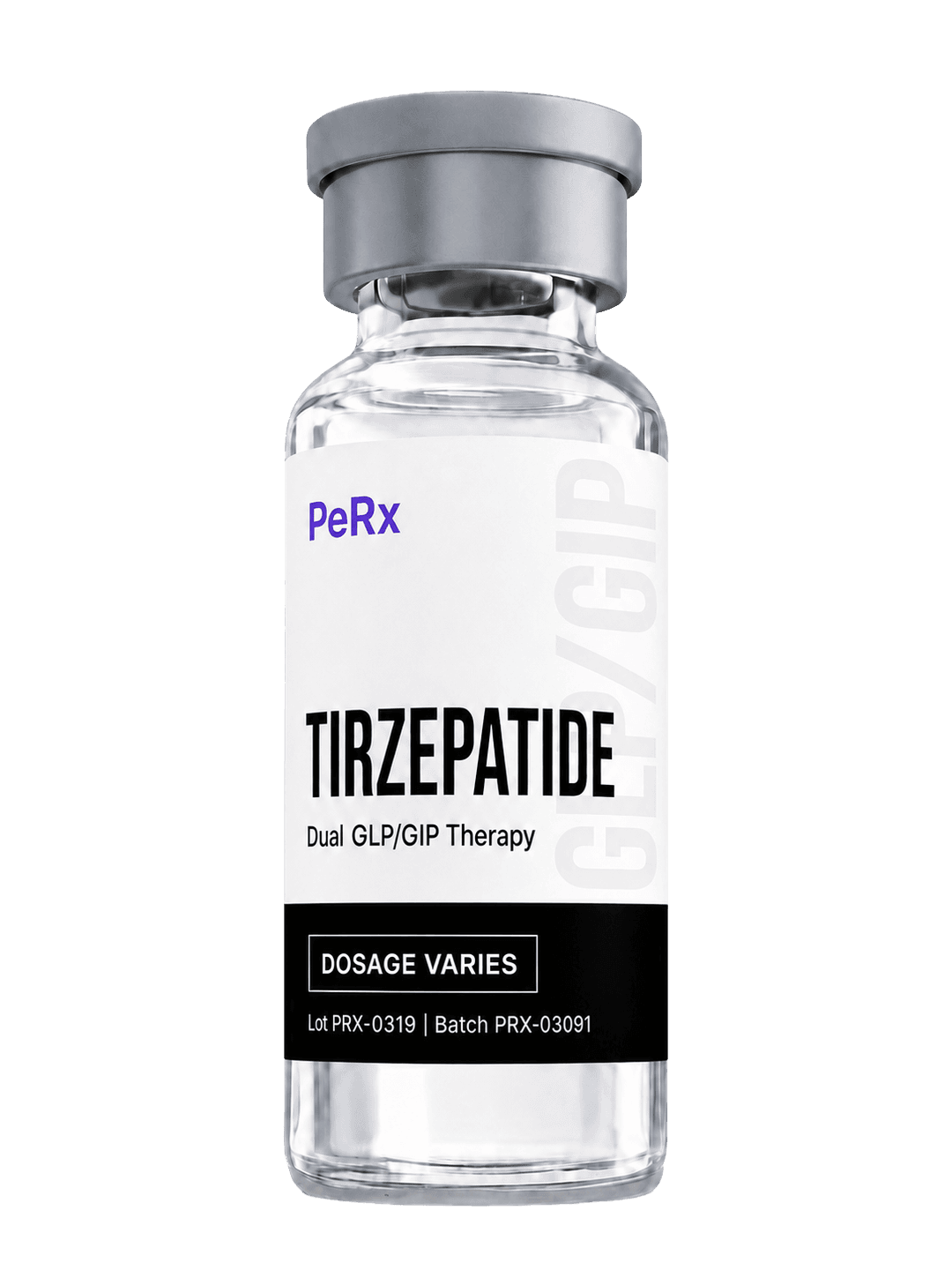
On the B12, one plain sentence: it is listed with its own strength, it does not enter the units arithmetic, and no controlled study has tested the blend against tirzepatide alone, so this page claims nothing for it.
Compounded Vial vs Brand Pen: What Differs in Dosing Terms
Mounjaro and Zepbound are FDA-approved products; the compounded vial is not, and nothing in the approved products' trial record transfers to it. With the legal and safety questions left to compounded tirzepatide, the dosing differences come down to who measures, what changes between steps, and what a package holds.
| Zepbound or Mounjaro | PeRx compounded vial | |
|---|---|---|
| Who measures the dose | The device: a single-dose pen or vial, or a KwikPen dial | You: 50 units on an insulin syringe |
| Moving up a step | A new box at the next strength | A new vial at the next concentration, same draw |
| Multi-dose format | 2.4 mL, four 0.6 mL doses, 4.17 to 25 mg/mL | 2 mL, four 0.5 mL doses, 5 to 30 mg/mL |
| Strengths | Six fixed products, 2.5 to 15 mg | Six provider-prescribed concentrations, 2.5 to 15 mg per draw |
| Syringe | None for pens; a 1 mL syringe for the vial | U-100 insulin syringe, included |
| Additives | None | Vitamin B12 in the same vial |
| FDA review of the finished product | Yes | No; the pharmacy is state-licensed, the preparation unreviewed |
Who measures the dose
- Zepbound or Mounjaro
- The device: a single-dose pen or vial, or a KwikPen dial
- PeRx compounded vial
- You: 50 units on an insulin syringe
Moving up a step
- Zepbound or Mounjaro
- A new box at the next strength
- PeRx compounded vial
- A new vial at the next concentration, same draw
Multi-dose format
- Zepbound or Mounjaro
- 2.4 mL, four 0.6 mL doses, 4.17 to 25 mg/mL
- PeRx compounded vial
- 2 mL, four 0.5 mL doses, 5 to 30 mg/mL
Strengths
- Zepbound or Mounjaro
- Six fixed products, 2.5 to 15 mg
- PeRx compounded vial
- Six provider-prescribed concentrations, 2.5 to 15 mg per draw
Syringe
- Zepbound or Mounjaro
- None for pens; a 1 mL syringe for the vial
- PeRx compounded vial
- U-100 insulin syringe, included
Additives
- Zepbound or Mounjaro
- None
- PeRx compounded vial
- Vitamin B12 in the same vial
FDA review of the finished product
- Zepbound or Mounjaro
- Yes
- PeRx compounded vial
- No; the pharmacy is state-licensed, the preparation unreviewed
The measuring row is the whole safety difference. What compounding is at all is in what is compounded semaglutide; the choice between the two compounded GLP-1s PeRx prescribes, which differ in dose ladder as much as mechanism, is in semaglutide vs tirzepatide.
What Changes the Dose and What Does Not
Body weight does not change the dose. The label doses are fixed amounts, not milligrams per kilogram, and the same six steps apply to everyone. Side effects do, in one direction: a dose that is not tolerated is held or lowered, never pushed through. Other medications matter more than people expect. The Zepbound label, written for the approved product, says to consider reducing insulin or a sulfonylurea when tirzepatide starts, because of hypoglycemia; warns that slowed stomach emptying can change how oral medications are absorbed, naming warfarin; and tells anyone on an oral hormonal contraceptive to use a non-oral or barrier method for four weeks after starting and after each dose increase. At PeRx every increase is a new vial, so each new strength restarts that window.
Zepbound (tirzepatide) injection, U.S. Prescribing Information, revised 08/2026. Section 7.1 Concomitant Use with Insulin or an Insulin Secretagogue; Section 7.2 Oral Medications, including oral hormonal contraceptives for 4 weeks after initiation and after each dose escalation. View study
A planned surgery is a dose question too: tell the surgeon and anesthesiologist, because delayed stomach emptying changes fasting instructions and some teams hold doses beforehand. What does not change the dose: a plateau on the scale, which is a check-in topic, not a reason to draw more; a week of feeling fine, which is the four-week minimum doing its job; and the B12. Effects that show up in training are not dose questions either; see tendon injuries and lifting after a GLP-1 and peptides to take with a GLP-1.
When to Contact a Provider
The PeRx prescribing instructions name three reasons to contact the care team: nausea or vomiting that stops you keeping fluids down, constipation lasting more than a few days, and injection-site irritation that does not settle within a few days. Four call for emergency help: severe abdominal pain, especially spreading to the back or with vomiting; yellowing of the skin or eyes; a neck lump or swelling, hoarseness or trouble swallowing; and swelling of the face, throat or tongue with difficulty breathing.
The dosing-specific reasons to stop and ask
A new vial whose label shows a concentration you did not expect. A draw you think was wrong; if you injected more than 50 units, call the care team or Poison Control at 1-800-222-1222 and do not take the next dose early. A vial that froze, sat warm, or looks cloudy. A pregnancy, a new prescription, a surgery date. None is a reason to change the draw yourself; all are a reason to send one message first.
Common Questions
Related Guides
Continue reading about peptides and protocols that pair well with this guide.
Semaglutide vs Tirzepatide: Which One Fits You
PeRx prescribes two compounded GLP-1 medications, one at $249 a month and one at $399. This is the decision guide we wish existed: what each molecule does, how the approved brands differ on their FDA labels, what the head-to-head research on those brands actually shows, and the questions a prescriber weighs before picking one for a specific patient.
Compounded Tirzepatide: The 2026 Rules, Explained
Compounded tirzepatide is the same active molecule as Mounjaro and Zepbound, drawn from a multi-dose vial a state-licensed pharmacy prepared for one named patient. Everything around the molecule is different: who checked it, what the law allows, what a court has said about how it is sold, and what the safety reports show. This page walks through all of it, dated.
TB-500 Dosage: Protocols, Units, Cycle Length
Search for a TB-500 dosage and you get loading phases, maintenance weeks, and milligram figures that no human trial has ever tested. This page lays out where those numbers come from, why the clinical literature cannot settle them, and what the numbers look like when TB-500 arrives as a prescribed blend at a fixed concentration: 20 units on an insulin syringe, Monday through Friday, six weeks on and six off, as of September 8, 2026.
Ready to get started?
Pharmaceutical-grade compounded tirzepatide with B12, prescribed by a licensed provider and shipped ready to use with no reconstitution needed.
Medical Disclaimer
The information provided on this website, including all articles, guides, and educational content, is for informational and educational purposes only and is not intended as medical advice, diagnosis, or treatment. Nothing on this site should be construed as a substitute for professional medical advice from a qualified healthcare provider.
The majority of peptides discussed on this site are not approved by the U.S. Food and Drug Administration (FDA) for the indications described. They are classified as bulk drug substances and are available only through a licensed prescribing provider and compounding pharmacy. All treatments require a valid prescription and provider oversight.
The majority of published research on peptide therapies has been conducted in preclinical (animal) models. While early human data is encouraging, comprehensive clinical trial data remains limited for most peptide compounds. Individual results may vary significantly based on health status, injury type, and other factors. No specific outcomes are guaranteed.
Certain peptides discussed on this site are classified as prohibited substances by the World Anti-Doping Agency (WADA) and are banned by major sports organizations including the NFL, NCAA, UFC, NBA, MLB, NHL, and PGA. If you are subject to anti-doping testing, consult your governing body before considering any peptide therapy.
Statements on this website have not been evaluated by the Food and Drug Administration. Products and therapies discussed are not intended to diagnose, treat, cure, or prevent any disease.
© 2026 Wellness MD Group PC DBA PeRx. All rights reserved.