Ipamorelin Side Effects: Alone and With CJC-1295
Most pages on ipamorelin side effects blur three things: ipamorelin by itself, CJC-1295 by itself, and the two in one vial. The evidence for each is different, and so is the list. This guide keeps them apart, labels every effect as trial-recorded, patient-reported or anecdotal, and says plainly when nobody has measured it.

In this article
Key Takeaways
- Ipamorelin side effects are usually mild and short-lived: injection-site reactions, headache, nausea, flushing, tiredness. Most of that list is patient-reported; the only human trials gave ipamorelin by vein.
- Combining it with CJC-1295 raises growth hormone and IGF-1 more than either peptide alone, so some people get more water retention, joint stiffness and flushing in the first weeks. No study has compared the stack with either peptide alone.
- The serious risks are immune reactions, which the FDA names for both substances, any cancer history, and intravenous use, the only setting where serious adverse events were recorded.
- Neither peptide is an FDA-approved drug, compounded versions are not FDA-approved, and both are WADA-prohibited at all times.
- PeRx prescribes ipamorelin only inside a blend with no-DAC CJC-1295 or tesamorelin, after a licensed provider reviews your history. It requires no labs and asks for a check-in before each renewal.
Ipamorelin Side Effects: Quick Facts
Most reported, ipamorelin alone
Injection-site sting, headache, mild nausea, hunger, flushing, tiredness after the dose. Patient reports, not measured rates.
What the stack adds
Water retention, puffy hands, joint stiffness, stronger flushing for some, mostly in the first weeks. Reported; no comparative trial.
Human trial record
Ipamorelin: 40 healthy men and 114 surgical patients, both by vein. CJC-1295: two trials of the DAC form PeRx does not prescribe.
Serious risks
Immune reactions, cancer history, intravenous use, unregulated products. The FDA names the first and third itself.
Regulatory status
Not FDA-approved. Compounded versions not FDA-approved. WADA-prohibited at all times.
Evidence key on this page
Established: a label or human trial recorded it. Reported: patients and clinicians describe it. Anecdotal: circulates without a source.
Ipamorelin side effects are usually mild and short-lived: a pink injection site, a headache, some nausea, warmth in the face, tiredness after the dose. Combine it with CJC-1295 and some people add water retention, stiff joints and stronger flushing. The serious risks are rarer but real: immune reactions, a cancer history, and vials bought from sellers who answer to nobody. Neither peptide is FDA-approved. That is the fifty-word version. The complete CJC-1295 and ipamorelin guide explains what the blend does; this page explains what it can cost you, with the source for each claim.
One rule runs through everything below. Ipamorelin alone, CJC-1295 alone and the two together have different evidence behind them, and the pages that rank for this search quietly merge the three. Every effect here carries a label: established when a label or a human trial recorded it, reported when patients and clinicians describe it consistently, anecdotal when it circulates without a source. At PeRx the blend is prescribed by a licensed provider and compounded by a state-licensed 503A pharmacy in a vial that ships fully reconstituted and ready to use.
Ipamorelin Side Effects at a Glance: Alone vs Combined With CJC-1295
The question people actually type is "is ipamorelin safe," and the answer depends on which of three products they mean. The table sorts reported effects by product and by evidence. CJC-1295 here means the no-DAC form, Modified GRF 1-29, the only form PeRx compounds; the long-acting DAC form has its own record in CJC-1295 side effects.
| Ipamorelin alone | CJC-1295 alone (no-DAC) | The two together |
|---|---|---|
| Injection-site redness or sting, headache, mild nausea, hunger, flushing, tiredness after the dose | Flushing or warmth, headache, lightheadedness, injection-site reactions | Both lists plus water retention, puffy fingers, vivid dreams and hunger in the first weeks |
| Dizziness right after the dose, tingling or numbness, mild water retention | Water retention, joint stiffness, tingling, a faster heartbeat | Joint stiffness or aching, swollen hands and feet, blood sugar drift in insulin-resistant people |
| Immune or allergic reaction; impurity reactions in unregulated products | Immune reaction; the vasodilatory reaction and raised heart rate the FDA recorded for the DAC form | Insulin resistance with long-term high growth hormone exposure; blunted response if dosing stops being pulsatile; immune reaction |
| None in the animal selectivity study, even at very high doses; never measured in people by the subcutaneous route | Not expected from a GHRH analog; not measured for the no-DAC form | Unmeasured as a combination |
| Two intravenous human studies plus patient reports | No human trial of the no-DAC form; DAC trials plus patient reports | Patient and clinician reports only; no comparative study |
| Not FDA-approved; WADA-prohibited | Not FDA-approved; WADA-prohibited | Not FDA-approved as a combination; WADA-prohibited |
Injection-site redness or sting, headache, mild nausea, hunger, flushing, tiredness after the dose
- CJC-1295 alone (no-DAC)
- Flushing or warmth, headache, lightheadedness, injection-site reactions
- The two together
- Both lists plus water retention, puffy fingers, vivid dreams and hunger in the first weeks
Dizziness right after the dose, tingling or numbness, mild water retention
- CJC-1295 alone (no-DAC)
- Water retention, joint stiffness, tingling, a faster heartbeat
- The two together
- Joint stiffness or aching, swollen hands and feet, blood sugar drift in insulin-resistant people
Immune or allergic reaction; impurity reactions in unregulated products
- CJC-1295 alone (no-DAC)
- Immune reaction; the vasodilatory reaction and raised heart rate the FDA recorded for the DAC form
- The two together
- Insulin resistance with long-term high growth hormone exposure; blunted response if dosing stops being pulsatile; immune reaction
None in the animal selectivity study, even at very high doses; never measured in people by the subcutaneous route
- CJC-1295 alone (no-DAC)
- Not expected from a GHRH analog; not measured for the no-DAC form
- The two together
- Unmeasured as a combination
Two intravenous human studies plus patient reports
- CJC-1295 alone (no-DAC)
- No human trial of the no-DAC form; DAC trials plus patient reports
- The two together
- Patient and clinician reports only; no comparative study
Not FDA-approved; WADA-prohibited
- CJC-1295 alone (no-DAC)
- Not FDA-approved; WADA-prohibited
- The two together
- Not FDA-approved as a combination; WADA-prohibited
Read it two ways. The stack column is longest not because the blend is dangerous but because it does more: two signals raising growth hormone together produce more of what follows growth hormone. And "mild" describes what people report, not a guarantee. The regulatory row is explained in is CJC-1295/Ipamorelin FDA approved.
CJC-1295/Ipamorelin
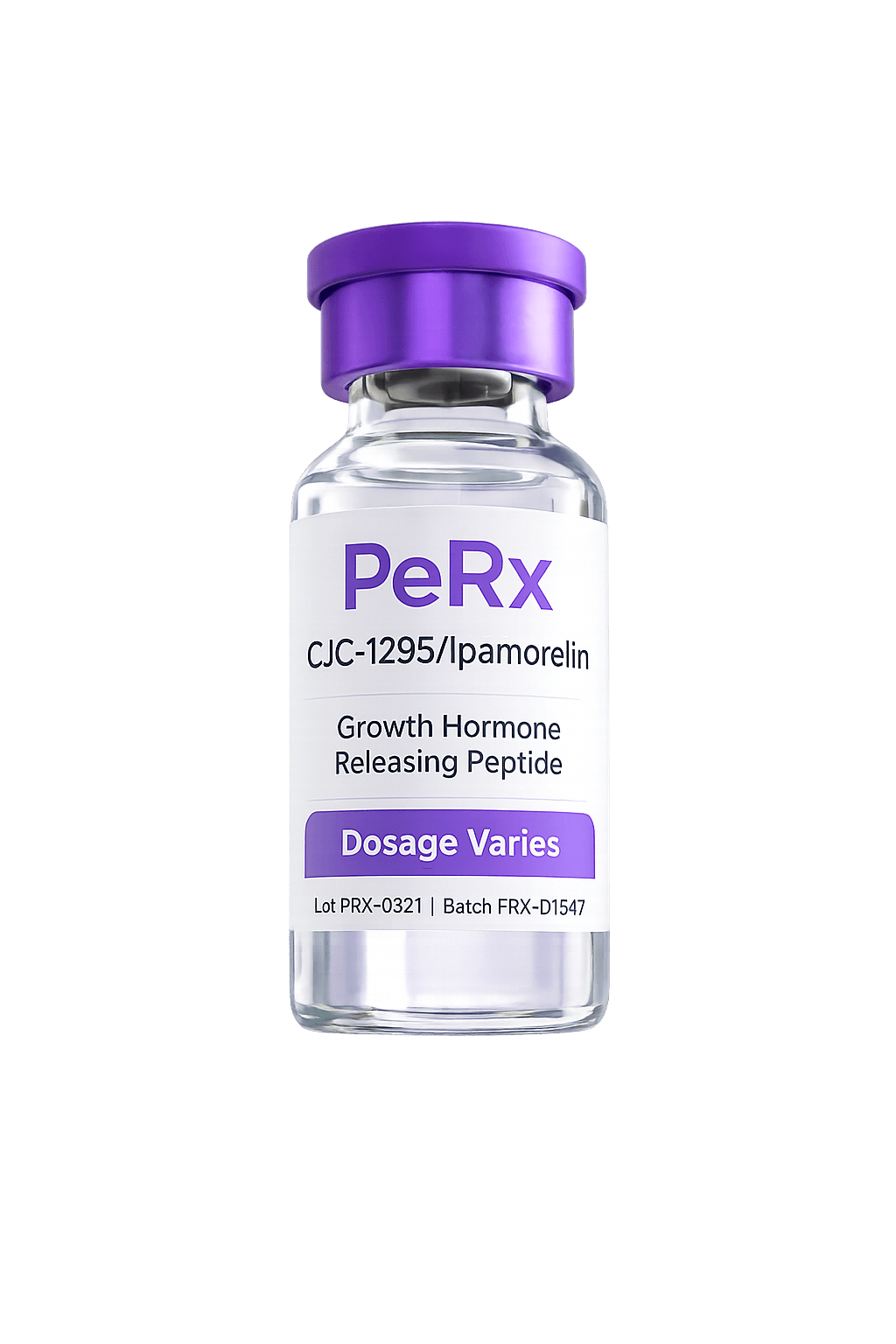
The blend this page is about. CJC-1295/Ipamorelin at PeRx pairs no-DAC CJC-1295 with ipamorelin in one vial that ships fully reconstituted and ready to use, prescribed by a licensed provider after an eligibility check and compounded by a state-licensed 503A pharmacy with every lot tested for potency and sterility.
It suits adults with no cancer history who want the growth hormone pathway without the long tail of the DAC form, and who will report side effects early rather than push through them. Compounded CJC-1295/Ipamorelin is not an FDA-approved drug.
Ipamorelin Side Effects When Used Alone
On its own, ipamorelin is one of the better-tolerated growth hormone secretagogues, by design: it was built in the 1990s to release growth hormone without the cortisol and prolactin spill of the earlier GHRP peptides. One caution first. Both published human studies gave ipamorelin by vein, a dose-finding study in 40 healthy men and a trial in 114 adults after bowel surgery. Nobody has published a side-effect study of subcutaneous ipamorelin, which is how every clinic prescribes it, so the effects below are reported, not measured.
Injection-site reactions
The usual ipamorelin injection site complaint is a small pink patch, an itch, or a sting that fades within the hour, sometimes a bruise where the needle nicked a capillary. Reported, not measured, and the same for any subcutaneous peptide. Rotating sites from the first day spares any one patch of skin; where to inject CJC-1295/Ipamorelin shows the rotation. A site that spreads, feels hot, drains or comes with a fever is not normal and needs review the same day.
Headache and dizziness
Headache is the second most reported effect, usually dull and gone within hours. A brief lightheaded spell right after injecting is described anecdotally and blamed on a short dip in blood pressure, although no study has measured blood pressure after a subcutaneous dose. Stand up slowly for the first few minutes. A severe, sudden or persistent headache belongs in the when-to-call section below.
Nausea and appetite changes
Mild nausea is reported in the first week and tends to fade. Hunger is the more interesting one. Ipamorelin acts on the ghrelin receptor, and ghrelin is the hormone that tells you to eat, so a wave of appetite after a dose has an obvious mechanism. Whether ipamorelin itself raises appetite in people has not been measured; the 1998 selectivity paper tested pigs for hormone release, not for how much they ate. Treat the hunger as reported and expected.
Flushing, tingling and fatigue
Warmth in the face or chest, tingling in the hands and tiredness after the injection are reported with ipamorelin alone and more often with the stack, where the GHRH half of the blend is the likelier cause of the flush. Ipamorelin water retention on its own is reported as mild, a pound or two in the first week that settles; it becomes noticeable mainly when growth hormone is pushed from two directions at once.
Cortisol, prolactin and blood pressure
This is where ipamorelin earned its reputation. In the 1998 study in conscious pigs, it released growth hormone as potently as GHRP-6 but did not raise ACTH or cortisol, even at more than 200 times the dose needed for growth hormone release, and no secretagogue tested moved prolactin, FSH, LH or TSH. GHRP-6 and GHRP-2 raised ACTH and cortisol in the same experiment. That is an animal finding; the human study measured growth hormone only. So "ipamorelin does not raise cortisol" is established in pigs and reasonable in people, not proven in people. No human study has measured blood pressure on subcutaneous ipamorelin, and the FDA says it has no safety information on the peptide by injectable routes other than intravenous. If you have hypertension, take a baseline reading before starting and check occasionally after.
Ipamorelin side effects in men and women
Searches for ipamorelin side effects men and ipamorelin side effects women both land here, and the evidence by sex is thin. The dose-finding study enrolled only men; the surgical trial enrolled both but did not report by sex. Nothing published supports a different list for either. What differs is precaution: pregnancy and breastfeeding exclude the blend because there is no safety data. For how ipamorelin compares with the other secretagogue PeRx prescribes, see ipamorelin vs sermorelin.
CJC-1295 Side Effects When Used Alone: The Short Version
CJC-1295 side effects have their own page, CJC-1295 side effects, with the full trial record and FDA file. The short version matters here because the form with human data is not the form you would be prescribed.
CJC-1295 no DAC side effects vs CJC-1295 with DAC
Two versions share the name. CJC-1295 with DAC carries a tag that binds it to albumin, so one injection keeps growth hormone and IGF-1 raised for days, with a published half-life of six to eight days. CJC-1295 without DAC, also called Modified GRF 1-29, clears within hours: one pulse per dose, then nothing. Every human trial used the DAC form. In healthy adults over 28 and 49 days, no serious adverse reactions were reported; the effects recorded were injection-site reactions, headache, flushing, nausea, diarrhea, brief dizziness with lower blood pressure and a faster heart rate. The cjc 1295 with dac side effects you read about online are that list. The cjc 1295 no dac side effects have never been studied; clinics describe a shorter, milder version of the same pattern, which the pharmacology predicts but nobody has measured. PeRx compounds the no-DAC form only, for the reasons in why we pair CJC-1295 with ipamorelin.
Flushing, water retention and the FDA wording
The flush, the warmth and the momentary blood pressure dip are the classic GHRH-analog effects, and the FDA chose to name them. Its compounding safety page, current as of April 22, 2026, says "FDA has identified serious adverse events associated with CJC-1295, including increased heart rate and systemic vasodilatory reaction," that compounded CJC-1295 "may pose risk for immunogenicity for certain routes of administration," and that "available clinical data are limited." Read that as a regulatory warning built on the DAC trials, not a measured rate.
CJC-1295 Ipamorelin Side Effects: What Changes When You Stack Them
Put the two in one syringe and growth hormone and IGF-1 rise more than either peptide produces alone. That is the point of the blend, and also why the shared effects can show up more often or more strongly for some people. The cjc-1295 ipamorelin side effects people ask about are mostly the growth hormone effects, amplified.
Why the stack can intensify reactions
The two act on different pituitary receptors. CJC-1295 mimics growth hormone-releasing hormone and primes the gland; ipamorelin mimics ghrelin and triggers the release. Together they produce a larger pulse than either alone, the proposed reason water retention, flushing and joint aching are reported more with the blend. It is a mechanism, not a rate. No controlled study has compared the stack against either peptide alone, and none is registered.
Common side effects of the stack
Flushing or warmth after the injection. Reported. A wave of heat in the face or upper body shortly after dosing, more often with the blend, because the GHRH analog is the usual trigger. Nobody has timed it in a study.
Water retention and mild swelling. Reported, with an established mechanism. Growth hormone shifts fluid balance, so a pound or two on the scale, puffy fingers or a tighter ring in the first week is the usual shape. The PeRx label for the blend warns of exactly this, alongside hunger and vivid dreams, as a normal first-days pattern that typically settles.
Joint stiffness or aching. Reported. Stiff hands in the morning or an ache in the knees are the classic growth hormone complaints, described more in the early weeks. Approved growth hormone products carry joint pain and fluid retention on their labels, the closest established anchor.
Post-injection fatigue and heavier sleep. Reported. GHRH promotes slow-wave sleep in human studies, so tiredness and vivid dreams after an evening dose have a plausible root. Most people describe it fading within two weeks; some call it the benefit they wanted.
Rare or theoretical. Two items belong here although no one has recorded them with this blend. Chronic high growth hormone exposure raises blood sugar and can push toward insulin resistance, which is why diabetes appears in the avoid list; the surgical ipamorelin trial fit that pattern in its laboratory readings. And a secretagogue dosed so that growth hormone never comes back down risks a blunted response over time, the argument for pulsatile dosing with the no-DAC form. Both are theoretical for the blend as prescribed.
Side effects in men and women
Nothing in the published record separates the ipamorelin and cjc 1295 side effects by sex, and PeRx does not claim a difference. The difference is in precautions: pregnancy and breastfeeding exclude the blend outright, and a cancer history screens out men and women alike. If you also take a GLP-1 medicine, the overlap in nausea and appetite effects is worth reading in CJC-1295/Ipamorelin with a GLP-1 before starting both.
How Long Do Ipamorelin Side Effects Last?
What patients and clinicians describe falls into three periods, all labeled as reports because no study has tracked side effects by week on a subcutaneous protocol.
First two weeks
The adjustment window
Hunger, vivid dreams, mild water retention, flushing and a sore site are reported as strongest here. The PeRx label describes the first days this way and says it typically settles.
Weeks three to six
Easing
Water retention, headache and fatigue are described as fading as the body adjusts to the nightly pulse. Joint stiffness, when it occurs, is the effect most likely to persist.
Longer-term use
The unmeasured stretch
No study has followed people on either peptide beyond 49 days. Ipamorelin side effects long term are an honest unknown, which is why the long-term questions are about IGF-1 and blood sugar.
The long-term question is really an IGF-1 question. Growth hormone raises IGF-1, IGF-1 tells cells to grow, and an IGF-1 above the normal range for your age is a reason to reassess, not a goal. PeRx does not order or require laboratory tests; it asks for a check-in before each renewal, where persistent or worsening effects are the first thing to raise. Anyone planning more than a few months on the blend can ask their own doctor to check IGF-1 and fasting glucose, and lab work before starting peptides explains what those numbers mean. Peptide safety monitoring covers tracking how you feel against a dated baseline.
Ipamorelin Safety: Serious Risks and Precautions
Ipamorelin safety has four serious considerations, none of them the sore injection site: regulatory status, cancer history, immune reactions and the route. A fifth, the vial itself, applies to people buying outside a prescription.
Not FDA-approved, and banned in sport
Neither ipamorelin nor CJC-1295 is an FDA-approved drug for any use, and compounded versions are not FDA-approved either; the dated record is in is CJC-1295/Ipamorelin FDA approved. Both appear on the World Anti-Doping Agency Prohibited List among growth hormone secretagogues and releasing factors, prohibited at all times; peptide therapy for athletes covers it in full.
Cancer history
The ipamorelin cancer question deserves a conservative answer. Growth hormone secretagogues raise growth hormone and IGF-1, both of which signal cells to grow and divide. No study has tested either peptide long term in people with cancer, and none has shown they cause it; the published human exposure is too short to show either. Adding a growth signal while a tumor may be present is a poor bet with no data behind it, so an active or recently treated malignancy screens you out, and an older cancer history is a decision for your oncologist. We do not write "no evidence of cancer risk," because the absence of a study is not evidence of safety.
Immune and allergic reactions
This is the concern the FDA puts first for both substances. Its compounding safety page says compounded drugs containing ipamorelin acetate "may pose risk for immunogenicity for certain routes of administration due to the potential for aggregation or peptide-related impurities," and that the peptide "contains unnatural amino acids, which add to the complexity of peptide characterization." The CJC-1295 entry uses the same language. These are regulatory concerns, not reports of patients harmed, and they are the argument for a pharmacy that tests each lot. Hives, swelling of the face, lips or throat, wheezing or trouble breathing, and a spreading rash need urgent care.
Intravenous use
Ipamorelin is injected under the skin, never into a vein. The FDA states that "a study published in literature identified serious adverse events including death when ipamorelin was administered intravenously for improving gastric motility." That is the 2014 surgical trial: 114 adults recovering from bowel resection, given ipamorelin or placebo by intravenous infusion twice a day for up to a week. The published report calls the drug well tolerated and found no significant difference from placebo, and deaths after major abdominal surgery have many causes, but the FDA counted the events and so should you. No prescription recreates that setting.
Research-grade products
Vials labeled for research, sold without a prescription, may be underdosed, mislabeled, degraded or not sterile, and the FDA concern about aggregation and impurities applies to them with full force. A state-licensed 503A pharmacy tests what it ships. Research peptides vs prescription peptides explains the difference, how PeRx tests its peptides shows the testing, important safety information carries the full warnings, and are peptides safe long term takes the long view.
Who Should Avoid Ipamorelin and CJC-1295
A licensed provider reviews your health history and medications before anything is compounded. This is what that review looks for; it is not exhaustive.
Avoid, or ask a clinician first
Active cancer or a cancer history: growth hormone and IGF-1 promote cell growth, and no study has tested safety in this group. Pregnancy or breastfeeding: no safety data. Under 18: nothing has been studied. Known allergy to either peptide or a reaction to a similar injectable: immune reactions are the FDA's leading concern. Diabetes or insulin resistance: growth hormone raises blood sugar. Uncontrolled high blood pressure or heart disease: the flush, the pressure dip and the faster heart rate recorded with the DAC form. A pituitary or hypothalamic tumor, past or present: both peptides act on the pituitary. Competitive athletes subject to testing: prohibited at all times.
If one of those describes you, the provider review is where it gets discussed, not after the vial arrives. What providers review before prescribing peptides describes the questions you will be asked.
How to Lower the Risk of Ipamorelin Side Effects
Most side effects on this page are reported as mild, and most of the serious ones are avoidable. The steps, with no numbers because the prescriber sets the numbers: use only a prescribed product from a licensed pharmacy, since pharmaceutical-grade means a state-licensed pharmacy compounded and tested it while research-grade means a seller labeled it and nobody checked; share your full history and every medicine; ask about labs if you want them, because PeRx requires none but your own doctor can check IGF-1 and glucose; follow the prescriber's timing and dose exactly; rotate sites and use a new needle every time; stay hydrated; and report symptoms early rather than waiting them out.
For telling a normal adjustment from a red flag, the peptide side effects guide covers every peptide PeRx prescribes, and the injection guide covers technique. Your dose and schedule live on your label and in the CJC-1295/Ipamorelin dosage chart; this page deliberately prints neither.
When to Call Your Provider or Get Medical Help
Do not wait on these
Spreading redness, warmth, swelling, pus or fever at an injection site, which can mean infection. Hives, swelling of the face or throat, or difficulty breathing, which can mean an allergic reaction and needs emergency care. Chest pain or a racing heart. A severe or persistent headache. Swelling, numbness or tingling that does not ease. Unusual thirst or urination, which can signal a blood sugar change. Each may point to infection, an allergic reaction or a metabolic effect, and none is something to sleep on.
Report any adverse effect to the prescriber, including the mild ones; the pattern across patients is how a clinic learns what the trials never measured. PeRx patients can message your care team at any time.
Getting Ipamorelin and CJC-1295 Through a Prescription
PeRx does not prescribe ipamorelin on its own. It comes in two blends, CJC-1295/Ipamorelin and Tesamorelin/Ipamorelin, both under growth hormone peptides. The path is the same: an eligibility check, a licensed provider reviews your history and medications, a state-licensed 503A pharmacy fills the prescription in a vial that is ready to use with no reconstitution needed, and a check-in before each renewal. Compounded versions are not FDA-approved. How to get peptides prescribed online walks through the steps.
Weighing the blend against the side effects?
New to PeRx: the eligibility check takes about a minute, and a licensed provider reviews your history before anything is compounded. Already a patient: message your care team about anything on this page, especially the mild things.
Ipamorelin Side Effects FAQs
Related Guides
Continue reading about peptides and protocols that pair well with this guide.
Is CJC-1295/Ipamorelin FDA Approved? (2026 Answer)
The short answer is no. CJC-1295 and Ipamorelin are not FDA-approved drugs. They are compounded medications, prescribed by licensed providers and prepared by regulated pharmacies. Here is what that actually means for you, how it compares to FDA-approved peptides, and why the distinction matters less than most people think.
Where to Inject CJC-1295/Ipamorelin: Sites, Timing
CJC-1295/Ipamorelin is a single subcutaneous injection, and for this stack the two decisions that matter most are where you put it and when. The four standard sites all work, but bedtime timing and an empty stomach change the result more than site choice does. Here is the practical guide patients ask for after their first vial arrives.
MOTS-c Side Effects: What Is Known and What Is Not
Every MOTS-c side-effect list online shares one problem: no study of injected MOTS-c in people has ever reported results, so none of those lists has a number behind it. This page sorts the evidence into what was measured in humans (almost nothing, mostly on an analog), what FDA reviewers flagged in 2026, and what users report, with straight answers on blood sugar, cancer, and the heart.
References and Review
Primary sources checked as of November 2026. Every regulatory quotation is taken from the FDA page it names.
Raun K, Hansen BS, Johansen NL, et al. Ipamorelin, the first selective growth hormone secretagogue. Eur J Endocrinol. 1998;139(5):552-561. View study
Gobburu JV, Agersø H, Jusko WJ, Ynddal L. Pharmacokinetic-pharmacodynamic modeling of ipamorelin, a growth hormone releasing peptide, in human volunteers. Pharm Res. 1999;16(9):1412-1416. View study
Beck DE, Sweeney WB, McCarter MD; Ipamorelin 201 Study Group. Prospective, randomized, controlled, proof-of-concept study of the ghrelin mimetic ipamorelin for the management of postoperative ileus in bowel resection patients. Int J Colorectal Dis. 2014;29(12):1527-1534. View study
Teichman SL, Neale A, Lawrence B, et al. Prolonged stimulation of growth hormone (GH) and insulin-like growth factor I secretion by CJC-1295, a long-acting analog of GH-releasing hormone, in healthy adults. J Clin Endocrinol Metab. 2006;91(3):799-805. View study
Ionescu M, Frohman LA. Pulsatile secretion of growth hormone (GH) persists during continuous stimulation by CJC-1295, a long-acting GH-releasing hormone analog. J Clin Endocrinol Metab. 2006;91(12):4792-4797. View study
US Food and Drug Administration. Certain bulk drug substances for use in compounding that may present significant safety risks. Content current as of April 22, 2026. Entries for CJC-1295 and ipamorelin acetate. View study
World Anti-Doping Agency. The Prohibited List 2026, section S2: peptide hormones, growth factors, related substances and mimetics. View study
Medical Disclaimer
The information provided on this website, including all articles, guides, and educational content, is for informational and educational purposes only and is not intended as medical advice, diagnosis, or treatment. Nothing on this site should be construed as a substitute for professional medical advice from a qualified healthcare provider.
The majority of peptides discussed on this site are not approved by the U.S. Food and Drug Administration (FDA) for the indications described. They are classified as bulk drug substances and are available only through a licensed prescribing provider and compounding pharmacy. All treatments require a valid prescription and provider oversight.
The majority of published research on peptide therapies has been conducted in preclinical (animal) models. While early human data is encouraging, comprehensive clinical trial data remains limited for most peptide compounds. Individual results may vary significantly based on health status, injury type, and other factors. No specific outcomes are guaranteed.
Certain peptides discussed on this site are classified as prohibited substances by the World Anti-Doping Agency (WADA) and are banned by major sports organizations including the NFL, NCAA, UFC, NBA, MLB, NHL, and PGA. If you are subject to anti-doping testing, consult your governing body before considering any peptide therapy.
Statements on this website have not been evaluated by the Food and Drug Administration. Products and therapies discussed are not intended to diagnose, treat, cure, or prevent any disease.
© 2026 Wellness MD Group PC DBA PeRx. All rights reserved.