MOTS-c Dosage Chart: Units, Timing, Cycle, Vial Math
Every MOTS-c dosage chart online prints 5 to 15 mg a week as though a trial had chosen it. No trial has. There is no completed human study of MOTS-c at any dose, and the clinic ranges in circulation are convention passed from site to site. This page lays those ranges out as what they are, then shows the one protocol a licensed physician actually prescribes through PeRx: 20 units of a 2 mg/mL vial, which is 0.4 mg, each weekday morning on an empty stomach, 8 weeks on and 4 weeks off. The unit math, the vial count, the timing logic, the dose-reduction rule and the cost, as of October 2026.

In this article
Key Takeaways
- The PeRx MOTS-c prescription is 20 units on a U-100 insulin syringe, which is 0.2 mL of a 2 mg/mL vial and therefore 0.4 mg per injection, each morning Monday through Friday on an empty stomach. That is 2 mg per week. A 5 mL vial holds 25 doses, five weeks of dosing, so an 8-week cycle spans two vials.
- No human dose-finding study of MOTS-c exists. The 5 to 15 mg per week figures on other sites are clinic and forum convention, and the PeRx dose is a physician-written prescription for a pharmacy-set concentration. Neither is a trial result, and this page says so wherever a number appears.
- Units measure volume, not peptide. At 2 mg/mL every milligram is 50 units, so 0.4 mg is 20 units. The same 0.4 mg would be 8 units at 5 mg/mL and 4 units at 10 mg/mL, which is why a unit count copied from a forum is meaningless without the concentration on the label.
- The timing rule, morning and fasted with no food for at least 30 minutes, rests on mechanism: MOTS-c acts through AMPK, the energy sensor that exercise and fasting switch on. No human trial has compared a fasted injection with a fed one, so treat the rationale as rationale.
- The cycle is 8 weeks on and 4 weeks off, and the prescription carries its own adjustment rule: if palpitations or insomnia appear, halve the dose to 10 units at the next injection. No human study has tested cycling or dose reduction for MOTS-c; both are precautions.
- As of October 2026 MOTS-c is not FDA-approved. FDA reviewers found no clinical studies, no pharmacokinetic data and no dose-response work before the July 2026 advisory vote, which was advisory only and reviewed no dose. The first placebo-controlled MOTS-c trial, NCT07505745, is recruiting with results not expected before 2027.
MOTS-c Dosing at a Glance
Peptide
MOTS-c, a 16-amino-acid mitochondrial-encoded peptide
How PeRx supplies it
Subcutaneous injection only, 2 mg/mL in a 5 mL vial (10 mg), ready to use
Prescribed dose
20 units (0.2 mL), which is 0.4 mg, each weekday morning, fasted
Weekly total
2 mg across five injections
Cycle
8 weeks on, 4 weeks off
Per vial
25 doses, five weeks; two vials per 8-week cycle
Human dosing data
None; the first placebo-controlled trial is recruiting
Cost
$229 per 5 mL vial at PeRx
The MOTS-c Dosage Chart
A dosage chart normally condenses what trials found. For MOTS-c there is nothing to condense: no completed human trial of the peptide exists at any dose. The rows below are labeled by what stands behind them, and the labels matter more than the numbers.
| Source | MOTS-c amount | Schedule | What stands behind it |
|---|---|---|---|
| PeRx prescription | 0.4 mg per 20-unit dose (0.2 mL at 2 mg/mL) | Weekday mornings, fasted; 8 weeks on, 4 off | Physician-prescribed after screening; filled at 2 mg/mL |
| PeRx per 8-week cycle | 16 mg across 40 doses (2 mg a week) | Two 5 mL vials, 10 doses left over | The same prescription, added up |
| PeRx reduced dose | 0.2 mg per 10-unit dose | Same schedule, from the next injection on | The label's rule for palpitations or insomnia |
| Clinic and forum convention | 5 to 10 mg per injection, 5 to 15 mg per week | 2 to 3 injections a week, often 8 to 12 weeks | Repeated across websites; no trial behind it |
| Mouse studies | 0.5 to 15 mg per kilogram per day, into the abdominal cavity | Daily or three times a week | Animal data; no human conversion exists |
| CB4211 analog trial (2018 to 2021) | A different molecule at its own dose | Once daily for four weeks (Phase 1b) | Human data, but not for MOTS-c |
| Phase 2a MOTS-c trial (recruiting) | A fixed daily dose; milligrams not stated in the registration | Once daily for 12 weeks | The first human MOTS-c trial; no results before 2027 |
| Published human dose-finding studies | None | None | Nobody has run the study |
PeRx prescription
- MOTS-c amount
- 0.4 mg per 20-unit dose (0.2 mL at 2 mg/mL)
- Schedule
- Weekday mornings, fasted; 8 weeks on, 4 off
- What stands behind it
- Physician-prescribed after screening; filled at 2 mg/mL
PeRx per 8-week cycle
- MOTS-c amount
- 16 mg across 40 doses (2 mg a week)
- Schedule
- Two 5 mL vials, 10 doses left over
- What stands behind it
- The same prescription, added up
PeRx reduced dose
- MOTS-c amount
- 0.2 mg per 10-unit dose
- Schedule
- Same schedule, from the next injection on
- What stands behind it
- The label's rule for palpitations or insomnia
Clinic and forum convention
- MOTS-c amount
- 5 to 10 mg per injection, 5 to 15 mg per week
- Schedule
- 2 to 3 injections a week, often 8 to 12 weeks
- What stands behind it
- Repeated across websites; no trial behind it
Mouse studies
- MOTS-c amount
- 0.5 to 15 mg per kilogram per day, into the abdominal cavity
- Schedule
- Daily or three times a week
- What stands behind it
- Animal data; no human conversion exists
CB4211 analog trial (2018 to 2021)
- MOTS-c amount
- A different molecule at its own dose
- Schedule
- Once daily for four weeks (Phase 1b)
- What stands behind it
- Human data, but not for MOTS-c
Phase 2a MOTS-c trial (recruiting)
- MOTS-c amount
- A fixed daily dose; milligrams not stated in the registration
- Schedule
- Once daily for 12 weeks
- What stands behind it
- The first human MOTS-c trial; no results before 2027
Published human dose-finding studies
- MOTS-c amount
- None
- Schedule
- None
- What stands behind it
- Nobody has run the study
The PeRx dose is a small fraction of the convention figures, 2 mg a week against 5 to 15, and neither side is in error: the convention was never derived from anything, and the PeRx row was written to fit a 2 mg/mL vial in one syringe draw. The only row with a trial in it is empty. The molecule itself is covered in the MOTS-c guide; this page stays on the numbers.
How to read this chart
The chart translates. If a site quotes 5 mg twice a week, you can see it is five times the PeRx weekly amount and that nobody tested either. The dose you inject is the one on your prescription label, and if the label differs from anything here, the label wins.
Units on an Insulin Syringe at 2 mg/mL
Doses are written in milligrams and drawn in units. A U-100 insulin syringe holds 100 units per milliliter, so units measure liquid, not peptide, and the concentration on the vial is the bridge. The conversion is one line: units equals milligrams divided by the concentration in mg/mL, times 100. At 2 mg/mL every milligram is 50 units, every 10 units is 0.2 mg, and the prescribed 0.4 mg is 20 units.
| Dose | Units on a U-100 syringe (at 2 mg/mL) | Volume | Doses per 5 mL vial |
|---|---|---|---|
| 0.1 mg | 5 units | 0.05 mL | 100 |
| 0.2 mg (PeRx reduced dose) | 10 units | 0.1 mL | 50 |
| 0.4 mg (PeRx prescribed) | 20 units | 0.2 mL | 25 |
| 0.5 mg | 25 units | 0.25 mL | 20 |
| 1 mg | 50 units | 0.5 mL | 10 |
| 2 mg | 100 units (a full syringe) | 1 mL | 5 |
0.1 mg
- Units on a U-100 syringe (at 2 mg/mL)
- 5 units
- Volume
- 0.05 mL
- Doses per 5 mL vial
- 100
0.2 mg (PeRx reduced dose)
- Units on a U-100 syringe (at 2 mg/mL)
- 10 units
- Volume
- 0.1 mL
- Doses per 5 mL vial
- 50
0.4 mg (PeRx prescribed)
- Units on a U-100 syringe (at 2 mg/mL)
- 20 units
- Volume
- 0.2 mL
- Doses per 5 mL vial
- 25
0.5 mg
- Units on a U-100 syringe (at 2 mg/mL)
- 25 units
- Volume
- 0.25 mL
- Doses per 5 mL vial
- 20
1 mg
- Units on a U-100 syringe (at 2 mg/mL)
- 50 units
- Volume
- 0.5 mL
- Doses per 5 mL vial
- 10
2 mg
- Units on a U-100 syringe (at 2 mg/mL)
- 100 units (a full syringe)
- Volume
- 1 mL
- Doses per 5 mL vial
- 5
One syringe tops out at 2 mg at this strength, so the 5 mg per injection in the convention rows would be 250 units, two and a half syringes, and a 10 mg vial would be gone in two doses.
The concentration changes the draw
The same 0.4 mg is 20 units at 2 mg/mL, 8 units at 5 mg/mL and 4 units at 10 mg/mL. Research-vendor vials are sold by total milligrams and mixed by the buyer. A PeRx vial arrives at a labeled 2 mg/mL, ready to use with no reconstitution needed, and the 20 units on the prescription already contain the math.
The catalog-wide reference is the peptide dosage chart; how to inject peptides covers the mechanics.
Where the Numbers Come From
MOTS-c was described in 2015 by Changhan Lee, Pinchas Cohen and colleagues: a 16-amino-acid peptide encoded inside the mitochondrial 12S ribosomal RNA gene. In their mice, MOTS-c injected into the abdominal cavity at 0.5 or 5 mg per kilogram per day activated AMPK in muscle and prevented the insulin resistance and weight gain a high-fat diet otherwise produced. In 2021 the same group reported that mice dosed the same way at 5 or 15 mg per kilogram per day ran longer on a treadmill, old mice included.
Lee C, Zeng J, Drew BG, et al. "The mitochondrial-derived peptide MOTS-c promotes metabolic homeostasis and reduces obesity and insulin resistance." Cell Metabolism. 2015;21(3):443-454. View study
Reynolds JC, Lai RW, Woodhead JST, et al. "MOTS-c is an exercise-induced mitochondrial-encoded regulator of age-dependent physical decline and muscle homeostasis." Nature Communications. 2021;12(1):470. View study
A per-kilogram dose injected into a mouse’s abdomen cannot be turned into a subcutaneous human dose: the species and route differ, and nobody has measured how much injected MOTS-c reaches a person’s bloodstream or how long it stays. The 2021 paper did include ten young men, but it measured their own MOTS-c, which rose in muscle and blood after one workout and was back to baseline four hours later: a finding about exercise, not injections. The only pharmacokinetic-related human data is a test-tube study showing MOTS-c breaks down quickly in human blood.
Knoop A, Thomas A, Thevis M. "Development of a mass spectrometry based detection method for the mitochondrion-derived peptide MOTS-c in plasma samples for doping control purposes." Rapid Communications in Mass Spectrometry. 2019;33(4):371-380. View study
The most thorough public review of that gap is the FDA staff briefing document for the July 2026 Pharmacy Compounding Advisory Committee meeting, dated May 11, 2026. Reviewers found no clinical studies of MOTS-c in humans, no pharmacokinetic study in animals or people, and no dose-response assessment even in rodents; the nomination cited twelve references, none clinical. A 2023 review put it from the other side: no method of using MOTS-c in the clinic has been developed.
U.S. Food and Drug Administration. "FDA Briefing Document for MOTS-c-Related Bulk Drug Substances (MOTS-c (free base) and MOTS-c acetate)." Pharmacy Compounding Advisory Committee Meeting, July 23-24, 2026. Evaluation dated May 11, 2026. View study
Zheng Y, Wei Z, Wang T. "MOTS-c: A promising mitochondrial-derived peptide for therapeutic exploitation." Frontiers in Endocrinology. 2023;14:1120533. View study
The analog that was dosed, and the trial that will dose MOTS-c
The one molecule in this family with a completed human trial is CB4211, an engineered analog from CohBar. It is not MOTS-c; it was designed to differ. Its Phase 1a/1b study began in mid-2018 and was suspended that November because, in the company’s words, mild injection-site reactions had been "unexpectedly persistent": painless bumps where some of the dose appeared to linger. Dosing resumed, and in August 2021 CohBar reported that the four-week Phase 1b stage in twenty adults met its safety endpoint with no serious adverse events. No later-phase trial was ever registered, and the company’s 2022 annual report said no suitable formulation had been found. Its dose says nothing about MOTS-c and is left off the chart on purpose.
CohBar, Inc. "CohBar Provides Update on CB4211 Clinical Trial: CB4211 Phase 1 Clinical Trial Temporarily Suspended to Address Injection Site Reactions." Press release filed as Exhibit 99.1 to Form 8-K, U.S. Securities and Exchange Commission, November 5, 2018. View study
CohBar, Inc. "CohBar Announces Positive Topline Results from the Phase 1a/1b Study of CB4211." Press release filed as Exhibit 99.2 to Form 8-K, U.S. Securities and Exchange Commission, August 10, 2021. View study
ClinicalTrials.gov. "A Phase 1a/1b Study of CB4211 in Healthy Non-obese Subjects and Subjects With Nonalcoholic Fatty Liver Disease." NCT03998514. Sponsor: CohBar, Inc. Phase 1; completed April 2021. View study
MOTS-c itself is now being tested. A Phase 2a study, NCT07505745, began recruiting on February 2, 2026: randomized, double-blind and placebo-controlled, about 120 adults aged 18 to 65 with prediabetes and a body mass index of 27 to 40, and a fixed subcutaneous dose once daily for 12 weeks against placebo. The primary measures are insulin sensitivity at 12 weeks and adverse events through week 16. The registration does not state the milligram dose, and primary completion is estimated for February 2027.
ClinicalTrials.gov. "MOTS-c for Improving Insulin Sensitivity in Adults With Prediabetes and Overweight/Obesity." NCT07505745. Sponsor: Hudson Biotech. Phase 2a, randomized, double-blind, placebo-controlled; study start February 2, 2026; recruiting as of October 2026. View study
So where did 5 to 15 mg a week come from, and where did 0.4 mg a day? Both from practice. The range that spread across clinics and forums grew by repetition, with no derivation behind it. The PeRx figure has a shorter history: the prescribing physician fixed a 20-unit draw for the pharmacy’s 2 mg/mL fill, a dose that fits one syringe and one vial cleanly. It is a prescription, with a screening record and a label behind it, not a finding.
FDA status, as of October 2026
MOTS-c is not an FDA-approved drug. On July 23, 2026 the Pharmacy Compounding Advisory Committee voted to recommend MOTS-c for the 503A bulks list, against the FDA staff position. The vote is advisory, no rule has been finalized, and the question before the committee was whether pharmacies may compound the substance, not what dose anyone should take. Detail in the FDA panel write-up and is MOTS-c FDA approved.
U.S. Food and Drug Administration. "July 23-24, 2026: Meeting of the Pharmacy Compounding Advisory Committee." Meeting page with briefing documents, questions to the committee, agenda and presentations. View study
When to Inject: Morning, Fasted, Before Training
The prescription says each morning, on an empty stomach, with nothing to eat for at least 30 minutes afterward, and the reasoning is mechanistic. MOTS-c acts through AMPK, the energy sensor that shifts a cell from storing fuel to burning it, the same switch exercise and nutrient restriction flip. In cell experiments MOTS-c moves into the nucleus under glucose restriction, and the body makes more of it during a workout. A fasted or pre-training injection stacks the peptide on the state it is meant to reinforce.
Hardie DG, Ross FA, Hawley SA. "AMPK: a nutrient and energy sensor that maintains energy homeostasis." Nature Reviews Molecular Cell Biology. 2012;13(4):251-262. View study
Kim KH, Son JM, Benayoun BA, Lee C. "The Mitochondrial-Encoded Peptide MOTS-c Translocates to the Nucleus to Regulate Nuclear Gene Expression in Response to Metabolic Stress." Cell Metabolism. 2018;28(3):516-524. View study
That is a rationale built from mechanism. No human study has compared a fasted injection with a fed one, or morning with evening, so the fasting window is a sensible default, not a measured requirement. On training days, inject before the session; on other days, before breakfast. Water is fine, and the injection does not break a fast, as do peptides break a fast explains.
Morning rather than night has a practical reason: insomnia is one of the two reactions the prescription names, so a morning dose keeps any alerting effect away from bedtime. Site choice and rotation are in where to inject MOTS-c; which peptides care about the clock is in best time of day to take peptides.
The one-line answer
Morning, before food, before training if you train that day, at a fresh site each time. Thirty minutes without eating afterward. The same slot five days a week.
The 8-On, 4-Off Cycle
The prescription runs for 8 weeks, then stops for 4 before it can be restarted. No human study has tested whether MOTS-c should be cycled or for how long, so the structure is a precaution: months of continuous AMPK stimulation with this peptide have never been studied in people, and a scheduled stop limits that unknown to eight weeks at a time. The break is also when to read whatever you tracked; MOTS-c before and after lays that out week by week.
Other sources describe 8 to 12 week cycles with a washout, or continuous use; neither has evidence over the other. On a PeRx prescription the label governs, and which peptide classes need breaks at all is in the peptide cycling guide.
What a Vial Covers: 25 Doses, Five Weeks, Two Vials per Cycle
A 5 mL vial at 2 mg/mL holds 10 mg, which at 0.2 mL per dose is 25 doses: five weeks on a Monday to Friday schedule. An 8-week cycle needs 40 doses, so the first vial runs out midway through week six and the second finishes the cycle with 10 doses, two weeks’ worth, still in it. The catalog lists MOTS-c as a one-month supply; one vial is not one cycle.
What becomes of those 10 doses depends on the beyond-use date on the label, since the 4-week break comes first. Keep every vial refrigerated at 36 to 46 degrees Fahrenheit, upright, out of light and never frozen; how to store peptides covers travel and the rest.
If You Feel Palpitations or Cannot Sleep: The Halving Rule
The prescription carries one adjustment. If you experience heart palpitations or insomnia, reduce the dose by half at your next injection: 10 units instead of 20, which is 0.1 mL and 0.2 mg, on the same schedule. Stay there. The label does not provide for stepping back up on your own, and a reaction that made you halve the dose is something the care team should hear about. No trial explains why those two; they are simply the complaints most often reported.
The thresholds on the label
Contact the care team for a mild rash, localized hives, or injection-site irritation that does not settle within a few days. Seek emergency care for sustained palpitations that do not resolve within 15 minutes, chest pain, swelling of the face, throat or tongue, difficulty breathing, or dizziness.
That is all the dose can do about side effects. Everything else, from what has been measured in people to the blood-sugar interaction, is in MOTS-c side effects, the page to read before the first injection.
What Changes the Dose, and What Does Not
Very little, which is the point of a fixed prescription. Body weight does not change it: the mouse studies dosed per kilogram, but into mice, with no pharmacokinetics to scale from, so the 20 units is the same for every adult who passes screening. The goal does not change it either, whatever numbers websites assign to metabolism, body composition or energy. Searches for a MOTS-c dosage for weight loss deserve a direct answer: there is not one. No dose has been tested against weight in a human trial, and PeRx does not prescribe MOTS-c for weight loss; what the evidence does support is graded in MOTS-c benefits. There is no loading phase and no titration upward.
Other medications change the screening conversation rather than the dose. Anything that lowers blood sugar, including metformin, insulin and sulfonylureas, belongs on your intake form, because the combination has never been tested; MOTS-c vs metformin walks through the overlap. The same holds for a GLP-1: if you take semaglutide or tirzepatide, whether an FDA-approved brand or a compounded version prepared against your own prescription, the MOTS-c dose is unchanged and the two stay separate prescriptions. MOTS-c and semaglutide covers that pairing; MOTS-c vs NAD+ covers the other common comparison.
One MOTS-c product at a time
PeRx also lists an AOD-9604/MOTS-c combination vial, currently out of stock, with its own prescription and units. A blend is not something to top up with a standalone vial, and a research-vendor vial of unknown concentration added to a prescription is not fine-tuning; it stacks an untested amount of an unverified product on a dose someone actually wrote down.
What a Month of MOTS-c Costs
PeRx MOTS-c is $229 per 5 mL vial. At 20 units per dose that is 25 doses, so a dose costs about $9.16 and a five-day week about $46. An 8-week cycle is two vials, $458 before any discount. The price includes the provider review, 503A compounding, refrigerated shipping and the syringes and swabs in the box; nothing is charged until a licensed provider approves the prescription.
MOTS-c
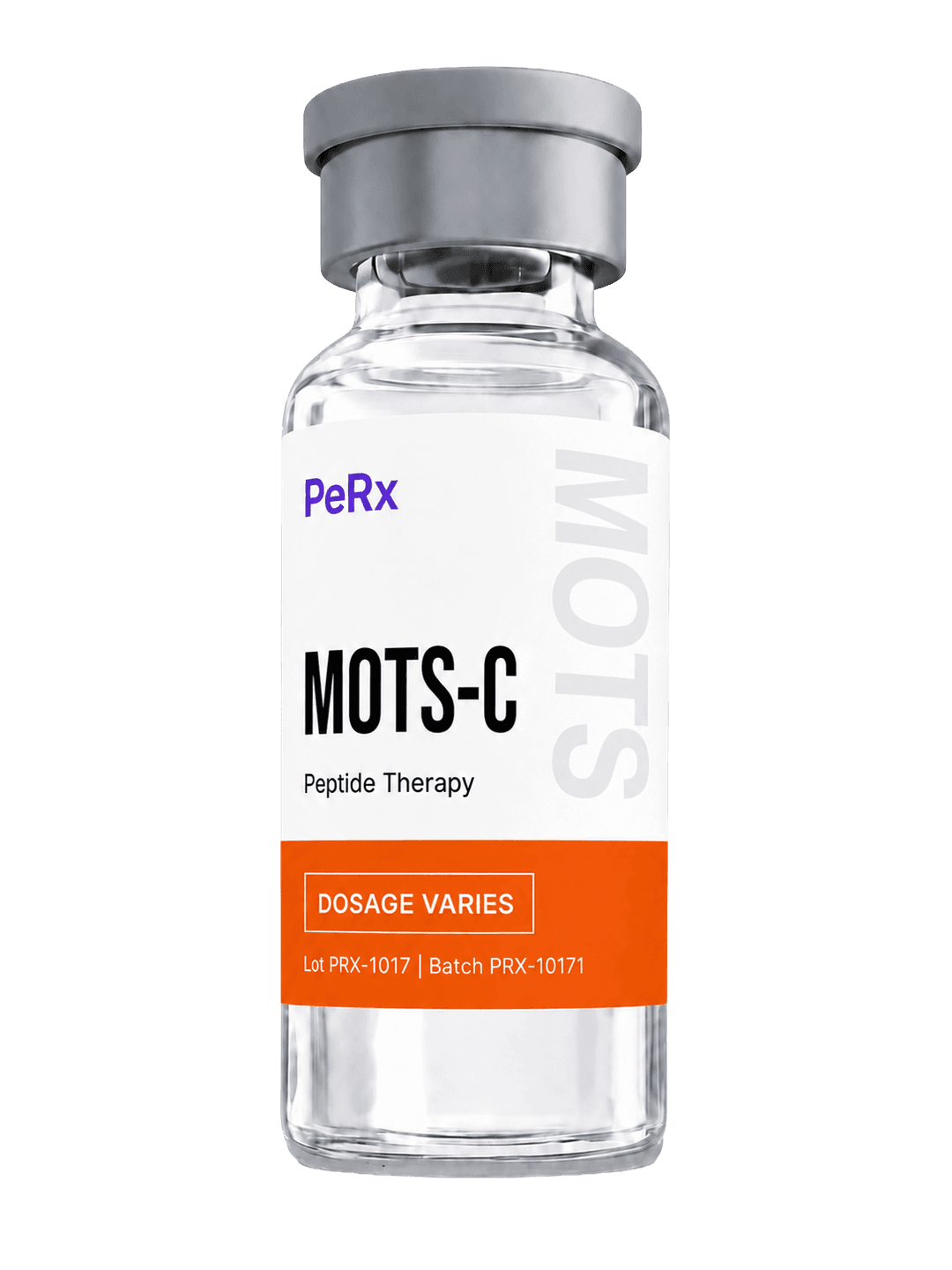
PeRx MOTS-c is prescribed by a licensed provider after screening, compounded by a US-based 503A pharmacy at a fixed 2 mg/mL, and tested for potency and sterility. It ships fully reconstituted and ready to use, so the 20-unit draw on the label is the only number you need.
Twenty-five doses per vial, each weekday morning. $229 per vial.
If You Miss a MOTS-c Dose
If you remember the same morning before eating, take the dose then. If you remember after food, take it at the next fasted window that day or let the day go and resume the next weekday morning; one missed weekday out of forty changes nothing worth correcting. Never inject twice to catch up. Weekends are not missed doses; Monday is a normal dose, not a make-up.
If several days slip, restart at the usual 20 units, not a larger one. If you stopped because something felt wrong, do not quietly restart; the care team needs to hear about that reaction first. If the problem is forgetting, fix the anchor, not the dose: tie the injection to something you already do every weekday morning.
Common Questions
Related Guides
Continue reading about peptides and protocols that pair well with this guide.
Where to Inject MOTS-c: Sites, Rotation, Timing
MOTS-c is a subcutaneous injection. The four standard sites work, but rotation, timing relative to exercise, and a few small technique details meaningfully change comfort and consistency. Here is the practical guide patients ask for after their first vial arrives.
MOTS-c Side Effects: What Is Known and What Is Not
Every MOTS-c side-effect list online shares one problem: no study of injected MOTS-c in people has ever reported results, so none of those lists has a number behind it. This page sorts the evidence into what was measured in humans (almost nothing, mostly on an analog), what FDA reviewers flagged in 2026, and what users report, with straight answers on blood sugar, cancer, and the heart.
Peptide Therapy Seattle: Pacific Northwest Guide
A plain guide to peptide therapy in Seattle: what it costs across local clinics, med spas, and telehealth, and who tends to use it here. Plus how pharmaceutical-grade peptides reach any Washington address without a clinic visit.
Ready to get started?
Pharmaceutical-grade MOTS-c, prescribed by a licensed provider, compounded at a US-based 503A pharmacy at a labeled 2 mg/mL, and shipped to your door ready to use with no reconstitution needed.
Medical Disclaimer
The information provided on this website, including all articles, guides, and educational content, is for informational and educational purposes only and is not intended as medical advice, diagnosis, or treatment. Nothing on this site should be construed as a substitute for professional medical advice from a qualified healthcare provider.
The majority of peptides discussed on this site are not approved by the U.S. Food and Drug Administration (FDA) for the indications described. They are classified as bulk drug substances and are available only through a licensed prescribing provider and compounding pharmacy. All treatments require a valid prescription and provider oversight.
The majority of published research on peptide therapies has been conducted in preclinical (animal) models. While early human data is encouraging, comprehensive clinical trial data remains limited for most peptide compounds. Individual results may vary significantly based on health status, injury type, and other factors. No specific outcomes are guaranteed.
Certain peptides discussed on this site are classified as prohibited substances by the World Anti-Doping Agency (WADA) and are banned by major sports organizations including the NFL, NCAA, UFC, NBA, MLB, NHL, and PGA. If you are subject to anti-doping testing, consult your governing body before considering any peptide therapy.
Statements on this website have not been evaluated by the Food and Drug Administration. Products and therapies discussed are not intended to diagnose, treat, cure, or prevent any disease.
© 2026 Wellness MD Group PC DBA PeRx. All rights reserved.