Semaglutide Dosage Chart: Titration, Units, Labels
Every semaglutide dosage chart online copies the same numbers from two FDA labels, then applies them to vials the labels never covered. This page keeps them apart: the Wegovy and Ozempic schedules as the labels print them, the tablet ladders, and the compounded vial, where the only dose that counts is the one on your pharmacy label. At PeRx the draw never changes, 25 units once a week, while the provider changes the strength at each renewal.

In this article
Key Takeaways
- Semaglutide is started low and stepped up at set intervals to limit stomach effects, and the schedule belongs to the product. Wegovy and Ozempic each have a label ladder, the tablets have their own, and a compounded vial has none: its dose is whatever the prescriber wrote.
- The Wegovy label (revised June 2026) starts at 0.25 mg once weekly for four weeks and climbs through 0.5, 1 and 1.7 mg to a 2.4 mg maintenance dose, with a 7.2 mg option for some adults. The Ozempic label (revised May 2026) is a type 2 diabetes schedule that stops at 2 mg; using it for weight is an off-label prescriber decision.
- At PeRx the draw never changes: 25 units, 0.25 mL, once a week from a 1 mL vial that holds four doses, with the provider setting the strength at each renewal. Five strengths carry the ladder, and two of them land near, not exactly on, the label steps.
- Units measure volume, not medicine. The milligrams in 25 units depend on the concentration printed on the vial, which differs between pharmacies, so a chart written for one concentration is wrong for another. The FDA has logged hospitalizations from exactly that mistake.
Semaglutide Dosing at a Glance
Compounded semaglutide
No label of its own; the dose is set by the prescriber and printed on the pharmacy label
Weekly draw at PeRx
25 units (0.25 mL) on a U-100 insulin syringe, once a week, at every strength
Vial at PeRx
1 mL, four weekly doses, one vial per 28-day cycle
Strength at PeRx
Provider-set at each renewal: 1, 2, 4, 6 or 10 mg/mL
Label ladder (Wegovy)
0.25 mg for 4 weeks, then 0.5, 1 and 1.7 mg at 4-week steps; 2.4 mg maintenance
Missed dose (Wegovy label)
Take it if the next dose is more than 2 days away; otherwise skip. Never two in one week
Labels checked
November 18, 2026
Semaglutide Dosage Chart at a Glance: Which Chart Applies to Which Product
A semaglutide dosage chart is only as good as the product it was written for, and there are four. Wegovy and Ozempic injections are FDA-approved Novo Nordisk products with different indications and different ladders; Wegovy tablets, Rybelsus and the newer Ozempic tablets are daily oral products on their own schedules. Compounded semaglutide is none of these: a state-licensed pharmacy prepares it for one patient against one prescription, so there is no label schedule to copy, only the one the prescriber wrote.
| Product | Approved for | Form | How the dose is set |
|---|---|---|---|
| Wegovy injection | Weight management and cardiovascular risk reduction; weight management from age 12 | Once-weekly subcutaneous injection, single-dose pens and syringes or a four-dose pen | Dose steps set by the label |
| Ozempic injection | Type 2 diabetes, plus cardiovascular and kidney indications in that population | Once-weekly subcutaneous injection, multi-dose pens | Dose steps set by the label |
| Wegovy tablets, Rybelsus, Ozempic tablets | Wegovy tablets: weight management and cardiovascular risk reduction. Rybelsus and Ozempic tablets: type 2 diabetes | Once-daily oral tablet | Dose steps set by each label; not interchangeable with the injection or with each other |
| Compounded semaglutide | Not FDA approved; prescribed off-label by a licensed provider | At PeRx, a multi-dose vial injected subcutaneously once weekly | Set by your prescriber and printed on your pharmacy label |
Wegovy injection
- Approved for
- Weight management and cardiovascular risk reduction; weight management from age 12
- Form
- Once-weekly subcutaneous injection, single-dose pens and syringes or a four-dose pen
- How the dose is set
- Dose steps set by the label
Ozempic injection
- Approved for
- Type 2 diabetes, plus cardiovascular and kidney indications in that population
- Form
- Once-weekly subcutaneous injection, multi-dose pens
- How the dose is set
- Dose steps set by the label
Wegovy tablets, Rybelsus, Ozempic tablets
- Approved for
- Wegovy tablets: weight management and cardiovascular risk reduction. Rybelsus and Ozempic tablets: type 2 diabetes
- Form
- Once-daily oral tablet
- How the dose is set
- Dose steps set by each label; not interchangeable with the injection or with each other
Compounded semaglutide
- Approved for
- Not FDA approved; prescribed off-label by a licensed provider
- Form
- At PeRx, a multi-dose vial injected subcutaneously once weekly
- How the dose is set
- Set by your prescriber and printed on your pharmacy label
Read the table as a warning as much as a map: the products are not interchangeable, and a chart for one cannot be used for another. The Ozempic ladder stops where the Wegovy ladder is still climbing, the tablet milligrams mean nothing for an injection, and no label covers the compounded vial. The weight-loss peptides page shows what PeRx prescribes in this area; the rest of this page is about the numbers.
Semaglutide
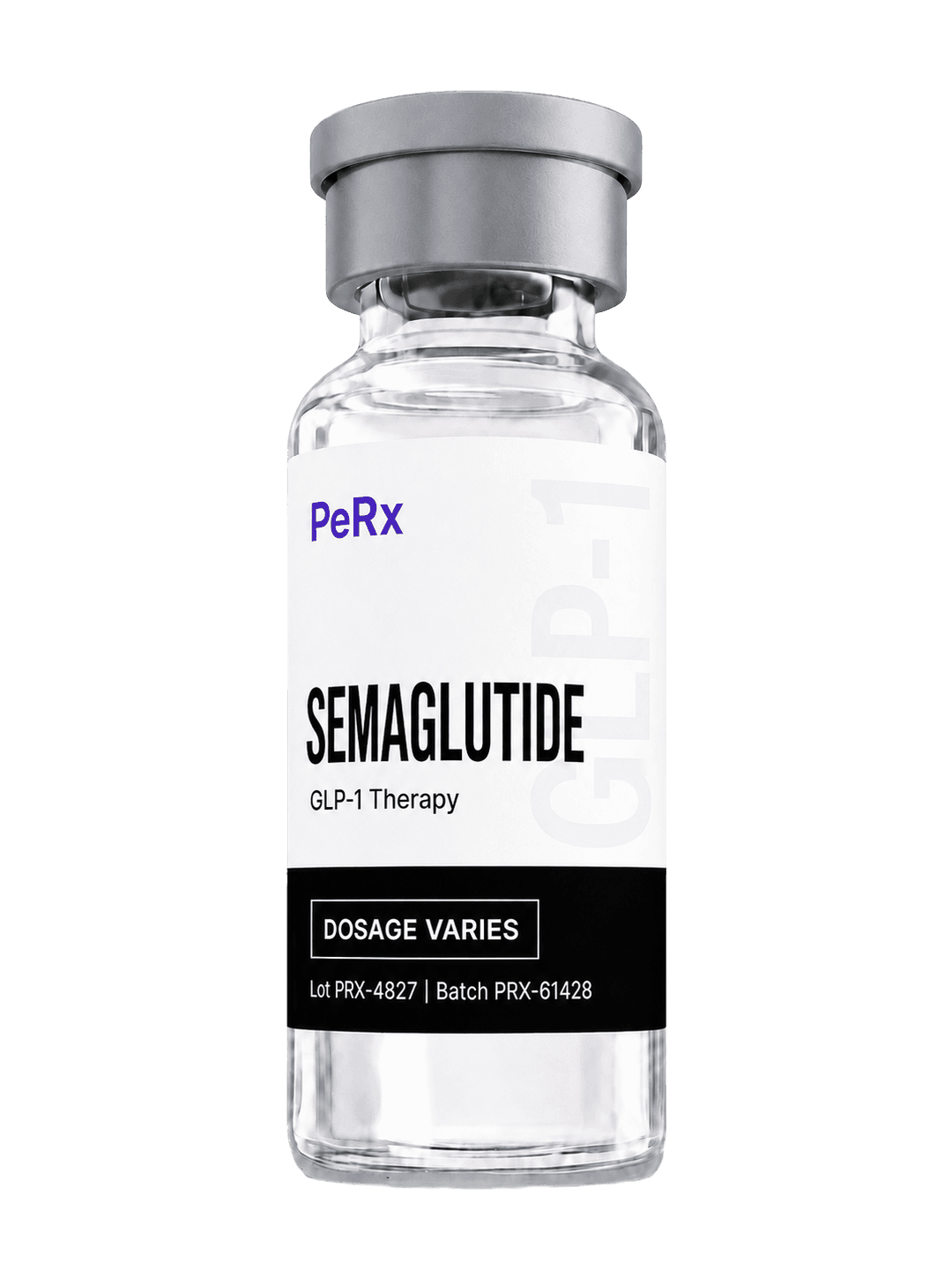
What PeRx prescribes is compounded semaglutide with vitamin B12 from a state-licensed 503A pharmacy, in a 1 mL multi-dose vial that ships fully reconstituted and ready to use. The label carries the semaglutide concentration in mg/mL, the B12 strength separately, your name, the prescriber and a beyond-use date, and a dosing sheet ships with the vial.
Four weekly draws of 25 units. It is not Wegovy, Ozempic or Rybelsus, it is not FDA approved, and the results on those labels are not evidence about it. Prescribed by a licensed provider after an eligibility check, one vial per 28 days, cancel in one step.
Semaglutide Titration Schedule: How the Dose Steps Up
Why the dose steps up
Semaglutide titration exists for one reason, and both labels state it: to reduce the risk of gastrointestinal adverse reactions. A low introductory dose lets the gut adjust, each step is held for a set interval, and the aim is tolerability, not speed. The interval has a pharmacological basis: the Ozempic label gives semaglutide an elimination half-life of about one week, so blood levels are still climbing for most of the first month at any dose. Both labels also let the schedule slow; the Wegovy label says that if a dose is not tolerated during escalation, consider delaying the next step for four weeks.
Ozempic (semaglutide) injection, U.S. Prescribing Information, revised 05/2026, Section 12.3: elimination half-life approximately 1 week. Via DailyMed. View study
Wegovy dosage chart: the label schedule
The Wegovy dosage chart is Table 1 of the Wegovy label, revised June 2026, and it applies to every approved indication in adults and adolescents aged 12 and older. The label's semaglutide dosage for weight loss starts at 0.25 mg once weekly and climbs in four-week blocks. The usual Wegovy dose at maintenance is 2.4 mg once weekly, with 1.7 mg as the alternative, chosen by treatment response and tolerability, and one higher option: adults who tolerate 2.4 mg for at least four weeks and need further weight reduction may be increased to a maximum of 7.2 mg once weekly, sold as Wegovy HD.
| Weeks on the Wegovy label | Once-weekly dose | What the label says |
|---|---|---|
| Weeks 1 to 4 | 0.25 mg | Starting dose |
| Weeks 5 to 8 | 0.5 mg | Dose escalation |
| Weeks 9 to 12 | 1 mg | Dose escalation |
| Weeks 13 to 16 | 1.7 mg | Dose escalation |
| Week 17 onward | 2.4 mg (recommended) or 1.7 mg | Maintenance; 7.2 mg maximum for some adults after at least 4 weeks at 2.4 mg |
Weeks 1 to 4
- Once-weekly dose
- 0.25 mg
- What the label says
- Starting dose
Weeks 5 to 8
- Once-weekly dose
- 0.5 mg
- What the label says
- Dose escalation
Weeks 9 to 12
- Once-weekly dose
- 1 mg
- What the label says
- Dose escalation
Weeks 13 to 16
- Once-weekly dose
- 1.7 mg
- What the label says
- Dose escalation
Week 17 onward
- Once-weekly dose
- 2.4 mg (recommended) or 1.7 mg
- What the label says
- Maintenance; 7.2 mg maximum for some adults after at least 4 weeks at 2.4 mg
Wegovy (semaglutide) injection and tablets, U.S. Prescribing Information, revised 06/2026, Section 2.2: Table 1 and maintenance dosages by indication. Via DailyMed. View study
Ozempic dosage chart: the label schedule
The Ozempic dosage chart is a type 2 diabetes schedule, and it reads differently: after the starting block, each step is taken only if additional glycemic control is needed. There is no Ozempic dose for weight loss on the label. Prescribing it for weight is an off-label decision that belongs to the prescriber, and the label the prescriber is working from stops at 2 mg.
| Ozempic label step | Once-weekly dose | What the label says |
|---|---|---|
| First 4 weeks | 0.25 mg | Starting dose |
| After 4 weeks | 0.5 mg | A maintenance dose |
| After at least 4 weeks at 0.5 mg | 1 mg | If more glycemic control is needed; the maintenance dose with chronic kidney disease |
| After at least 4 weeks at 1 mg | 2 mg | If more glycemic control is needed; the maximum recommended dose |
First 4 weeks
- Once-weekly dose
- 0.25 mg
- What the label says
- Starting dose
After 4 weeks
- Once-weekly dose
- 0.5 mg
- What the label says
- A maintenance dose
After at least 4 weeks at 0.5 mg
- Once-weekly dose
- 1 mg
- What the label says
- If more glycemic control is needed; the maintenance dose with chronic kidney disease
After at least 4 weeks at 1 mg
- Once-weekly dose
- 2 mg
- What the label says
- If more glycemic control is needed; the maximum recommended dose
Ozempic (semaglutide) injection, U.S. Prescribing Information, revised 05/2026, Section 2.2 Recommended Dosage. Via DailyMed. View study
How the Label Ladder Becomes a Vial at PeRx
A compounded vial has no dose built in, so a clinic has to decide how the label steps map onto what the patient draws. PeRx fixes the volume and moves the concentration. Every patient, at every step, draws 25 units, 0.25 mL on a U-100 insulin syringe, once a week. The step lives in the vial: five concentrations from 1 to 10 mg/mL, in a 1 mL vial that holds exactly four draws, so one vial is one 28-day cycle, and the provider sets the strength at each renewal after reading your check-in. This is the semaglutide dosage chart in units for a PeRx vial, and one column never changes.
| Vial strength (PeRx) | Weekly draw | Semaglutide per injection | Nearest label step |
|---|---|---|---|
| 1 mg/mL | 25 units (0.25 mL) | 0.25 mg | Starting dose, first cycle |
| 2 mg/mL | 25 units | 0.5 mg | Second step |
| 4 mg/mL | 25 units | 1 mg | Third step |
| 6 mg/mL | 25 units | 1.5 mg | Near the label's 1.7 mg step |
| 10 mg/mL | 25 units | 2.5 mg | Near the label's 2.4 mg maintenance dose |
1 mg/mL
- Weekly draw
- 25 units (0.25 mL)
- Semaglutide per injection
- 0.25 mg
- Nearest label step
- Starting dose, first cycle
2 mg/mL
- Weekly draw
- 25 units
- Semaglutide per injection
- 0.5 mg
- Nearest label step
- Second step
4 mg/mL
- Weekly draw
- 25 units
- Semaglutide per injection
- 1 mg
- Nearest label step
- Third step
6 mg/mL
- Weekly draw
- 25 units
- Semaglutide per injection
- 1.5 mg
- Nearest label step
- Near the label's 1.7 mg step
10 mg/mL
- Weekly draw
- 25 units
- Semaglutide per injection
- 2.5 mg
- Nearest label step
- Near the label's 2.4 mg maintenance dose
Two honest notes on that table. Two of the five strengths land near the Wegovy steps rather than on them: the 6 mg/mL vial delivers 1.5 mg where the label says 1.7, and the 10 mg/mL vial delivers 2.5 mg where the label's recommended maintenance dose is 2.4. The gaps are small, but they are gaps, the provider prescribing the strength knows them, and nothing on the PeRx ladder reaches the label's 7.2 mg option. And the ladder is a prescribing protocol built around label numbers, not a label: no trial has tested a compounded vial at any of these concentrations, and the approved products' results do not transfer to it.
The one number to remember
Twenty-five units. Your milligram dose this cycle is the mg/mL on the label divided by four: a 2 mg/mL vial is 0.5 mg a week, a 4 mg/mL vial is 1 mg. If a new vial shows a strength you did not expect, ask before injecting.
Escalation under the PeRx protocol is monthly and conditional. The dose moves up one step only when you tolerate the current one, you are not losing weight too quickly, and no new contraindication has appeared since the last review, such as a pregnancy or a plan for one, a new medication, or symptoms pointing to the pancreas or gallbladder. If all three hold, the next vial ships at the next strength; if any one fails, it ships at the same strength or a lower one. One vial holds one concentration, so you cannot move faster than one step per cycle; drawing more than 25 units spends the vial early and skips the review the step exists for.
Rybelsus, Ozempic Tablets and Wegovy Tablets: Oral Semaglutide Dosing
Oral semaglutide has its own label schedules and is taken differently: once daily, on an empty stomach in the morning, with up to four ounces of water and nothing else, then a wait of at least 30 minutes before food, drink or other oral medicines. The milligrams are not interchangeable with the injection, and the diabetes tablets are not interchangeable with each other. On the labels revised in January and June 2026, Rybelsus starts at 3 mg daily for 30 days, then 7 mg, with 14 mg available if more glycemic control is needed; Ozempic tablets start at 1.5 mg for 30 days, then 4 mg, then 9 mg on the same condition; Wegovy tablets start at 1.5 mg for 30 days and step through 4 and 9 mg to a 25 mg maintenance dose. A missed tablet is skipped and the next one taken the following day.
Rybelsus and Ozempic (semaglutide) tablets, U.S. Prescribing Information, revised 1/2026, Sections 2.1 and 2.2; Wegovy tablets, Sections 2.1 to 2.4 of the Wegovy label revised 06/2026. Via DailyMed. View study
PeRx does not sell any of these tablets. The oral form on the PeRx roadmap is sublingual semaglutide, a compounded liquid held under the tongue, listed as coming soon; it is not one of the approved tablets and has none of their schedules.
Compounded Semaglutide Dosage Chart: Why Your Pharmacy Label Comes First
What semaglutide units mean on a syringe
A unit on an insulin syringe is a volume mark. A standard U-100 syringe holds 100 units in 1 mL, so 25 units is a quarter of a milliliter and nothing more. Semaglutide units are not a dose: the same 25 units contain more medicine from a more concentrated vial and less from a weaker one, which is why the strength, not the draw, is what changes between PeRx cycles. Syringe size matters too: 25 units is a quarter of a 1 mL syringe, half of a 0.5 mL syringe and most of a 0.3 mL one, so check the capacity before the first draw.
Semaglutide units to mg: why there is no single chart
Converting semaglutide units to mg needs one more number, the concentration on the vial, and that number differs between pharmacies and between cycles. A semaglutide 5mg/ml dosage chart applies only to a 5 mg/mL vial; set the same unit counts against a 2 mg/mL vial and every row is wrong by a factor of two and a half. That is why this page prints no universal units table. The PeRx ladder above works because the draw is fixed and the concentration is what the provider chooses; a chart from another clinic, or a forum, describes a vial you do not have.
How to use your pharmacy label
Follow the units and the concentration printed on your own label, and check the concentration against the vial every cycle, because the label is what changes when the provider moves you up or down a step. A PeRx vial arrives ready to use with no reconstitution needed, with the concentration on the label and a dosing sheet in the box; other pharmacies dispense differently, and if yours gives written preparation instructions, follow those exactly and never improvise. Confirm the first draw with the pharmacist or the prescriber if anything on the label does not match what you expected. A semaglutide dosage calculator, including the PeRx peptide dosage calculator, is for checking a label, never for replacing one, so do not rely on an online calculator alone. The injection guide for semaglutide and tirzepatide walks through the draw itself.
Dosing errors the FDA has warned about
The reason to be strict is on the public record. In its statement on unapproved GLP-1 drugs, current as of October 1, 2026, the FDA writes that it "received multiple reports of adverse events, some requiring hospitalization, that may be related to dosing errors associated with compounded injectable semaglutide products. These dosing errors resulted from patients measuring and self-administering incorrect doses of the drug, and in some cases, health care professionals miscalculating doses of the drug." The errors have three shapes: confusing units with milligrams, using the wrong syringe type, and drawing from vials of different concentrations as if they were the same. A 2023 poison-center case series shows it one patient at a time, including two tenfold overdoses and one patient dosing in milliliters and units rather than milligrams. An overdose can look like severe nausea, vomiting and dehydration; if you think you injected the wrong amount, contact your provider or Poison Control at 1-800-222-1222 right away and do not take the next dose early. What a legitimate compounded prescription looks like, and what the gray market does instead, is in gray-market GLP-1s vs compounded and what is compounded semaglutide.
U.S. Food & Drug Administration, "FDA's Concerns with Unapproved GLP-1 Drugs Used for Weight Loss." Dosing concerns with compounded semaglutide and tirzepatide. Content current as of October 1, 2026. View study
Lambson JE, Flegal SC, Johnson AR. "Administration errors of compounded semaglutide reported to a poison control center-Case series." J Am Pharm Assoc. 2023;63(5):1643-1645. PMID 37392810. View study
Semaglutide Maintenance Dose and Dose Changes
A maintenance dose is the dose a prescriber settles on after titration, and not everyone reaches the top of the ladder. The Wegovy label names 2.4 mg as the recommended maintenance dose for weight reduction in adults and 1.7 mg as the alternative; the Ozempic label names 0.5, 1 or 2 mg, based on glycemic control. Under the PeRx protocol there is no fixed maintenance strength: some people stay at the strength where they arrived, others step down one vial at a time to the lowest strength at which meals still satisfy. Dose changes, pauses and restarts are decided at each renewal check-in, not between cycles, and halving the draw is not a step-down; it is an unprescribed dose from a vial labeled for a different one. The stretched intervals and tiny doses that circulate under the name microdosing are covered in GLP-1 maintenance and microdosing.
How to Take Semaglutide Safely and What to Do If You Miss a Dose
Both weekly products are taken on the same day each week, at any time of day, with or without meals, under the skin of the abdomen, thigh or upper arm, rotating sites. Wash your hands, inspect the vial, which should be clear and colorless, draw exactly the units on your label with a new needle, inject, and drop the syringe in a sharps container. Where to inject semaglutide and tirzepatide has the full walkthrough, and injection-site reactions on a GLP-1 shows what a normal site looks like.
The missed-dose rules come from the labels. Wegovy: if the next scheduled dose is more than two days away, take the missed dose as soon as possible; if it is less than two days away, skip it and resume on the regular day; if two or more consecutive doses are missed, reinitiate the escalation at a lower dose. Ozempic states the same idea from the other direction: take a missed dose within five days, skip it after that, and change the weekly day only with more than 48 hours between doses. No label covers a compounded vial, so the rule is the one your prescriber gave; the PeRx instruction matches the Wegovy label, and never means two doses in one week. If you have missed two or more in a row, message the care team before restarting at the strength in the fridge.
Wegovy label revised 06/2026, Section 2.4 Recommendations Regarding Missed Dose(s); Ozempic label revised 05/2026, Section 2.1 (missed dose within 5 days; more than 48 hours between doses when changing the day). Via DailyMed. View study
Storage is the one place this page gives no numbers for a compounded vial on purpose: the beyond-use date and storage instructions printed by your pharmacy are the only ones that apply. A PeRx vial is refrigerated and never frozen, and a vial that froze, sat warm, or looks cloudy is a pharmacy question first, not something to inject and see.
Semaglutide Side Effects and Safety Considerations
The approved labels are the safety reference, and the escalation schedule exists because of the first group of side effects: nausea, vomiting, diarrhea, constipation and abdominal pain are the common reactions on the Wegovy and Ozempic labels, and the Ozempic label notes that most reports of nausea, vomiting and diarrhea occurred during dose escalation. The serious risks the labels list include acute pancreatitis, acute gallbladder disease, acute kidney injury from dehydration after severe stomach effects, hypoglycemia when semaglutide is combined with insulin or an insulin secretagogue, and serious hypersensitivity reactions including anaphylaxis and angioedema.
The boxed warning and who should not use it
Every semaglutide label carries a boxed warning for the risk of thyroid C-cell tumors, based on rodent studies, with the human relevance not determined. Semaglutide is contraindicated in anyone with a personal or family history of medullary thyroid carcinoma or with Multiple Endocrine Neoplasia syndrome type 2, and in anyone with a prior serious hypersensitivity reaction to semaglutide or an ingredient of the product. Those labels describe the approved products; a compounded vial has not been evaluated by the FDA at all, so the same cautions are the floor, not the ceiling.
Call a provider for nausea or vomiting that stops you keeping fluids down, constipation lasting more than a few days, or an injection site that does not settle within a few days. Seek urgent care for severe abdominal pain, especially pain spreading to the back or with vomiting; yellowing of the skin or eyes; a lump or swelling in the neck, hoarseness or trouble swallowing; or swelling of the face, lips or throat with difficulty breathing. The first weeks are covered in nausea and gut effects on a GLP-1; the standing reference is the PeRx safety information.
Wegovy label revised 06/2026 and Ozempic label revised 05/2026: boxed warning, Sections 4 and 5; Ozempic Section 6.1 on gastrointestinal reactions during escalation. Via DailyMed. View study
Getting Semaglutide Through a Prescription
The path at PeRx is the same as for every peptide it prescribes: an eligibility check, a licensed provider reviewing your health profile, a state-licensed 503A pharmacy filling the prescription, and a check-in before each renewal, where the strength for the next cycle is decided. Nothing is charged until a provider approves the prescription, there is no separate consultation fee, and the plan-level figures are on the pricing page. Compounded semaglutide is not FDA approved. How to get peptides prescribed online describes the process step by step. New here? Check your eligibility below. Already a patient? Message the care team from your account or through the contact page.
Common Questions
Related Guides
Continue reading about peptides and protocols that pair well with this guide.
What Is Compounded Semaglutide? Is It Safe?
Compounded semaglutide is the same active molecule as Ozempic and Wegovy, prepared by a licensed pharmacy for one named patient instead of manufactured under an FDA approval. That one sentence carries a lot of legal weight. This page unpacks it: what compounding is, how the compounded product differs from the brands, what changed between 2022 and 2026, and what a legitimate prescription looks like from inside a clinic that writes them.
Semaglutide and Menopause: Does It Still Work?
Somewhere in the mid-40s, the strategies that always worked stop working. Same food, same walks, new midsection. Then comes the question nobody answers well: does a GLP-1 even work after menopause, and does hormone therapy change the math? The cohort data exists. This page walks through it, plus the muscle problem that matters more for this reader than for almost anyone else.
Cleveland Peptide Therapy: Sourcing & Costs
A plain guide to peptide therapy in Cleveland: how to tell a real pharmacy from a gray-market seller, what it costs across local clinics, med spas, and telehealth, and who tends to use it here. Plus how pharmaceutical-grade peptides reach any Northeast Ohio address without a clinic visit.
Ready to get started?
Pharmaceutical-grade compounded semaglutide with B12, prescribed by a licensed provider and shipped ready to use with no reconstitution needed.
Medical Disclaimer
The information provided on this website, including all articles, guides, and educational content, is for informational and educational purposes only and is not intended as medical advice, diagnosis, or treatment. Nothing on this site should be construed as a substitute for professional medical advice from a qualified healthcare provider.
The majority of peptides discussed on this site are not approved by the U.S. Food and Drug Administration (FDA) for the indications described. They are classified as bulk drug substances and are available only through a licensed prescribing provider and compounding pharmacy. All treatments require a valid prescription and provider oversight.
The majority of published research on peptide therapies has been conducted in preclinical (animal) models. While early human data is encouraging, comprehensive clinical trial data remains limited for most peptide compounds. Individual results may vary significantly based on health status, injury type, and other factors. No specific outcomes are guaranteed.
Certain peptides discussed on this site are classified as prohibited substances by the World Anti-Doping Agency (WADA) and are banned by major sports organizations including the NFL, NCAA, UFC, NBA, MLB, NHL, and PGA. If you are subject to anti-doping testing, consult your governing body before considering any peptide therapy.
Statements on this website have not been evaluated by the Food and Drug Administration. Products and therapies discussed are not intended to diagnose, treat, cure, or prevent any disease.
© 2026 Wellness MD Group PC DBA PeRx. All rights reserved.