TB-500 Dosage: Protocols, Units, Cycle Length
Search for a TB-500 dosage and you get loading phases, maintenance weeks, and milligram figures that no human trial has ever tested. This page lays out where those numbers come from, why the clinical literature cannot settle them, and what the numbers look like when TB-500 arrives as a prescribed blend at a fixed concentration: 20 units on an insulin syringe, Monday through Friday, six weeks on and six off, as of September 8, 2026.

In this article
Key Takeaways
- The TB-500 dosing patterns circulating online usually run 2 to 2.5 mg injected twice a week for four to six weeks, then a similar amount weekly or every other week as maintenance. Those figures come from gray-market vendors and forum convention, not from any clinical trial, and they are not what PeRx prescribes.
- There is no official TB-500 dose because no human dose-finding study of the compounded peptide exists. The human trials that do exist used full-length synthetic thymosin beta-4 in very different settings, including intravenous doses of 42 to 1260 mg per day in a safety study, numbers that translate to nothing at the syringe.
- PeRx dispenses TB-500 only inside a combination product: the BPC/TB-500 injectable at 3 mg of each peptide per mL, dosed at 20 units (0.2 mL) Monday through Friday, or the oral capsules at 500 mcg of each peptide once daily. Your prescription label governs.
- At the combo concentration, one unit on a U-100 insulin syringe holds 30 mcg of TB-500, so the prescribed 20 units delivers 0.6 mg per injection and 3 mg per week. Every unit also carries the same amount of BPC-157; the vial cannot dose one peptide without the other.
- The prescribed cycle is six weeks on, then six weeks fully off before any restart. The off period is not optional, and doubling doses to compensate for missed days is not part of the protocol.
TB-500 Dosing at a Glance
How PeRx dispenses it
Only inside the BPC/TB-500 blend: injectable vial or oral capsules
Injectable
3 mg TB-500 + 3 mg BPC-157 per mL, 5 mL vial, ready to use
Prescribed dose
20 units (0.2 mL) = 0.6 mg TB-500 + 0.6 mg BPC-157, Monday through Friday
Capsules
500 mcg TB-500 + 500 mcg BPC-157, one capsule every morning
Cycle
6 weeks on, 6 weeks off
Cost
BPC/TB-500 injectable is $299 per vial at PeRx
TB-500 Dosage: What the Protocols Actually Say
Nearly every TB-500 dosing scheme you will encounter follows the same two-phase shape. A loading phase first: somewhere between 2 and 2.5 mg injected subcutaneously twice a week, kept up for four to six weeks. Then a maintenance phase: a similar injection once a week, once every two weeks, or once a month, continued for as long as the user intends to keep going. Some versions scale the loading dose to body weight, quoting 2 mg for smaller users and 2.5 mg or more for larger ones. Others compress the schedule into a single larger weekly injection.
It is worth being precise about what these numbers are. They are circulating research protocols: conventions that formed on bodybuilding forums and gray-market vendor pages over roughly fifteen years, passed along until repetition made them look authoritative. No clinical trial produced the 2.5 mg figure. No published study compared twice-weekly loading against any alternative. The pattern survives because it is what everyone else quotes, which is a mechanism for consistency, not for correctness. This page describes those protocols so you can recognize them for what they are, not because PeRx endorses or prescribes them.
What a gray-market milligram actually contains
A dosing convention built on research-chemical vials inherits their quality control. Products sold "for research purposes" carry no potency verification, no sterility testing, and no requirement that the vial contain what the label claims, so a forum protocol quoting 2.5 mg is quoting a number nobody has audited. Peptides from a licensed 503A compounding pharmacy are tested for identity, potency, and sterility, which is the difference between a labeled dose and a hopeful one. The regulatory picture is covered in is TB-500 FDA approved.
Why There Is No Official TB-500 Dose
TB-500 is the compounding name for synthetic thymosin beta-4, a 43-amino-acid peptide your body already produces in platelets, white blood cells, and wound fluid. Its day job is holding a reserve pool of actin, the protein cells use to build internal scaffolding and crawl toward injury sites, which is why the research interest centers on tissue repair. The TB-500 pillar guide covers that biology in full; what matters here is the shape of the human evidence, because it explains the dosing vacuum.
Goldstein AL, Hannappel E, Kleinman HK. "Thymosin beta4: actin-sequestering protein moonlights to repair injured tissues." Trends in Molecular Medicine. 2005;11(9):421-429. View study
Every human trial in this space studied full-length thymosin beta-4 in development programs aimed at specific medical indications, mostly eye surface repair and cardiac protection, using routes and quantities that have nothing in common with a subcutaneous recovery protocol. The clearest example is the phase 1 safety study by Ruff and colleagues: healthy volunteers received intravenous synthetic thymosin beta-4 at 42, 140, 420, or 1260 mg, first as a single dose and then daily for 14 days. The drug was well tolerated across that entire range, which is genuinely useful safety information, and completely useless for choosing a milligram figure at the syringe. An IV dose of 42 mg is not a data point about 2 mg under the skin, and 1260 mg is five hundred times the forum loading dose.
Ruff D, Crockford D, Girardi G, Zhang Y. "A randomized, placebo-controlled, single and multiple dose study of intravenous thymosin beta4 in healthy volunteers." Annals of the New York Academy of Sciences. 2010;1194:223-229. View study
The efficacy programs never reached a completed confirmatory trial, so no dose was ever validated for any indication, let alone for tendon or muscle recovery in healthy adults. That is the whole story behind the missing number. Dose-finding is a formal process: escalating cohorts, predefined endpoints, a published curve relating dose to response. TB-500 skipped it entirely and went from animal studies to gray-market convention. When a prescribing clinic sets a dose anyway, it is exercising clinical judgment inside that evidence gap, which is exactly why the label, not a forum thread, has to be the number you follow.
How PeRx Doses TB-500: Inside the Combo
PeRx does not dispense TB-500 as a standalone vial. It ships inside a combination product with BPC-157, because the two peptides are studied for complementary sides of the same repair process: BPC-157 for local signaling at the injury site, TB-500 for cell migration and inflammation regulation body-wide. The reasoning behind the pairing has its own guide, and BPC-157 vs TB-500 walks through how the molecules differ. The dosing consequence is simple: the prescribed TB-500 dose at PeRx is defined by the blend.
PeRx BPC/TB-500 Protocol
Concentration
3 mg TB-500 + 3 mg BPC-157 per mL, 5 mL vial
Dose
20 units (0.2 mL): 0.6 mg of each peptide per injection
Route
Subcutaneous, as close to the injury site as possible
Days
Monday through Friday
Cycle
6 weeks on, then 6 weeks off before any restart
Avoid
NSAIDs (ibuprofen, naproxen, aspirin) during use
Storage
Refrigerate at 36 to 46 degrees Fahrenheit. Do not freeze.
Set the weekly arithmetic side by side with the forum pattern and the difference in philosophy shows. A circulating loading protocol at 2.5 mg twice a week puts 5 mg of TB-500 into the body in two large boluses. The PeRx protocol delivers 3 mg per week as five small daily doses, each accompanied by an equal amount of BPC-157, on a schedule that caps total exposure with a hard stop at six weeks. Smaller amounts, spread out, inside a bounded course, with pharmacy-tested material. Anyone who prefers to avoid needles entirely has the capsule form: BPC/TB-500 capsules carry 500 mcg of each peptide, taken as one capsule every morning on an empty stomach. Oral and injected milligrams are not interchangeable, so the two formats are different protocols, not two ways to hit one number.
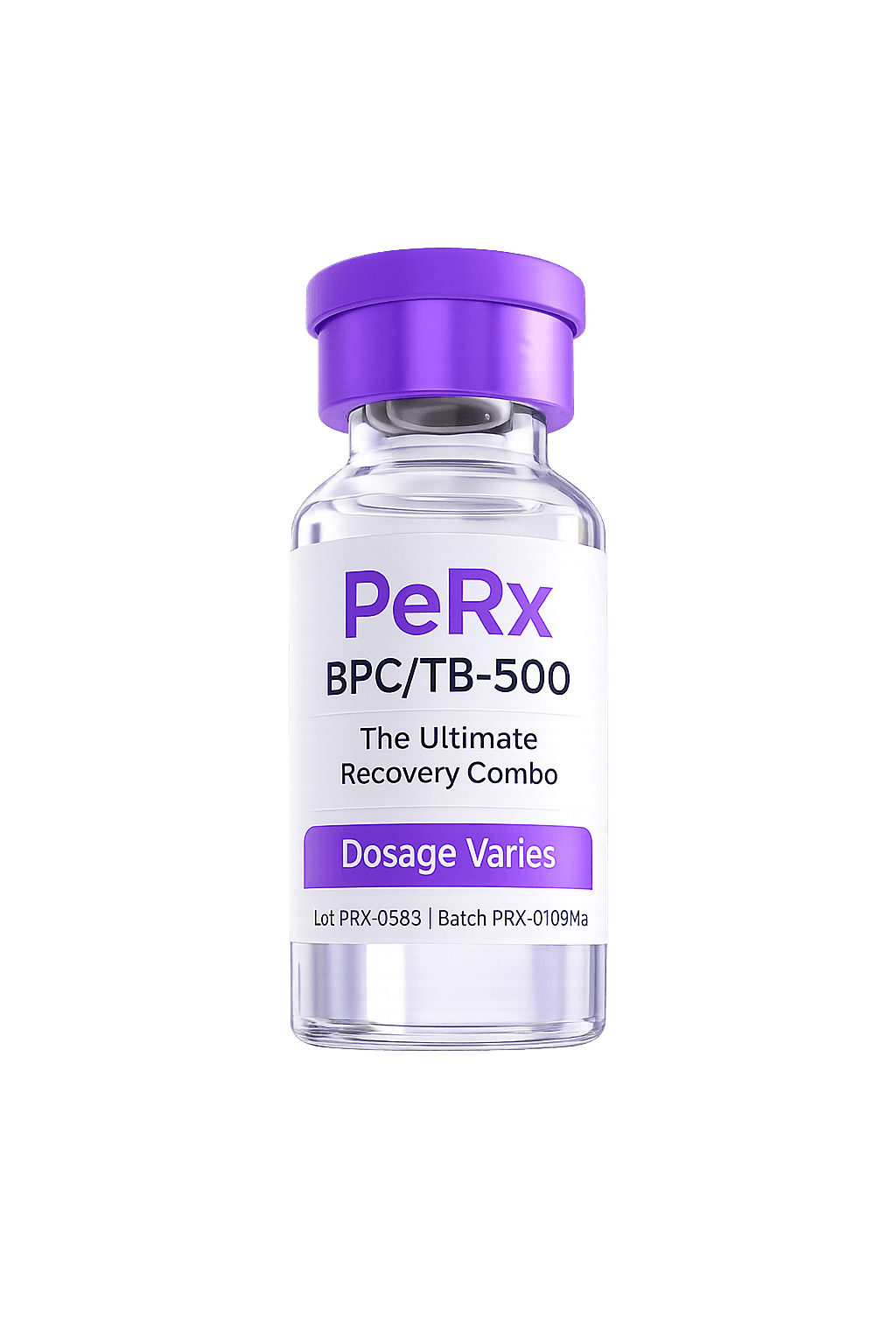
BPC/TB-500
The vial TB-500 actually ships in at PeRx: 3 mg of TB-500 and 3 mg of BPC-157 per mL, prescribed by a licensed provider after a health screening and compounded at a state-licensed 503A pharmacy with testing for potency and sterility.
The 5 mL vial ships fully reconstituted and ready to use, with insulin syringes and printed instructions in the box. Nothing is charged until the provider approves the prescription.
The label governs
A licensed provider prescribes your protocol; nobody at PeRx coaches doses up or down by message, and nothing on this page overrides the instructions that arrive with your vial. If your prescription came from another clinic with different numbers, follow that label and direct questions to the prescriber who wrote it.
Units on an Insulin Syringe
The conversion takes one line. A U-100 insulin syringe holds 100 units per mL, so each unit is 0.01 mL. At 3 mg of TB-500 per mL, one unit carries 30 mcg. Divide a milligram dose by 0.03 to get units, or multiply units by 30 to get micrograms. The chart below runs the common figures, including the ones circulating protocols quote, so you can translate any number you have read into volume at this concentration.
| TB-500 dose | Units at 3 mg/mL | Volume | BPC-157 drawn with it |
|---|---|---|---|
| 0.3 mg | 10 units | 0.1 mL | 0.3 mg |
| 0.5 mg | 16.7 units (draw to 17) | 0.17 mL | 0.5 mg |
| 0.6 mg (PeRx prescribed) | 20 units | 0.2 mL | 0.6 mg |
| 1 mg | 33 units | 0.33 mL | 1 mg |
| 2 mg | 67 units | 0.67 mL | 2 mg |
| 2.5 mg | 83 units | 0.83 mL | 2.5 mg |
0.3 mg
- Units at 3 mg/mL
- 10 units
- Volume
- 0.1 mL
- BPC-157 drawn with it
- 0.3 mg
0.5 mg
- Units at 3 mg/mL
- 16.7 units (draw to 17)
- Volume
- 0.17 mL
- BPC-157 drawn with it
- 0.5 mg
0.6 mg (PeRx prescribed)
- Units at 3 mg/mL
- 20 units
- Volume
- 0.2 mL
- BPC-157 drawn with it
- 0.6 mg
1 mg
- Units at 3 mg/mL
- 33 units
- Volume
- 0.33 mL
- BPC-157 drawn with it
- 1 mg
2 mg
- Units at 3 mg/mL
- 67 units
- Volume
- 0.67 mL
- BPC-157 drawn with it
- 2 mg
2.5 mg
- Units at 3 mg/mL
- 83 units
- Volume
- 0.83 mL
- BPC-157 drawn with it
- 2.5 mg
Read the lower rows as translations, not as options. They exist so a dose quoted on a forum or another label makes sense in these units; the dose you inject is the one on your prescription, and at PeRx that is 20 units. The fourth column is the part standalone dosing pages leave out: this is a blend at equal concentrations, so every unit of TB-500 you draw brings the same amount of BPC-157 with it. Drawing 83 units to chase a forum loading dose would also quadruple the BPC-157 dose, which is one of several reasons improvising on a combination vial is a bad idea. A full walkthrough of the combined math, per-day and per-week totals included, lives in the BPC-157/TB-500 dosage chart. For needle technique and site choice, see where to inject TB-500 and the general primer on how to take peptides.
Cycle Length
The PeRx label is explicit: six weeks of Monday through Friday injections, then a six-week break before restarting, and never continuous use. At 20 units a day, five days a week, a six-week course is 30 injections and 18 mg of TB-500. A 5 mL vial holds 25 doses, so a full course runs one vial plus part of a second.
The bounded cycle is a direct answer to the evidence gap described above. With no human data defining safe long-term exposure to the compounded peptide, an equal off period keeps cumulative use capped at half the year, and it also matches how the peptide is supposed to be used: pointed at a specific injury with a defined recovery window, not run in the background indefinitely. Circulating protocols that maintain monthly injections for a year have no more evidence behind their duration than behind their dose. How on-off structures work across the catalog, and why some peptides cycle while others do not, is the subject of the peptide cycling guide.
If You Miss a Dose
Skip it. Take your next scheduled injection at its normal time and do not draw extra to make up the difference. The protocol works through repeated small exposures across the course, so one missed weekday is a rounding error in a 30-dose cycle, while a doubled injection changes the one variable your prescription fixed. If you have missed several days in a row, message your care team through the contact page rather than improvising a catch-up schedule.
Two practical notes from the label while you are here. Do not take NSAIDs such as ibuprofen, naproxen, or aspirin during the cycle. And a brief lightheaded feeling after an injection can occur; sit or lie down until it passes, and seek medical attention if it lasts beyond 15 to 20 minutes or you faint.
TB-500 Dosage: Common Questions
Related Guides
Continue reading about peptides and protocols that pair well with this guide.
TB-500 Peptide: What It Is and How It Works
TB-500 is a lab-made fragment of thymosin beta-4, a protein nearly every cell in your body uses to move repair machinery to where damage is. This guide covers what TB-500 actually is, the actin mechanism behind it, what the research does and does not show, side effects, and why it reaches patients only inside prescribed combination vials.
Where to Inject TB-500: Sites and Rotation
TB-500 is a subcutaneous injection. One detail catches most people off guard: PeRx does not dispense TB-500 on its own. It comes pre-mixed with BPC-157 in a single ready-to-use vial, so "where to inject TB-500" is really "where to inject the BPC-157/TB-500 combo." The four standard subQ sites all work, and because this is a tissue-repair combination, there is a practical case for injecting near the injury when it makes sense. Here is the guide patients ask for after their first vial arrives.
FDA-Approved Peptides: The Full List (2026)
Peptide drugs have been FDA-approved for over forty years, from recombinant insulin in 1982 to tirzepatide in 2022. Most of the peptides people actually search for, though, are not on that list. This guide lays out every FDA-approved peptide drug with its brand names and approval year, explains the difference between an approved drug, a compounded medication, and a research chemical, and covers where the 2026 FDA compounding review left peptides like BPC-157. Current as of August 2026.
Ready to get started?
TB-500 the prescribed way: paired with BPC-157 in a single vial, reviewed and prescribed by a licensed provider, compounded at a state-licensed 503A pharmacy, and shipped to your door ready to use.
Medical Disclaimer
The information provided on this website, including all articles, guides, and educational content, is for informational and educational purposes only and is not intended as medical advice, diagnosis, or treatment. Nothing on this site should be construed as a substitute for professional medical advice from a qualified healthcare provider.
The majority of peptides discussed on this site are not approved by the U.S. Food and Drug Administration (FDA) for the indications described. They are classified as bulk drug substances and are available only through a licensed prescribing provider and compounding pharmacy. All treatments require a valid prescription and provider oversight.
The majority of published research on peptide therapies has been conducted in preclinical (animal) models. While early human data is encouraging, comprehensive clinical trial data remains limited for most peptide compounds. Individual results may vary significantly based on health status, injury type, and other factors. No specific outcomes are guaranteed.
Certain peptides discussed on this site are classified as prohibited substances by the World Anti-Doping Agency (WADA) and are banned by major sports organizations including the NFL, NCAA, UFC, NBA, MLB, NHL, and PGA. If you are subject to anti-doping testing, consult your governing body before considering any peptide therapy.
Statements on this website have not been evaluated by the Food and Drug Administration. Products and therapies discussed are not intended to diagnose, treat, cure, or prevent any disease.
© 2026 Wellness MD Group PC DBA PeRx. All rights reserved.