TB-500 Peptide: What It Is and How It Works
TB-500 is a lab-made fragment of thymosin beta-4, a protein nearly every cell in your body uses to move repair machinery to where damage is. This guide covers what TB-500 actually is, the actin mechanism behind it, what the research does and does not show, side effects, and why it reaches patients only inside prescribed combination vials.

In this article
Key Takeaways
- TB-500 is a synthetic fragment of thymosin beta-4, a 43-amino-acid protein found in nearly every human cell. The fragment reproduces the short actin-binding region that drives cell migration.
- Its mechanism is systemic rather than local: TB-500 regulates actin, the structural protein cells use to move, so repair cells can migrate to damaged tissue anywhere in the body.
- The evidence is honest but lopsided. Wound-healing and cardiac results come from animal studies and early-phase human trials of the full thymosin beta-4 protein. The TB-500 fragment itself has no published human trials.
- TB-500 is almost always paired with BPC-157, which concentrates its effects at the injury site while TB-500 covers the rest of the body. That division of labor is why the two ship together.
- PeRx does not sell TB-500 as a standalone vial. It is prescribed inside three combinations: BPC/TB-500 ($299), BPC/TB-500 Capsules ($225), and the four-peptide KLOW blend ($349), each shipped ready to use.
- Thymosin beta-4 is on the WADA Prohibited List, so athletes subject to anti-doping testing should treat TB-500 as off-limits.
TB-500 Quick Facts
Full Name
TB-500 (synthetic thymosin beta-4 fragment)
Type
Short synthetic peptide, lab-made copy of an actin-binding region
Origin
Thymosin beta-4, discovered in thymus research in the 1960s-80s
Primary Mechanism
Actin regulation and cell migration, body-wide
Primary Uses
Injury recovery, flexibility, systemic inflammation support
At PeRx
Subcutaneous injection or oral capsule, inside prescribed combos only
What Is TB-500?
TB-500 is a synthetic peptide built to copy the working part of thymosin beta-4, a small protein your body already makes in enormous quantities. Thymosin beta-4 shows up in nearly every cell and in the fluid around wounds, and its day job is managing actin, the protein scaffolding that lets cells hold their shape and physically move. When tissue is damaged, cells have to travel to the site to rebuild it. Thymosin beta-4 is a big part of what makes that travel possible.
The backstory runs through immunology. In the 1960s, Allan Goldstein and colleagues were isolating proteins from the thymus gland to understand immune function, and thymosin beta-4 came out of that work. The surprise arrived decades later: the molecule turned out to matter less for immunity than for repair. It binds actin, escorts repair cells to injuries, supports the growth of new blood vessels, and dials down inflammatory signaling. Goldstein himself summarized this second career in a 2005 review titled, fittingly, an actin-sequestering protein that moonlights to repair injured tissues.
Goldstein AL, Hannappel E, Kleinman HK, "Thymosin beta4: actin-sequestering protein moonlights to repair injured tissues," Trends in Molecular Medicine, 2005. Mechanistic review of the parent protein. View study
TB-500 exists because full thymosin beta-4 is a 43-amino-acid protein that is expensive to synthesize at scale. Most of its repair activity traces to one short stretch near the front of the molecule, the segment usually identified as amino acids 17 through 23, with the sequence LKKTETQ. That is the piece that grabs actin. TB-500 is a synthetic peptide built around that actin-binding segment: shorter, cheaper to make, and designed to keep the cell-migration activity of the parent. In practice, people use the names interchangeably. Chemically, they are not the same thing, and that difference matters more than most articles admit.
Is TB-500 the Same as Thymosin Beta-4?
No, and this is the single most useful thing to understand before reading anything else about TB-500, because nearly every impressive claim you will encounter borrows evidence from the parent molecule. Thymosin beta-4 is the full natural protein. It is the version that went through laboratory research, animal studies, and early-phase human clinical trials under the drug names RGN-137 and RGN-352. TB-500 is a fragment: a synthetic copy of the active region, sold by gray-market vendors and compounded by pharmacies, that has never been through a human trial of its own.
The fragment retains the actin-binding sequence, so the mechanistic logic carries over, and animal work on the isolated actin-binding domain supports its activity. But a seven-amino-acid core is not a 43-amino-acid protein, and honest accounting means saying so: when this article describes wound-healing trials or cardiac studies, that data belongs to full thymosin beta-4 unless stated otherwise. The regulatory picture reflects the same split. Neither molecule is an FDA-approved drug, and the full story of the trials, the pause in development, and where compounding law stands sits in our dedicated guide to whether TB-500 is FDA approved.
One Name, Two Molecules
Products labeled TB-500 on the gray market may contain the short fragment, full-length thymosin beta-4, or something in between, and vendors rarely say which. The compounded version prescribed through PeRx is dispensed by a US 503A pharmacy with the contents stated on the label. When this article says TB-500, it means the synthetic fragment.
How Does TB-500 Work?
Most repair peptides are described in terms of what they signal. TB-500 is better described in terms of what it moves. Actin is one of the most abundant proteins in your body, the internal skeleton that cells constantly assemble and disassemble to crawl from one place to another. Thymosin beta-4 is the main protein that holds unpolymerized actin in reserve, keeping a ready pool that cells can draw on the moment they need to migrate. More available actin regulation means repair cells, the fibroblasts and endothelial and progenitor cells that rebuild tissue, can reach damage faster and start working sooner.
That is why TB-500 behaves differently from an injury-site peptide. It does not concentrate its effects where the needle goes. It circulates, and its influence shows up wherever cells are trying to move: healing tendons, remodeling blood vessels, closing wounds, calming inflamed tissue. Four downstream effects account for most of what the research describes.
How TB-500 Works
Four mechanisms behind TB-500
Actin Regulation
Binds unpolymerized actin, maintaining the reserve pool cells draw on to build the structures they move with.
Cell Migration
Repair cells physically travel to damaged tissue faster, the central finding in the parent-molecule research.
New Blood Vessels
Promotes endothelial cell migration and vessel formation, restoring blood supply that healing tissue depends on.
Lower Inflammation
Reduces inflammatory signaling in animal models, shifting injured tissue from a defensive state to a rebuilding one.
TB-500 is the synthetic version of thymosin beta-4, one of the most abundant peptides in the human body.
A useful mental model: if BPC-157 is a foreman directing construction at one job site, TB-500 is the highway system that gets workers to every site in the city. That framing also previews the pairing question below, and it explains why users describe TB-500 effects in whole-body terms, flexibility, general looseness, multiple old injuries quieting at once, rather than a single spot improving.
What Does the TB-500 Research Show?
Stated plainly: the TB-500 fragment has no published human trials. No dosing study, no safety trial, no efficacy trial. Everything meaningful in the literature was done on full thymosin beta-4, in animals and in a handful of early-phase human studies. That evidence is genuinely interesting, which is why the fragment became popular, but it transfers by inference, not by direct measurement. Here is what the parent-molecule record actually contains.
Wound healing is the anchor. In 1999, Malinda and colleagues showed that thymosin beta-4 applied to wounds in rats accelerated closure, increased new blood vessel growth, and sped the migration of keratinocytes, the cells that resurface a wound. This is the study that moved thymosin beta-4 from curiosity to drug candidate.
Malinda KM et al., "Thymosin beta4 accelerates wound healing," Journal of Investigative Dermatology, 1999. Rat wound model of the full protein. View study
The cardiac work made headlines. A 2004 study in Nature found that thymosin beta-4 promoted heart cell migration and survival in mice after cardiac injury, improving function afterward. It remains one of the most cited results in the field, it is also purely preclinical, and the injectable human cardiac program that followed was paused for funding reasons rather than completed.
Bock-Marquette I et al., "Thymosin beta4 activates integrin-linked kinase and promotes cardiac cell migration, survival and cardiac repair," Nature, 2004. Mouse model. View study
Human data exists, and it is early-phase. Treadwell and colleagues summarized the clinical program in 2012: in preclinical models and in patients with hard-to-heal wounds such as pressure ulcers and venous stasis ulcers, thymosin beta-4 accelerated dermal healing. These were small phase 2 trials of a topical gel, not injections, and they were conducted with the full protein. They are the closest thing TB-500 has to human evidence, and they are two steps removed from the product people actually inject.
Treadwell T et al., "The regenerative peptide thymosin β4 accelerates the rate of dermal healing in preclinical animal models and in patients," Annals of the New York Academy of Sciences, 2012. View study
The Regulatory Picture, September 2026
On July 23, 2026, the FDA Pharmacy Compounding Advisory Committee voted 8 to 6 to recommend TB-500, alongside BPC-157 and KPV, for the list of substances 503A pharmacies may compound. The vote is non-binding and no rule has followed as of this writing. Neither TB-500 nor thymosin beta-4 is an FDA-approved drug. Our write-up of what the 2026 FDA panel means for BPC-157 and TB-500 users covers the practical implications.
TB-500 Benefits: What the Evidence Supports
Benefit lists for TB-500 tend to be copied vendor to vendor without grades attached. The table below keeps the claims and adds the grades, because a benefit backed by a human trial of the parent protein and a benefit backed by forum posts are not the same kind of claim.
| Area | What is claimed | Evidence grade |
|---|---|---|
| Wound and skin healing | Faster wound closure, better tissue quality | Strongest in the file: animal studies plus early-phase human trials, all of full thymosin beta-4 |
| Tendon, ligament, muscle recovery | Faster repair of soft-tissue injuries | Animal models of the parent protein plus consistent user reports; no human trials |
| Flexibility and range of motion | Whole-body looseness, easier movement | Anecdotal only, though mechanistically plausible via tissue remodeling |
| Systemic inflammation | Calmer inflammatory response body-wide | Animal and cell models; no human inflammation trial |
| Cardiac tissue | Heart cell survival and repair after injury | Mouse data (Nature, 2004); the human injectable trial program was paused |
| Hair growth | Faster regrowth | Rodent studies of full thymosin beta-4 only; no human evidence |
Wound and skin healing
- What is claimed
- Faster wound closure, better tissue quality
- Evidence grade
- Strongest in the file: animal studies plus early-phase human trials, all of full thymosin beta-4
Tendon, ligament, muscle recovery
- What is claimed
- Faster repair of soft-tissue injuries
- Evidence grade
- Animal models of the parent protein plus consistent user reports; no human trials
Flexibility and range of motion
- What is claimed
- Whole-body looseness, easier movement
- Evidence grade
- Anecdotal only, though mechanistically plausible via tissue remodeling
Systemic inflammation
- What is claimed
- Calmer inflammatory response body-wide
- Evidence grade
- Animal and cell models; no human inflammation trial
Cardiac tissue
- What is claimed
- Heart cell survival and repair after injury
- Evidence grade
- Mouse data (Nature, 2004); the human injectable trial program was paused
Hair growth
- What is claimed
- Faster regrowth
- Evidence grade
- Rodent studies of full thymosin beta-4 only; no human evidence
Reading that table honestly, the pattern is clear. The mechanism is real and well documented, the animal results are consistent across tissue types, and the human column is thin everywhere except topical wound care. People using TB-500 for a stubborn shoulder or chronically tight hamstrings are extrapolating, and reasonable people can decide that extrapolation is worth it, especially under provider screening. What nobody can honestly quote is a human response rate.
Why TB-500 Is Almost Always Paired With BPC-157
TB-500 rarely travels alone, and the reason is the mechanism split described above. BPC-157 acts strongest near the injection site, driving blood vessel growth and growth factor signaling right at the damage. TB-500 works everywhere at once, moving repair cells and calming inflammation system-wide. One is focal, one is systemic, and an injury needs both things to happen. Run together, the pair covers the specific problem and the environment it heals in. The combination is common enough that it earned a nickname, the Wolverine stack, which we unpack in our Wolverine stack guide.
This site covers the pairing from several angles, so this section stays short. Why we pair BPC-157 with TB-500 walks through which injuries call for one peptide and which call for both. BPC-157 vs TB-500 puts the two molecules side by side for anyone deciding between them. And the BPC/TB-500 combination guide covers the prescribed product itself, week-by-week expectations included. If TB-500 is the molecule that brought you here, know that at PeRx it is dispensed as half of that pair rather than on its own, for reasons the next sections make concrete.
TB-500 Side Effects and Unknowns
The honest framing first: with no human safety trials of the fragment, there is no measured side-effect rate for TB-500. What exists is the absence of documented serious harm in decades of parent-molecule research, the clean tolerability of the early thymosin beta-4 trials, and a large volume of informal user reports. That is reassuring but it is not a safety database, and anyone who tells you TB-500 is proven safe is overstating the file.
What users actually report is mild. Injection-site reactions lead the list: brief redness, a small welt, occasional soreness where the needle went in, all typical of any subcutaneous injection and handled by rotating sites. A short-lived head rush or lightheadedness after a dose appears in reports often enough to mention, and injecting while seated for the first week is a sensible habit. Temporary fatigue on injection days shows up occasionally in user accounts and has no controlled data behind it either way.
The unknowns deserve equal billing. Because TB-500 promotes cell migration and blood vessel growth, the same properties that make it interesting for repair raise a theoretical concern around cancer: a molecule that helps cells move and vessels grow is not something to take with an active malignancy. No human evidence shows TB-500 causes or accelerates cancer, and no evidence rules it out. This is precisely why the prescription route screens for cancer history before anything ships. Pregnancy and breastfeeding are excluded outright for lack of any data. And long-term use is uncharted territory, which is why prescribed protocols are cycled rather than continuous.
A Note for Tested Athletes
Thymosin beta-4 and its fragments sit on the World Anti-Doping Agency Prohibited List under category S2, banned in and out of competition. Anti-doping labs test for TB-500 specifically. Any athlete subject to WADA or similar testing should treat TB-500 as prohibited and confirm with their compliance authority before considering it.
TB-500 Dosage Basics
Gray-market TB-500 dosing folklore involves loading phases, weekly milligram targets, and maintenance schedules, none of it anchored to human data, because no human dosing study of the fragment exists. The prescribed protocol through PeRx is simpler and bounded. The BPC/TB-500 vial is compounded at 3 mg of each peptide per mL, and the prescription is 20 units (0.2 mL) subcutaneously once daily, Monday through Friday, six weeks on and six weeks off. Each injection delivers 0.6 mg of TB-500 alongside 0.6 mg of BPC-157. The vial ships fully reconstituted and ready to use, so there is no mixing and no concentration math.
The numbers get their own treatments elsewhere: the TB-500 dosage guide covers how prescribed dosing compares with the forum conventions, and the BPC-157/TB-500 dosage chart does the full units-to-milligrams arithmetic, vial math included. For placement, rotation, and technique, see where to inject TB-500. Your PeRx provider prescribes the protocol, and the label on your vial is the final word.
How to Get TB-500
Two routes exist, and they are different in kind. Research-chemical websites sell TB-500 powder labeled not for human use, with no prescription, no screening, and no verification of what the vial contains or whether it is the fragment, the full protein, or neither. The prescription route runs the opposite way: a licensed provider reviews your health history, screens for the exclusions above, and if appropriate sends a prescription to a US 503A compounding pharmacy, which dispenses a labeled product. The gap between those two supply chains is the subject of our guide to research peptides vs prescription peptides.
One thing to know before you look for a standalone vial here: PeRx does not sell one. TB-500 is dispensed only inside combination products, because the clinical reasoning runs pairing-first. A systemic migration peptide with no local repair signal is half a protocol, so the prescribed formats build the pairing in. There are three.
BPC/TB-500
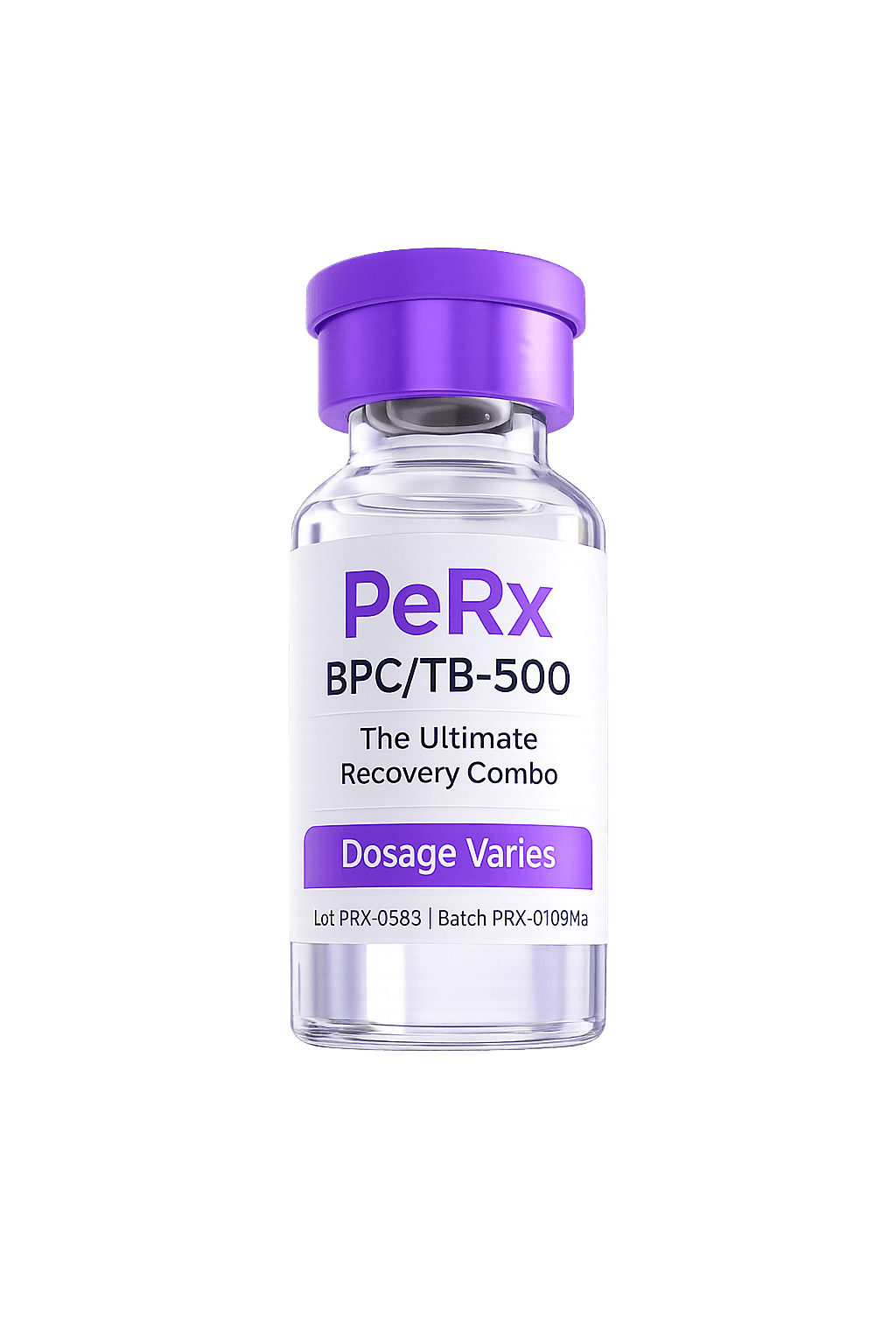
The core format: 3 mg of BPC-157 and 3 mg of TB-500 per mL in a single 5 mL vial, compounded by a US 503A pharmacy and third-party tested. One daily subcutaneous injection covers the local repair signal and the systemic one at once. It ships fully reconstituted and ready to use, refrigerated, with insulin syringes and an injection guide in the box.
From $299 for a one-month supply, prescribed after provider review of your intake. Your card is charged only if a provider approves the prescription.
BPC/TB-500 Capsules
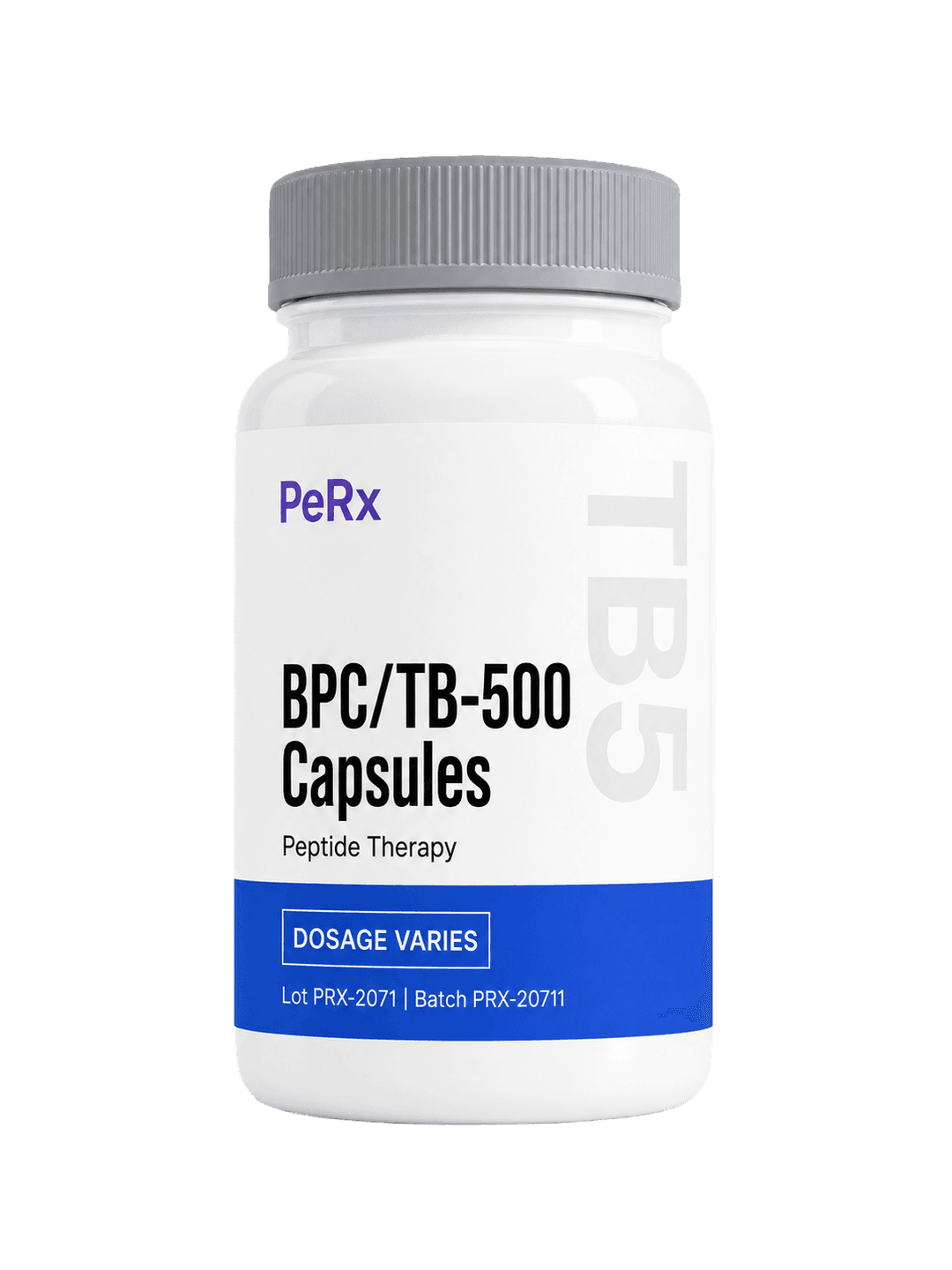
The same pairing in a needle-free format: 500 mcg of each peptide in a once-daily oral capsule. Capsules trade injection logistics for convenience, travel easily, need no refrigeration, and suit people whose goals lean toward gut support and general recovery rather than a single acute injury.
From $225 for 30 capsules. Some patients also use capsules to continue support between injection cycles, a call your reviewing provider makes on your prescription.
The third format is KLOW, a four-peptide blend that adds GHK-Cu and KPV to the BPC-157/TB-500 pair for people juggling recovery alongside skin and inflammation goals, at $349 per month. Our KLOW guide covers when the four-peptide version earns its place over the pair. Whichever format fits, the process is the same: complete the online intake, a licensed provider reviews it, and if approved the pharmacy ships overnight in refrigerated packaging with everything needed to start.
TB-500: Common Questions
Related Guides
Continue reading about peptides and protocols that pair well with this guide.
TB-500 Dosage: Protocols, Units, Cycle Length
Search for a TB-500 dosage and you get loading phases, maintenance weeks, and milligram figures that no human trial has ever tested. This page lays out where those numbers come from, why the clinical literature cannot settle them, and what the numbers look like when TB-500 arrives as a prescribed blend at a fixed concentration: 20 units on an insulin syringe, Monday through Friday, six weeks on and six off, as of September 8, 2026.
Wolverine Stack: BPC-157 and TB-500, Explained
The wolverine stack is two peptides, BPC-157 and TB-500, run together for injury recovery. This guide covers where the comic-book name came from, what each peptide contributes, what the research honestly supports, the side effects and open questions, what forum reports get right and wrong, and how the prescribed single-vial version differs from buying two research vials.
Peptides vs TRT: What Each Actually Does
They get compared constantly, but they work on two different hormone systems. Here is the honest version, from a clinic that sells peptides and does not sell testosterone, so we have no reason to talk you into either.
Ready to get started?
Pharmaceutical-grade BPC/TB-500, the recovery pairing in one ready-to-use vial, delivered to your door with everything you need.
Medical Disclaimer
The information provided on this website, including all articles, guides, and educational content, is for informational and educational purposes only and is not intended as medical advice, diagnosis, or treatment. Nothing on this site should be construed as a substitute for professional medical advice from a qualified healthcare provider.
The majority of peptides discussed on this site are not approved by the U.S. Food and Drug Administration (FDA) for the indications described. They are classified as bulk drug substances and are available only through a licensed prescribing provider and compounding pharmacy. All treatments require a valid prescription and provider oversight.
The majority of published research on peptide therapies has been conducted in preclinical (animal) models. While early human data is encouraging, comprehensive clinical trial data remains limited for most peptide compounds. Individual results may vary significantly based on health status, injury type, and other factors. No specific outcomes are guaranteed.
Certain peptides discussed on this site are classified as prohibited substances by the World Anti-Doping Agency (WADA) and are banned by major sports organizations including the NFL, NCAA, UFC, NBA, MLB, NHL, and PGA. If you are subject to anti-doping testing, consult your governing body before considering any peptide therapy.
Statements on this website have not been evaluated by the Food and Drug Administration. Products and therapies discussed are not intended to diagnose, treat, cure, or prevent any disease.
© 2026 Wellness MD Group PC DBA PeRx. All rights reserved.