Retatrutide vs Tirzepatide: Data and What You Can Get
Tirzepatide is FDA approved and can be prescribed today. Retatrutide is still in phase 3 trials, is not approved by any regulator, cannot be prescribed and cannot legally be compounded. This page lays out what each drug's trials actually showed, with the trial, the population and the analysis named for every number, explains why the two cannot be ranked against each other yet, and shows the one route that exists right now.

In this article
Key Takeaways
- Tirzepatide is FDA approved as Mounjaro and Zepbound and can be prescribed. Retatrutide is investigational, not approved by any regulator, not prescribable, and cannot legally be compounded. As of October 26, 2026, Lilly plans to file for approval in the first quarter of 2027, which is a filing date, not an approval date.
- The two drugs have never been compared in a published trial. Their weight-loss percentages come from different trials with different populations, lengths and analysis methods, so they cannot be ranked against each other. TRIUMPH-5, the head-to-head trial, is running with no result published.
- Every trial figure on this page describes the approved brand or the investigational molecule, not a compounded product. PeRx prescribes compounded tirzepatide with B12, which was not the product in any of these trials and is not FDA approved.
- Anything sold online as retatrutide is unregulated: no verified contents, no prescriber, and FDA warning letters to sellers who label it as a research product. The only legal route to retatrutide is a registered clinical trial.
- Both drugs share the same digestive side effects. Retatrutide trials added skin-sensation changes and a heart-rate rise. Tirzepatide's label carries a boxed warning on thyroid C-cell tumors and spells out who should not take it.
Status Box: Checked October 26, 2026
Tirzepatide
FDA approved. Mounjaro for type 2 diabetes (May 2022); Zepbound for weight management (November 2023) and obstructive sleep apnea (December 2024).
Retatrutide
Not approved by the FDA or any other regulator. Investigational, in phase 3 trials. Latest readout July 23, 2026.
Planned filing
Lilly plans to submit a Biologics License Application in the first quarter of 2027. No approval date exists.
What PeRx prescribes
Compounded tirzepatide with B12, by prescription, filled by a state-licensed 503A pharmacy. Not FDA approved. PeRx does not prescribe retatrutide.
Retatrutide vs tirzepatide has a short answer and a long one. The short answer: tirzepatide is FDA approved, and a licensed provider can prescribe it today. Retatrutide is still in phase 3 trials, is not approved by any regulator, cannot be prescribed and cannot legally be compounded. No trial has compared the two head to head, and the one that will has not reported.
The rest of this page covers how the two drugs work, what their trials showed, where approval stands, what you can get, the side effects, and how to choose. PeRx prescribes compounded tirzepatide and compounded semaglutide; the semaglutide vs tirzepatide comparison has its own guide.
Read this first
Mounjaro and Zepbound are FDA-approved tirzepatide products made by Eli Lilly. Retatrutide is an investigational Lilly molecule approved nowhere. PeRx prescribes compounded tirzepatide with vitamin B12, prepared by a state-licensed 503A pharmacy against a licensed provider's prescription; it has not been through FDA review and was not the product in any trial here. Every trial result below describes the approved brand or the investigational molecule, not the compounded product.
Retatrutide vs Tirzepatide at a Glance
Read the weight-loss row carefully: the two figures come from different trials, run for different lengths in different populations and analyzed in different ways. They sit side by side for reference, not for ranking, and the trial section explains why.
| Retatrutide | Tirzepatide | |
|---|---|---|
| What it targets | Three receptors: GIP, GLP-1 and glucagon | Two receptors: GIP and GLP-1 |
| FDA status (October 2026) | Not approved. Investigational, phase 3. Filing planned for early 2027. | Approved. Mounjaro (2022, type 2 diabetes); Zepbound (2023, weight management; 2024, obstructive sleep apnea). |
| Reported weight loss | TRIUMPH-1, 80 weeks, 2,339 adults with obesity, no diabetes: 17.6% to 25.0% vs 3.9% placebo, treatment-regimen estimand (NEJM 2026). Sponsor topline: 19.0% to 28.3% vs 2.2%, efficacy estimand. | SURMOUNT-1, 72 weeks, 2,539 adults with obesity, no diabetes: 15.0% to 20.9% vs 3.1% placebo, treatment-regimen estimand (NEJM 2022). |
| Dosing form and schedule | Once-weekly injection in trials; no approved dose | Once-weekly injection; dose set by the prescriber |
| Availability today | Clinical trials only. Cannot be prescribed or compounded. | Brand by prescription; compounded tirzepatide by prescription (not FDA approved) |
| Common side effects | Nausea, diarrhea, constipation, vomiting, decreased appetite; skin-sensation changes and a heart-rate rise in trials | Nausea, diarrhea, constipation, vomiting, decreased appetite; boxed warning on thyroid C-cell tumors |
What it targets
- Retatrutide
- Three receptors: GIP, GLP-1 and glucagon
- Tirzepatide
- Two receptors: GIP and GLP-1
FDA status (October 2026)
- Retatrutide
- Not approved. Investigational, phase 3. Filing planned for early 2027.
- Tirzepatide
- Approved. Mounjaro (2022, type 2 diabetes); Zepbound (2023, weight management; 2024, obstructive sleep apnea).
Reported weight loss
- Retatrutide
- TRIUMPH-1, 80 weeks, 2,339 adults with obesity, no diabetes: 17.6% to 25.0% vs 3.9% placebo, treatment-regimen estimand (NEJM 2026). Sponsor topline: 19.0% to 28.3% vs 2.2%, efficacy estimand.
- Tirzepatide
- SURMOUNT-1, 72 weeks, 2,539 adults with obesity, no diabetes: 15.0% to 20.9% vs 3.1% placebo, treatment-regimen estimand (NEJM 2022).
Dosing form and schedule
- Retatrutide
- Once-weekly injection in trials; no approved dose
- Tirzepatide
- Once-weekly injection; dose set by the prescriber
Availability today
- Retatrutide
- Clinical trials only. Cannot be prescribed or compounded.
- Tirzepatide
- Brand by prescription; compounded tirzepatide by prescription (not FDA approved)
Common side effects
- Retatrutide
- Nausea, diarrhea, constipation, vomiting, decreased appetite; skin-sensation changes and a heart-rate rise in trials
- Tirzepatide
- Nausea, diarrhea, constipation, vomiting, decreased appetite; boxed warning on thyroid C-cell tumors
How Retatrutide and Tirzepatide Work
Both drugs are built on the same idea. After a meal, the gut releases hormones called incretins that tell the pancreas to release insulin, slow the stomach's emptying and tell the brain the meal has landed. Tirzepatide activates two of those hormone receptors, GIP and GLP-1. Retatrutide activates the same two and adds a third, the glucagon receptor. The shared effects are what people feel on either drug: less appetite, fullness that arrives sooner and lasts longer, and insulin release that scales with blood sugar. The weight loss category page explains how GLP-1 medications work in depth.
The glucagon piece is what makes retatrutide different, and it is the least settled part. Glucagon receptor activity is thought to raise energy use and reduce liver fat; that is a hypothesis still under study, and glucagon also raises blood sugar, which is why the molecule pairs it with the two incretin receptors. More receptors does not mean more weight loss or better tolerability. It means a different balance of effects, which only trials can measure.
What the Trial Data Shows
Every number here carries its trial name, length, population and analysis type, and says whether it was peer reviewed or reported by the sponsor. That matters more in retatrutide vs tirzepatide than in most comparisons, because the same retatrutide trial has produced two different headline numbers depending on which analysis you read.
Two kinds of trial number
The efficacy estimand counts people only while they are taking the drug. The treatment-regimen estimand counts everyone randomized, including people who stopped early, so it is always smaller and closer to what a real group of patients would see. Lilly's topline releases lead with the first; the peer-reviewed papers lead with the second.
Tirzepatide Trial Results
SURMOUNT-1, published in the New England Journal of Medicine in 2022, randomized 2,539 adults with obesity, or overweight plus a weight-related complication, and no diabetes, to 5 mg, 10 mg or 15 mg of tirzepatide once weekly or placebo for 72 weeks. The mean change in body weight was 15.0%, 19.5% and 20.9% on the three doses against 3.1% on placebo, by the treatment-regimen estimand, so those figures already include people who stopped. Adverse events led to discontinuation in 4.3%, 7.1% and 6.2% of the tirzepatide groups and 2.6% of the placebo group.
Those results describe the product Lilly tested, which became the approved brands Mounjaro (2022) and Zepbound (2023). Compounded tirzepatide with B12, the product PeRx prescribes, was not the product in SURMOUNT-1 or any other tirzepatide trial, and those results do not describe it. The compounded tirzepatide guide explains that distinction.
Retatrutide Phase 2 Results
The 2023 New England Journal of Medicine phase 2 trial randomized 338 adults with obesity, or overweight plus a weight-related condition, to 1 mg, 4 mg, 8 mg or 12 mg once weekly or placebo for 48 weeks; the primary endpoint was weight change at 24 weeks. At 48 weeks the least-squares mean change was 8.7%, 17.1%, 22.8% and 24.2% across the four dose groups against 2.1% on placebo. A phase 2 trial of 338 people is designed to pick doses, not to settle how a drug performs; the figure is peer reviewed, and it is why phase 3 was run.
Retatrutide Phase 3 Results So Far
The phase 3 program is called TRIUMPH. As of October 26, 2026, four trials have reported, two of them peer reviewed. Where both a sponsor topline number and a published number exist, both appear, because the gap between them is the clearest lesson in the retatrutide vs tirzepatide debate.
| Trial | Population and length | Result | Source type |
|---|---|---|---|
| TRIUMPH-4 | 445 adults with obesity or overweight and knee osteoarthritis, no diabetes; 68 weeks | 26.4% (9 mg) and 28.7% (12 mg) vs 2.1% placebo, efficacy estimand; 20.0% and 23.7% vs 4.6%, treatment-regimen estimand | Sponsor topline, December 11, 2025; not yet peer reviewed |
| TRIUMPH-1 | 2,339 adults with obesity, no diabetes; 80 weeks | 17.6%, 23.7% and 25.0% vs 3.9% placebo, treatment-regimen estimand, as published; sponsor topline 19.0%, 25.9% and 28.3% vs 2.2%, efficacy estimand | Topline May 21, 2026; published in NEJM September 29, 2026 |
| TRIUMPH-2 | 1,152 adults with type 2 diabetes and obesity or overweight; 80 weeks | 11.9%, 16.8% and 18.8% vs 5.1% placebo, treatment-regimen estimand, as published; sponsor topline 12.7%, 19.1% and 20.8% vs 4.0%, efficacy estimand | Topline July 23, 2026; published in The Lancet October 10, 2026 |
| TRIUMPH-3 | 1,949 adults with severe obesity and established cardiovascular disease; 80 weeks | 21.6% (9 mg) and 22.6% (12 mg) vs 3.2% placebo, efficacy estimand | Sponsor topline, July 23, 2026; not yet peer reviewed |
TRIUMPH-4
- Population and length
- 445 adults with obesity or overweight and knee osteoarthritis, no diabetes; 68 weeks
- Result
- 26.4% (9 mg) and 28.7% (12 mg) vs 2.1% placebo, efficacy estimand; 20.0% and 23.7% vs 4.6%, treatment-regimen estimand
- Source type
- Sponsor topline, December 11, 2025; not yet peer reviewed
TRIUMPH-1
- Population and length
- 2,339 adults with obesity, no diabetes; 80 weeks
- Result
- 17.6%, 23.7% and 25.0% vs 3.9% placebo, treatment-regimen estimand, as published; sponsor topline 19.0%, 25.9% and 28.3% vs 2.2%, efficacy estimand
- Source type
- Topline May 21, 2026; published in NEJM September 29, 2026
TRIUMPH-2
- Population and length
- 1,152 adults with type 2 diabetes and obesity or overweight; 80 weeks
- Result
- 11.9%, 16.8% and 18.8% vs 5.1% placebo, treatment-regimen estimand, as published; sponsor topline 12.7%, 19.1% and 20.8% vs 4.0%, efficacy estimand
- Source type
- Topline July 23, 2026; published in The Lancet October 10, 2026
TRIUMPH-3
- Population and length
- 1,949 adults with severe obesity and established cardiovascular disease; 80 weeks
- Result
- 21.6% (9 mg) and 22.6% (12 mg) vs 3.2% placebo, efficacy estimand
- Source type
- Sponsor topline, July 23, 2026; not yet peer reviewed
Read the TRIUMPH-1 row twice: the topline release said 28.3% on the top dose, and the NEJM paper said 25.0% by the analysis that counts everyone. Both are true. Discontinuation because of adverse events, per the sponsor, was 4.1%, 6.9% and 11.3% across the three doses against 4.9% on placebo, which is why the gap is widest at the top dose. TRIUMPH-3 and TRIUMPH-4 remain sponsor-reported, and FDA review has not started.
Why Neither Drug Can Be Called "Stronger" Yet
Put 20.9% next to 25.0% and the comparison looks decided. It is not. The populations differ, the lengths differ (72 weeks against 80), the dose schedules differ, raw and placebo-adjusted loss are different numbers that pages mix freely, and people who stop a drug change the average: a higher dropout rate on the top dose, left out of an on-treatment estimate, flatters the result, which is what the two TRIUMPH-1 numbers show.
The only fair test randomizes the same people to one drug or the other, and that trial exists. TRIUMPH-5, registered as NCT06662383, is a phase 3 double-blind study of about 800 adults with obesity assigned to retatrutide or tirzepatide, with percent change in body weight at 80 weeks as its primary endpoint. It is active, no longer recruiting, with an estimated primary completion of November 2026, and no result has been published as of October 26, 2026. Until it reports, "retatrutide is stronger than tirzepatide" is a reading of two separate trials, not a finding.
Retatrutide FDA Approval: Where It Stands Today
As of October 26, 2026, retatrutide is not approved by the FDA or by any other regulator, and Lilly's own page describes it as an investigational molecule available only to participants in its clinical trials. On July 23, 2026, Lilly said it plans to submit a Biologics License Application to the FDA in the first quarter of 2027. A planned filing is not an approval date: review takes months, approval is not guaranteed, and nobody, including Lilly, has named a date on which retatrutide will be prescribable. Lilly lists obesity with and without type 2 diabetes, severe obesity with cardiovascular disease, knee osteoarthritis pain, obstructive sleep apnea, chronic low back pain, cardiovascular and kidney outcomes, and metabolic dysfunction-associated steatotic liver disease as conditions under study, none of them approved uses.
The FDA's position on compounding is unambiguous. Its page on unapproved GLP-1 drugs, current as of October 1, 2026, states that retatrutide and cagrilintide cannot be used in compounding under federal law, because they are not components of an FDA-approved drug and have not been found safe and effective for any condition. The same page says the agency has sent warning letters to telehealth companies marketing retatrutide, to ingredient distributors selling it to compounders, to outsourcing facilities repackaging it, and to sellers whose products were falsely labeled as being for research purposes. That is a different situation from which peptides are FDA approved and will the FDA ban peptides, which concern how established peptides may be compounded; retatrutide cannot be compounded at all.
Is Retatrutide Available? What You Can Actually Get Today
Retatrutide Today
No licensed provider can prescribe retatrutide, and no pharmacy, compounding or otherwise, can legally dispense it. The only legal route is a registered clinical trial; ClinicalTrials.gov lists the TRIUMPH studies, and most have finished recruiting. A clinic that says it can get you retatrutide, or a compounder who says they can make it, is operating outside the law and outside any quality control. If someone offers to prescribe it, leave.
"Research" and Gray-Market Retatrutide
Vials sold online as retatrutide exist, and nobody has verified what is in them. There is no prescriber, no pharmacy, no lot testing and no recourse. The FDA describes the risks of unapproved GLP-1 products as wrong doses from self-measured vials, contamination, and adverse events that needed hospital care. In August 2026 the FDA sent warning letters to five online peptide vendors; the letter to Peak Performance Peptides, dated August 24, 2026, names retatrutide and states that labeling a product for research only, or not for human consumption, does not change the fact that it was being sold as a drug for people. Lilly says illicit retatrutide products may contain unknown ingredients, contaminants, the wrong amount of active ingredient, or the wrong ingredient entirely.
The gray market vs compounded GLP-1 guide explains the difference between an unregulated vial and a compounded prescription, and is it safe to buy peptides online covers how to tell them apart. Retatrutide also belongs on the list of peptides PeRx does not prescribe: there is no legal way to offer it, so no one at PeRx will.
Tirzepatide Today
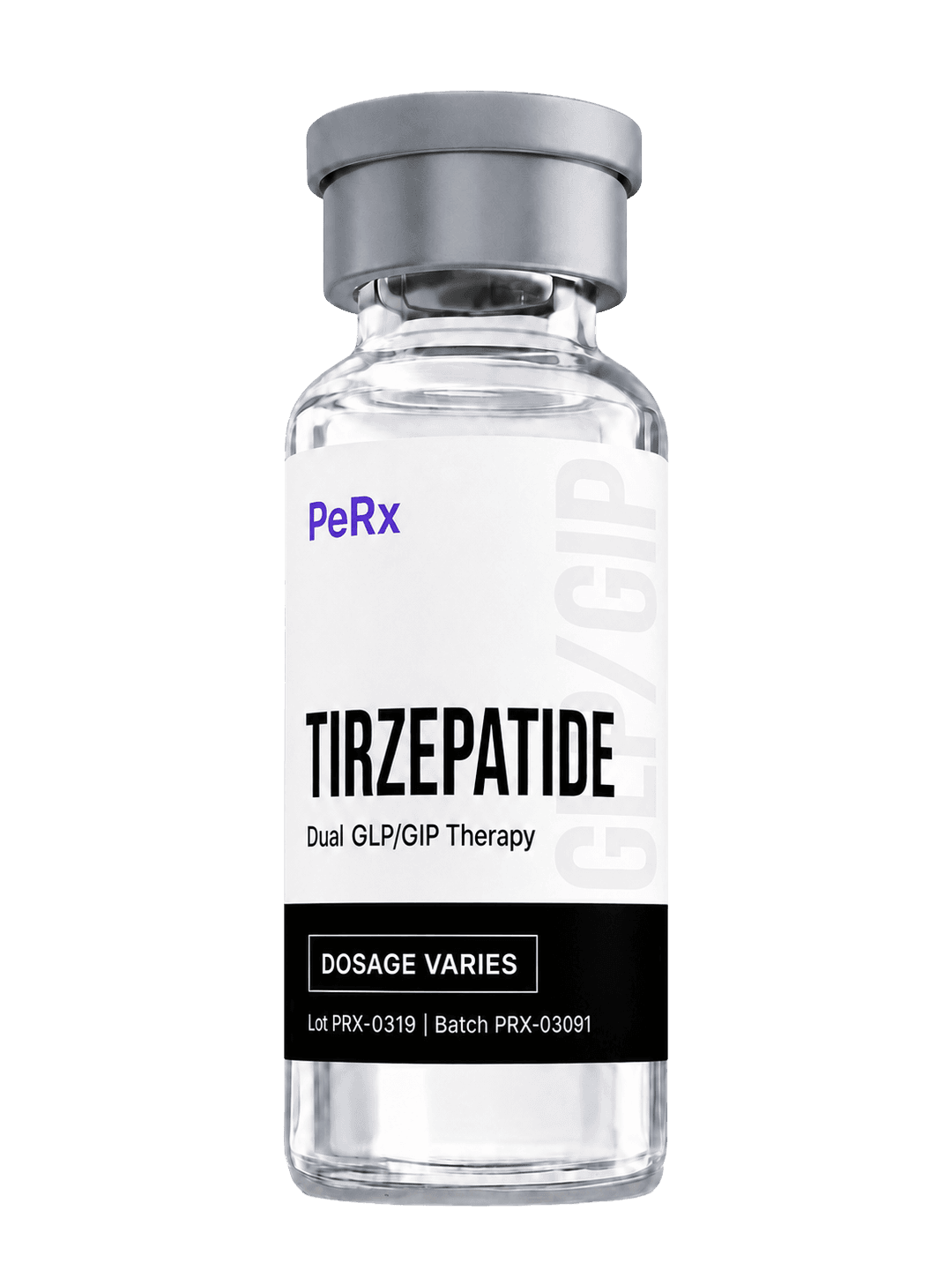
Tirzepatide has two legal routes. The first is the brand, Mounjaro or Zepbound, prescribed by a clinician and filled by a retail pharmacy, through insurance or Lilly's own programs. The second is provider-prescribed compounded tirzepatide, prepared by a state-licensed 503A pharmacy for a named patient. Compounded tirzepatide is not FDA approved: it has not been through FDA review, and the brand's trial results do not describe it. At PeRx, a licensed provider reviews your eligibility first, a state-licensed 503A pharmacy fills the prescription, and the vial ships ready to use with no reconstitution needed. The compounded tirzepatide guide has the full picture; current pricing is on its own page, and this guide gives no prices.
Tirzepatide
Available by prescription today. Tirzepatide at PeRx is compounded with vitamin B12 by a state-licensed 503A pharmacy, prescribed by a licensed provider after an eligibility check, and shipped as one ready-to-use vial per 28 days on a subscription you can cancel in one click.
It is the dual GIP and GLP-1 option in the PeRx catalog. Compounded tirzepatide is not FDA approved and is not the product studied in the brand's trials.
Retatrutide Side Effects vs Tirzepatide Side Effects
Shared Digestive Effects
Nausea, diarrhea, constipation, vomiting and reduced appetite are the most common adverse events with both drugs. In SURMOUNT-1 they were mostly mild to moderate and clustered during dose escalation. In TRIUMPH-1, per Lilly's release, nausea was reported by 28.6%, 38.4% and 42.4% of the three retatrutide groups against 14.8% on placebo. The usual way to reduce these effects is a slow dose increase, which is how both drugs are dosed. The nausea on GLP-1 guide covers what helps.
Retatrutide-Specific Signals
Two findings in the retatrutide trials are not typical of tirzepatide. The first is dysesthesia, an altered skin sensation such as tingling or heightened sensitivity: the published TRIUMPH-2 paper reports it in 4%, 6% and 7% of the 4 mg, 9 mg and 12 mg groups against 1% on placebo, and the TRIUMPH-4 topline release describes the same signal rising with dose. The second is heart rate: in the phase 2 trial, dose-dependent increases peaked at 24 weeks and declined afterward. TRIUMPH-2 also reported low blood pressure more often with retatrutide, and discontinuation because of adverse events ran higher at the top retatrutide doses than on placebo in every TRIUMPH trial so far. Long-term safety beyond 80 weeks is unknown.
Tirzepatide Labeled Risks
Tirzepatide's risks are written on an FDA label, revised as recently as August 2026, which is itself a difference. The Zepbound label carries a boxed warning on the risk of thyroid C-cell tumors, seen in rats, with relevance to humans unknown. It lists severe gastrointestinal reactions, acute kidney injury from fluid loss, acute gallbladder disease, acute pancreatitis, serious allergic reactions, low blood sugar when combined with insulin or a sulfonylurea, diabetic retinopathy complications, and aspiration during anesthesia. It is contraindicated for anyone with a personal or family history of medullary thyroid carcinoma, anyone with multiple endocrine neoplasia syndrome type 2, and anyone with a known serious hypersensitivity to tirzepatide. A prescriber screens for every one of these. The muscle loss on GLP-1 and injection site reactions guides cover two common practical concerns.
When to Seek Care
On either drug, contact a clinician promptly for severe or persistent vomiting or diarrhea, severe stomach pain, especially pain that spreads to the back, yellowing of the skin or eyes, signs of low blood sugar such as shakiness, sweating or confusion, any sign of an allergic reaction such as swelling of the face or throat, or a marked change in mood. On retatrutide, which you would only be taking inside a trial, report new skin sensations or a racing heart to the study team.
Retatrutide or Tirzepatide: Which Should You Consider Today?
Availability decides retatrutide vs tirzepatide in October 2026, because only one of the two can be prescribed. If retatrutide is approved in 2027 or later, the question changes, and the head-to-head trial should have reported by then. Until then, the choice a clinician can actually make is whether tirzepatide, semaglutide or neither fits a particular person.
Ideal for
Adults with obesity, or overweight with a weight-related condition, who want a once-weekly medication, can tolerate a gradual dose increase, have no personal or family history of medullary thyroid carcinoma or MEN 2, and will pair the drug with food, strength training and sleep, as the PeRx approach to weight loss lays out. A clinician makes the final call.
Consider alternatives if
Anyone who is pregnant, breastfeeding or planning pregnancy. Anyone with type 1 diabetes. Anyone with a history of pancreatitis, severe gastroparesis, or medullary thyroid carcinoma in themselves or their family. Anyone with a known serious reaction to tirzepatide. Some of these rule the drug out; others mean a prescriber wants more history first.
Medicine is one part of a plan, not the plan. Dose belongs to the prescriber: the tirzepatide dosage chart explains how the approved label's escalation works, and where to inject covers technique. Semaglutide is the other prescribable option; the semaglutide vs tirzepatide guide walks through that decision.
Weight loss medications
Browse the category
Semaglutide
The other prescribable option
Getting Tirzepatide Through a Prescription
The path is short. You complete an eligibility check. A licensed provider reviews your medical history, your measurements, the contraindications above and your goals; PeRx does not order labs. If the provider writes a prescription, a state-licensed 503A pharmacy compounds it and the vial ships ready to use. The provider reviews again before each renewal. Compounded tirzepatide is not FDA approved. The general process is described in how to get peptides prescribed online.
Want to know if tirzepatide fits?
New to PeRx: the eligibility check takes about a minute, and a licensed provider reviews every order before it ships. Already a patient: message your care team with questions about your prescription or your next renewal.
Frequently Asked Questions About Retatrutide and Tirzepatide
Related Guides
Continue reading about peptides and protocols that pair well with this guide.
Tirzepatide Dosage Chart: Units, Strengths, Schedule
Every tirzepatide dosage chart online shows the same six numbers, 2.5 mg to 15 mg, because they all come from one FDA label. What none of them shows is how a compounded multi-dose vial carries those numbers. At PeRx the draw never changes: 50 units once a week, every cycle, while the provider changes the strength of the vial. This page lays out the label ladder, the six vial strengths that map onto it, the units arithmetic for any concentration, and the rules for escalation, maintenance and missed doses, as of October 2026.
Semaglutide vs Tirzepatide: Which One Fits You
PeRx prescribes two compounded GLP-1 medications, one at $249 a month and one at $399. This is the decision guide we wish existed: what each molecule does, how the approved brands differ on their FDA labels, what the head-to-head research on those brands actually shows, and the questions a prescriber weighs before picking one for a specific patient.
What Providers Review Before Prescribing Peptides
When your intake reaches a licensed provider, it is not a rubber stamp. There is a specific list they run down before any peptide is approved: the conditions that change whether a peptide is safe, the medication classes that have to be cross-checked, and the reasons an order gets sent back or declined. Here is that list, from the provider’s side of the screen.
References and Review
Every trial figure on this page comes from the primary paper or the sponsor's own release, and the regulatory statements come from the FDA and from Lilly. Facts were checked on October 26, 2026, and this page will be updated when retatrutide's status changes.
Jastreboff AM, Aronne LJ, Ahmad NN, et al. Tirzepatide once weekly for the treatment of obesity (SURMOUNT-1). N Engl J Med. 2022;387(3):205-216. View study
Jastreboff AM, Kaplan LM, Frías JP, et al. Triple-hormone-receptor agonist retatrutide for obesity: a phase 2 trial. N Engl J Med. 2023;389(6):514-526. View study
Jastreboff AM, Kaplan LM, Davies MJ, et al. Retatrutide, a triple hormone receptor agonist, for treatment of obesity (TRIUMPH-1). N Engl J Med. Published online September 29, 2026. View study
Bellido V, le Roux CW, Ekinci EI, et al. Retatrutide in adults with obesity and type 2 diabetes (TRIUMPH-2): a phase 3 trial. Lancet. 2026;408(10563):1455-1472. View study
Eli Lilly and Company. Retatrutide TRIUMPH-4 topline results. Press release, December 11, 2025. View study
Eli Lilly and Company. Retatrutide TRIUMPH-1 topline results. Press release, May 21, 2026. View study
Eli Lilly and Company. Retatrutide TRIUMPH-2 and TRIUMPH-3 topline results. Press release, July 23, 2026. View study
Eli Lilly and Company. What to know about retatrutide. Lilly.com, updated September 2026. View study
ClinicalTrials.gov. Retatrutide compared to tirzepatide in adults who have obesity (TRIUMPH-5). NCT06662383. View study
U.S. Food and Drug Administration. FDA's concerns with unapproved GLP-1 drugs used for weight loss. Current as of October 1, 2026. View study
U.S. Food and Drug Administration. Warning letter to Peak Performance Peptides, reference 735127. August 24, 2026. View study
Zepbound (tirzepatide) prescribing information. Eli Lilly and Company, revised August 2026. DailyMed. View study
Drugs@FDA. Mounjaro, NDA 215866, approved May 13, 2022; Zepbound, NDA 217806, approved November 8, 2023, sleep apnea supplement December 20, 2024. View study
Medical Disclaimer
The information provided on this website, including all articles, guides, and educational content, is for informational and educational purposes only and is not intended as medical advice, diagnosis, or treatment. Nothing on this site should be construed as a substitute for professional medical advice from a qualified healthcare provider.
The majority of peptides discussed on this site are not approved by the U.S. Food and Drug Administration (FDA) for the indications described. They are classified as bulk drug substances and are available only through a licensed prescribing provider and compounding pharmacy. All treatments require a valid prescription and provider oversight.
The majority of published research on peptide therapies has been conducted in preclinical (animal) models. While early human data is encouraging, comprehensive clinical trial data remains limited for most peptide compounds. Individual results may vary significantly based on health status, injury type, and other factors. No specific outcomes are guaranteed.
Certain peptides discussed on this site are classified as prohibited substances by the World Anti-Doping Agency (WADA) and are banned by major sports organizations including the NFL, NCAA, UFC, NBA, MLB, NHL, and PGA. If you are subject to anti-doping testing, consult your governing body before considering any peptide therapy.
Statements on this website have not been evaluated by the Food and Drug Administration. Products and therapies discussed are not intended to diagnose, treat, cure, or prevent any disease.
© 2026 Wellness MD Group PC DBA PeRx. All rights reserved.