Fat Loss Peptides
Fat loss peptides work on metabolism directly instead of suppressing appetite. PeRx prescribes them through licensed US providers as compounded medications, shipped ready to use to all 50 states. The three options here are AOD-9604, a growth hormone fragment built for fat breakdown, MOTS-c, a mitochondrial peptide that changes how your cells burn fuel, and the combination vial that pairs them. Each is a prescription: you complete an assessment, a provider reviews your history, and nothing ships without their approval.

Fat Loss Peptides Available at PeRx
Showing 3 peptides in Fat Loss
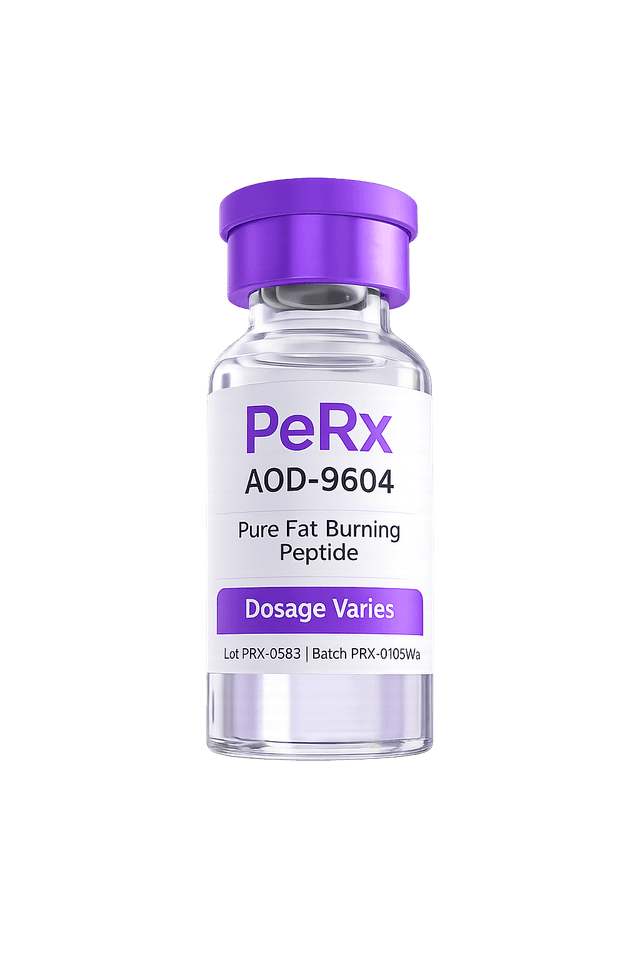
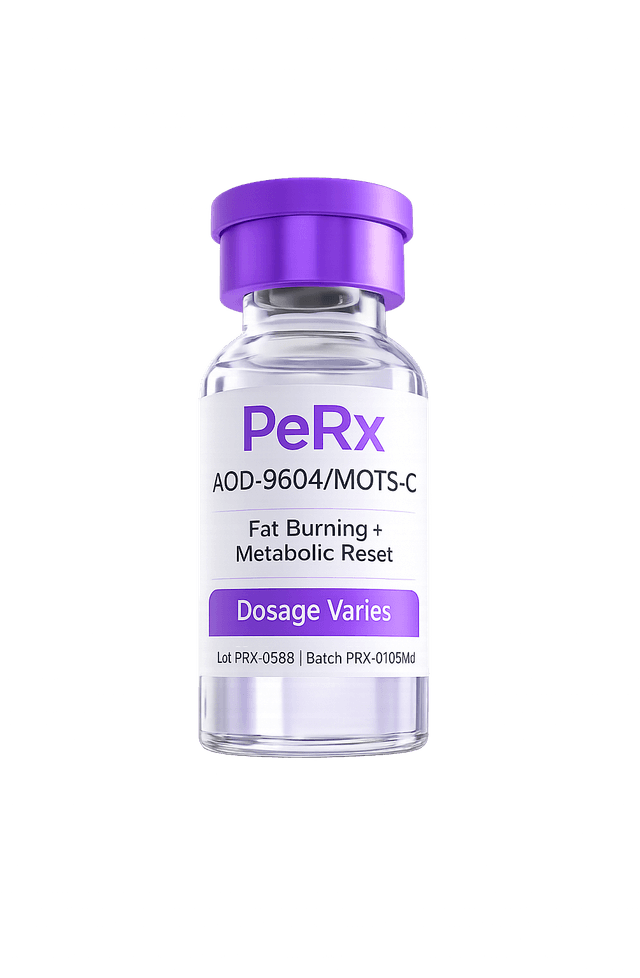
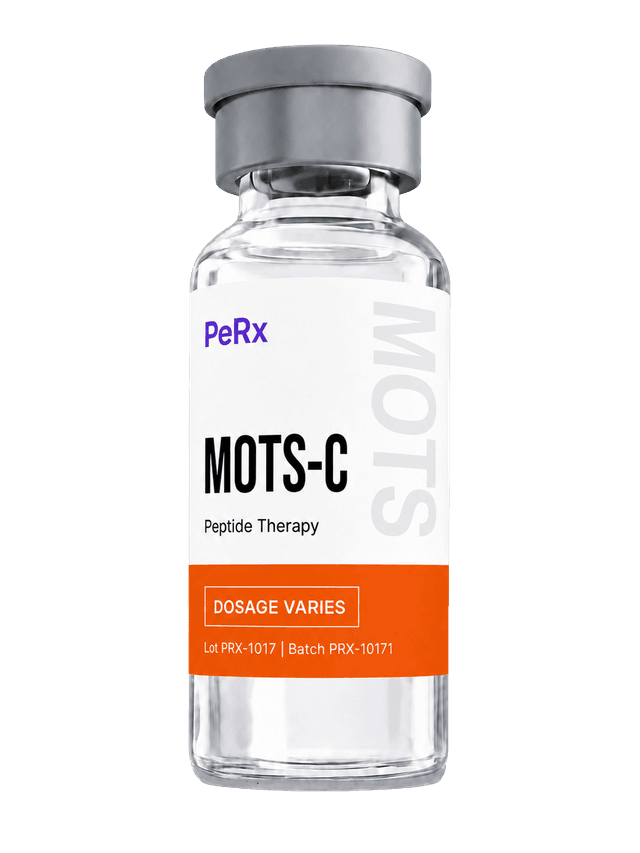
Not sure which peptide is right for you?
Take our 60-second assessment. A licensed US provider reviews and recommends a protocol if appropriate.
How AOD-9604 and MOTS-c Target Fat Metabolism
AOD-9604 is amino acids 176 to 191 of human growth hormone, the fragment responsible for fat metabolism, isolated on its own. It stimulates lipolysis, the breakdown of stored fat, and inhibits new fat storage, while leaving out the parts of the full hormone that raise blood sugar, IGF-1 or growth signaling. That selectivity is the whole point of the molecule.
MOTS-c comes from a different place entirely: it is encoded in mitochondrial DNA rather than the nucleus, one of the first mitochondrial-derived peptides studied in metabolism. It activates AMPK, the same cellular energy switch that exercise and fasting flip, which improves insulin sensitivity and how flexibly your cells move between burning sugar and burning fat. Researchers call it an exercise mimetic for that reason.
Fat loss peptides in this category do not blunt hunger. They act on the tissue math itself, which is why providers think of them as metabolic tools rather than appetite tools, and why the comparison with GLP-1s below matters.
Stacking AOD-9604 with MOTS-c
The two are often paired because they split the problem. AOD-9604 works on the fat cell directly, driving the release of stored fat. MOTS-c works on everything around it, the insulin sensitivity and mitochondrial capacity that determine whether the released fat actually gets used. One opens the tap; the other upgrades the engine.
AOD 9604/MOTS-C puts both in a single vial for exactly that reason. Combining peptides for fat loss this way targets lipolysis and metabolic conditioning in one protocol instead of choosing between them, which is why the stack is the form providers reach for most in this category.
The honest caveat is that the evidence for the combination is mechanistic rather than from large trials of the pair. Each compound has its own research base, and the pairing logic follows from the mechanisms. A provider weighs that when deciding whether the stack, a single agent, or neither fits your case.
Fat Loss Peptides vs. GLP-1 Weight-Loss Medications
The distinction matters because most people searching this category are really deciding between two strategies. Semaglutide and tirzepatide work upstream, on appetite: they quiet the hunger signals and slow digestion, and the calorie deficit does the rest. A fat loss peptide like AOD-9604 works downstream, on the fat tissue and metabolic machinery itself, with no effect on how hungry you feel.
That difference sorts patients fairly cleanly. If overeating is the driver, appetite is the lever, and the GLP-1 options at PeRx are the evidence-heavy route. If your intake is already reasonable and the scale still will not move, or you are past a GLP-1 phase and working on body composition, the metabolic route is the conversation to have.
They are not mutually exclusive, and some protocols sequence one after the other. A provider decides based on where your particular problem actually lives.
Blood Sugar, Metabolic Health & Who Should Consider This Combo
Blood sugar is where this combo differs from growth hormone itself. Full GH raises glucose; AOD-9604 was engineered to keep the fat-metabolism fragment while dropping that effect, and studies of the oral form found no meaningful impact on blood sugar or IGF-1. MOTS-c pushes the other direction entirely, improving insulin sensitivity through AMPK. That profile makes the pairing interesting for people whose weight concern travels with early metabolic warning signs.
It still comes with screening. Every peptide for fat loss on this page is a compounded medication that requires a valid prescription, and none is FDA-approved. Pregnancy and breastfeeding are hard stops, an active or recent cancer history warrants a conversation first, and anyone on diabetes medication needs provider oversight, because improving insulin sensitivity changes how those drugs land. Results vary, and no outcome is guaranteed.
Starting Fat-Loss Peptide Therapy at PeRx
Starting fat loss peptides at PeRx takes three steps and no office visit.
First, take the 60-second assessment. It covers your goals, health history and the screening questions above. You are not charged at this point.
Second, a licensed US provider reviews your file. If they approve, they write the prescription and set your dose and cycle, and only then is your card charged.
Third, the pharmacy ships one vial, ready to use, with syringes, alcohol swabs and instructions.
One availability note: MOTS-c is available now, while AOD-9604 and the AOD/MOTS-c combination vial are periodically out of stock. If the AOD options show unavailable, take the assessment anyway or talk to us and we will let you know when they return.
Compare Fat Loss Peptides at PeRx
The three peptides for fat loss at PeRx split by mechanism, and the table shows which side of the problem each one works on.
| Product | Mechanism | Best for |
|---|---|---|
| AOD 9604 | GH fragment; stimulates lipolysis without affecting blood sugar | Targeted fat breakdown |
| AOD 9604/MOTS-C | Combined lipolysis + mitochondrial support | Fat loss with metabolic reset |
| MOTS-C | Mitochondrial-derived peptide; AMPK pathway, insulin sensitivity | Metabolic flexibility, cellular energy |
Frequently Asked Questions
What are fat loss peptides?
Fat loss peptides are compounds that act on fat metabolism directly rather than on appetite. At PeRx that means AOD-9604, a growth hormone fragment that stimulates the breakdown of stored fat, and MOTS-c, a mitochondrial peptide that improves how cells burn fuel.
How is AOD-9604 different from GLP-1 medications like semaglutide?
Semaglutide reduces appetite through the incretin system, so you eat less. AOD-9604 does not touch appetite; it stimulates lipolysis in fat tissue directly. Different levers: GLP-1s create the calorie deficit, AOD-9604 works on the fat-metabolism side of the equation.
What does MOTS-c do for metabolism?
MOTS-c activates AMPK, the cellular energy sensor that exercise also triggers. That improves insulin sensitivity, mitochondrial function and metabolic flexibility, meaning your cells switch more easily between fuel sources. Researchers describe it as an exercise mimetic for that reason.
Do fat loss peptides require a prescription?
Yes. In the US these are compounded prescription medications, and compounded medications require a valid prescription. At PeRx a licensed provider reviews your assessment and writes it before anything ships, and your card is only charged if you are approved.
How long until I see results from AOD-9604 or MOTS-c?
Gradually, over months rather than weeks. MOTS-c users often notice energy and workout capacity first, within four to six weeks. Body-composition change follows a two-to-three-month timeline and depends on training and diet. Results vary, and neither compound replaces a calorie deficit.