Peptides for Skin
Peptides for skin are short chains of amino acids that carry repair signals the skin already knows how to read. PeRx prescribes them through licensed US providers as compounded medications, shipped ready to use to all 50 states. The three options here approach skin from different angles: GHK-Cu drives collagen synthesis and tissue repair, the GHK-Cu/Epitalon blend pairs skin renewal with cellular-level support, and Glutathione defends against the oxidative stress that ages skin from the inside. Each one is a prescription. You complete an assessment, a provider reviews your history, and nothing ships until they approve it.

Skin Peptides Available at PeRx
Showing 3 peptides in Skin
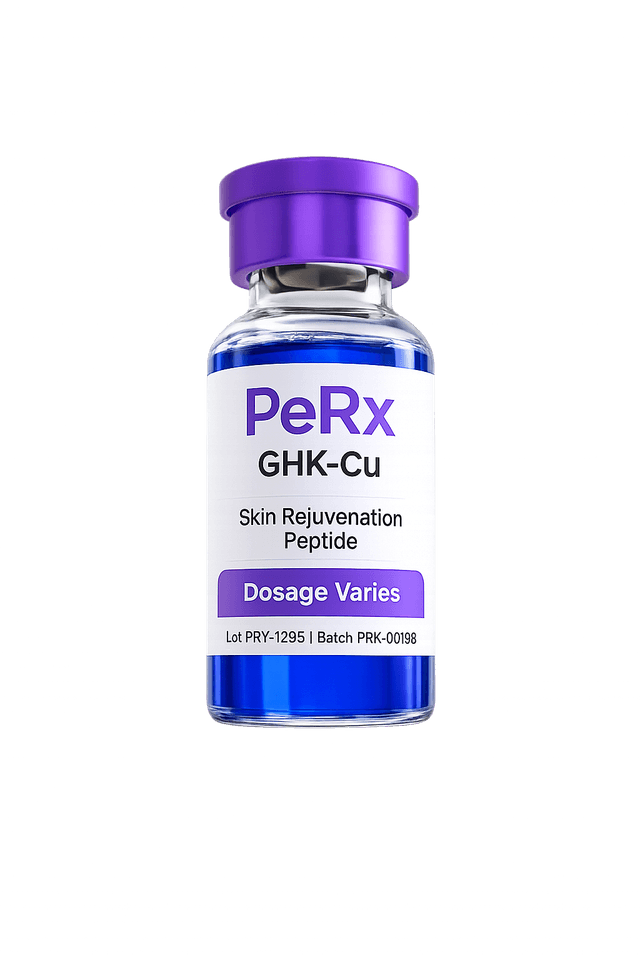
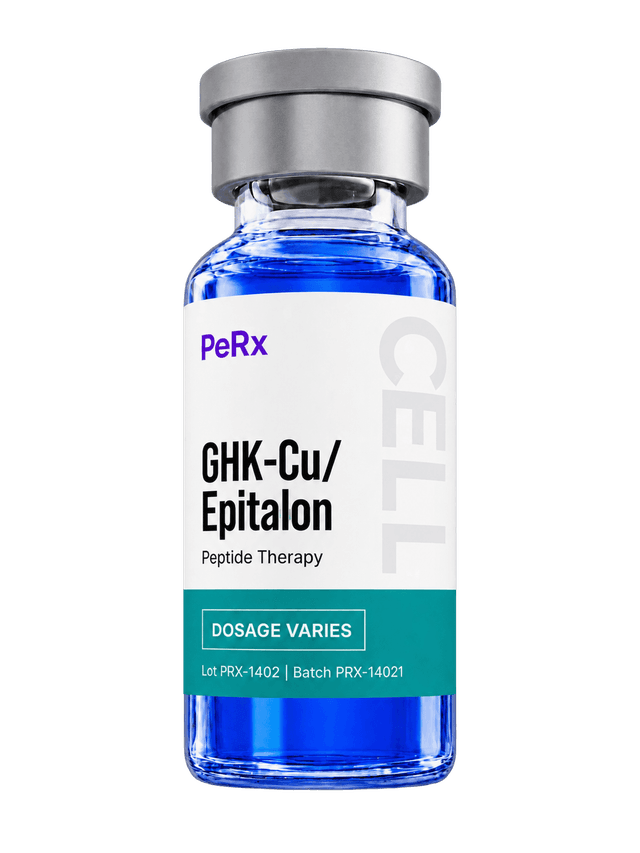
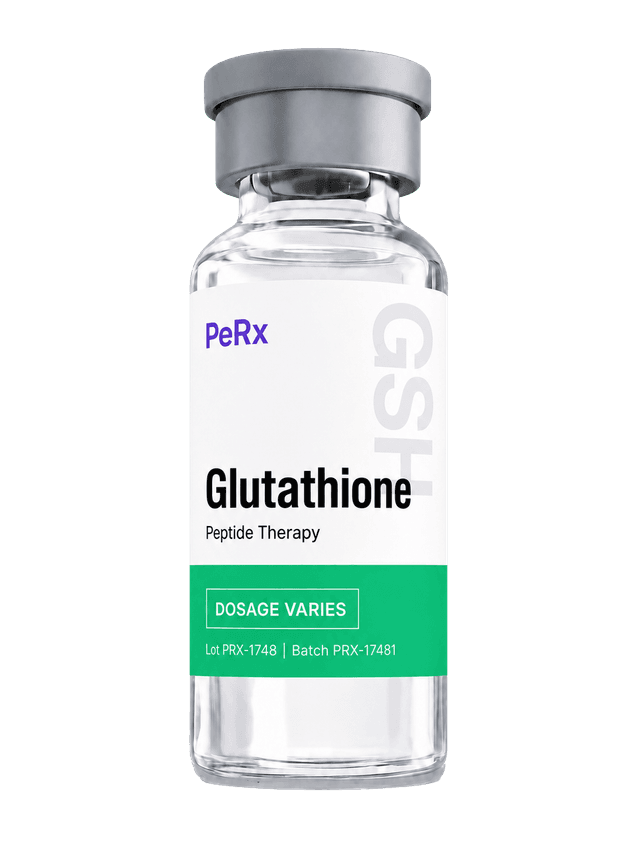
Not sure which peptide is right for you?
Take our 60-second assessment. A licensed US provider reviews and recommends a protocol if appropriate.
How Peptides Support Skin Renewal
Skin renews itself on a cycle, and that cycle slows with age: fibroblasts produce less collagen, repair after minor damage takes longer, and the support structure under the surface thins. Peptides for skin work by putting the repair signal back.
GHK-Cu is the clearest example. It is a three-amino-acid copper peptide your body already produces, and the copper binding is the point: the complex signals fibroblasts to step up collagen synthesis and matrix remodeling, the same program the skin runs after a wound. Plasma levels fall roughly 60 percent between age 25 and 60, which is part of why repair slows.
Not everything sold as collagen peptides for skin works this way. The collagen powders in a grocery aisle are broken-down collagen protein taken as food; they supply amino acids but carry no signal. A signaling peptide does not add collagen from outside. It tells your own cells to make more, which is a different mechanism and the reason it is prescribed and dosed differently.
Which Peptides Have the Strongest Evidence for Skin
Evidence is where this category separates. GHK-Cu is the best-studied peptide for skin, with more than forty years of research behind it: studies on collagen production, elasticity, wound repair and photodamage, most of it topical or in cultured tissue. That body of work is why copper peptides for skin outgrew the lab and became a fixture of dermatology research in the first place.
The rest of the field is earlier-stage, and honesty about that matters. Epitalon, the second half of our combination vial, has decades of animal data on cellular aging but thin human evidence, and its role here is supportive rather than primary. Glutathione’s antioxidant chemistry is textbook biology and its skin-brightening effects are documented, but large controlled trials in skin specifically are limited.
A fair summary: strong mechanistic and clinical support for GHK-Cu, plausible but developing support for the others. A provider weighs that spread when deciding what, if anything, to prescribe for your goal.
Addressing Skin Tightening and Loose Skin After Weight Loss
Rapid weight loss changes the math of your skin. The fat that stretched it is gone, but the collagen and elastin scaffold takes far longer to adapt, which is how people on GLP-1 medications end up searching for Ozempic face and loose skin months into an otherwise successful run.
This is the most common reason patients ask about peptides for skin tightening, and the honest framing is support, not surgery. No injection re-drapes skin the way a surgical lift does. What collagen peptides for skin elasticity may support is the slower biological half of the problem: giving fibroblasts a stronger signal to rebuild the matrix while your weight stabilizes, so the skin you have recovers more of its snap.
GHK-Cu is the usual candidate because matrix remodeling is its core mechanism, and it pairs naturally with a GLP-1 protocol since the two act on entirely different systems. Results vary with age, genetics and how much weight moved, and a provider can tell you whether your case is a peptide conversation or a referral.
How Peptides Compare to Toxins, Fillers & Biostimulators
Botox, fillers and Sculptra all work, and nothing on this page replaces them. They answer different questions. A neurotoxin relaxes the muscle behind a specific line. A filler restores volume in a specific place. A biostimulator like Sculptra provokes collagen where it is injected. All three are procedures: done in an office, localized, with results you can point to.
Peptides for skin care sit a level below that, on the biology those procedures work on top of. Injectable peptides for skin are dosed subcutaneously and act systemically, supporting collagen synthesis and repair capacity across the skin rather than fixing one spot, over months rather than in an appointment.
That is why the practical answer is complement, not either-or. Patients run peptide therapy alongside toxins and fillers, and some find better tissue quality helps procedure results settle in, though that is clinical observation rather than trial data. If your goal is one deep line by Friday, see an injector. If it is the overall trajectory of your skin, that is the peptide conversation.
Candidacy, Safety & What to Expect
The benefits of peptides for skin come with the same screening as any prescription. PeRx prescribes to adults 21 and older after a health assessment, and every option here is a compounded medication that requires a valid prescription; none is FDA-approved for cosmetic use.
Some histories change the answer. Pregnancy and breastfeeding are hard stops. GHK-Cu is not appropriate with a copper metabolism disorder such as Wilson’s disease. Glutathione can interact with certain chemotherapy agents, and an active or recent cancer history warrants a conversation before starting anything that acts on growth and repair pathways. Injection site redness is the common side effect and usually settles on its own.
On expectations: peptides for skin are gradual by nature. Hydration and texture changes tend to show first, over weeks; firmness and elasticity move on collagen’s timeline, which is months. Results vary, and a provider will tell you honestly whether your goal fits that curve.
Starting Peptide Therapy for Skin at PeRx
Starting peptides for skin at PeRx takes three steps and no office visit.
First, take the 60-second assessment. It covers your skin goals, health history and the screening questions above. Choose your peptide and save a card; you are not charged yet.
Second, a licensed US provider reviews your file. If they approve, they write the prescription and set your dose and cycle, and only then is your card charged. If they do not approve, you are not charged at all.
Third, the pharmacy ships one vial, ready to use, with syringes, alcohol swabs and instructions. Whether the goal is to boost collagen, brighten tone or support repair after weight loss, the protocol is set by the provider, not the checkout page.
Not sure which fits? Take the assessment and let a provider decide, or talk to us first.
Compare Skin Peptides at PeRx
The three peptides for skin at PeRx split cleanly by mechanism, and the table is the fastest way to see which one lines up with your goal.
| Product | Mechanism | Best for |
|---|---|---|
| GHK-Cu | Copper peptide; collagen & tissue repair | Visible skin aging, elasticity, wound healing |
| GHK-Cu/Epitalon | Combined skin + cellular renewal | Skin renewal alongside longevity goals |
| Glutathione | Master antioxidant; oxidative-stress defense | Skin brightness, cellular protection |
Frequently Asked Questions
What do peptides do for skin?
They carry repair signals. A copper peptide like GHK-Cu stimulates collagen production and matrix remodeling, while an antioxidant like Glutathione protects cells from the oxidative stress that ages skin. Different peptides, different jobs.
What are the best peptides for skin?
GHK-Cu has the deepest evidence base and is the usual first choice as a peptide for skin aging and elasticity. Glutathione fits oxidative-stress and brightness goals instead. A provider matches the option to your goal.
How long do peptides take to work for skin?
Gradually. Hydration and texture changes tend to appear within several weeks, while firmness and elasticity follow collagen’s slower timeline of two to three months or more. Results vary by person.
Are peptides good for skin, or is it marketing?
Both exist. GHK-Cu carries four decades of published research on collagen and repair, which is real evidence. Plenty of cosmetic products borrow the word with far less behind them.
Do injectable peptides work better than peptide serums?
They work differently. A serum treats the skin it touches, and absorption through the barrier is the limit. A subcutaneous dose reaches circulation and acts system-wide, which is why that route requires a prescription.