BPC-157 Capsules: The Complete Guide
Most peptides are destroyed in the stomach, which is why "peptide pills" are usually a red flag. BPC-157 is the exception with a genuine oral story. This guide covers whether capsules actually work, what the research supports, capsule strengths, the arginate salt question, and why the capsules sold on Amazon are a different product category from a prescription.
In this article
Key Takeaways
- BPC-157 is one of the very few peptides where an oral capsule is a legitimate route. It was derived from a protective protein in human gastric juice and is unusually stable in the stomach, so a capsule puts it in direct contact with the tissue it is best studied for: the GI lining.
- The oral evidence is real but almost entirely preclinical. Rodent studies support oral BPC-157 in gut injury models, and a 2022 pharmacokinetic study in rats and dogs measured what an oral dose actually does in the body. No large human trial has tested the capsules.
- Capsules and injections are tools for different jobs. Capsules lead for gut-focused goals and needle-free convenience; injections deliver more intact peptide to the bloodstream for tendon, ligament, and systemic repair.
- BPC-157 is not a lawful dietary supplement ingredient, which means the "BPC-157 capsules" sold on Amazon and supplement shelves exist outside any prescription or pharmacy oversight. A prescription capsule from a US 503A compounding pharmacy is a different product category, not a different brand.
- There are no BPC-157 capsule pickup counters. The realistic answer to "BPC-157 capsules near me" is a telehealth prescription reviewed by a licensed provider and shipped to your door.
BPC-157 Capsules at a Glance
What they are
Oral capsules of BPC-157, a 15-amino-acid peptide derived from human gastric juice
Why oral works here
Unusual stability in stomach acid; direct contact with the GI lining
Best-studied use
Gut lining support and GI repair research (mostly rodent studies)
Common strengths
Market ranges 250 to 1000 mcg; PeRx capsules are 500 mcg
Legal status
Not FDA-approved; not a lawful dietary supplement ingredient
PeRx product
BPC Capsules, $200 per 30 capsules, prescription only
What BPC-157 Capsules Are
BPC-157 is a 15-amino-acid fragment of a protective protein found in human gastric juice. Researchers have studied it since the early 1990s, almost entirely in rodents, for wound healing, tendon repair, and especially protection of the stomach and intestinal lining. The full research picture lives in our complete BPC-157 guide; this page focuses on what happens when you put that peptide in a capsule and swallow it.
For most peptides, the answer would be "nothing useful." Peptides are chains of amino acids, and the digestive system exists to cleave chains of amino acids. Stomach acid and pepsin start the job, intestinal enzymes finish it, and what reaches the bloodstream is mostly fragments. That is why growth hormone peptides are injected and why "oral peptide" is usually marketing rather than pharmacology.
BPC-157 is the exception worth taking seriously, for a reason that sounds almost too neat: it comes from the stomach. The parent protein it was isolated from does its work in gastric juice, and BPC-157 inherits an unusual degree of stability there. It is not immune to digestion. But it survives long enough to make contact with the stomach and intestinal wall, and for gut-focused goals that contact is the point.
Do BPC-157 Capsules Actually Work?
The honest answer has three layers. First, the mechanistic case: oral BPC-157 reaches the tissue it is best studied for. Decades of rodent work, much of it from Predrag Sikiric’s group in Zagreb, used oral or intragastric administration in models of stomach ulcers, intestinal injury, and gut inflammation, and reported protective effects by that route. If the capsule route were pharmacologically dead, that body of research would not exist.
Sikiric P, Hahm KB, Blagaic AB, et al., "Stable Gastric Pentadecapeptide BPC 157, Robert's Stomach Cytoprotection/Adaptive Cytoprotection/Organoprotection, and Selye's Stress Coping Response," Gut and Liver, 2020. Review of predominantly rodent gastric research. View study
Second, the pharmacokinetic case: a 2022 study in Frontiers in Pharmacology measured what happens to BPC-157 after dosing in rats and dogs, including absorption, distribution, metabolism, and excretion. Systemic bioavailability of an oral dose was low, confirming what the digestion story predicts: most of a swallowed dose does not reach the bloodstream intact.
He L, Feng D, Guo H, et al., "Pharmacokinetics, distribution, metabolism, and excretion of body-protective compound 157, a potential drug for treating various wounds, in rats and dogs," Frontiers in Pharmacology, 2022. View study
Third, the human-evidence caveat, stated plainly: no randomized human trial has tested BPC-157 capsules for any outcome. A 2025 systematic review in HSS Journal screened 544 BPC-157 papers and found that 35 of the 36 studies meeting its criteria were preclinical. So the answer resolves to this: for gut-lining support, the animal evidence and the delivery logic line up well. For systemic goals like tendon repair, the capsule asks a low-bioavailability route to do a job the injection does more directly. Anyone who says capsules are proven in humans is ahead of the data; anyone who says oral BPC-157 is worthless is ignoring how it was discovered.
Vasireddi N, Hahamyan H, Salata MJ, et al., "Emerging Use of BPC-157 in Orthopaedic Sports Medicine: A Systematic Review," HSS Journal, 2025. View study
BPC-157 Capsule Benefits: What the Research Supports
Gut lining contact is the headline. The rodent literature on oral BPC-157 centers on the GI tract: protection of the stomach lining against acid, alcohol, and NSAID irritation, and support for intestinal repair after injury. Inflammatory bowel conditions appear in that research too, strictly as models under study, not as conditions any capsule is approved to treat. For a patient whose goals are digestive, the capsule delivers the peptide directly onto the tissue in question before digestion takes its toll, which is a delivery advantage no injection can replicate. Our overview of how we approach gut-health peptides puts this in protocol context.
Some systemic exposure is plausible, and honestly hedged. A fraction of an oral dose does survive to circulation in animal pharmacokinetic work, so capsules may contribute something beyond the gut. Users who choose capsules for general recovery are relying on that fraction. It is a reasonable bet for someone who will not use a needle, and a weaker tool than injection for a named tendon or ligament problem. We draw that line in detail in BPC-157 capsules vs injection.
The practical benefits are underrated. No needles, no refrigeration, no supplies, and nothing to prepare. That matters for consistency: protocols run on daily exposure over multi-week courses, and the route you will actually stick with for eight weeks beats the stronger route you quietly abandon in week three.
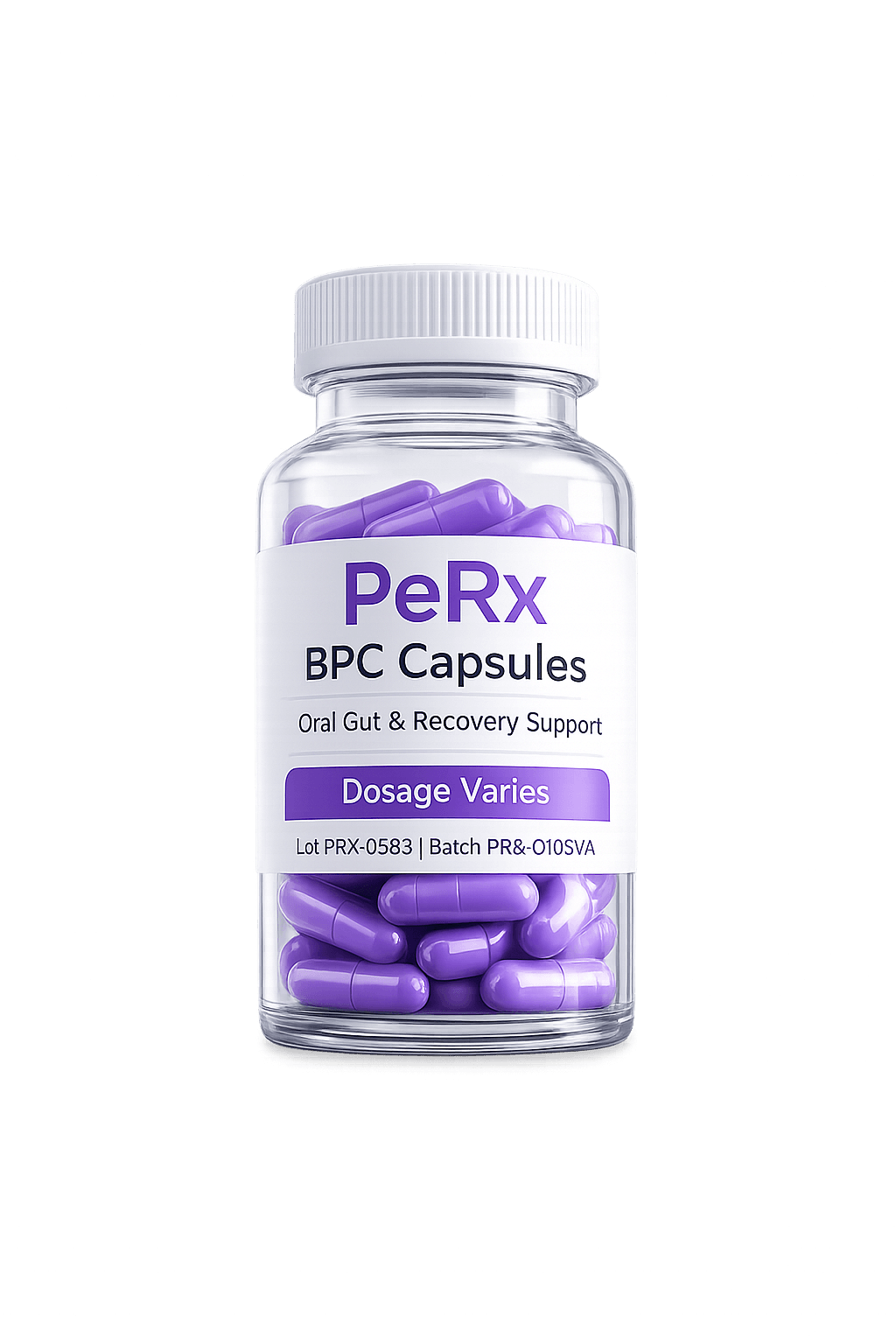
BPC Capsules
PeRx BPC Capsules are oral BPC-157, prescribed by a licensed provider after a health screening and compounded at a US-based 503A pharmacy with third-party testing for purity. This is the gut-first option: daily oral contact with the GI lining, built for digestive-support goals and for anyone who wants BPC-157 without a needle.
No refrigeration, no mixing, no supplies. One capsule daily on the schedule your provider sets, 30 capsules per bottle, $200 per month. Nothing is charged until a licensed provider reviews your intake and approves the prescription.
BPC-157 Capsules vs Injection: The Short Version
The two routes are not competing versions of the same product; they are different delivery systems with different strengths. A subcutaneous injection deposits intact BPC-157 under the skin, where it absorbs into circulation without meeting stomach acid, so far more of the dose is available systemically. That is why injectable BPC-157 remains the standard choice for tendon, ligament, joint, and post-surgical goals. A capsule sacrifices most of that systemic exposure in exchange for direct gut contact and needle-free convenience.
| Factor | BPC-157 capsules | BPC-157 injection |
|---|---|---|
| Best for | Gut lining support, needle-free protocols, travel | Tendons, ligaments, joints, systemic repair |
| Systemic bioavailability | Low fraction survives digestion | High; bypasses digestion entirely |
| Gut contact | Direct, the point of the route | Indirect only |
| Logistics | Room temperature, no supplies | Refrigerated vial, insulin syringes |
| Side-effect profile | No injection-site reactions; occasional mild GI reports | Injection-site redness or bruising most common |
Best for
- BPC-157 capsules
- Gut lining support, needle-free protocols, travel
- BPC-157 injection
- Tendons, ligaments, joints, systemic repair
Systemic bioavailability
- BPC-157 capsules
- Low fraction survives digestion
- BPC-157 injection
- High; bypasses digestion entirely
Gut contact
- BPC-157 capsules
- Direct, the point of the route
- BPC-157 injection
- Indirect only
Logistics
- BPC-157 capsules
- Room temperature, no supplies
- BPC-157 injection
- Refrigerated vial, insulin syringes
Side-effect profile
- BPC-157 capsules
- No injection-site reactions; occasional mild GI reports
- BPC-157 injection
- Injection-site redness or bruising most common
Some providers prescribe both at once, capsules for ongoing gut support and a vial for a specific injury window. The full breakdown of what survives digestion, when each route wins, and how providers choose lives in the dedicated BPC-157 capsules vs injection guide; this page will not duplicate it.
500 mcg vs 1000 mcg: Capsule Strengths Explained
Searches for "BPC-157 capsules 500mcg" and "1000mcg" reflect how the market labels bottles, so it is worth decoding. Capsule strength is the micrograms of BPC-157 per capsule. Most products cluster between 250 and 1000 mcg, with 500 mcg the most common single-capsule strength. Those numbers sit in the same range as informal injectable dosing, but the routes are not interchangeable at equal numbers, because an oral dose loses part of itself to digestion. A 500 mcg capsule and a 500 mcg injection are not the same systemic exposure.
Two practical rules follow. First, more is not automatically better: no human dose-response study exists for oral BPC-157, so a 1000 mcg capsule is not "twice as effective" as a 500 mcg capsule in any documented sense, and with unregulated products the number on the label has no verified relationship to the contents anyway. Second, with a prescription capsule the strength is not yours to optimize. PeRx capsules are compounded at 500 mcg of BPC-157 per capsule, and the combo capsule pairs 500 mcg of BPC-157 with 500 mcg of TB-500; your prescription label confirms it, and one capsule daily on your provider’s schedule is the whole protocol. The unit math and cost tables injectable users need are in the BPC-157 dosage chart, which also covers capsule dosing.
The Arginate Salt Question
Shop for BPC-157 capsules for more than five minutes and you will meet the phrase "arginate salt," usually presented as the form you must insist on. Here is what it actually means. A peptide can be manufactured as different salt forms, meaning the same active peptide paired with a different counter-ion. Most BPC-157 is produced as an acetate salt. The arginate form pairs the peptide with arginine instead, and vendors market it as more stable in stomach acid, which would matter most for an oral product.
The claim is not absurd, but it deserves proportion. The stability comparison between acetate and arginate BPC-157 comes from manufacturer materials, not published head-to-head human data, and the deeper point is that BPC-157 was isolated from a gastric protein and studied orally in animals for decades in its standard form. Gastric stability is the starting property of this peptide, not a feature one salt form unlocks. Treat "arginate" as a formulation detail worth knowing, not a purity signal or a dividing line between capsules that work and capsules that do not.
For any specific product, the form is a label question. A compounding pharmacy lists what it dispensed on the prescription label, which is where to look for your own bottle. That label is also the difference between a product that tells you what is in it and a listing that asks you to take the checkout page’s word for it.
Amazon BPC-157 Capsules vs Prescription Capsules
Search "bpc 157 capsules amazon" and you will find pages of listings, which makes the legal backdrop worth stating carefully. BPC-157 is not FDA-approved for any use, and it does not meet the legal definition of a dietary ingredient under US supplement law, a point the Department of Defense’s Operation Supplement Safety program states flatly: BPC-157 is not a dietary ingredient and cannot lawfully be sold as a supplement. The FDA has separately treated BPC-157 as a drug subject to compounding rules rather than a supplement, and the agency’s evolving position on compounded access is covered in is BPC-157 FDA approved.
That backdrop explains what a marketplace or supplement-shelf listing actually is: a product sold outside the framework that would normally verify it. No prescription, no health screening, no pharmacy dispensing standards, and no requirement that anyone independently confirm the bottle contains what the label claims. Some listings sidestep the problem by selling "BPC-157" products whose fine print reveals amino-acid blends rather than the peptide itself. None of this requires assuming bad faith from any seller. It is simply what unregulated means: the buyer carries the entire verification burden, with no tools to carry it.
A prescription capsule inverts those defaults. A licensed provider reviews your health history first, a US 503A compounding pharmacy dispenses it under state pharmacy regulation with third-party testing, and the strength on the label is the strength in the capsule. This is also the honest answer to "best BPC-157 capsules" threads: the meaningful dividing line in this market is not between brands, it is between verified and unverified products.
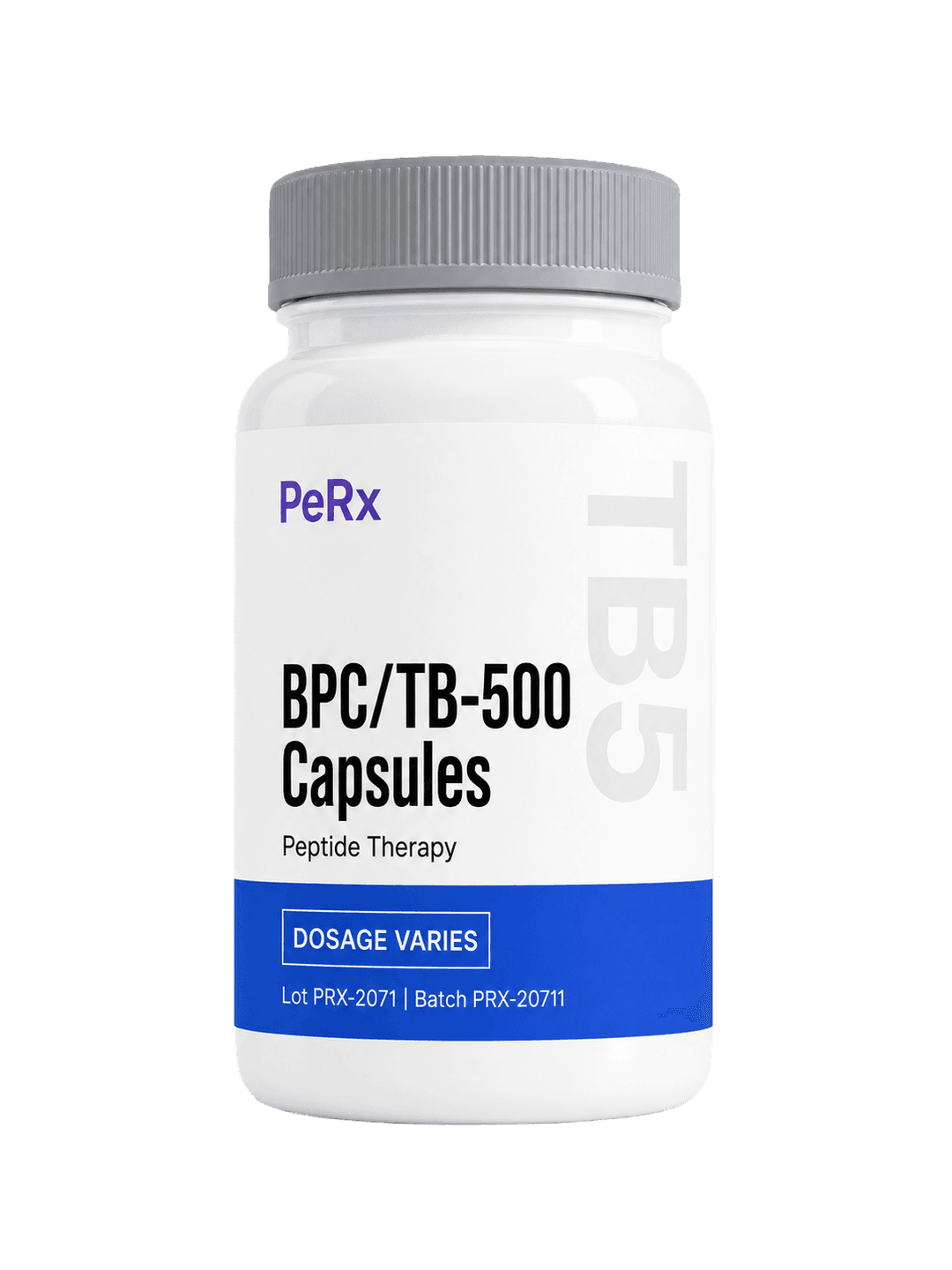
BPC/TB-500 Capsules
For recovery-focused goals, PeRx also offers the oral combo: BPC-157 plus TB-500 in a single daily capsule. The two peptides are studied for complementary repair pathways, and the capsule format keeps the gut-contact advantage while adding TB-500 to the protocol without a second product or a syringe.
Like the single-peptide capsules, the combo is prescribed by a licensed provider after screening, compounded at a US 503A pharmacy, and third-party tested. No refrigeration and no needles, 30 capsules per bottle, $225 per month.
BPC-157 Capsules Near Me: The Honest Answer
People search "BPC-157 capsules near me" expecting a counter to walk up to, and the honest answer is that no such counter exists. BPC-157 is not stocked behind pharmacy counters the way an approved medication is, and the products that appear on local supplement shelves are the unregulated listings described above, in a category the peptide does not legally belong to. A few local compounding pharmacies advertise BPC-157 capsules, but they still require a prescription from a licensed prescriber, so the pharmacy address was never the real bottleneck.
What actually exists near you is your front door. The telehealth model handles every step remotely: you complete a health intake online, a provider licensed for your state reviews it, and if capsules are appropriate for your history, the prescription goes to a US 503A pharmacy that ships the bottle directly to you. No card is charged unless a provider approves the prescription, and the bottle stores at room temperature. That is the whole "near me" answer: not a place, a process, and the process comes to you.
BPC-157 Capsule Side Effects
The capsule route starts with a structural advantage: the most commonly reported BPC-157 side effects are injection-site reactions, and capsules have no injection site. What remains is a short list. Occasional user reports mention mild nausea or digestive adjustment in the first days of an oral protocol, typically fading within a week or two. These reports are anecdotal, because no controlled human trial has measured side-effect rates for BPC-157 by any route. That absence of trial data is the most important safety fact, and it is why provider screening, particularly for cancer history given the peptide’s blood-vessel-growth mechanism, does the work trial data normally would.
Two questions come up often enough to answer directly. On the liver: no human hepatotoxicity data exists in either direction, and the animal pharmacokinetic work that tracked metabolism and excretion did not flag liver toxicity, but formal long-term toxicology has never been run, so "no evidence of harm" here means unstudied, not cleared. On the heart: the same structure applies. The theoretical questions trace to the angiogenesis mechanism, no human cardiac harm has been documented, and no human cardiac safety study exists either. The full safety picture, including the cancer question and who gets screened out, is in the BPC-157 side effects guide.
Who should not take BPC-157 capsules
The oral route does not change the exclusion list. Active or recent cancer, pregnancy or breastfeeding, and age under 18 remain reasons a provider will decline. Competitive athletes should know WADA prohibits BPC-157 under category S0 regardless of route; a capsule is exactly as prohibited as an injection.
How to Take BPC-157 Capsules
The protocol is deliberately simple: one capsule daily with water, on the schedule your provider sets. Many patients take it on an empty stomach on the theory that less competing food means more direct gut-lining contact, but no study has compared fed and fasted oral BPC-157 in humans, so consistency matters more than timing perfection. Store the bottle at room temperature away from heat and moisture; no refrigeration is needed.
Courses typically run 8 to 12 weeks and then pause, rather than continuing indefinitely. Gut-focused users often notice digestive changes earlier than tissue-focused users notice anything, and how long BPC-157 takes to work maps the realistic week-by-week expectations. If you miss a day, take the next capsule at its normal time; doubling up adds nothing a daily-exposure protocol needs.
BPC-157 Capsules: Common Questions
Related Guides
Continue reading about peptides and protocols that pair well with this guide.
BPC-157 Capsules vs Injection: Which Route Wins
BPC-157 is the rare peptide with a real oral story, but that does not mean capsule and injection are interchangeable. A physician-reviewed breakdown of gut-local vs systemic delivery, what survives digestion, and how providers choose the route.
Peptides for Recreational Soccer Players
The Sunday-league hamstring. The rolled ankle in week three. How BPC-157, the BPC/TB-500 combo, CJC-1295/Ipamorelin, and MOTS-c fit into the recovery of a weekend adult-league player whose body no longer bounces back the way it did at 22.
Research Peptides vs Prescription Peptides (2026)
An honest comparison for the patient who already uses peptides, what the 'Not for Human Use' label actually means, the real quality differences, and the practical steps to switch from research-chemical sourcing to a prescription supply.
Ready to get started?
Oral BPC-157 capsules, prescribed by a licensed provider and compounded at a US 503A pharmacy. No needles, no refrigeration, shipped to your door.
Medical Disclaimer
The information provided on this website, including all articles, guides, and educational content, is for informational and educational purposes only and is not intended as medical advice, diagnosis, or treatment. Nothing on this site should be construed as a substitute for professional medical advice from a qualified healthcare provider.
The majority of peptides discussed on this site are not approved by the U.S. Food and Drug Administration (FDA) for the indications described. They are classified as bulk drug substances and are available only through a licensed prescribing provider and compounding pharmacy. All treatments require a valid prescription and provider oversight.
The majority of published research on peptide therapies has been conducted in preclinical (animal) models. While early human data is encouraging, comprehensive clinical trial data remains limited for most peptide compounds. Individual results may vary significantly based on health status, injury type, and other factors. No specific outcomes are guaranteed.
Certain peptides discussed on this site are classified as prohibited substances by the World Anti-Doping Agency (WADA) and are banned by major sports organizations including the NFL, NCAA, UFC, NBA, MLB, NHL, and PGA. If you are subject to anti-doping testing, consult your governing body before considering any peptide therapy.
Statements on this website have not been evaluated by the Food and Drug Administration. Products and therapies discussed are not intended to diagnose, treat, cure, or prevent any disease.
© 2026 Wellness MD Group PC DBA PeRx. All rights reserved.