KPV Peptide Benefits: Gut, Skin and Recovery Evidence
KPV is three amino acids cut from a hormone, and the list of things it is said to do online is far longer than the list of things anyone has shown it does in a person. This page sorts the KPV peptide benefits people search for into what cell and animal studies actually report, what is unknown in humans, and what that means for the four-peptide stack PeRx prescribes it in.
In this article
Key Takeaways
- KPV is lysine-proline-valine, the last three amino acids of the hormone alpha-MSH. Every benefit attributed to it comes from cell cultures and rodents. No human treatment trial of KPV has been published, by any route.
- The strongest evidence is intestinal: in cells, nanomolar KPV damped NF-kB and MAP kinase signaling, and in two mouse colitis models oral KPV reduced inflammation. Later delivery papers needed nanoparticles to get it to the colon, which says something about plain oral dosing.
- Skin evidence is cell-only, including a 2025 study where KPV protected human keratinocytes from fine-dust damage in a dish. Recovery and "immune balance" claims are mechanistic extensions, not measured outcomes.
- The FDA reviewed KPV in May 2026, found no human exposure data at all, and proposed against adding it to the 503A bulks list. On July 23, 2026 its advisory committee voted 8 to 6, one abstaining, to recommend it anyway. That vote is advisory and KPV is not an FDA-approved drug.
- PeRx does not sell KPV on its own. It is one of four peptides in KLOW, a ready-to-use subcutaneous blend with BPC-157, GHK-Cu and TB-500, prescribed by a licensed provider.
KPV Peptide Benefits: Quick Facts
What it is
Lysine-proline-valine, the three-amino-acid tail of alpha-MSH. Studied for inflammatory signaling, not pigmentation.
Best-supported area
Gut inflammation in cells and mice. Consistent animal results, zero human trials.
Human treatment evidence
None published for any benefit, by any route. The FDA reached the same conclusion in May 2026.
Skin and recovery
Cell studies for skin. Recovery claims are mechanistic, built on the inflammation work.
At PeRx
Only inside KLOW, a four-peptide subcutaneous blend that ships fully reconstituted and ready to use. No standalone KPV.
FDA status
Not FDA-approved. Advisory committee recommended it for the 503A bulks list on July 23, 2026; nothing finalized.
KPV peptide benefits, in one honest sentence: KPV is a three-amino-acid fragment of a natural hormone that calms inflammatory signaling in cells and in mice, nearly all of the evidence is from those cells and mice, no human treatment trial exists, and every benefit on this page is graded for that reason. KPV is available at PeRx as part of the KLOW stack, and not on its own. If you want the molecule itself explained first, start with what is KPV; this page is the one that takes each benefit claim and checks it against the study behind it.
How the grades work on this page
Cell: a result in cultured cells, often a human cell line. Animal: a result in mice or rats, usually with inflammation induced on purpose. Human: a controlled study in people, which for KPV currently means none. Anecdotal: what users and vendors report, with no measurement. A benefit graded cell or animal is a reason for research interest, not a promise about your body.
What Is KPV Peptide?
Alpha-melanocyte-stimulating hormone is thirteen amino acids long and does two unrelated jobs: it drives pigment in the skin and it quiets inflammation in a wide range of tissues. KPV is the last three of those thirteen amino acids, lysine, proline and valine. Cutting the hormone down to its tail turned out to keep the anti-inflammatory activity and lose the tanning activity, at least in the laboratory models where it has been tested, and that is the whole reason a tripeptide this small has a research literature of its own. In mice the effect appears to work without the classical melanocortin receptors, which is unusual and still not fully explained.
One thing to be clear about before any benefit gets listed. Being a piece of a hormone your body already makes does not show that a vial, capsule or cream containing that piece is safe or useful for people. Insulin is a natural hormone too. The question for KPV is the same as for any compound: what has been measured, in whom, and how. The longer story of where KPV came from is in the KPV explainer.
KPV Peptide Benefits by Evidence Grade
Here are the KPV peptide benefits that circulate online, each matched to the kind of study it actually rests on. The last column is the one to read twice: human treatment evidence is "none" on every row, and that is not a formatting shortcut.
| Area | What studies report | Model used | Grade | Human treatment evidence |
|---|---|---|---|---|
| Inflammatory signaling | Lower NF-kB and MAP kinase activation and less cytokine release after KPV, at very low concentrations | Human intestinal epithelial cell lines and human T cells | Cell | None. A blocked pathway in a dish is the starting point, not the finish line. |
| Gut inflammation | Less tissue damage and lower inflammatory markers in induced colitis; later work needed colon-targeted nanoparticles | Mouse colitis models (chemical and immune-cell transfer) | Animal | None. Mouse colitis is not Crohn's disease, ulcerative colitis or irritable bowel syndrome. |
| Immune balance | Selective damping of some inflammatory signals without shutting down immune defense, inferred from the alpha-MSH peptide literature | Cells and rodents, mostly for the parent hormone and related peptides | Cell and animal | None. "Immune balance" is a description of a mechanism, not a measured outcome in people. |
| Skin | Better keratinocyte survival and lower IL-1 beta after fine-dust exposure; wound-healing interest from melanocortin reviews | Human HaCaT keratinocytes in culture; animal and cell data for related peptides | Cell | None. No human skin trial of KPV is cited by any source, and KPV crosses intact skin poorly on its own. |
| Recovery and healing | Assigned the "inflammation" role in recovery stacks next to BPC-157 and TB-500 | No direct recovery study; the claim extends the signaling work | Mechanistic and anecdotal | None. No study has measured recovery from injury or training with KPV in people or animals. |
| Metabolic and oxidative stress (newest) | Lower reactive oxygen species and inflammasome activity in 2025 and 2026 cell papers on skin, liver and immune cells | Cultured cell lines, one research group | Cell | None. Early, single-lab work that has not been repeated. |
Inflammatory signaling
- What studies report
- Lower NF-kB and MAP kinase activation and less cytokine release after KPV, at very low concentrations
- Model used
- Human intestinal epithelial cell lines and human T cells
- Grade
- Cell
- Human treatment evidence
- None. A blocked pathway in a dish is the starting point, not the finish line.
Gut inflammation
- What studies report
- Less tissue damage and lower inflammatory markers in induced colitis; later work needed colon-targeted nanoparticles
- Model used
- Mouse colitis models (chemical and immune-cell transfer)
- Grade
- Animal
- Human treatment evidence
- None. Mouse colitis is not Crohn's disease, ulcerative colitis or irritable bowel syndrome.
Immune balance
- What studies report
- Selective damping of some inflammatory signals without shutting down immune defense, inferred from the alpha-MSH peptide literature
- Model used
- Cells and rodents, mostly for the parent hormone and related peptides
- Grade
- Cell and animal
- Human treatment evidence
- None. "Immune balance" is a description of a mechanism, not a measured outcome in people.
Skin
- What studies report
- Better keratinocyte survival and lower IL-1 beta after fine-dust exposure; wound-healing interest from melanocortin reviews
- Model used
- Human HaCaT keratinocytes in culture; animal and cell data for related peptides
- Grade
- Cell
- Human treatment evidence
- None. No human skin trial of KPV is cited by any source, and KPV crosses intact skin poorly on its own.
Recovery and healing
- What studies report
- Assigned the "inflammation" role in recovery stacks next to BPC-157 and TB-500
- Model used
- No direct recovery study; the claim extends the signaling work
- Grade
- Mechanistic and anecdotal
- Human treatment evidence
- None. No study has measured recovery from injury or training with KPV in people or animals.
Metabolic and oxidative stress (newest)
- What studies report
- Lower reactive oxygen species and inflammasome activity in 2025 and 2026 cell papers on skin, liver and immune cells
- Model used
- Cultured cell lines, one research group
- Grade
- Cell
- Human treatment evidence
- None. Early, single-lab work that has not been repeated.
Notice the pattern in the middle columns. Almost every "KPV works" statement online traces back to a signaling pathway that was switched off in a culture dish, or to a mouse with inflammation that researchers induced on purpose so they could measure it. Those are legitimate experiments and they are why KPV is interesting. They are also a long way from a person with a diagnosis taking a product and getting better. The claim and the context tend to travel separately on the internet; this page keeps them together.
Where do the anecdotes come from, then? Mostly from three places: people using research-grade KPV bought online, where the product's identity and strength are unverified; people using it inside a multi-peptide stack, where any change could belong to another component; and vendor pages that describe "reported use" with no source. None of that is worthless as a signal of what to study next. All of it is worthless as evidence of what KPV does, because there is no diagnosis, no measurement and no control in any of it. Treat a before-and-after story about KPV the way you would treat one about a supplement: interesting, unverifiable, and not a reason to skip the questions further down this page.
KLOW: The Four-Peptide Repair Stack
The only way KPV reaches patients at PeRx is inside KLOW, a single ready-to-use subcutaneous vial that combines BPC-157, GHK-Cu, KPV and TB-500. KPV is the component aimed at inflammatory signaling; the other three carry the local repair, systemic recovery and connective-tissue roles.
KLOW is prescribed by a licensed provider after an eligibility check and filled by a state-licensed 503A pharmacy. It is a compounded product and not an FDA-approved drug, and the KPV research above does not describe what four peptides do together.

KPV for Gut Health: What the Research Shows
KPV for gut health is the claim with the most behind it, so it gets the longest look. The reason the intestine dominates the KPV literature is a transporter called PepT1, which carries two- and three-amino-acid fragments into cells. PepT1 normally lives in the small intestine, and during bowel inflammation the colon starts making it too. A tripeptide that enters cells through PepT1 therefore has a built-in way of reaching inflamed gut tissue. That observation shaped nearly every KPV experiment that followed.
What the Colitis Studies Show
The foundational paper is from Didier Merlin's group at Emory in 2008. In human intestinal epithelial cell lines and human T cells that had been provoked with inflammatory cytokines, nanomolar KPV reduced NF-kB and MAP kinase activation and cut the release of inflammatory messengers, and radiolabeled-uptake experiments showed the peptide entering those cells through PepT1. The same paper gave KPV in drinking water to mice with two different forms of chemically induced colitis and reported lower incidence of disease and lower inflammatory gene expression in the colon. A German group reported the same year that KPV produced earlier recovery, better weight regain and fewer inflammatory infiltrates in two mouse colitis models, including in mice whose MC1 melanocortin receptor did not work, which is part of why the receptor story remains unsettled.
The next step in the literature is delivery, and it is the step most benefit lists skip. In 2010 the Emory group loaded KPV into nanoparticles and sealed them in an alginate and chitosan gel designed to collapse in the colon, because plain KPV by mouth does not arrive there in a controlled way. Mice given that package after a colitis trigger were protected on inflammatory and histology measures. In 2017 a follow-on paper wrapped KPV in hyaluronic-acid-coated nanoparticles that homed to colon cells and macrophages, and reported stronger effects than uncoated particles in a mouse model of ulcerative colitis. Read those two papers as a pair and the message is plain: route and formulation change the experiment, and the best mouse results came from engineered delivery straight to the inflamed tissue.
Dalmasso G, Charrier-Hisamuddin L, Nguyen HT, Yan Y, Sitaraman S, Merlin D. "PepT1-mediated tripeptide KPV uptake reduces intestinal inflammation." Gastroenterology. 2008;134(1):166-178. View study
Laroui H, Dalmasso G, Nguyen HT, Yan Y, Sitaraman SV, Merlin D. "Drug-loaded nanoparticles targeted to the colon with polysaccharide hydrogel reduce colitis in a mouse model." Gastroenterology. 2010;138(3):843-853. View study
What This Does Not Show
A mouse with chemically induced colitis is a research tool. It does not have Crohn's disease, ulcerative colitis, irritable bowel syndrome or a food sensitivity, and a result in that mouse does not show a benefit in a person who does. KPV is not a proven treatment for any of those conditions, and the FDA's 2026 review found no published study of KPV given to humans by any route. One more detail matters for anyone reading vendor pages: the oral results above were obtained with KPV in mouse drinking water or inside engineered nanoparticles, and neither describes what a capsule or liquid sold to people does. PeRx sells no oral KPV. Our broader position on this category is in how we approach gut-health peptides, and digestive effects of a different drug class are covered in nausea and gut issues on GLP-1s.
Symptoms That Need a Medical Evaluation First
Some gut symptoms should never be self-treated with a peptide, or with anything else bought online. Persistent diarrhea, abdominal pain that keeps coming back, blood in the stool or rectal bleeding, weight loss you did not try for, fever, severe bloating, and bowel movements that wake you at night all need a clinician first. Your own doctor may order stool tests or blood work or refer you to a gastroenterologist; PeRx does not order labs, and a peptide prescription here is not a substitute for that workup. Get the diagnosis, then talk about whether a repair stack has any place alongside the care you are already getting.
KPV for Skin
Skin is the second-biggest KPV benefit claim, and the evidence is a grade below the gut work because none of it has left the culture dish. The most specific recent study, published in 2025, exposed human HaCaT keratinocytes to fine airborne particulate matter and then added KPV. Particulate exposure killed cells and raised IL-1 beta; KPV restored cell viability, lowered IL-1 beta, reduced reactive oxygen species, and quieted the MAP kinase and NF-kB signaling downstream. That is a clean cell experiment on a real-world insult, and it is still a cell experiment. The concentrations used do not translate to a cream or an injection, which is why none appear here.
The older skin interest comes from the melanocortin field as a whole. Reviews of alpha-MSH and its fragments treat KPV as a candidate for wound healing and inflammatory skin conditions on the strength of animal and cell data for the family, and the compounding nomination the FDA reviewed in 2026 was for a topical cream and gel aimed at wounds, psoriasis and eczema. Two cautions apply. No human skin trial of KPV is cited by the FDA, by the reviews or by any competitor page we checked. And a 2017 permeation study found KPV does not cross intact human skin well on its own, needing microporation or an electrical current to reach the deeper epidermis, which is an awkward fact for topical products. Topical, oral and injectable KPV are three different experiments, and reports of less redness or irritation from any of them are anecdotal. For skin peptides with human data, see peptides for glowing skin and the copper peptide that shares KLOW with KPV in GHK-Cu for skin after GLP-1 weight loss.
Sung J, Ju SY, Park S, Jung WK, Je JY, Lee SJ. "Lysine-Proline-Valine peptide mitigates fine dust-induced keratinocyte apoptosis and inflammation by regulating oxidative stress and modulating the MAPK/NF-κB pathway." Tissue and Cell. 2025;95:102837. View study
Pawar K, Kolli CS, Rangari VK, Babu RJ. "Transdermal Iontophoretic Delivery of Lysine-Proline-Valine (KPV) Peptide Across Microporated Human Skin." Journal of Pharmaceutical Sciences. 2017;106(7):1814-1820. View study
KPV for Recovery and Immune Balance
"Immune balance" is the phrase vendors reach for when they want to say anti-inflammatory without sounding like a drug. In the research it has a narrower meaning. Alpha-MSH peptides, KPV among them, damped inflammation driven by some signals, such as IL-1 beta, IL-6 and TNF-alpha, while leaving others alone, and in the one antimicrobial experiment on record they did not blunt the ability of white cells to kill bacteria. The literature therefore describes KPV as a modulator of a specific inflammatory pathway rather than a general immunosuppressant. That is a real distinction, measured in cells and rodents, and it is the honest version of the balance claim.
It is also the reason some people need a conversation before any immune-active compound, not after. If you have an autoimmune disease, inflammatory bowel disease, mast cell or histamine symptoms, or a chronic infection, nobody knows how a pathway modulator with no human data interacts with your condition or your medicines, and that is a question for the clinician who manages it. KLOW's own screening flags autoimmune conditions and immunosuppressant medicines for review for exactly this reason.
Recovery is the thinnest of the three claims. KPV is assigned the inflammation role in repair stacks because inflammation is part of every injury, and because BPC-157 and TB-500 cover the tissue-repair and cell-migration roles, as laid out in the BPC-157 guide. No study has measured recovery from an injury, a surgery or a training block with KPV, in people or in animals. Grade it mechanistic and anecdotal. Is KPV the same as BPC-157? No. They are different peptides with different research histories: BPC-157 is a fifteen-amino-acid gastric peptide with a large animal literature on tendon, muscle and gut repair, and KPV is a hormone fragment studied for signaling. Peptides for inflammation sets the two side by side.
Brzoska T, Luger TA, Maaser C, Abels C, Böhm M. "Alpha-melanocyte-stimulating hormone and related tripeptides: biochemistry, antiinflammatory and protective effects in vitro and in vivo, and future perspectives for the treatment of immune-mediated inflammatory diseases." Endocrine Reviews. 2008;29(5):581-602. View study
Cutuli M, Cristiani S, Lipton JM, Catania A. "Antimicrobial effects of alpha-MSH peptides." Journal of Leukocyte Biology. 2000;67(2):233-239. View study
How KPV Peptide Works: The Mechanism
Uptake Through PepT1
PepT1 is a transporter in the gut wall that moves short peptides from the digestion of food into cells. KPV is small enough to use it, and competition experiments with radiolabeled KPV confirmed that it does. Because inflamed colon tissue makes more PepT1, the transporter doubles as a targeting system in the mouse work. Outside the gut, how KPV enters cells is less studied.
NF-kB and MAP Kinase Signaling
NF-kB and the MAP kinases are switches that turn on inflammatory genes when a cell senses damage or a cytokine. In cell experiments, very low concentrations of KPV reduced the activity of both and lowered the release of inflammatory messenger proteins. The 2025 and 2026 cell papers add a layer the older work lacked: KPV reduced reactive oxygen species, which are one of the triggers for those switches, and in immune cells it reduced assembly of the NLRP3 inflammasome, a complex that matures IL-1 beta. Whether the receptor-independent route is the whole story is still argued, and the FDA's 2026 review flagged that the molecular target has not been pinned down.
What KPV Does Not Appear to Do
Two negatives are worth stating because they get inverted online. KPV does not act like the parent hormone at the melanocortin receptors in the assays where that has been tested, which is why it is not expected to darken skin and why it is not a melanotan-type compound. And the often-repeated line that KPV is a natural antibiotic rests on a single in-vitro observation that alpha-MSH peptides reduced growth of two microbes in a dish; nothing has tested that against an infection in an animal, let alone a person. Neither negative is a safety finding. They are reminders that the molecule is narrower than its reputation.
Why a Mechanism Is Not a Human Outcome
A pathway blocked in a dish shows that the molecule can do something to a cell under those conditions. It does not show that the molecule reaches that cell in a person at a useful concentration, stays there long enough, or changes anything the person can feel or a clinician can measure. The authors of the foundational KPV papers wrote in the conditional, suggesting that KPV might be useful and that clinical studies would be needed to find out, and nearly two decades later those studies have not been done. The newest cell work comes from a single group and has not been repeated elsewhere.
Bai JS, Kim RW, Li Y, Jung WK, Je JY, Lee SJ. "Lysine-Proline-Valine attenuates oxidized low-density lipoprotein-induced foam cell formation and inflammatory responses in RAW264.7 macrophages." Tissue and Cell. 2026;104(Pt 3):104036. View study
KPV Dosage: What the Research Reports
There is no standardized human dose or schedule for KPV, because there has never been a human dosing study to set one. The FDA's 2026 review searched for pharmacokinetic data on KPV by any route and found none. What the research reports instead are experimental settings: concentrations in a culture medium, a quantity dissolved in the drinking water of mice, and a loading of peptide inside coated particles built for colon delivery. None of those can be converted into an amount for a person, and the vendor "serving sizes" that circulate online were extrapolated from animal work by guesswork rather than by pharmacology.
Oral, topical and injectable KPV products are also aimed at different things, and a figure for one says nothing about another: an oral product is chasing the gut-lumen experiments, a cream is chasing the skin-cell work, and an injection puts the peptide into circulation. At PeRx the only KPV is the fixed concentration inside KLOW, set by the pharmacy and listed on the product page, and any dose step is decided by the prescribing provider at each renewal check-in rather than by the patient. The KPV dosage chart walks through why the numbers you see online are not comparable to each other.
KPV Peptide Side Effects and Safety
People who use KPV products usually report mild effects or none, and that sentence is weaker than it sounds, because no human study has measured how often anything happens. Long-term human safety data do not exist. This page will not call KPV safe, and it will not call it unsafe; both would be claims without evidence. What can be said is that the colitis experiments were efficacy studies, not toxicology programs, and that the FDA's search of its adverse-event database through December 2025 found no reports, which mostly reflects how rarely compounded-product users report anything.
The questions the FDA raised in 2026 were about the material itself rather than about any observed harm. The agency noted that KPV is sold under inconsistent names, that KPV free base and KPV acetate are different substances, that no quality attributes for impurities, aggregates or microbial contamination were available in the literature, and that nothing is known about immune reactions to the peptide in people. Those are the concerns of a chemist and a pharmacologist, and they are why the product's source and testing matter more for KPV than its reputation does. Route changes the risk picture too: an injected peptide carries sterility and immunogenicity questions a cream does not. The detailed version is in KPV peptide side effects, and the general framework in the peptide side effects guide.
KPV Peptide Legal and Regulatory Status
KPV is not an FDA-approved drug for any use, and the KPV peptide benefits described above have not been reviewed by the FDA as evidence of effectiveness. The regulatory history is short and easy to misquote, so here it is with dates from FDA pages. Earlier, the FDA placed KPV among the bulk substances in "Category 2" of its interim compounding policy, the group it considers to raise significant safety concerns. The current version of that FDA page, dated April 22, 2026, lists KPV under substances whose nominations were withdrawn and that were previously in Category 2, and the agency's May 14, 2026 category list contains no KPV entry at all. Being off that list does not make a substance eligible for routine compounding; eligibility would come only from a place on the 503A bulks list, which KPV does not have.
On May 12, 2026 FDA staff issued their evaluation of KPV free base and KPV acetate for the 503A bulks list and proposed not adding either, on three grounds: the substances are not well characterized, the extent of their use in compounding is unknown, and there is no information on their use in humans from which to judge safety or effectiveness. On July 23, 2026 the Pharmacy Compounding Advisory Committee heard that evaluation and voted, as recorded at the meeting, 8 in favor, 6 against and 1 abstaining, to recommend KPV for the list anyway. The vote is advisory. It did not change what pharmacies may compound, it is not an approval, and adding a substance to the 503A list requires the FDA to go through formal rulemaking, which had not begun when this page was last checked. The same meeting is covered peptide by peptide in our FDA peptide review, and the wider question of where the rules are heading is in will the FDA ban peptides in 2026.
FDA compounding status checked on November 23, 2026
KPV is not FDA-approved. Compounded products containing it are not FDA-approved either, whatever the advisory committee recommended. Products sold online as "research use only" are not approved for human use, and their identity, strength and purity are unverified. If this page is older than the latest FDA action, the FDA's compounding pages are the record.
KPV in KLOW: What Single-Peptide Research Can and Cannot Tell You
KLOW is a four-peptide stack: BPC-157, GHK-Cu, KPV and TB-500 in one vial, at the concentrations listed on the KLOW product page. KPV is the component tied to the inflammatory-signaling research on this page, GHK-Cu carries the skin and connective-tissue signaling, BPC-157 the local repair work and TB-500 the systemic recovery role. Each has its own evidence grade, and the honest way to read the stack is as four separate grades sitting next to each other, not one combined score. Research on KPV alone says nothing about how four peptides behave together, because no study has tested the combination.
| KLOW component | Claimed role in the stack | Grade for that role | Human data for that role |
|---|---|---|---|
| BPC-157 | Local tendon, muscle and gut repair | Animal, with a few small uncontrolled human reports | Limited and uncontrolled |
| TB-500 | Systemic recovery and cell migration | Animal | None for the fragment itself |
| GHK-Cu | Collagen signaling, skin and connective tissue | Cell and animal, plus human data mainly for topical use | Topical only |
| KPV | Inflammatory signaling | Cell and animal | None |
BPC-157
- Claimed role in the stack
- Local tendon, muscle and gut repair
- Grade for that role
- Animal, with a few small uncontrolled human reports
- Human data for that role
- Limited and uncontrolled
TB-500
- Claimed role in the stack
- Systemic recovery and cell migration
- Grade for that role
- Animal
- Human data for that role
- None for the fragment itself
GHK-Cu
- Claimed role in the stack
- Collagen signaling, skin and connective tissue
- Grade for that role
- Cell and animal, plus human data mainly for topical use
- Human data for that role
- Topical only
KPV
- Claimed role in the stack
- Inflammatory signaling
- Grade for that role
- Cell and animal
- Human data for that role
- None
Read across the bottom row and the point of this page lands: the one component of KLOW with no human data of any kind is the one this page is about. That does not make KPV a bad inclusion. It makes it the component whose benefit you should hold most loosely, and the reason a provider weighs the stack on the strength of BPC-157 and GHK-Cu rather than on KPV.
PeRx offers KLOW as a provider-prescribed compounded stack. It is not an FDA-approved drug, and KPV is not sold separately in any form. The product-level detail is in the KLOW guide, the component-by-component claim audit in KLOW peptide benefits, the safety picture in KLOW side effects, and the comparison with the three-peptide and two-peptide stacks in Glow vs KLOW vs Wolverine. People whose goal is specifically the gut sometimes find that the four-peptide injectable is more than they came for; the recovery peptides page lists the narrower options, including the one below.
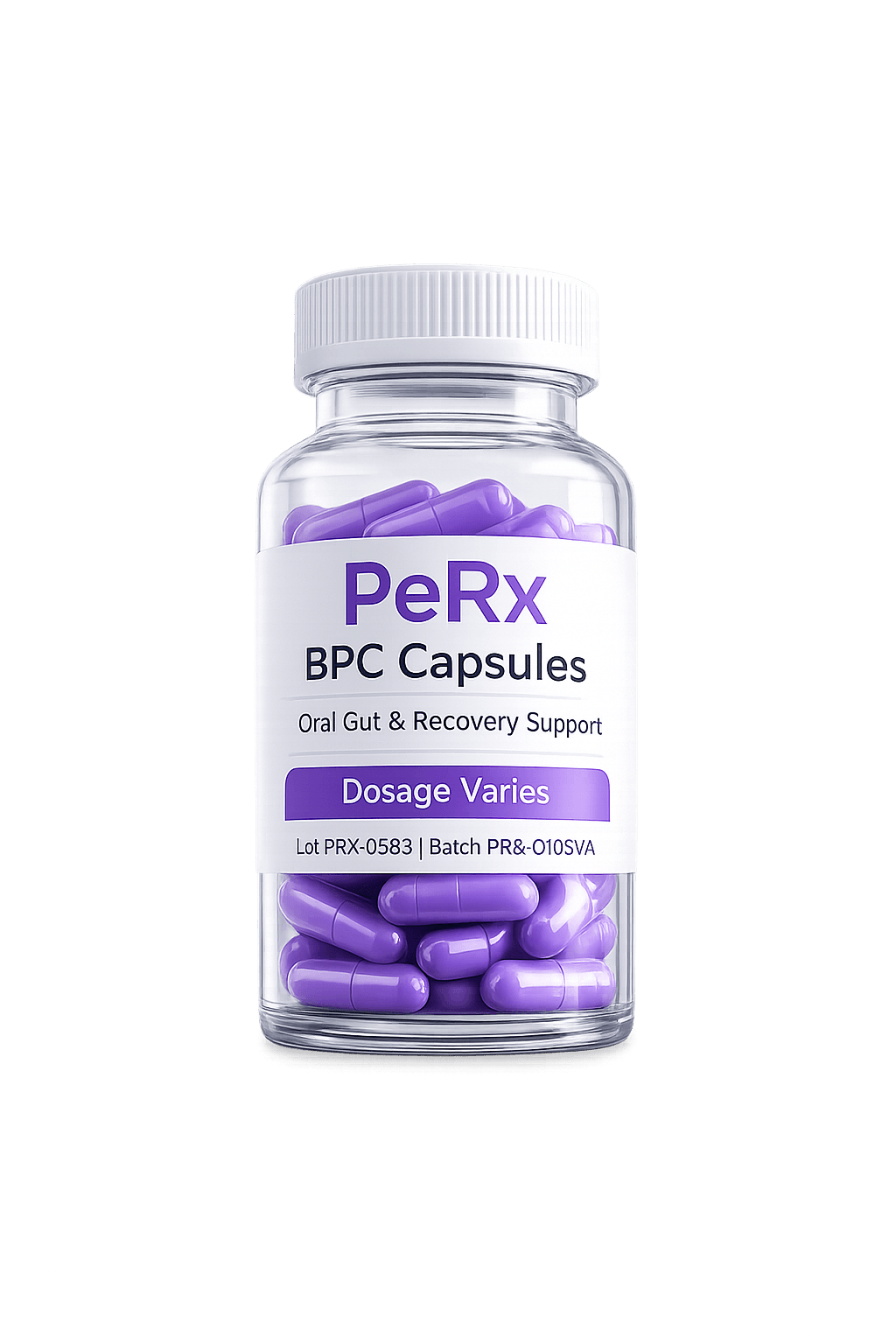
BPC-157 Capsules
For readers who arrived here because of the gut research, BPC-157 capsules are the oral, needle-free option PeRx actually prescribes. BPC-157 is the one peptide in the KLOW stack with its own oral research record, which is why it exists as a capsule and KPV does not.
Prescribed by a licensed provider after an eligibility check and filled by a state-licensed 503A pharmacy. Compounded BPC-157 is not an FDA-approved drug and is not a treatment for any diagnosed digestive condition. More in BPC-157 capsules.
Questions to Ask Your Provider About KPV
A short list that separates a useful conversation from a sales pitch. Which of my symptoms need a diagnosis from my own doctor before any peptide enters the picture? Would stool tests, blood work or a specialist referral change the plan, and who orders them? What does the KPV research actually support for my goal, and at what evidence grade? What is unknown about safety and long-term use? How would we know whether it is doing anything, given that there is no biomarker for a KPV effect? And how does KLOW compare with a single peptide, or with no peptide at all, for what I am trying to fix?
One question deserves a pre-written answer. KPV is not a stand-alone answer for mast cell or histamine symptoms, whatever the forums say; the mast-cell claim is hard to trace to a direct KPV study, and a complex immune history is a reason for your treating clinician to be in the loop before a provider here reviews anything. What providers review before prescribing peptides explains what that review covers.
Getting KLOW Through a Prescription
The path is the same as for every PeRx product. You complete the online eligibility check, a licensed provider reviews your history and any contraindications, and if KLOW is appropriate the prescription goes to a state-licensed 503A pharmacy that compounds it and tests every lot before release. The vial ships fully reconstituted and ready to use. Dose steps are decided at each renewal check-in. Compounded KLOW is not an FDA-approved drug, and nothing about the KPV research changes that. The full walkthrough is in how to get peptides prescribed online, and our lot testing is described on the quality testing page.
Ready to get started?
KLOW is prescribed by a licensed provider and ships ready to use. New to PeRx? Check your eligibility in about a minute. Already a patient? Your care team can answer KPV questions directly.
KPV Peptide Benefits FAQs
Related Guides
Continue reading about peptides and protocols that pair well with this guide.
What Is KPV? The Peptide Inside KLOW
KPV is three amino acids long, which makes it one of the smallest molecules anyone calls a peptide. Search interest in KPV peptide benefits has grown far faster than the evidence has, and almost none of the literature behind those benefit claims involves humans. Here is what is actually known, what the research supports and does not, why PeRx only supplies KPV inside a four-peptide blend, and what the July 2026 FDA panel vote did and did not do.
GLOW vs KLOW vs Wolverine Stack: Which One?
Three nicknames, four peptides, one recurring confusion. GLOW is GHK-Cu plus BPC-157 plus TB-500. KLOW is GLOW with KPV added. The Wolverine stack is BPC-157 and TB-500 on their own. Here is what each name actually contains, which goal each one fits, what a prescribing clinic dispenses in their place, and why an $80 research vial and a $349 pharmacy vial are not the same product.
Peptides for Disc Golf: Tennis and Golfer's Elbow
The hot point on the inside or outside of the elbow that flares with every swing, throw, or hard grip. How peptide therapy is used for lateral and medial epicondylitis in tennis, golf, pickleball, climbing, disc golf, and any gripping work.
References and Review
Every PubMed citation on this page was checked against the National Library of Medicine record before publication, and every regulatory statement against the FDA page it describes, on the check date shown above. This page is reviewed by Dr. Cory Mellon, MD, and the updated date in the byline reflects the last substantive change. Where this page and an FDA page disagree, the FDA page is more recent.
Kannengiesser K, Maaser C, Heidemann J, et al. "Melanocortin-derived tripeptide KPV has anti-inflammatory potential in murine models of inflammatory bowel disease." Inflammatory Bowel Diseases. 2008;14(3):324-331. View study
Xiao B, Xu Z, Viennois E, et al. "Orally Targeted Delivery of Tripeptide KPV via Hyaluronic Acid-Functionalized Nanoparticles Efficiently Alleviates Ulcerative Colitis." Molecular Therapy. 2017;25(7):1628-1640. View study
U.S. Food and Drug Administration. "FDA Briefing Document: KPV-Related Bulk Drug Substances (KPV (free base) and KPV acetate)." Pharmacy Compounding Advisory Committee, July 23-24, 2026. Evaluation dated May 12, 2026. View study
U.S. Food and Drug Administration. "July 23-24, 2026: Meeting of the Pharmacy Compounding Advisory Committee." Meeting materials, agenda and voting questions. View study
U.S. Food and Drug Administration. "Certain Bulk Drug Substances for Use in Compounding that May Present Significant Safety Risks" (Category 2 of the bulk substances nominated under sections 503A or 503B). Content current as of April 22, 2026. View study
U.S. Food and Drug Administration. "Bulk Drug Substances Nominated for Use in Compounding Under Section 503A of the Federal Food, Drug, and Cosmetic Act." Category lists, updated May 14, 2026. View study
Medical Disclaimer
The information provided on this website, including all articles, guides, and educational content, is for informational and educational purposes only and is not intended as medical advice, diagnosis, or treatment. Nothing on this site should be construed as a substitute for professional medical advice from a qualified healthcare provider.
The majority of peptides discussed on this site are not approved by the U.S. Food and Drug Administration (FDA) for the indications described. They are classified as bulk drug substances and are available only through a licensed prescribing provider and compounding pharmacy. All treatments require a valid prescription and provider oversight.
The majority of published research on peptide therapies has been conducted in preclinical (animal) models. While early human data is encouraging, comprehensive clinical trial data remains limited for most peptide compounds. Individual results may vary significantly based on health status, injury type, and other factors. No specific outcomes are guaranteed.
Certain peptides discussed on this site are classified as prohibited substances by the World Anti-Doping Agency (WADA) and are banned by major sports organizations including the NFL, NCAA, UFC, NBA, MLB, NHL, and PGA. If you are subject to anti-doping testing, consult your governing body before considering any peptide therapy.
Statements on this website have not been evaluated by the Food and Drug Administration. Products and therapies discussed are not intended to diagnose, treat, cure, or prevent any disease.
© 2026 Wellness MD Group PC DBA PeRx. All rights reserved.