PE-22-28 Peptide: What It Is, Evidence and Status
PE-22-28 is seven amino acids long, was designed in a French pharmacology lab in 2017, and has never been given to a human being in a published study. Here is what it does to a potassium channel called TREK-1, what the mouse experiments measured, why every dosing chart online is a guess, and why PeRx prescribes it only inside a three-peptide blend.

In this article
Key Takeaways
- PE-22-28 is a synthetic seven-amino-acid peptide (Gly-Val-Ser-Trp-Gly-Leu-Arg), also called mini-spadin: a trimmed version of spadin, a natural fragment of the sortilin propeptide. It is not an FDA-approved drug.
- It blocks TREK-1, a background potassium channel that keeps neurons quiet. Mice lacking the TREK-1 gene behave as if they were on antidepressants, which is the entire rationale for the peptide.
- The whole file comes from one CNRS group in Valbonne, France. In mice, PE-22-28 blocked TREK-1 at 0.12 nanomolar, changed behavior in depression models after four days, and increased markers of new neurons and synapses. PubMed lists three records naming it.
- There is no published human study of PE-22-28 or spadin by any route, no human pharmacokinetic data, no toxicology program, and no registered trial. Every dosing chart online is an extrapolation from mouse work.
- The 2019 stroke paper found the effect flips with dose: very low doses activated TREK-1 and higher doses blocked it. That is a real problem for anyone guessing a human dose from a vendor page.
- Spadin raised insulin secretion in mouse beta cells and in mice, so blood sugar is on our intake screen, along with seizure history and psychiatric medications.
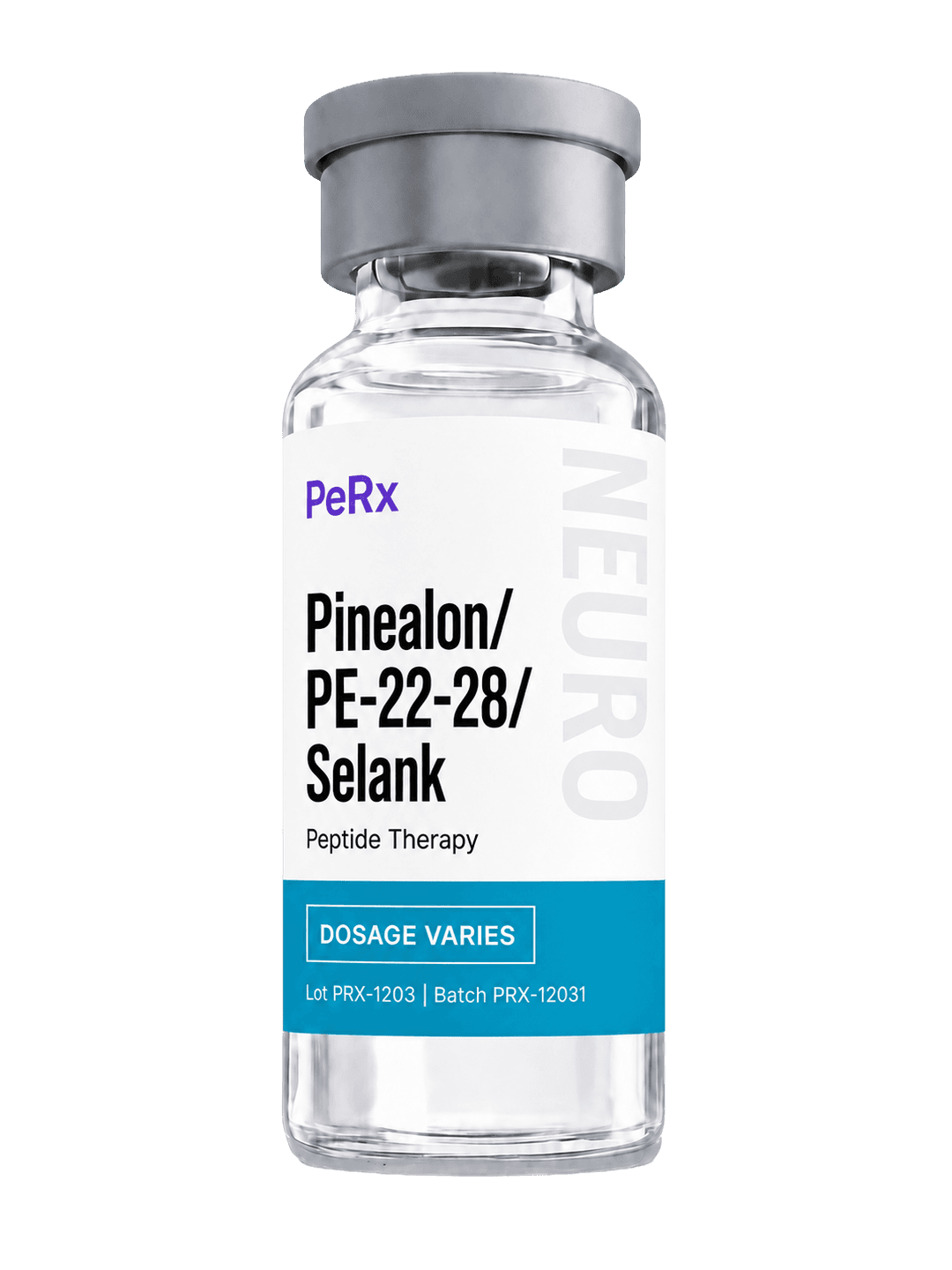
- PeRx prescribes PE-22-28 only inside the subcutaneous Pinealon/PE-22-28/Selank blend ($299 for a one-month supply, 2 mg/mL of each peptide). There is no standalone vial and no nasal product. Its compounding status with the FDA is unsettled.
PE-22-28 at a Glance
Full name
PE 22-28, also called mini-spadin. Sequence Gly-Val-Ser-Trp-Gly-Leu-Arg
Type
Synthetic seven-amino-acid fragment of the sortilin propeptide
Developed by
Institut de Pharmacologie Moleculaire et Cellulaire (CNRS), Valbonne, France. First paper: 2017
Target
The TREK-1 potassium channel, blocked at 0.12 nanomolar in patch-clamp tests
Human evidence
None published, by any route. No registered trial
How PeRx supplies it
Only inside the subcutaneous Pinealon/PE-22-28/Selank blend, 2 mg/mL of each
Last reviewed
September 2026
What Is PE-22-28?
PE-22-28 is a synthetic peptide made of seven amino acids: glycine, valine, serine, tryptophan, glycine, leucine and arginine. The name is a set of coordinates. Sortilin, a receptor protein found throughout the brain, is built with a 44-amino-acid tail called a propeptide (PE) that gets snipped off as the receptor matures, and positions 22 through 28 of that tail are PE 22-28. Some vendors call it mini-spadin, because it is a shortened version of spadin, the longer natural fragment (positions 12 through 28) the same French laboratory identified first.
What the peptide does is block one potassium channel, TREK-1. The channel sits in neurons of the prefrontal cortex, hippocampus and amygdala and leaks potassium out of the cell, which holds the neuron at a quiet, negative resting voltage. Mice engineered without it behave, across a battery of stress tests, like mice on antidepressant drugs. A molecule that plugs the channel might do the same thing faster than a drug that works on serotonin reuptake. That hypothesis is the entire reason PE-22-28 exists.
It is not an approved drug anywhere. Online it is sold as a research chemical in vials and, by some sellers, as a nasal spray, with benefit lists that run from mood to memory to stroke recovery. PeRx prescribes it inside one blend with Pinealon and Selank, and we would rather you see the size of the evidence file first. It is small.
From Sortilin to Spadin to PE-22-28
The story runs through one building: the Institut de Pharmacologie Moleculaire et Cellulaire in Valbonne, near Nice, a CNRS laboratory with decades of potassium channel work. The same names, Heurteaux, Mazella, Borsotto and later Djillani, appear on nearly every paper, which matters for how much weight the results can carry. Here is the sequence.
2004
TREK-1 turns out to protect the brain
Mice lacking the TREK-1 gene were more vulnerable to seizures and to brain damage from reduced blood flow. This is the finding that later becomes a safety question for any TREK-1 blocker.
2010
Spadin
The group identified a natural 17-amino-acid fragment of the sortilin propeptide that bound TREK-1 at 10 nanomolar and blocked it. Four days of intravenous spadin produced antidepressant-like behavior in mice and more new hippocampal neurons, changes SSRIs take weeks to produce in the same models.
2015
Synapses and BDNF
Spadin raised neuronal membrane potential, switched on the MAPK and PI3K growth pathways, increased the synapse proteins PSD-95 and synapsin, and raised BDNF in the mouse hippocampus after injection.
2019
Stroke and post-stroke depression, in mice
Given at a very low dose right after an induced stroke and at a hundred-fold higher dose afterward, mini-spadin limited weight loss and dopamine neuron loss, improved motor and cognitive deficits, and prevented depression-like behavior in mice. Low doses activated TREK-1; higher doses blocked it.
2006
The depression-resistant mouse
The same knockout mice went through five behavioral tests used to screen antidepressants and behaved like animals on chronic fluoxetine, with heightened serotonin signaling.
2012
The side-effect check
Because the knockout mice were seizure-prone, the lab checked whether spadin caused the same problems. In mice it did not change pain responses, induced seizures, stroke lesion size, heart rhythm, blood pressure or blood sugar, and it left four related potassium channels alone.
2017
PE 22-28 is designed
Spadin fell apart in blood within about seven hours. From its breakdown fragments the group designed the seven-amino-acid PE 22-28, which blocked TREK-1 at 0.12 nanomolar against 40 to 60 for spadin, stayed active for up to 23 hours in mice, changed behavior in two depression models after four days, and raised markers of neurogenesis and synapse formation.
Heurteaux C, Guy N, Laigle C, et al. "TREK-1, a K+ channel involved in neuroprotection and general anesthesia." The EMBO Journal. 2004;23(13):2684-2695. View study
Heurteaux C, Lucas G, Guy N, et al. "Deletion of the background potassium channel TREK-1 results in a depression-resistant phenotype." Nature Neuroscience. 2006;9(9):1134-1141. View study
Mazella J, Petrault O, Lucas G, et al. "Spadin, a sortilin-derived peptide, targeting rodent TREK-1 channels: a new concept in the antidepressant drug design." PLoS Biology. 2010;8(4):e1000355. View study
Moha Ou Maati H, Veyssiere J, Labbal F, et al. "Spadin as a new antidepressant: absence of TREK-1-related side effects." Neuropharmacology. 2012;62(1):278-288. View study
Devader C, Khayachi A, Veyssiere J, et al. "In vitro and in vivo regulation of synaptogenesis by the novel antidepressant spadin." British Journal of Pharmacology. 2015;172(10):2604-2617. View study
Djillani A, Pietri M, Moreno S, Heurteaux C, Mazella J, Borsotto M. "Shortened Spadin Analogs Display Better TREK-1 Inhibition, In Vivo Stability and Antidepressant Activity." Frontiers in Pharmacology. 2017;8:643. View study
Pietri M, Djillani A, Mazella J, Borsotto M, Heurteaux C. "First evidence of protective effects on stroke recovery and post-stroke depression induced by sortilin-derived peptides." Neuropharmacology. 2019;158:107715. View study
How PE-22-28 Is Thought to Work
Most antidepressant drugs change how much serotonin or norepinephrine sits between neurons. PE-22-28 works one step earlier, on the electrical state of the neuron itself. The chain of reasoning from the papers above has four links.
How PE-22-28 Works
Four links in the proposed chain
TREK-1 keeps neurons quiet
The channel leaks potassium out of the cell, holding the resting voltage low. It is dense in the prefrontal cortex, hippocampus and amygdala.
Blocking it wakes them up
Spadin raised the membrane potential of cultured neurons. PE-22-28 blocks the same channel at 300 to 500 times lower concentration, and leaves the related channels TREK-2 and TRAAK alone.
Serotonin circuits fire faster
In mice, spadin increased the firing rate of serotonin neurons in the dorsal raphe nucleus, the circuit the knockout mice ran hot.
Growth signals switch on
The MAPK and PI3K pathways activate, BDNF rises in the hippocampus, synapse proteins PSD-95 and synapsin increase, and after four days of treatment mice show more newborn hippocampal neurons.
Every link was measured in mice or in cultured mouse neurons. None has been measured in a person.
The link vendors lean on hardest is the fourth one, the four-day neurogenesis figure, usually rendered as "grows new brain cells." In context it means a marker of cell division in the mouse hippocampus rose after four daily injections, an effect established antidepressants also produce, more slowly. Whether that has anything to do with how a person feels is a twenty-year argument in the field, and PE-22-28 has not been part of it, because it has not been given to people.
One wrinkle deserves its own sentence. In the 2019 stroke paper the lab reported that mini-spadin is biphasic: at a very low dose it increased TREK-1 activity, and only at a higher dose did it block the channel. The direction of the effect may therefore depend on how much you take, and no study has mapped where that line sits in a human being.
Djillani A, Mazella J, Heurteaux C, Borsotto M. "Fighting against depression with TREK-1 blockers: Past and future. A focus on spadin." Pharmacology and Therapeutics. 2019;194:185-198. View study
What the Mouse Studies Measured
A PubMed search in September 2026 returns 41 records mentioning spadin and three naming PE 22-28 or mini-spadin. The table sorts the claims you will see on sales pages by the strongest evidence that actually exists for each.
| Claim on the sales page | What was actually measured | Evidence tier | Human data? |
|---|---|---|---|
| Fast-acting antidepressant | Less immobility in the forced swim test and a shorter wait before eating in a new cage, after four daily injections in mice | Animal behavior models | None |
| Grows new neurons | A cell-division marker rose in the mouse hippocampus after a four-day course. The strongest effect was from a modified analog, not PE 22-28 itself | Animal | None |
| Builds new synapses | More PSD-95 protein in cultured mouse cortical neurons. For spadin, also synapsin and mature dendritic spines | Cell culture, mouse | None |
| Improves memory and focus | No study in healthy animals. Stroke-induced cognitive deficits were smaller in treated mice (2019) | Animal, injury model | None |
| Protects the brain | Less weight loss, fewer lost dopamine neurons and better motor recovery after induced stroke in mice, at a dose that activated rather than blocked TREK-1 | Animal, single study | None |
| Safe and well tolerated | A 2012 mouse side-effect screen of spadin, not PE 22-28. No toxicology, no human safety data | Animal, parent compound | None |
Fast-acting antidepressant
- What was actually measured
- Less immobility in the forced swim test and a shorter wait before eating in a new cage, after four daily injections in mice
- Evidence tier
- Animal behavior models
- Human data?
- None
Grows new neurons
- What was actually measured
- A cell-division marker rose in the mouse hippocampus after a four-day course. The strongest effect was from a modified analog, not PE 22-28 itself
- Evidence tier
- Animal
- Human data?
- None
Builds new synapses
- What was actually measured
- More PSD-95 protein in cultured mouse cortical neurons. For spadin, also synapsin and mature dendritic spines
- Evidence tier
- Cell culture, mouse
- Human data?
- None
Improves memory and focus
- What was actually measured
- No study in healthy animals. Stroke-induced cognitive deficits were smaller in treated mice (2019)
- Evidence tier
- Animal, injury model
- Human data?
- None
Protects the brain
- What was actually measured
- Less weight loss, fewer lost dopamine neurons and better motor recovery after induced stroke in mice, at a dose that activated rather than blocked TREK-1
- Evidence tier
- Animal, single study
- Human data?
- None
Safe and well tolerated
- What was actually measured
- A 2012 mouse side-effect screen of spadin, not PE 22-28. No toxicology, no human safety data
- Evidence tier
- Animal, parent compound
- Human data?
- None
The forced swim test, explained
The forced swim test does most of the work on the sales pages, so it is worth understanding. A mouse is placed in a cylinder of water it cannot escape, and researchers time how long it floats instead of swimming. Antidepressants shorten the floating, and so did PE-22-28. Many researchers now read the test as a measure of coping strategy under acute stress rather than of anything resembling depression, and it has flattered dozens of candidate antidepressants that later did nothing in people. Floating less in a beaker is not a mood.
Why single-lab evidence gets a discount
Every primary paper on spadin and PE-22-28 that we could find carries an author from the Valbonne institute, and we found no independent laboratory that has tried to reproduce the effects of the seven-amino-acid fragment. That is not an accusation. Unreplicated findings simply carry less weight: the people who design a molecule tend to run the experiments most likely to flatter it, and null results are published less often than positive ones.
The Stroke Experiments
Several vendor pages list stroke recovery as a benefit. The source is one 2019 mouse study. Mice had a stroke induced by blocking an artery. Thirty minutes later they received 0.03 micrograms per kilogram of mini-spadin into the abdomen, daily for a week, a tiny dose that activated TREK-1, the direction associated with brain protection. Then the dose rose a hundred-fold, to 3 micrograms per kilogram four days a week, to block the channel and act on mood. Treated mice lost less weight, kept more dopamine neurons, moved and learned better, and did not develop the depression-like behavior untreated stroke mice showed.
It is a clever design and a mouse study from the inventing lab, with a two-phase dosing scheme keyed to the hour of an induced stroke. Nothing in it says what a fixed daily dose does in a person who has not had a stroke, and it is no reason to use a compounded peptide after a stroke instead of emergency care.
What Nobody Has Measured
There is no published study of PE-22-28 in humans, by any route, at any dose. There is no human pharmacokinetic study, so nobody knows its half-life in a person, how much of a subcutaneous dose reaches the blood, or how much of that crosses into the brain. The 23-hour figure is from mice, which clear peptides differently. ClinicalTrials.gov lists no study of spadin or mini-spadin, and no toxicology has been published for the seven-amino-acid fragment.
Route is a second gap. The mouse experiments injected the peptide into a vein or the abdominal cavity, routes nobody uses at home. Neither the nasal sprays some sellers offer nor the subcutaneous injection US clinics use, PeRx included, has been studied. Long-term effects are unknown by every route, a gap our long-term safety guide covers in general terms.
A third gap is metabolic, and it is the one finding from the lab that rarely reaches a sales page. TREK-1 channels also sit in the insulin-producing beta cells of the pancreas. In 2016 the group showed that blocking them with spadin depolarized those cells, potentiated insulin release in cell culture and isolated mouse islets, and raised glucose-stimulated insulin in living mice. The authors framed it as a possible diabetes therapy. For anyone on glucose-lowering medication or prone to low blood sugar, it is a reason for caution, and it is on our intake questionnaire for that reason.
Hivelin C, Beraud-Dufour S, Devader C, et al. "Potentiation of Calcium Influx and Insulin Secretion in Pancreatic Beta Cell by the Specific TREK-1 Blocker Spadin." Journal of Diabetes Research. 2016;2016:3142175. View study
Finally, no study has tested PE-22-28 together with Pinealon and Selank, the two peptides it shares a vial with at PeRx. The combination is a formulation decision built on non-overlapping mechanisms, not a tested protocol, and the blend guide says so.
PE-22-28 Dosing: Why There Is No Chart
Search for a PE-22-28 dosage and you will find confident microgram figures, nasal spray schedules and cycle lengths laid out in tables. None traces back to a dose-finding study, because none exists. The only tested doses are mouse doses: 3 micrograms per kilogram to block the channel, and a hundred times less to activate it. Scaling either to a person is guesswork, and the biphasic result means that getting the number wrong could, in principle, reverse the effect rather than weaken it.
PeRx does not prescribe PE-22-28 by itself, so there is no PeRx PE-22-28 dose to chart. What we can give you is the arithmetic of the blend it comes in.
What the Blend Delivers
Vial
5 mL, with Pinealon, PE-22-28 and Selank at 2 mg/mL each
Per 10 units (0.1 mL)
0.2 mg of each peptide
Per 20 units (0.2 mL)
0.4 mg of each peptide
Your dose
The units printed on your prescription label
Route
Subcutaneous injection, usually in the evening
Format
One pre-mixed vial that ships fully reconstituted and ready to use
Because all three peptides share one vial at one concentration, the PE-22-28 dose cannot rise without the other two rising with it. That suits people who want the combination and not anyone chasing a PE-22-28 number from a forum. Timing and cycle length are covered in the blend guide, and technique in how to inject peptides.
Why We Only Prescribe It Inside a Blend
A standalone PE-22-28 vial would ask you to pay for, and inject, a molecule whose entire record is mouse work from one laboratory. We were not comfortable building a product on that. Inside the blend, PE-22-28 is one of two speculative thirds, alongside Pinealon, next to Selank, which has a 62-patient clinical trial and a Russian prescription registration behind it. Read plainly, the case for the blend rests mostly on Selank for how you feel in the first weeks, with PE-22-28 as a mechanistically interesting addition nobody has tested in people.
If you want the combination, understanding that two of its three parts are early-stage, it is available after a provider reviews your intake. If what you want is calm focus with the best-supported peptide in the vial, Selank on its own is the cleaner choice, Semax vs Selank sorts out which of the two fits, and our nootropic peptides overview puts all of them side by side.
Ideal for
Adults who want one evening injection aimed at calm, sleep and cognition together, who understand that PE-22-28 and Pinealon are early-stage, and who have no seizure history, no diabetes or hypoglycemia history, and no psychiatric medication that would complicate Selank or a TREK-1 blocker.
Consider alternatives if
For calm focus alone, the Selank guide covers the one component with human data. For sleep alone, DSIP at $229 is the single-purpose option, compared in best peptides for sleep. Anyone with a seizure disorder or diabetes, anyone on an SSRI, SNRI, MAO inhibitor or benzodiazepine, anyone pregnant or breastfeeding, and tested athletes should not use the blend.
Pinealon/PE-22-28/Selank
PE-22-28 arrives as one ingredient of a single 5 mL vial, 2 mg/mL of each of the three peptides, made by a US 503A pharmacy and shipped cold with syringes and swabs in the box. The vial is ready to use with no reconstitution needed, so the dose you draw is the dose the prescription describes.
$299 for a one-month supply. You complete an online intake, a licensed provider reviews it, and checkout holds your card without charging it until a prescription is approved.
Side Effects and Who Gets Screened Out
With no human study, any side-effect list for PE-22-28 is theoretical, which is different from reassuring. What can be said comes from three places: the biology of the channel it blocks, the 2012 mouse screen of its parent compound, and what people on the blend report to us.
The channel biology raises three flags. TREK-1 knockout mice are more prone to seizures, so a blocker could in principle lower the seizure threshold; spadin did not in mice, but PE-22-28 itself was never put through that screen. Second, the insulin effect described above. Third, the peptide acts on serotonin circuits, so its interaction with SSRIs, SNRIs and MAO inhibitors is unknown, and in a vial that also contains Selank, psychiatric medication is the first thing our intake asks about.
What people on the blend report is modest: redness or a small bump at the injection site, vivid dreams in the first week or two, and an occasional mild headache. In a three-peptide vial none of that can be pinned on PE-22-28. We have no reports of seizures or low blood sugar, and we screen for both histories before a prescription is considered.
Who Is Screened Out at Intake
A history of seizures or epilepsy. Diabetes, or any history of hypoglycemia. Current use of an SSRI, SNRI, MAO inhibitor, lithium, an antipsychotic or a benzodiazepine, unless the prescribing physician has cleared it. Pregnancy or breastfeeding. Active cancer. Athletes subject to anti-doping testing. This is not a substitute for prescribed psychiatric treatment, and nobody should stop an antidepressant to try it.
FDA and Anti-Doping Status
Where PE-22-28 Stands With the FDA
PE-22-28 is not FDA-approved for any use, is not a component of any approved drug, and we could not find a record of any national regulator approving it as a medicine. It does not appear on the FDA list of bulk substances nominated for compounding under section 503A, current as of May 14, 2026, in any category, nor on the agency page of nominated substances flagged for safety risks, which does name Selank and Semax. It was not among the twelve peptides moved out of Category 2 in April 2026 and was not on the July 2026 advisory committee agenda.
Put plainly, the FDA has never evaluated PE-22-28 for compounding, favorably or unfavorably. That leaves it in a regulatory gray zone with its status unsettled. The nearest reviewed comparison is Semax: in May 2026 FDA staff set aside foreign-language papers without verified translations, noted the absence of human pharmacokinetic and animal toxicology data, and found insufficient evidence for the uses proposed. PE-22-28 has no human papers in any language, so the same review would have less to work with. We will update this section if that changes; our FDA panel write-up covers the peptides that were voted on.
Anti-doping is a separate question. PE-22-28 is not named on the 2026 World Anti-Doping Agency Prohibited List, but the S0 catch-all class prohibits at all times any substance with no current approval by a governmental health authority for human therapeutic use, and PE-22-28 fits that description exactly. Tested athletes should treat it as prohibited; anti-doping laboratories can test for peptides whether or not they are named. Peptide therapy for athletes goes through the wider picture, and do peptides show up on a drug test covers which tests look for what.
PE-22-28: Common Questions
Related Guides
Continue reading about peptides and protocols that pair well with this guide.
Pinealon, PE-22-28 & Selank Guide (2026)
Three peptides, three layers of brain support. Pinealon is studied for neuroprotection in cell and animal models, and its name promises more than any study has measured. PE-22-28 drives neurogenesis by blocking the TREK-1 potassium channel. Selank calms anxiety through GABA modulation without sedation or dependence. Together they rebuild, grow, and protect neural tissue from three independent angles.
Pinealon Peptide: What It Is, Evidence and Dosing
Pinealon is three amino acids long, comes from one research institute in St. Petersburg, and is sold with a confidence its evidence does not support. Here is what the peptide actually is, why its name points at the wrong gland, what about twenty published studies do and do not show, why the dosing charts online disagree, and why we only prescribe it as one part of a three-peptide blend.
Peptides for Gamers: Focus and Wrist Repair
Competitive gaming is three problems wearing one jersey: the wrist that gives out, the focus that fades in hour seven, and the fatigue that no energy drink touches. This guide treats the esports athlete like the performance athlete they are, and maps each of those three problems to where BPC-157, Semax, and NAD+ might actually fit. Honest about the evidence, and about what stays an ergonomics problem.
Ready to get started?
Pharmaceutical-grade Pinealon/PE-22-28/Selank, delivered to your door with everything you need.
Medical Disclaimer
The information provided on this website, including all articles, guides, and educational content, is for informational and educational purposes only and is not intended as medical advice, diagnosis, or treatment. Nothing on this site should be construed as a substitute for professional medical advice from a qualified healthcare provider.
The majority of peptides discussed on this site are not approved by the U.S. Food and Drug Administration (FDA) for the indications described. They are classified as bulk drug substances and are available only through a licensed prescribing provider and compounding pharmacy. All treatments require a valid prescription and provider oversight.
The majority of published research on peptide therapies has been conducted in preclinical (animal) models. While early human data is encouraging, comprehensive clinical trial data remains limited for most peptide compounds. Individual results may vary significantly based on health status, injury type, and other factors. No specific outcomes are guaranteed.
Certain peptides discussed on this site are classified as prohibited substances by the World Anti-Doping Agency (WADA) and are banned by major sports organizations including the NFL, NCAA, UFC, NBA, MLB, NHL, and PGA. If you are subject to anti-doping testing, consult your governing body before considering any peptide therapy.
Statements on this website have not been evaluated by the Food and Drug Administration. Products and therapies discussed are not intended to diagnose, treat, cure, or prevent any disease.
© 2026 Wellness MD Group PC DBA PeRx. All rights reserved.