Peptides for Hair Growth: What Works, What Does Not
Search for peptides for hair growth and you find serums promising regrowth, injectable stacks sold as follicle fuel, and clinic cocktails with trademarked names. The evidence is not one pile. Topical copper peptides have some human data; the injectable peptides, including every component of KLOW, rest on animal and laboratory work. This page sorts each one by route and evidence, and says plainly what none of them can do.

In this article
Key Takeaways
- No peptide is FDA approved for hair loss. Minoxidil and finasteride remain the approved options.
- Topical copper peptides have the most human data, but the best 2025 study combined them with minoxidil and dutasteride, so it cannot show the copper peptide regrew anything on its own.
- Injectable GHK-Cu, BPC-157, TB-500 and the KLOW blend have no hair-specific human trial. Their hair claims rest on cultured follicles and rodents.
- Peptides may support follicles that are weakened but alive. Nothing in the research suggests they rebuild a follicle that is already gone, which is why long-standing thinning responds least.
- PeRx prescribes injectable GHK-Cu and KLOW for skin, tissue and recovery goals, never as hair-loss treatments. This page makes no hair claim for either.
Peptides and Hair: Quick Facts
FDA approved peptides for hair loss
None. Minoxidil and finasteride are the approved drugs for pattern hair loss.
Strongest peptide evidence
Topical copper peptides, in small human studies and cultured follicles. Encouraging, not proven to regrow hair alone.
Injectable peptides and hair
GHK-Cu, BPC-157, TB-500 and KLOW: animal and laboratory data only. No human hair trial.
What peptides cannot do
Rebuild a follicle that is already gone, or replace a diagnosis of why hair is shedding.
Realistic timeline for any hair treatment
Months. Visible change on the scalp lags the follicle by a full growth cycle.
At PeRx
Injectable GHK-Cu and KLOW are prescribed for skin, tissue and recovery goals, not for hair loss. Compounded, not FDA approved.
Here is the short version on peptides for hair growth. No peptide is approved for hair loss. Topical GHK-Cu, the copper peptide in serums, has the most human data of the group, but not for regrowing hair on its own. The injectable peptides, including every component of KLOW, rest mostly on animal work when it comes to hair. Minoxidil and finasteride remain the approved options, and they are the comparison every peptide claim has to survive. This page sits under the complete GHK-Cu guide and covers only the hair question, across every peptide people ask about.
How to read the evidence labels on this page
Human means a study in people, with the size and design stated. Animal means mice or rats. Laboratory means cultured cells or follicles. Anecdotal means user reports with no measurement. For hair, almost every peptide sits in the last three groups, and the one with human data was tested as part of a mixture.
Peptides for Hair Loss at a Glance: What Each Peptide Can and Cannot Do
The table is the whole page in one view. Route comes first because route decides what the evidence can say: a copper peptide in a serum and a copper peptide in a syringe are the same molecule with different data behind them.
| Peptide and route | How it is thought to act | Hair evidence | Status for hair and main caution |
|---|---|---|---|
| GHK-Cu, topical | Raises VEGF and collagen signals in skin cells | Human, small: cosmetic skin trials, a 7-person combination study, cultured follicles | Cosmetic ingredient, not a hair drug. Can irritate the scalp; patch test first |
| GHK-Cu, injectable | Same signals delivered systemically rather than to the scalp | Laboratory and animal only for hair; no human hair trial | Compounded, not FDA approved. Not prescribed for hair loss at PeRx |
| KLOW (GHK-Cu, BPC-157, TB-500, KPV), injectable | Four peptides, none a proven hair mechanism in people | None as a blend. Component data is animal or laboratory; KPV has no hair data | Compounded, not FDA approved. Not marketed for hair |
| BPC-157, injectable | Angiogenesis and tissue repair in animals | Animal and laboratory; no human hair data | Compounded, not FDA approved. Scalp healing is not follicle regrowth |
| TB-500, injectable | Thymosin beta-4 activates follicle stem cells in rodents; TB-500 is a fragment of that protein | Animal: thymosin beta-4 stimulated hair growth in rats and mice. No human hair trial | Not approved for any use. PeRx dispenses it only inside blends |
| CJC-1295/ipamorelin, injectable | Raises growth hormone and IGF-1, which take part in the growth phase | Theoretical only; no clinical evidence of regrowth | Compounded, not FDA approved. Endocrine effects need supervision |
| Biomimetic cocktails such as QR678 Neo, intradermal | Growth-factor and peptide mixtures injected into the scalp by a clinician | Human, single-center: a 2025 transplant study of 112 men; earlier small series | Clinic-delivered; needs independent replication. Not offered by PeRx |
| PN/PDRN polynucleotides, intradermal (not a peptide) | DNA fragments thought to calm inflammation and support blood vessel growth | Human, small: a 2025 study of 28 people with pattern hair loss, no control group | Clinic-delivered; not a peptide, not approved for hair. Not offered by PeRx |
GHK-Cu, topical
- How it is thought to act
- Raises VEGF and collagen signals in skin cells
- Hair evidence
- Human, small: cosmetic skin trials, a 7-person combination study, cultured follicles
- Status for hair and main caution
- Cosmetic ingredient, not a hair drug. Can irritate the scalp; patch test first
GHK-Cu, injectable
- How it is thought to act
- Same signals delivered systemically rather than to the scalp
- Hair evidence
- Laboratory and animal only for hair; no human hair trial
- Status for hair and main caution
- Compounded, not FDA approved. Not prescribed for hair loss at PeRx
KLOW (GHK-Cu, BPC-157, TB-500, KPV), injectable
- How it is thought to act
- Four peptides, none a proven hair mechanism in people
- Hair evidence
- None as a blend. Component data is animal or laboratory; KPV has no hair data
- Status for hair and main caution
- Compounded, not FDA approved. Not marketed for hair
BPC-157, injectable
- How it is thought to act
- Angiogenesis and tissue repair in animals
- Hair evidence
- Animal and laboratory; no human hair data
- Status for hair and main caution
- Compounded, not FDA approved. Scalp healing is not follicle regrowth
TB-500, injectable
- How it is thought to act
- Thymosin beta-4 activates follicle stem cells in rodents; TB-500 is a fragment of that protein
- Hair evidence
- Animal: thymosin beta-4 stimulated hair growth in rats and mice. No human hair trial
- Status for hair and main caution
- Not approved for any use. PeRx dispenses it only inside blends
CJC-1295/ipamorelin, injectable
- How it is thought to act
- Raises growth hormone and IGF-1, which take part in the growth phase
- Hair evidence
- Theoretical only; no clinical evidence of regrowth
- Status for hair and main caution
- Compounded, not FDA approved. Endocrine effects need supervision
Biomimetic cocktails such as QR678 Neo, intradermal
- How it is thought to act
- Growth-factor and peptide mixtures injected into the scalp by a clinician
- Hair evidence
- Human, single-center: a 2025 transplant study of 112 men; earlier small series
- Status for hair and main caution
- Clinic-delivered; needs independent replication. Not offered by PeRx
PN/PDRN polynucleotides, intradermal (not a peptide)
- How it is thought to act
- DNA fragments thought to calm inflammation and support blood vessel growth
- Hair evidence
- Human, small: a 2025 study of 28 people with pattern hair loss, no control group
- Status for hair and main caution
- Clinic-delivered; not a peptide, not approved for hair. Not offered by PeRx
Two things stand out. The benefits most loudly marketed, regrowth from an injectable stack, have the least human evidence, and the only human studies that exist tested a mixture or had no control group. Plausible is not proven. On regulation, is GHK-Cu FDA approved has the same answer as every other peptide here: no.
GHK-Cu
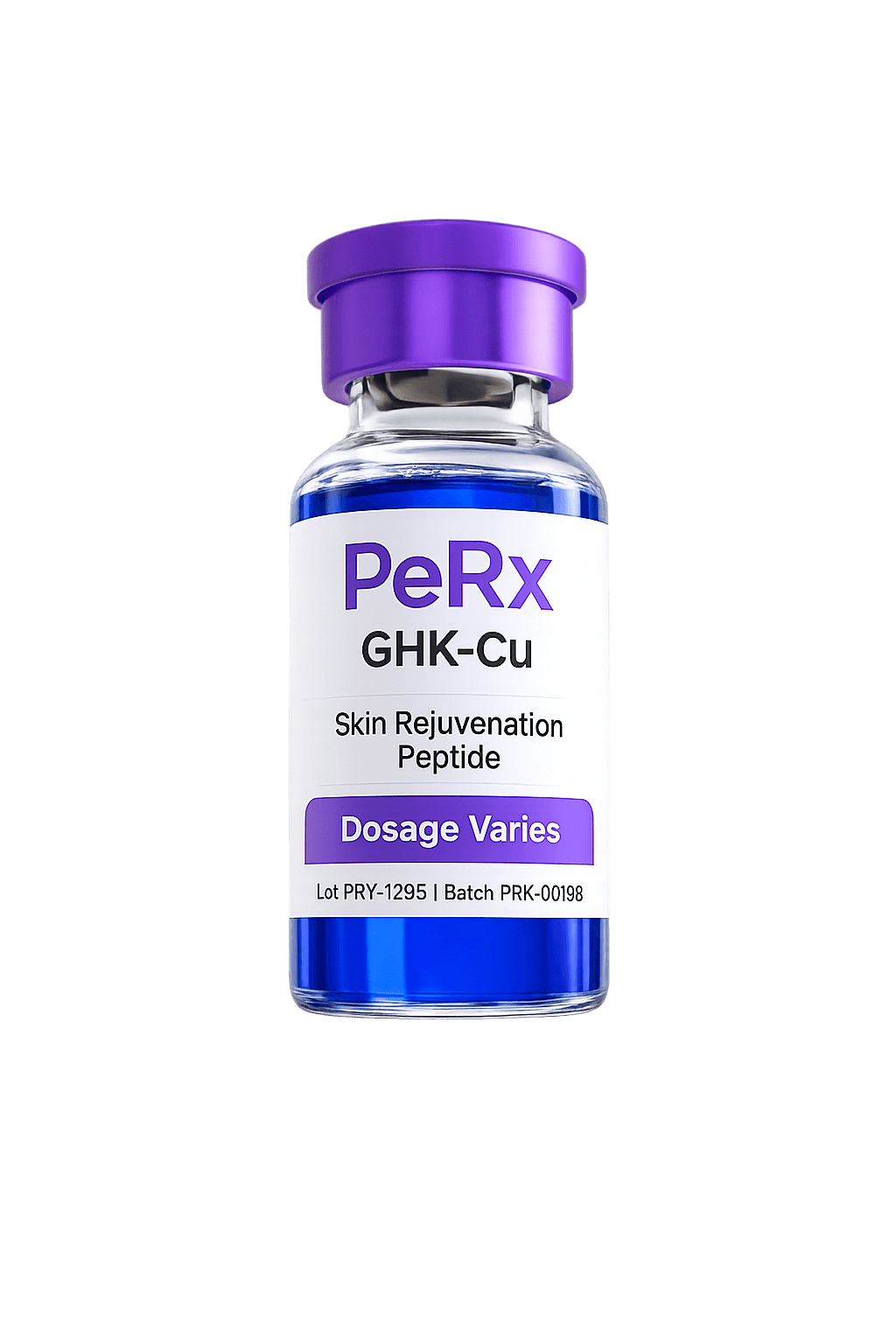
GHK-Cu at PeRx is the injectable copper peptide, prescribed by a licensed provider for skin and connective-tissue goals after an eligibility check and compounded at a state-licensed 503A pharmacy. It ships fully reconstituted and ready to use.
It is not prescribed as a hair-loss treatment and this page makes no hair claim for it. Compounded GHK-Cu is not an FDA-approved drug.
How Peptides Might Affect the Hair Follicle
A hair follicle runs on a cycle. Anagen is the growth phase, which lasts years on the scalp. Catagen is a short transition in which the follicle shrinks. Telogen is rest, after which the old hair sheds and, if the follicle is healthy, a new one starts. Pattern hair loss happens when follicles sensitive to DHT, a testosterone by-product, miniaturize cycle after cycle: the growth phase shortens, the hair gets finer, and eventually no visible hair is produced. Inflammation around the follicle and reduced blood supply are part of the same picture.
Peptides are studied for hair because they are small enough to act as signals in that system. The proposed mechanisms, each a laboratory finding or a hypothesis rather than a result in people, fall into four groups: switching on growth-phase signaling inside the follicle, encouraging new blood vessels around it, supporting the collagen and matrix that anchor it, and calming the inflammation that shortens its cycle. A 2026 review in Biomedicines sorts the peptides studied for hair into those pathways and notes that none of the clinical work has been compared with minoxidil or finasteride.
The point that matters most for anyone considering peptides for thinning hair: every one of those mechanisms needs a living follicle to act on. Peptides may help a follicle that is weakened but still cycling. Nothing in the research suggests they rebuild a follicle that is already lost, which is why long-bare scalp responds least to anything short of a transplant.
Copper Peptides for Hair Growth: What GHK-Cu Can Do
GHK-Cu is the copper-binding tripeptide Loren Pickart identified in 1973, the peptide with the longest research history on skin, and the one ingredient here you can buy in a copper peptide serum for hair at any pharmacy. That availability is why the hair claims have outrun the data.
Do copper peptides regrow hair?
Nobody has shown it on its own. The human data are small controlled cosmetic studies of topical GHK-Cu on facial skin, plus limited hair-specific work. In the laboratory, a related copper tripeptide, AHK-Cu, stimulated cultured human follicles and dermal papilla cells in a 2007 Korean study. The 2026 review mentions one clinical study of copper peptide in 45 people with pattern hair loss, and notes in the same breath that it offered no comparison with the approved drugs.
The study most often quoted as proof is a 2025 letter in JAAD International. Seven men who had not responded to a year of standard treatment had a mixture of minoxidil, dutasteride and copper peptides delivered into the scalp by a tattoo machine, once a month for five months. Blinded dermatologists scored photographs, and the median bald-area score fell from 40 percent to 7.5 percent. Striking, and it cannot show the copper peptide did anything: every patient also received two approved hair drugs, more sessions than the earlier minoxidil-and-dutasteride series, and topical minoxidil throughout. Plausible, encouraging, incomplete. Copper peptides for hair growth are not proven to regrow hair by themselves.
GHK-Cu for hair growth: topical vs injectable
Topical use is the cosmetic route and holds nearly all of the human evidence. Whether a peptide hair serum reaches the follicle depends on the formulation: GHK-Cu is water soluble and does not pass through skin easily, so the better-studied products use carriers or microneedling to get it past the surface.
Injectable GHK-Cu is compounded by prescription, not FDA approved, and for hair it rests on the same animal and laboratory work as the topical form without any human hair trial of its own. PeRx offers only the injectable form and sells no topical copper peptide. No evidence lets anyone claim that injecting GHK-Cu works better or worse for hair than applying it. For what people describe after starting it, see GHK-Cu before and after; for the technique, where to inject GHK-Cu.
Using GHK-Cu with minoxidil or finasteride
Copper peptides belong beside the approved drugs, not instead of them; the one promising human result used them inside a minoxidil and dutasteride regimen. Layering active topicals can irritate the scalp, and ghk cu hair loss forums are full of people who stacked a serum on minoxidil and blamed the wrong product. A dermatologist should guide any combination. Do not expect GHK-Cu to protect the scalp from sun damage; that claim circulates and is unsupported. The copper question and other side effects are covered in the GHK-Cu guide, and GHK-Cu vs retinol compares it with the other serum ingredient people pair it with.
KLOW and Hair: What a Four-Peptide Stack Can and Cannot Do
KLOW is a single-vial blend of GHK-Cu, BPC-157, TB-500 and KPV. People searching for klow hair growth results usually arrive from a forum thread, and four names make the claim sound well supported. Take the components one at a time. GHK-Cu has topical cosmetic data and a laboratory follicle study. BPC-157 and TB-500 have animal data, none in people. KPV has no hair data of any kind. No study has tested KLOW for hair, and PeRx does not market it for hair loss.
Combining peptides does not add their evidence together. A blend of one peptide with cosmetic skin data and three with rodent data has no human hair evidence, and that is how it should be described. It is prescribed for skin, recovery and inflammation support. The KLOW guide covers the blend in full and KLOW side effects covers what to watch for.
KLOW
KLOW at PeRx is prescribed by a licensed provider for skin, recovery and inflammation goals, compounded at a state-licensed 503A pharmacy, and ships fully reconstituted and ready to use.
It is not prescribed or marketed as a hair-loss treatment. No study has evaluated the four peptides together, and compounded KLOW is not an FDA-approved drug.

BPC-157 and TB-500 for Hair: What the Animal Data Show
These are the recovery peptides, usually prescribed together as the BPC/TB-500 pair for tendon, ligament and soft-tissue goals. Their hair reputation is borrowed from that work.
TB-500 hair growth: what mouse studies show
The tb 500 hair growth claim traces to a 2004 study at the National Institutes of Health in which thymosin beta-4, the full 43-amino-acid protein, stimulated hair growth in normal rats and mice by activating stem cells in the follicle bulge. TB-500 is a synthetic fragment of thymosin beta-4, not the protein itself, and no human hair trial exists for either. Thymosin beta-4 is not approved for any use. At PeRx it is dispensed only inside the BPC/TB-500 and KLOW blends, for recovery, not hair. The regulatory detail is in is TB-500 FDA approved.
BPC-157 hair growth: scalp healing, not follicles
BPC-157 has no hair study at all. The bpc 157 hair growth theory is indirect: in animal models the peptide promotes new blood vessel growth and tissue repair, so a scalp that heals faster and carries less inflammation might, in theory, be a better environment for follicles. That is a hypothesis about the soil, not the seed, with no human hair data and no approval. BPC-157 vs GHK-Cu covers how the two differ, and is BPC-157 FDA approved the approval question. For both peptides, human safety and long-term effects are not established, and vials sold as research chemicals add sterility, purity and labeling risks on top.
Growth Hormone Peptides and Hair: An Indirect Link
Growth hormone secretagogues such as CJC-1295 and ipamorelin raise growth hormone, which raises IGF-1, and IGF-1 is one of the signals that keeps a follicle in its growth phase. That is the entire theory. No clinical evidence shows these peptides regrow hair; people who report fuller hair on them are usually also sleeping better and losing fat. They act on the endocrine system and need medical supervision for reasons unrelated to hair. The mechanism is on the growth hormone peptides page, and their anti-doping status is covered under injury recovery peptides.
Biomimetic Peptides and PN/PDRN: Emerging Options
Two clinic-delivered options come up in any search for peptide therapy for hair loss. The first is the family of biomimetic peptide cocktails, of which qr678 Neo is the best known: a growth-factor and peptide mixture injected into the scalp over a series of sessions. The largest study is a 2025 single-blind trial of 112 men undergoing FUE transplantation, in which the formulation prepared the donor scalp and stored the grafts, with better density in the treated group. The second is PN or PDRN, polynucleotides, which are DNA fragments rather than peptides. A 2025 prospective study followed 28 people with pattern hair loss through four scalp injections a month apart and measured thicker, denser hair by dermoscopy, with no control group.
Both are interesting, both are single-center results from the clinics that use them, and both need independent replication before anyone calls them established. PeRx does not offer either, and this page recommends no clinic or procedure.
How Peptides Fit Next to Minoxidil, Finasteride and Hair Transplants
Minoxidil, applied to the scalp or taken by mouth on prescription, lengthens the window in which follicles grow and is the most widely used approved treatment. Finasteride, taken daily, lowers the DHT that miniaturizes sensitive follicles and is approved for men with pattern hair loss. Dutasteride does the same more completely and is used off-label for hair in the United States. PRP injections help selected patients. A transplant moves follicles that are not DHT-sensitive into the thinning zone, and it is the only option here that restores hair where the follicles are already gone.
| Proven core | What it does | Emerging adjunct | What it might add |
|---|---|---|---|
| Minoxidil | Prolongs the growth phase; approved | Topical copper peptides | Scalp environment and signaling; adjunct only |
| Finasteride | Lowers DHT; approved for men | Biomimetic cocktails, PN/PDRN | Clinic series with early results; need replication |
| Transplant, PRP | Moves follicles; PRP for selected patients | Injectable peptides | No human hair data; not an adjunct anyone can justify yet |
Minoxidil
- What it does
- Prolongs the growth phase; approved
- Emerging adjunct
- Topical copper peptides
- What it might add
- Scalp environment and signaling; adjunct only
Finasteride
- What it does
- Lowers DHT; approved for men
- Emerging adjunct
- Biomimetic cocktails, PN/PDRN
- What it might add
- Clinic series with early results; need replication
Transplant, PRP
- What it does
- Moves follicles; PRP for selected patients
- Emerging adjunct
- Injectable peptides
- What it might add
- No human hair data; not an adjunct anyone can justify yet
Peptides, where they have a place at all, are an adjunct to that core, not a replacement. Someone who drops minoxidil for a peptide for hair regrowth trades an approved drug with decades of data for a hypothesis. A dermatologist can also find the causes of shedding that no peptide addresses: thyroid disease, iron deficiency, and telogen effluvium after illness, surgery or rapid weight loss. Treat those first and the hair often returns on its own.
What Results and Timelines Are Realistic?
Hair biology sets the speed limit. A follicle that re-enters its growth phase today produces a hair that will not be visible for weeks and will not change how the hair looks for months. Shedding usually falls before density rises, and some people see a temporary increase in shedding when follicles reset, a known pattern with minoxidil. Any page that promises a date is guessing.
If you want to know whether anything is working, including whether do peptides help hair growth at all in your case, measure it. Photograph the same part of the scalp under the same light every month. An honest ghk cu hair before and after is a set of consistent photos over six months, not a split image from a product page; GHK-Cu before and after explains what people report and how to read it. No peptide guarantees regrowth, and follicles miniaturized for years are the least likely to respond to anything.
Safety, Side Effects and Who Should Avoid Peptides for Hair
Topical GHK-Cu is generally well tolerated. The side effects people report are mild irritation, redness, stinging and, rarely, contact sensitivity; patch test first. Injectable peptides carry a different list: unapproved, limited long-term human safety data, injection-site reactions as the most common complaint, and sterility and purity risks with vials bought outside a pharmacy. The general picture is in the peptide side effects guide.
Some people should avoid peptides for hair or ask a clinician first. Anyone with Wilson disease or another disorder of copper handling, because GHK-Cu carries copper. Anyone with liver disease, for the same reason. Pregnant or breastfeeding people, because there is no safety data. Anyone under 18. Anyone with active or suspected cancer, since several of these peptides promote cell growth and blood vessel formation. Anyone with a known copper or nickel sensitivity. A provider reviews history and medications first; see what providers review before prescribing and lab work before starting peptides.
When to get care
Spreading redness, warmth, pus or fever at an injection site; hives, facial swelling or trouble breathing after any product; or sudden hair loss with other symptoms such as fatigue, weight change or a rash. The last is a reason to see a doctor about the cause, not to try another product. If shedding started a few months into a GLP-1 medicine, read hair loss on GLP-1s first; that pattern usually resolves on its own.
Getting Peptides Through a Prescription
At PeRx the path is the same for every peptide: an eligibility check, a review by a licensed provider, a prescription filled by a state-licensed 503A pharmacy, and a check-in before each renewal. Compounded peptides are not FDA approved, and PeRx does not prescribe any peptide as a hair-loss treatment. Injectable GHK-Cu and KLOW sit in the anti-aging peptides category for that reason. How to get peptides prescribed online walks through the process.
Not sure which peptide fits your goal?
New to PeRx: the eligibility check takes about a minute, and a licensed provider reviews every order before it ships. Already a patient: message your care team with questions about your prescription or your next renewal.
Peptides for Hair Growth: Common Questions
Related Guides
Continue reading about peptides and protocols that pair well with this guide.
GHK-Cu Dosage Chart: Units, Schedule, Copper Math
Search for a GHK-Cu dosage chart and you get a Reddit thread and a handful of research-vendor pages, all quoting 1 to 2 mg per injection as if a trial had set it. No trial did. The human GHK-Cu data is almost entirely topical, and the injection figures are clinic convention. This page lays out those conventions as the ranges they are, then the one dose a licensed provider actually prescribes through PeRx: 20 units, 2 mg, Monday through Friday, from a 10 mg/mL vial. Units, weekly totals, the copper arithmetic, timing and missed doses, as of October 1, 2026.
GHK-Cu Before and After: Results, Week by Week
Most GHK-Cu before-and-after pages show a serum result and describe an injection, or describe an injection and cite nothing. The human results that exist come from 12-week trials of creams on the faces of a few dozen women. No published trial has measured what injected GHK-Cu does to anyone. This guide keeps those facts apart from what patients on the injectable protocol report, lays out the week-by-week picture with its sources attached, and shows you how to photograph and track your own skin so the comparison means something.
PT-141 for Women: Low Libido and Vyleesi
PT-141 is the only FDA-approved medication that targets sexual desire in a woman’s brain rather than blood flow in the body. Here is who it is for, what the approval actually covers, how it compares to the daily pill Addyi, and the honest answers to the questions women ask most.
References and Review
Every study below was checked against its PubMed record. This page reflects the evidence as of November 2026 and will be updated when a controlled human trial of any peptide for hair is published.
Fan C, Chen Y, Huang Q, et al. Overview of short peptides for hair loss. Biomedicines. 2026;14(4). View study
Paus R, Cotsarelis G. The biology of hair follicles. N Engl J Med. 1999;341(7):491-497. View study
Kuceki G, Coppinger AJ, Ragi SD, et al. Enhanced hair regrowth with five monthly sessions of minoxidil-dutasteride-copper peptides tattooing for androgenetic alopecia assessed by artificial intelligence and blinded evaluators. JAAD Int. 2025;20:38-40. View study
Pyo HK, Yoo HG, Won CH, et al. The effect of tripeptide-copper complex on human hair growth in vitro. Arch Pharm Res. 2007;30(7):834-839. View study
Pickart L, Vasquez-Soltero JM, Margolina A. GHK peptide as a natural modulator of multiple cellular pathways in skin regeneration. Biomed Res Int. 2015;2015:648108. View study
Pickart L, Margolina A. Regenerative and protective actions of the GHK-Cu peptide in the light of the new gene data. Int J Mol Sci. 2018;19(7):1987. View study
Philp D, Nguyen M, Scheremeta B, et al. Thymosin beta4 increases hair growth by activation of hair follicle stem cells. FASEB J. 2004;18(2):385-387. View study
Seiwerth S, Rucman R, Turkovic B, et al. BPC 157 and standard angiogenic growth factors. Gastrointestinal tract healing, lessons from tendon, ligament, muscle and bone healing. Curr Pharm Des. 2018;24(18):1972-1989. View study
Gold M, Zaman UMSM, Chouksey V, Gosavi M. Evaluation of the efficacy of a biomimetic peptide solution for rejuvenation of donor scalp and as storage media for hair follicle grafts during FUE hair transplantation. J Cosmet Laser Ther. 2025;27(3):64-70. View study
Thanasarnaksorn W, Limsuchaiwat N, Sirithanabadeekul P, et al. Polynucleotides as a novel therapeutic approach in androgenetic alopecia: an analysis of effectiveness and safety. Arch Dermatol Res. 2025;317(1):399. View study
Członkowska A, Litwin T, Dusek P, et al. Wilson disease. Nat Rev Dis Primers. 2018;4(1):21. View study
Medical Disclaimer
The information provided on this website, including all articles, guides, and educational content, is for informational and educational purposes only and is not intended as medical advice, diagnosis, or treatment. Nothing on this site should be construed as a substitute for professional medical advice from a qualified healthcare provider.
The majority of peptides discussed on this site are not approved by the U.S. Food and Drug Administration (FDA) for the indications described. They are classified as bulk drug substances and are available only through a licensed prescribing provider and compounding pharmacy. All treatments require a valid prescription and provider oversight.
The majority of published research on peptide therapies has been conducted in preclinical (animal) models. While early human data is encouraging, comprehensive clinical trial data remains limited for most peptide compounds. Individual results may vary significantly based on health status, injury type, and other factors. No specific outcomes are guaranteed.
Certain peptides discussed on this site are classified as prohibited substances by the World Anti-Doping Agency (WADA) and are banned by major sports organizations including the NFL, NCAA, UFC, NBA, MLB, NHL, and PGA. If you are subject to anti-doping testing, consult your governing body before considering any peptide therapy.
Statements on this website have not been evaluated by the Food and Drug Administration. Products and therapies discussed are not intended to diagnose, treat, cure, or prevent any disease.
© 2026 Wellness MD Group PC DBA PeRx. All rights reserved.