Semax Nasal Spray vs Injection: Which Route?
Nearly every published human study of Semax used a nasal spray or nasal drops, and no human study has measured what a subcutaneous dose does. PeRx prescribes the injection anyway, as a Semax/Selank blend that ships fully reconstituted and ready to use. This guide puts the two routes side by side, explains what each one buys and gives up, and lets a prescriber make the call.

In this article
Key Takeaways
- The nasal route is the one the published human evidence was built on. Russian stroke, cerebrovascular and optic-nerve studies, and a resting-state imaging study in healthy volunteers, all used Semax nasal drops or a 1% nasal solution.
- No published human study has measured absorption, brain delivery or duration after a subcutaneous Semax injection. Injected dosing is extrapolated from animal work and from clinical experience, and this page says so rather than hiding it.
- A nasal spray adds a variable the injection does not have: the device and the nasal lining. A subcutaneous dose from a pharmacy-made vial is the same measured volume every time.
- PeRx does not sell a nasal product. The only form it prescribes is a subcutaneous Semax/Selank blend compounded by a state-licensed 503A pharmacy, which ships fully reconstituted and ready to use.
- Semax is not FDA approved. In the United States it is available only as a compounded prescription, and a licensed provider decides whether it fits you and at what dose.
Semax by route, at a glance
Best-studied route
Nasal. Drops or a 1% solution in every published human trial, nearly all of it Russian.
Human data for injection
None published for subcutaneous dosing. Injected dosing rests on animal studies and clinical experience.
Onset
Nasal: brain levels within minutes in rats; imaging changes within 5 to 20 minutes in volunteers. Injection: not measured in people.
Dose consistency
Injection wins. A pharmacy-made solution gives a fixed volume per dose; a spray depends on the pump and the nasal lining.
What PeRx prescribes
A subcutaneous Semax/Selank blend, 503A-compounded, shipped fully reconstituted and ready to use. Nothing nasal.
FDA status
Not FDA approved by any route. Available in the US only as a compounded prescription.
Here is the short answer to the semax nasal spray vs injection question. The nasal spray is the route the human research was done with, and it acts within minutes. The injection delivers Semax through the bloodstream first and has almost no published human data behind it. PeRx prescribes the injection, as a subcutaneous Semax/Selank blend that arrives ready to use, and a licensed provider decides whether that route and that product fit you. Both halves of that answer are true at the same time, and the rest of this page explains how they fit together.
What Is Semax, and Why Does the Route Matter?
Semax is a short synthetic peptide, seven amino acids long, built from a fragment of the hormone ACTH with a small tail added to slow its breakdown. It was developed in Moscow and has been used in Russian clinical practice since the 1990s for conditions that involve the brain under stress: the recovery phase of ischemic stroke, chronic cerebrovascular insufficiency and diseases of the optic nerve. Our complete Semax guide covers the molecule, the animal mechanism work and what the FDA reviewers said about it in 2026. This page is only about how it gets into the body.
The route matters more for Semax than for most peptides because the molecule was designed around one of them. The Russian product is a nasal solution, and the reason is anatomical. The nasal lining sits a few millimeters from the olfactory nerve, which runs straight into the brain without crossing the blood-brain barrier. A drop placed there can reach brain tissue by a path that a swallowed tablet or an injected dose cannot use. An injection puts the same molecule into the blood instead, where it is diluted, cleared by enzymes and has to find its own way across the barrier. Same peptide, two different deliveries, and the published evidence is lopsided toward one of them.
One sentence on the third option, since people ask: swallowing does not work. Semax is a peptide, and the gut breaks peptides into amino acids before they are absorbed. The oral vs injectable peptides guide explains why that is true for nearly every peptide in the nootropic category, and nootropic peptides for brain health puts Semax beside the other cognitive peptides PeRx carries.
Semax Nasal Spray vs Injection at a Glance
The table below compares the two routes on the four things that decide the choice in practice: how the peptide reaches the brain, how fast it acts, what the evidence says about how much is absorbed, and how convenient each one is to use day after day. Read the semax nasal spray column as the research route and the semax injection column as the prescribed route, and notice that neither column is strong on every row.
| Nasal spray or drops | Subcutaneous injection | |
|---|---|---|
| Path to the brain | Olfactory and trigeminal nerve pathways from the nasal lining; some systemic absorption as well | Absorbed from the fat layer into the bloodstream, then must cross the blood-brain barrier |
| Onset | Brain levels measurable within minutes in rats; imaging changes 5 to 20 minutes after dosing in healthy volunteers | Not measured in people. Rodent injection studies show behavioral effects, but timing in humans is unknown |
| Bioavailability evidence | Rat pharmacokinetic study: a small fraction of the dose reaches the brain, quickly, and is broken down fast | No published human or animal study of subcutaneous absorption. The FDA found none either |
| Human clinical trials | Stroke, cerebrovascular insufficiency, optic-nerve disease and a volunteer imaging study, all Russian | None |
| Dose consistency | Depends on the pump or dropper, head position, congestion and how much runs down the throat | A fixed concentration from the pharmacy; the dose is a volume read on a syringe |
| Convenience | No needle; can be dosed more than once a day; device must be kept clean | One shallow injection, usually in the morning; supplies arrive with the vial |
| Availability in the US | No approved product. Not a form PeRx prescribes | Compounded by prescription. The form PeRx prescribes, as a Semax/Selank blend |
Path to the brain
- Nasal spray or drops
- Olfactory and trigeminal nerve pathways from the nasal lining; some systemic absorption as well
- Subcutaneous injection
- Absorbed from the fat layer into the bloodstream, then must cross the blood-brain barrier
Onset
- Nasal spray or drops
- Brain levels measurable within minutes in rats; imaging changes 5 to 20 minutes after dosing in healthy volunteers
- Subcutaneous injection
- Not measured in people. Rodent injection studies show behavioral effects, but timing in humans is unknown
Bioavailability evidence
- Nasal spray or drops
- Rat pharmacokinetic study: a small fraction of the dose reaches the brain, quickly, and is broken down fast
- Subcutaneous injection
- No published human or animal study of subcutaneous absorption. The FDA found none either
Human clinical trials
- Nasal spray or drops
- Stroke, cerebrovascular insufficiency, optic-nerve disease and a volunteer imaging study, all Russian
- Subcutaneous injection
- None
Dose consistency
- Nasal spray or drops
- Depends on the pump or dropper, head position, congestion and how much runs down the throat
- Subcutaneous injection
- A fixed concentration from the pharmacy; the dose is a volume read on a syringe
Convenience
- Nasal spray or drops
- No needle; can be dosed more than once a day; device must be kept clean
- Subcutaneous injection
- One shallow injection, usually in the morning; supplies arrive with the vial
Availability in the US
- Nasal spray or drops
- No approved product. Not a form PeRx prescribes
- Subcutaneous injection
- Compounded by prescription. The form PeRx prescribes, as a Semax/Selank blend
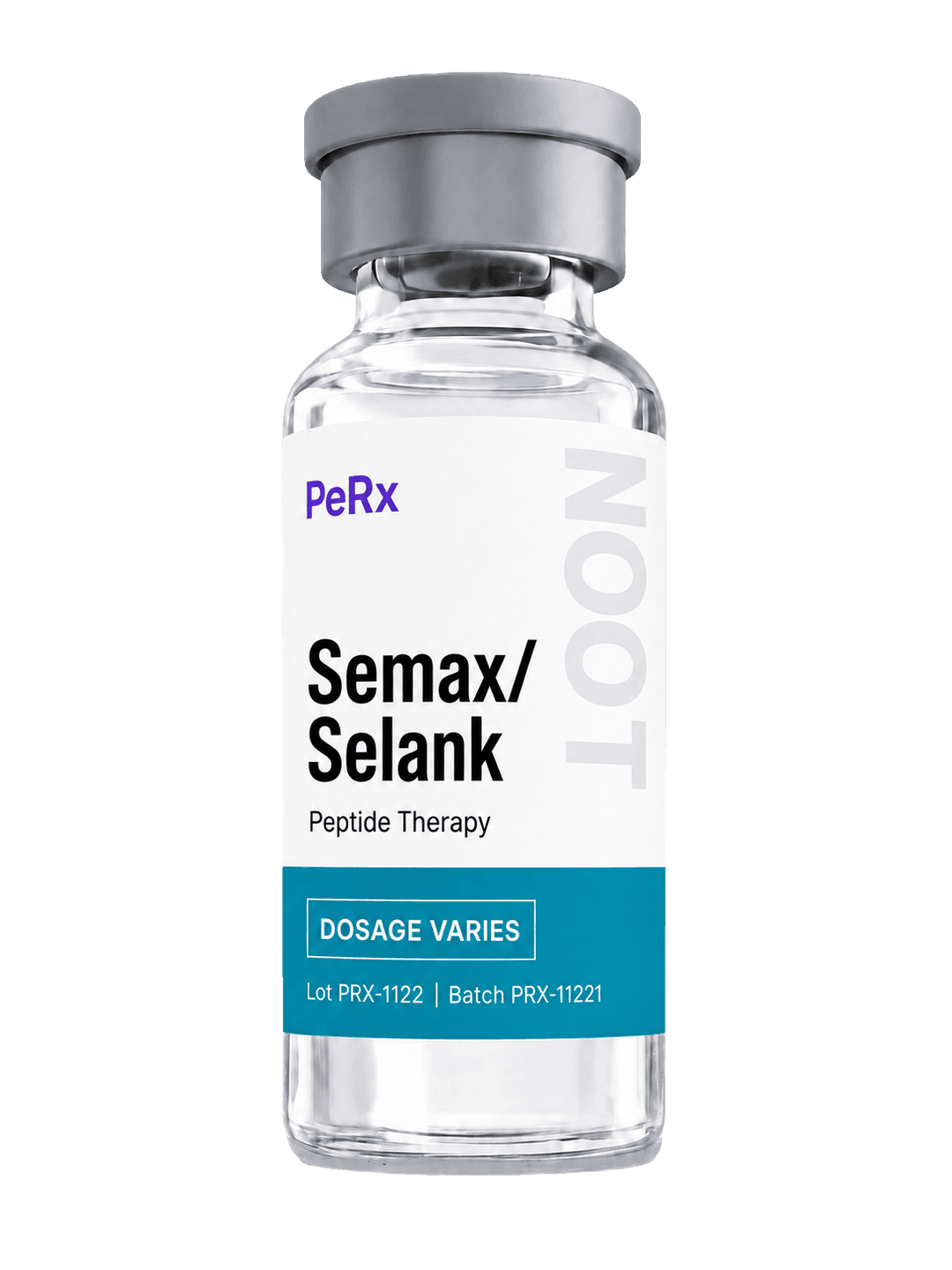
Semax/Selank
Subcutaneous blend, ready to use, no spray-device variability. Semax and Selank together in one vial, compounded by a state-licensed 503A pharmacy, prescribed by a licensed provider after an eligibility check and review.
The vial ships fully reconstituted and ready to use, packed cold, with syringes and alcohol swabs in the box. Your dose is the one printed on your prescription label.
How Semax Nasal Spray Works: Absorption and the Nose-to-Brain Pathway
The Nose-to-Brain Pathway
The upper part of the nasal cavity is lined with olfactory epithelium, the tissue that does the smelling. Olfactory nerve fibers pass from that tissue through a thin perforated bone into the olfactory bulb, which is brain. Branches of the trigeminal nerve run through the same lining. A drug that reaches this region can travel along those nerves, or through the spaces around them, into brain tissue and cerebrospinal fluid without ever entering the general circulation. It is the pathway behind every nasal peptide that is meant to act on the brain, and it is why the Russian developers of Semax made a nasal product rather than a tablet or an injection.
The rest of a nasal dose does not take that path. Some is absorbed through the lower nasal lining into blood vessels, where it behaves like an injected dose. Some runs down the back of the throat and is swallowed, which for a peptide means it is lost. So a nasal dose is really three doses in one: a brain fraction, a blood fraction and a wasted fraction, in proportions that vary with technique. Our guide to brain health peptides covers the pathway in more general terms.
What Affects Absorption
Four things change how much of a nasal dose reaches the olfactory region. Head position decides whether the drop lands high in the nose or runs straight back. Volume matters, because the lining can hold only so much liquid before the rest drains. Congestion, allergy and a recent cold change the thickness of the mucus layer and the blood flow beneath it. And the device sets the droplet size: a pump spray and a dropper deliver different sprays of liquid to different parts of the nose, which is why the same concentration can produce a different effective dose from a different bottle. None of these variables exists for a subcutaneous dose, which is the point the injection side of this page will return to.
What the Human Evidence Shows
The pharmacokinetic work is in rats, not people. Russian investigators gave radiolabeled Semax into the nose and tracked it: the peptide reached brain tissue within minutes, the fraction that arrived was small, and it was broken down quickly, leaving its three-amino-acid tail as the main remnant. That study is the basis for every claim that nasal Semax acts fast, and it is a rat study. No one has repeated it in humans.
What exists in humans is clinical and imaging data, all with the nasal route. A 1997 study followed 30 patients in the acute phase of ischemic stroke who received Semax alongside standard treatment, compared with 80 who received standard treatment alone, and reported faster recovery of motor function on clinical scales. A 2005 study of 187 patients with cerebrovascular insufficiency reported good tolerability, including in older patients. A 2000 ophthalmology study gave Semax as nasal drops to patients with optic-nerve disease. And in 2018, a resting-state MRI study gave 1% nasal Semax or placebo to 24 healthy volunteers and scanned them before dosing and again 5 and 20 minutes afterward; the Semax group showed a larger medial frontal component of the default mode network. Numbers on how much peptide was absorbed do not exist for any of these studies. What they show is that nasal Semax does something measurable in people, quickly, with few reported problems.
What onset claims rest on
When a seller says a nasal Semax product works in 15 to 30 minutes, that is what users report, not a measured human result. The measured facts are a rat study showing brain penetration within minutes and a volunteer imaging study showing network changes 5 to 20 minutes after a 1% nasal dose. Keep the two kinds of claim separate.
What 0.1% and 1% Semax Mean
The Russian product comes in two strengths, and people searching for a semax nasal spray run into both. A 0.1% solution contains 1 mg of Semax per milliliter of liquid. A 1% solution contains 10 mg per milliliter, ten times as much. The 0.1% strength is the one used for cognitive and cerebrovascular indications in Russian practice; the 1% strength is the stroke product, and it is the concentration the 2018 volunteer imaging study used. The difference is the amount of peptide in each drop, not the number of drops.
That arithmetic is where nasal dosing gets slippery. A drop is not a fixed unit. Dropper tips, pump sprays and head angle all change how much liquid comes out and how much of it lands where it can be absorbed, so two people using the same bottle can take different amounts. Seller pages often print a per-drop or per-spray figure in micrograms as though it were precise. This page does not, because it is not. If you ever need the number, it is the concentration multiplied by the volume the device actually delivers, and the second half of that equation is the part nobody can see.
Two more points. Home mixing is a poor idea for exactly this reason: a powder dissolved in tap water in a spray bottle has an unknown concentration, an unknown pH and no sterility, and the dose that reaches the nerve endings is unknowable. A pharmacy-made product removes that problem by fixing the concentration and the volume. And in either case the strength and the dose are set by a prescriber, not chosen by the person using it.
How Semax Injection Works: Subcutaneous Absorption and the Evidence
How Subcutaneous Absorption Works
A subcutaneous injection places a measured volume of solution into the fat layer just under the skin, usually the abdomen or thigh, using a short fine needle of the kind used for insulin. From there the peptide diffuses into small blood vessels and lymphatic channels over minutes to an hour, and the bloodstream carries it everywhere at once. To reach brain tissue it then has to cross the blood-brain barrier, which small peptides do only partially, or act on receptors outside the brain. The route is slower to start than a drop on the olfactory lining, and it delivers a known quantity. A semax injection from a pharmacy-made vial is the same milligram amount every time, which no semax spray can promise.
What the Evidence Does and Does Not Show
Here is the part a clinic that prescribes injected Semax has to say out loud. There is no published human study of subcutaneous Semax: no absorption data, no brain-delivery data, no measurement of how long it lasts. When the FDA reviewed Semax for its compounding advisory committee in 2026, its reviewers reported that they could not find literature on subcutaneous administration in people, or an animal study of the subcutaneous route. That is the state of the evidence, and PeRx would rather print it than have you find it elsewhere.
What does exist is animal work with injections into the abdominal cavity, a route called intraperitoneal that laboratories use for convenience. Those studies show that injected Semax reaches a rodent brain and changes behavior, which is why no one doubts the injection does something. A 2010 rat study compared the two routes directly: given into the nose, Semax improved learning on a passive-avoidance task more potently than the same peptide given by abdominal injection, while the pain-relieving effect appeared only after injection and not after nasal dosing. The authors read that as evidence that the two effects use different brain structures. Two caveats carry over to any human use. Intraperitoneal is not subcutaneous, and a rat is not a person. What the study supports is modest: route changes which effects appear and how strongly, and the nasal route had the edge on the cognitive one.
So the honest summary of the semax nasal spray vs injection evidence is this. The nasal route has human clinical data without absorption numbers. The injected route has animal data without any human data at all. Anyone who tells you the subcutaneous dose is equivalent to the nasal dose is guessing, and anyone who tells you it does nothing is ignoring the rodent work. Where to inject and how to inject peptides cover the practical side of the route for anyone who is prescribed it.
What PeRx Prescribes: A Subcutaneous Semax/Selank Blend, Ready to Use
PeRx does not carry a semax nasal spray, and it does not carry Semax on its own. The only form it prescribes is Semax and Selank together in one vial, compounded by a state-licensed 503A pharmacy as a sterile solution at a fixed concentration, given as a subcutaneous injection. The vial ships fully reconstituted and ready to use. That is a deliberate choice, made with the evidence gap above in full view, and the next three sections explain the reasoning.
Why a Prescriber May Choose Subcutaneous
The first reason is the dose. A semax injection from a pharmacy vial is a measured volume drawn into a syringe, so every dose contains the same amount of peptide, and the provider knows what that amount is. A nasal product cannot offer that. The FDA made the same point from the other direction when it said it would have strong concerns about a compounded Semax nasal spray, because nothing is known about how a container and pump would be chosen to deliver a consistent dose. The variability that worries a regulator is the same variability that makes a spray hard to prescribe responsibly.
The second reason is that there is nothing to mix. A prescribed vial arrives ready to use, so the concentration was set and checked by a pharmacist rather than estimated in a kitchen, and the solution is sterile, which matters most for anything that goes under the skin. The third is follow-up. A prescription is tied to a provider who reviews your history before the first dose and checks in before each renewal, and who can stop or change the prescription. The trade is real and PeRx states it plainly: the injection buys measured dosing, a sterile pharmacy-made product and a prescriber, and gives up the nose-to-brain shortcut the original research was built around. Some of what the nasal studies measured may not transfer to the injected route, and no one can yet say how much.
Semax and Selank Together
Selank is a separate Russian peptide, built from a fragment of the immune molecule tuftsin, that has been studied for anxiety with a calming effect that does not sedate. PeRx pairs the two because the people who ask for sharper focus are usually under pressure, and adding drive to an already tense nervous system is a poor fit. Both peptides are compounded into one vial at a fixed concentration of each, so a single morning injection delivers both. Semax vs Selank takes the two apart if you want to understand which one is doing what. On stability, the published literature contains no study of the two peptides mixed in one solution, so this page makes no claim beyond the fact that the pharmacy compounds them together and dates the vial.
What to Know Before You Start
Four things, stated without softening. Semax is not FDA approved, by any route, and the compounded product PeRx prescribes is not FDA approved either. The human evidence is limited and almost entirely nasal, so what the injected blend does for any given person is not established. There is no guarantee of any cognitive effect, and a page that promises one is selling something. And a licensed provider reviews eligibility before anything is prescribed, which means some people who ask for it will be told no. PeRx publishes how it tests its peptides so you can see what the pharmacy checks before a vial ships.
For people whose interest is sleep and longer-horizon brain health rather than daytime focus, the other Selank-containing blend is Pinealon/PE-22-28/Selank, also subcutaneous; the Pinealon guide explains what each of its three peptides has been studied for.
Semax Dosing by Route: What the Published Evidence Reports
This section reports what the sources say, as context. It is not a dosing instruction. The Russian label doses for the semax nasal spray and drops are set by Russian regulators for Russian indications, and the trial doses below belong to the patients in those trials. Your dose, if you are prescribed Semax at all, is set by your prescriber and printed on your pharmacy label. Our peptide dosage chart explains why PeRx does not publish a dose for any peptide outside that label.
| Source | Route and strength | What it reports |
|---|---|---|
| Acute ischemic stroke, 1997 (30 patients) | Nasal, 1% solution | Most effective daily doses were 12 mg for moderate stroke and 18 mg for severe stroke, over 5-day and 10-day courses, alongside standard treatment |
| Healthy volunteers, 2018 (24 adults) | Nasal, 1% solution, single dose | Resting-state MRI 5 and 20 minutes after dosing showed a larger medial frontal component of the default mode network than placebo |
| Cerebrovascular insufficiency, 2005 (187 patients) | Nasal | Clinical improvement and good tolerability, including in older patients; the abstract gives no dose |
| Optic-nerve disease, 2000 | Nasal drops, and nasal electrophoresis | Improved visual acuity, visual field and conduction alongside standard therapy; no dose in the abstract |
| Rat route comparison, 2010 | Nasal vs intraperitoneal injection, several doses | Nasal more potent for learning; pain relief only after injection. Not a human study and not subcutaneous |
| Subcutaneous, humans | Not studied | No published trial, no published dose |
Acute ischemic stroke, 1997 (30 patients)
- Route and strength
- Nasal, 1% solution
- What it reports
- Most effective daily doses were 12 mg for moderate stroke and 18 mg for severe stroke, over 5-day and 10-day courses, alongside standard treatment
Healthy volunteers, 2018 (24 adults)
- Route and strength
- Nasal, 1% solution, single dose
- What it reports
- Resting-state MRI 5 and 20 minutes after dosing showed a larger medial frontal component of the default mode network than placebo
Cerebrovascular insufficiency, 2005 (187 patients)
- Route and strength
- Nasal
- What it reports
- Clinical improvement and good tolerability, including in older patients; the abstract gives no dose
Optic-nerve disease, 2000
- Route and strength
- Nasal drops, and nasal electrophoresis
- What it reports
- Improved visual acuity, visual field and conduction alongside standard therapy; no dose in the abstract
Rat route comparison, 2010
- Route and strength
- Nasal vs intraperitoneal injection, several doses
- What it reports
- Nasal more potent for learning; pain relief only after injection. Not a human study and not subcutaneous
Subcutaneous, humans
- Route and strength
- Not studied
- What it reports
- No published trial, no published dose
Three things to take from the table. First, the human doses that exist are stroke doses, given in hospital for days, and have nothing to do with what a healthy adult might be prescribed for focus. Second, the cognitive and cerebrovascular uses in Russian practice rely on the lower 0.1% product, for which the published trial record is thinner. Third, no published human trial has validated a subcutaneous Semax dose, so published injected dosing comes from animal studies and from clinical experience rather than from a trial. PeRx says this in its own voice rather than in a footnote: the dose on a PeRx label is a prescriber judgment, informed by the nasal literature and by the pharmacy concentration, and it is reviewed at every renewal.
Semax Side Effects and Safety by Route
Semax has a reputation for being well tolerated, and the Russian trials support that at the doses they used. The side effects that do occur sort by route. With a semax nasal spray or drops, the reported problems are local: dryness or irritation of the nasal lining, a brief headache, an unpleasant taste when the solution runs down the throat, and sneezing or watering eyes right after a dose. People with chronic congestion, nasal polyps or a recent sinus infection may absorb an unpredictable amount, which is a dosing problem as much as a safety one.
With a semax injection, the problems are also local, and they are the ones any subcutaneous peptide can cause: redness, soreness or a small lump at the injection site, bruising, and a real if small risk of skin infection when sterile technique is poor. Rotating sites and using a fresh needle for every dose address most of it. Systemic effects reported with Semax by either route are uncommon in the literature and include restlessness, trouble sleeping if dosed late in the day, and in a few reports an increase in anxiety, which is one reason the PeRx product pairs it with Selank. Our general guide to peptide safety covers the screening questions that apply to every peptide prescription.
Who should not use either route without a conversation
Semax has not been studied in pregnancy or breastfeeding, in people under 18, or in people with a history of seizures or psychosis, and the FDA reviewers flagged how little long-term safety data exists by any route. If you have a psychiatric diagnosis, take a medicine that acts on serotonin or dopamine, or have an active nasal or sinus condition, tell the provider before anything is prescribed. If you develop a rash, swelling, chest tightness or trouble breathing after any dose, stop and seek care.
Giving a Subcutaneous Injection Safely
Since the injection is the route PeRx prescribes, this is the only how-to on the page. A prescribed vial arrives ready to use, with syringes and alcohol swabs, so the routine is short. Wash your hands. Wipe the vial top with a swab and let it dry. Draw the volume on your label into the syringe and tap out any air. Choose a site on the abdomen a few finger-widths from the navel, or the front of the thigh, and move it a little each day. Pinch a fold of skin, insert the short needle at a right angle, press the plunger slowly, and hold for a few seconds before withdrawing. Put the needle in a sharps container, not the trash. The full walk-through, with photos, is in how to inject peptides, and the site map specific to this product is in where to inject Selank.
Which Route Is Right for You?
The honest answer is that in the United States the choice is narrower than the research makes it look. There is no approved or pharmacy-made semax nasal spray available by prescription, so the nasal route in practice means a product bought without one, with no assurance of what is in the bottle. The semax injection is the route a licensed provider can actually prescribe and a licensed pharmacy can actually make. The question for most readers is therefore not nasal versus injection but whether a compounded, prescribed, injected Semax/Selank blend is worth trying at all, given that the human evidence for the injected route is thin.
A few pointers for that decision. If what you want is the fast-onset, nose-to-brain effect the Russian studies describe, understand that the injection has not been shown to reproduce it, and may not. If what you want is a measured, sterile, provider-reviewed product that you take once in the morning, the injection is the only route that offers it. If a needle is the obstacle, peptides without needles sets out what exists and what does not, and Semax is not among the needle-free options PeRx carries. And if you are not sure a cognitive peptide is the right starting point, a provider will tell you so during the review.
On cost, three sentences. A prescribed product costs more than a bottle from a research site because it includes the pharmacy, the testing, the provider review and the shipping. There are no separate consultation fees at PeRx and no subscription for this product. Current pricing lists what a one-month supply costs. For new visitors, the next step is the eligibility check; it takes about a minute and nothing is charged until a provider approves a prescription.
Semax vs Selank by Route: What About Selank Nasal Spray?
Selank follows the same pattern as Semax, one step further along. It is a Russian peptide developed from tuftsin, studied for generalized anxiety and for the kind of tension that disrupts concentration, and the Russian product is a nasal solution for the same anatomical reason. The published human data on Selank, including the anxiety trial described in our Selank guide, used the nasal route. Published human data on injected Selank is as sparse as it is for Semax. Semax vs Selank compares what the two peptides do; this paragraph only confirms that the route question comes out the same way for both.
PeRx does not prescribe a Selank nasal product either. Selank reaches PeRx patients inside the subcutaneous Semax/Selank blend, or inside the Pinealon/PE-22-28/Selank blend, both ready to use, both prescribed. Dosing for the blend is set by the prescriber, and this page gives none. The practical guide for the injection site is where to inject Selank.
Getting Semax Through a Prescription
The path at PeRx has four steps. You complete a short online eligibility check. A licensed provider reviews your health history and decides whether to prescribe. If approved, a state-licensed 503A pharmacy compounds the Semax/Selank vial and ships it to you fully reconstituted and ready to use, with supplies, in cold packaging. Before each renewal you complete a check-in with the provider. The product is compounded and is not FDA approved. How to get peptides prescribed online walks through each step, and are peptides legal in 2026 explains where a compounded prescription sits in the law.
Ready to find out if Semax/Selank fits you?
New visitors: the eligibility check takes about a minute, and a licensed provider reviews every order before a pharmacy fills it. Already a PeRx patient? Message your care team with any question about your route, dose or product.
Frequently Asked Questions About Semax Routes
Related Guides
Continue reading about peptides and protocols that pair well with this guide.
Selank Peptide: What It Is, What It Does & Benefits
Your immune system already makes a molecule that calms anxiety. Soviet scientists found it in the 1970s, reverse-engineered it, and created two peptides: one that quiets anxiety without sedation, and another that sharpens cognition through BDNF. Both have been prescription medications in Russia since 2009. Combined in a single injectable blend, Selank and Semax cover both sides of the equation: calm and sharp at the same time.
Semax vs Selank: Which One Do You Actually Need?
Every page ranking for this question tells you to pick one: Semax for focus, Selank for calm. The split is useful and softer than the marketing admits. Here is what the single human head-to-head found, where the two run on the same machinery, where the FDA record splits them, and why a prescribing clinic puts both in one vial instead of making you choose.
Philadelphia Peptide Therapy: 2026 Guide
A plain guide to peptide therapy in Philadelphia: what it costs across local clinics, med spas, and telehealth, and who tends to use it here. Plus how pharmaceutical-grade peptides reach any Pennsylvania address without a clinic visit.
References and Review
Every clinical and pharmacokinetic claim above is tied to one of the sources below, each checked against its PubMed record. Figures are reported as the abstracts give them. Medically reviewed by Dr. Cory Mellon, MD. This page will be updated if a human study of subcutaneous Semax is published, and the date of any update will be shown in the byline.
Shevchenko KV, Nagaev IIu, Alfeeva LIu, et al. "Kinetics of Semax penetration into the brain and blood of rats after its intranasal administration." Bioorganicheskaia Khimiia, 2006;32(1):64-70. In Russian. View study
Manchenko DM, Glazova NIu, Levitskaia NG, et al. "Nootropic and analgesic effects of Semax following different routes of administration." Rossiiskii Fiziologicheskii Zhurnal imeni I.M. Sechenova, 2010;96(10):1014-1023. In Russian. View study
Gusev EI, Skvortsova VI, Miasoedov NF, et al. "Effectiveness of semax in acute period of hemispheric ischemic stroke (a clinical and electrophysiological study)." Zhurnal Nevrologii i Psikhiatrii imeni S.S. Korsakova, 1997;97(6):26-34. In Russian. View study
Gusev EI, Skvortsova VI, Chukanova EI. "Semax in prevention of disease progress and development of exacerbations in patients with cerebrovascular insufficiency." Zhurnal Nevrologii i Psikhiatrii imeni S.S. Korsakova, 2005;105(2):35-40. In Russian. View study
Polunin GS, Nurieva SM, Baiandin DL, et al. "Evaluation of therapeutic effect of new Russian drug semax in optic nerve disease." Vestnik Oftalmologii, 2000;116(1):15-18. In Russian. View study
Lebedeva IS, Panikratova YR, Sokolov OY, et al. "Effects of Semax on the Default Mode Network of the Brain." Bulletin of Experimental Biology and Medicine, 2018;165(5):653-656. View study
U.S. Food and Drug Administration. "FDA Briefing Document: Semax-Related Bulk Drug Substances (Semax (free base) and Semax acetate)." Pharmacy Compounding Advisory Committee, July 2026. View study
Medical Disclaimer
The information provided on this website, including all articles, guides, and educational content, is for informational and educational purposes only and is not intended as medical advice, diagnosis, or treatment. Nothing on this site should be construed as a substitute for professional medical advice from a qualified healthcare provider.
The majority of peptides discussed on this site are not approved by the U.S. Food and Drug Administration (FDA) for the indications described. They are classified as bulk drug substances and are available only through a licensed prescribing provider and compounding pharmacy. All treatments require a valid prescription and provider oversight.
The majority of published research on peptide therapies has been conducted in preclinical (animal) models. While early human data is encouraging, comprehensive clinical trial data remains limited for most peptide compounds. Individual results may vary significantly based on health status, injury type, and other factors. No specific outcomes are guaranteed.
Certain peptides discussed on this site are classified as prohibited substances by the World Anti-Doping Agency (WADA) and are banned by major sports organizations including the NFL, NCAA, UFC, NBA, MLB, NHL, and PGA. If you are subject to anti-doping testing, consult your governing body before considering any peptide therapy.
Statements on this website have not been evaluated by the Food and Drug Administration. Products and therapies discussed are not intended to diagnose, treat, cure, or prevent any disease.
© 2026 Wellness MD Group PC DBA PeRx. All rights reserved.