Selank Dosage Chart: Units, Timing, Semax Pairing
Search for a Selank dosage chart and the results disagree on the amount, the frequency, the cycle and even the half-life, because most of them are research-vial sellers quoting each other. The primary record is a Russian nasal-drop label and two small Russian trials, none of which studied an injection. This page shows what those sources report, why the figures do not convert to a subcutaneous dose, and the one prescription PeRx writes: 20 units of the Semax/Selank blend, 200 mcg of each peptide, Monday through Friday, 8 weeks on and 4 off, as of November 2026.

In this article
Key Takeaways
- There is no standard Selank dose outside Russia. The registered product is a 0.15% nasal drop, 2 drops per nostril three times a day for 14 days, and the two human trials behind it are small, Russian and nasal. No published trial has given Selank by injection to people.
- PeRx prescribes Selank only inside the subcutaneous Semax/Selank blend, 1 mg/mL of each peptide in a 5 mL vial that ships fully reconstituted and ready to use: 20 units once daily Monday through Friday, 200 mcg of Selank and 200 mcg of Semax per dose, 8 weeks on and 4 off.
- One unit on a U-100 insulin syringe holds 10 mcg of each peptide at this concentration, so micrograms equal units times ten. A 5 mL vial holds 25 doses, about five weeks, for $299.
- Nasal doses do not convert into injected doses. The Russian label reports 92.8 percent nasal bioavailability and a plasma signal gone within about five minutes, a mouse study found the two routes engage different receptors, and nobody has measured the subcutaneous curve in people.
- The blend is a morning injection because Semax is the activating half of the vial, and the label says not to combine it with anti-anxiety medicines, sleep aids or alcohol. No study has tested the two peptides together, so the cautions of each apply to the pair.
- As of November 2026 Selank is not an FDA-approved drug, its 503A nomination was withdrawn, and it is not among the six peptides in the October 2026 HHS interim enforcement policy, which covers Semax only as a single-ingredient nasal product. The subcutaneous blend sits outside it.
Selank Dosing at a Glance
Peptide
Selank, a seven-amino-acid tuftsin analog (Thr-Lys-Pro-Arg-Pro-Gly-Pro)
How PeRx supplies it
Only inside the subcutaneous Semax/Selank blend, 1 mg/mL of each in a 5 mL vial. No standalone Selank, no nasal product.
Prescribed dose
20 units (0.2 mL): 200 mcg of Selank plus 200 mcg of Semax, once daily Monday through Friday
Weekly total
1 mg of each peptide across five injections
Cycle
8 weeks on, 4 weeks off
Human dosing data
Russian nasal drops only: a 0.15% label and two small trials. No injected dose studied in people.
Also contains Selank
Pinealon/PE-22-28/Selank, 2 mg/mL of each, same 20-unit Monday-to-Friday schedule
Cost
$299 per 5 mL vial at PeRx, 25 doses, about five weeks
The Selank Dosage Chart
A dosage chart normally condenses what trials settled. For Selank the trials settled a nasal drop, in Russia, in patients with anxiety diagnoses, and nothing else. Every injected figure online was scaled from those drops, borrowed from a forum, or set by a clinic. So this chart has three kinds of rows and labels each: the PeRx prescription, which a licensed provider writes for a pharmacy-set concentration; the Russian record, which is the only human evidence; and the online conventions, which are unanchored and contradict one another. For what the two peptides are and do, start with the Selank guide; the catalog-wide reference is the peptide dosage chart. This page stays on the numbers.
| Context | Selank amount | Route, frequency and duration | Standing behind it |
|---|---|---|---|
| PeRx Semax/Selank blend, prescribed | 200 mcg Selank plus 200 mcg Semax per 20-unit dose | Subcutaneous, once daily Monday through Friday, 8 weeks on then 4 off | Physician prescription; 503A pharmacy fills at 1 mg/mL of each |
| PeRx weekly total | 1 mg of each across 5 doses | Subcutaneous | Same prescription, added up |
| PeRx per 5 mL vial | 5 mg of each, 25 doses | About five weeks | Vial size times concentration |
| Inside Pinealon/PE-22-28/Selank (PeRx) | 400 mcg Selank per 20-unit dose, with 400 mcg each of Pinealon and PE-22-28 | Subcutaneous, Monday through Friday, 8 weeks on then 4 off | Blend prescription; 2 mg/mL of each |
| Russian label, 0.15% nasal drops | 2 drops per nostril, 3 times a day; roughly 0.9 mg a day by our arithmetic | Nasal; 14-day course, repeatable after 1 to 3 weeks on medical advice | Registered in Russia, sold there without a prescription; not a product PeRx carries |
| Russian trial, 2008 (62 patients) | The registered nasal drops; the abstract gives no dose | A course against the benzodiazepine medazepam | Published trial, Russian language, from the institute that developed the peptide |
| Russian trial, 2014 (60 patients) | No dose in the abstract | A course against phenazepam; effect reported a week past the last dose | Published trial, Russian language |
| Animal dose-response | 300 mcg per kilogram in rats and mice | Single doses, or daily for 5 days to 4 weeks | Per-kilogram rodent doses; they do not convert to a person |
| Online guides (research vials) | 250 to 500 mcg per dose on one site; 250 to 3,000 mcg a day on another | 10 days on and 5 off, or 14 to 30 days with an equal break | Forum convention, not evidence; the guides disagree with each other |
| Published human subcutaneous trials | None at any dose | None | Nobody has run the study |
PeRx Semax/Selank blend, prescribed
- Selank amount
- 200 mcg Selank plus 200 mcg Semax per 20-unit dose
- Route, frequency and duration
- Subcutaneous, once daily Monday through Friday, 8 weeks on then 4 off
- Standing behind it
- Physician prescription; 503A pharmacy fills at 1 mg/mL of each
PeRx weekly total
- Selank amount
- 1 mg of each across 5 doses
- Route, frequency and duration
- Subcutaneous
- Standing behind it
- Same prescription, added up
PeRx per 5 mL vial
- Selank amount
- 5 mg of each, 25 doses
- Route, frequency and duration
- About five weeks
- Standing behind it
- Vial size times concentration
Inside Pinealon/PE-22-28/Selank (PeRx)
- Selank amount
- 400 mcg Selank per 20-unit dose, with 400 mcg each of Pinealon and PE-22-28
- Route, frequency and duration
- Subcutaneous, Monday through Friday, 8 weeks on then 4 off
- Standing behind it
- Blend prescription; 2 mg/mL of each
Russian label, 0.15% nasal drops
- Selank amount
- 2 drops per nostril, 3 times a day; roughly 0.9 mg a day by our arithmetic
- Route, frequency and duration
- Nasal; 14-day course, repeatable after 1 to 3 weeks on medical advice
- Standing behind it
- Registered in Russia, sold there without a prescription; not a product PeRx carries
Russian trial, 2008 (62 patients)
- Selank amount
- The registered nasal drops; the abstract gives no dose
- Route, frequency and duration
- A course against the benzodiazepine medazepam
- Standing behind it
- Published trial, Russian language, from the institute that developed the peptide
Russian trial, 2014 (60 patients)
- Selank amount
- No dose in the abstract
- Route, frequency and duration
- A course against phenazepam; effect reported a week past the last dose
- Standing behind it
- Published trial, Russian language
Animal dose-response
- Selank amount
- 300 mcg per kilogram in rats and mice
- Route, frequency and duration
- Single doses, or daily for 5 days to 4 weeks
- Standing behind it
- Per-kilogram rodent doses; they do not convert to a person
Online guides (research vials)
- Selank amount
- 250 to 500 mcg per dose on one site; 250 to 3,000 mcg a day on another
- Route, frequency and duration
- 10 days on and 5 off, or 14 to 30 days with an equal break
- Standing behind it
- Forum convention, not evidence; the guides disagree with each other
Published human subcutaneous trials
- Selank amount
- None at any dose
- Route, frequency and duration
- None
- Standing behind it
- Nobody has run the study
Provider-set dosing
This chart reports sources. It does not recommend an amount. The dose you inject is the one on your prescription label, written by a licensed provider after reviewing your health history and medicines, and the units printed there already include the arithmetic on this page. The PeRx row is not a better guess than the online ranges; it is a different kind of number, with a screening record and a pharmacy label behind it.
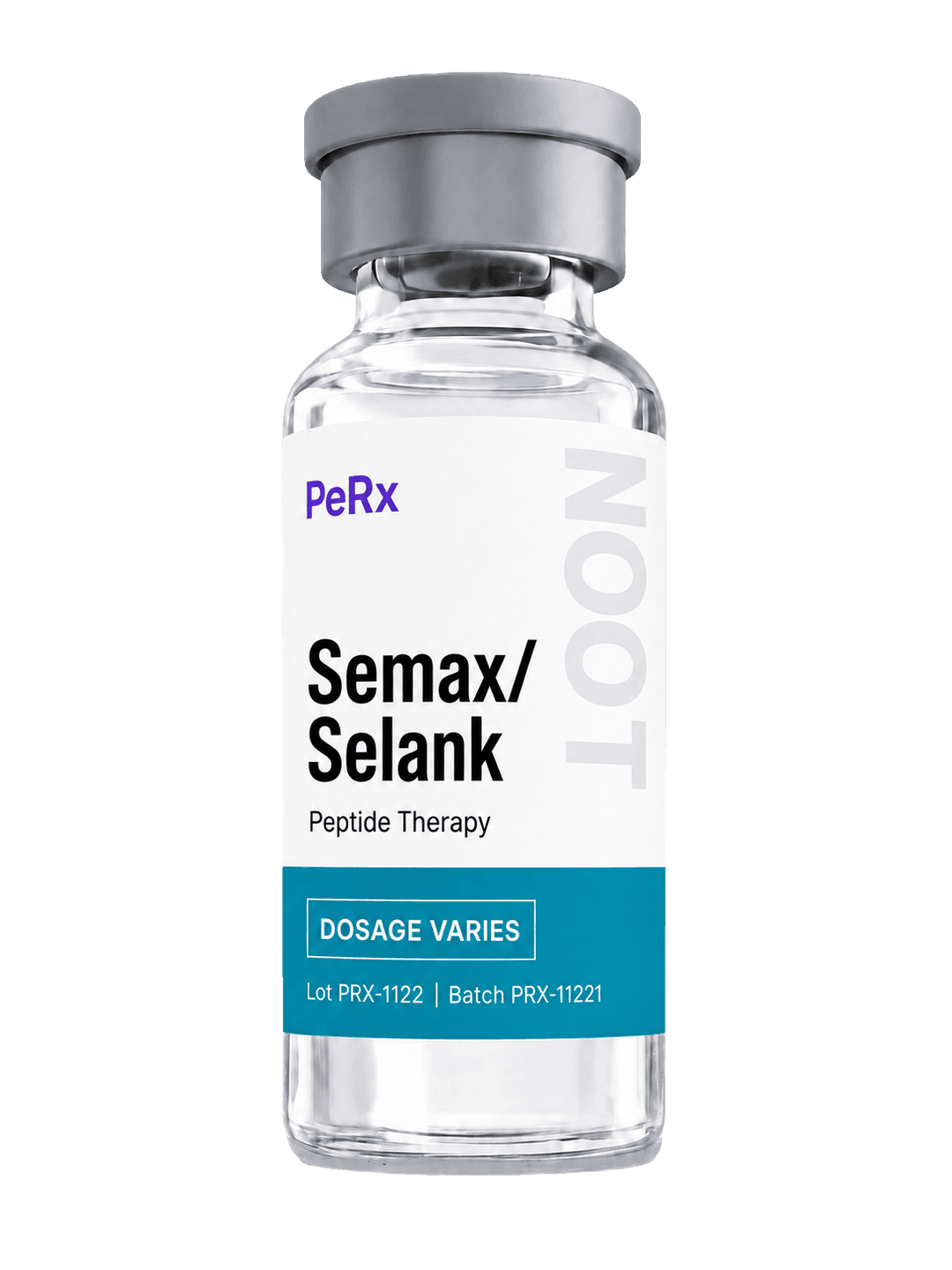
Semax/Selank
Every conversion on this page rests on one fact: PeRx ships both peptides in a single vial at a labeled 1 mg/mL of each, prescribed by a licensed provider and compounded by a US-based, state-licensed 503A pharmacy. It ships fully reconstituted and ready to use, packed cold, with insulin syringes in the box.
One 20-unit draw delivers 200 mcg of Selank and 200 mcg of Semax together. Twenty-five doses per vial, Monday through Friday, 8 weeks on and 4 off. $299 per vial.
Units on an Insulin Syringe
A U-100 insulin syringe is marked in units, 100 to the milliliter, and units measure volume rather than peptide. At 1 mg/mL, one unit is 0.01 mL and carries 10 mcg of Selank, and because both peptides share the same solution at the same strength, the same unit carries 10 mcg of Semax. The rule of thumb is one line: micrograms equal units times ten. The prescribed 20 units is 200 mcg of each. PeRx includes U-100 syringes with every order so the chart matches the barrel in your hand; how to inject peptides covers the mechanics, and where to inject Semax/Selank covers sites and rotation for this vial.
| Units on U-100 syringe | Volume | Selank (mcg) | Semax (mcg) | Doses per 5 mL vial |
|---|---|---|---|---|
| 5 units | 0.05 mL | 50 mcg | 50 mcg | 100 |
| 10 units | 0.10 mL | 100 mcg | 100 mcg | 50 |
| 15 units | 0.15 mL | 150 mcg | 150 mcg | 33 |
| 20 units (PeRx prescribed) | 0.20 mL | 200 mcg | 200 mcg | 25 |
| 25 units | 0.25 mL | 250 mcg | 250 mcg | 20 |
| 30 units | 0.30 mL | 300 mcg | 300 mcg | 16 |
| 50 units | 0.50 mL | 500 mcg | 500 mcg | 10 |
5 units
- Volume
- 0.05 mL
- Selank (mcg)
- 50 mcg
- Semax (mcg)
- 50 mcg
- Doses per 5 mL vial
- 100
10 units
- Volume
- 0.10 mL
- Selank (mcg)
- 100 mcg
- Semax (mcg)
- 100 mcg
- Doses per 5 mL vial
- 50
15 units
- Volume
- 0.15 mL
- Selank (mcg)
- 150 mcg
- Semax (mcg)
- 150 mcg
- Doses per 5 mL vial
- 33
20 units (PeRx prescribed)
- Volume
- 0.20 mL
- Selank (mcg)
- 200 mcg
- Semax (mcg)
- 200 mcg
- Doses per 5 mL vial
- 25
25 units
- Volume
- 0.25 mL
- Selank (mcg)
- 250 mcg
- Semax (mcg)
- 250 mcg
- Doses per 5 mL vial
- 20
30 units
- Volume
- 0.30 mL
- Selank (mcg)
- 300 mcg
- Semax (mcg)
- 300 mcg
- Doses per 5 mL vial
- 16
50 units
- Volume
- 0.50 mL
- Selank (mcg)
- 500 mcg
- Semax (mcg)
- 500 mcg
- Doses per 5 mL vial
- 10
The strength changes the draw
The chart only holds at 1 mg/mL. Research vials are sold by total milligrams and mixed by the buyer, so two people following the same 250 mcg protocol can be injecting different amounts, and a 2 mg/mL vial turns the same 20 units into 400 mcg. That is exactly what happens inside the Pinealon/PE-22-28/Selank blend, which PeRx fills at 2 mg/mL of each peptide. The unit number on your label refers to the whole solution, never to one ingredient.
Where the Numbers Come From
Selank came out of the Institute of Molecular Genetics in Moscow as a stabilized analog of tuftsin, an immune peptide, and the product that came out of that program is a nasal drop. The Russian instruction for use, registered in 2009, describes a 0.15 percent solution, 1.5 mg per milliliter in a 3 mL dropper bottle, taken as 2 drops in each nostril three times a day for 14 days, with a repeat course possible after 1 to 3 weeks on medical advice. It is sold in Russia without a prescription. A standard dropper gives roughly 0.05 mL per drop, so that regimen is about 300 mcg per round and 0.9 mg a day; the conversion is ours and approximate, since the label states drops, not milligrams. PeRx does not carry this product or any nasal form of Selank.
Peptogen Innovative Scientific-Production Center, Moscow. Selank nasal drops 0.15%, instruction for medical use, registration LSR-003338/09, instruction dated October 1, 2011 (Russian). Dosing, course length, pharmacokinetics and contraindications as reproduced on medi.ru. View study
Vidal Russia drug reference. Selank nasal drops 0.15%: composition, pharmacokinetics, indications and contraindications; re-registration LP-No.(010951)-(RG-RU) dated July 15, 2025 (Russian). View study
Two trials carry the human evidence. In 2008 Zozulia and colleagues reported 62 patients with generalized anxiety disorder or neurasthenia, 30 given Selank and 32 given medazepam, a benzodiazepine, rated on the Hamilton, Zung and CGI scales: similar anxiolytic scores in both arms, with Selank adding an antiasthenic and mildly activating effect, and no dose in the abstract. In 2014 Medvedev and colleagues compared Selank with phenazepam in 60 patients with phobic-anxiety and somatoform disorders, described a pronounced anxiolytic and mild nootropic effect that lasted about a week after the last dose, and again gave no dose. Both are Russian-language, from the community that developed the peptide, and neither has been replicated outside it. They examined patients with diagnosed conditions; nothing here is a claim that Selank treats any condition.
Zozulia AA, Neznamov GG, Siuniakov TS, et al. [Efficacy and possible mechanisms of action of a new peptide anxiolytic selank in the therapy of generalized anxiety disorders and neurasthenia]. Zhurnal Nevrologii i Psikhiatrii imeni S.S. Korsakova. 2008;108(4):38-48. Russian. View study
Medvedev VE, Tereshchenko ON, Israelian AIu, et al. [A comparison of the anxiolytic effect and tolerability of selank and phenazepam in the treatment of anxiety disorders]. Zhurnal Nevrologii i Psikhiatrii imeni S.S. Korsakova. 2014;114(7):17-22. Russian. View study
The animal record is where the per-kilogram figures come from. Seredenin and colleagues gave rats 300 mcg per kilogram in 1995 and reported a calmer response to stress. A Polish group dosed rats with 0.3 mg per kilogram daily for four weeks in 2006 and saw the anxiety measures fall from the second day and stay down. Volkova and colleagues gave rats 300 mcg per kilogram in 2016 and found 45 neurotransmission genes shifted within an hour in a pattern that tracked GABA itself, which is where the GABA-modulation story comes from. These are rodent doses by body weight; they do not scale to a 70 kg adult by multiplication, and none used the subcutaneous route at a human-sized dose.
Seredenin SB, Semenova TP, Kozlovskaia MM, et al. [The characteristics of the anxiolytic action of taftsin and its analog TP-7 on behavior and serotonin metabolism in the brain of rats with chronic deprivation of serotoninergic system activity]. Eksperimentalnaia i Klinicheskaia Farmakologiia. 1995;58(6):3-6. Russian. View study
Czabak-Garbacz R, Cygan B, Wolanski L, Kozlovsky I. "Influence of long-term treatment with tuftsin analogue TP-7 on the anxiety-phobic states and body weight." Pharmacological Reports. 2006;58(4):562-567. View study
Volkova A, Shadrina M, Kolomin T, et al. "Selank Administration Affects the Expression of Some Genes Involved in GABAergic Neurotransmission." Frontiers in Pharmacology. 2016;7:31. View study
Half-Life: Minutes, and Two Different Clocks
Half-life is the Selank number online sources disagree about most: under two minutes on one page, two to three on another, 25 to 30 on a third. The only primary figure is on the Russian label, and it describes the nasal product: 92.8 percent bioavailability through the nasal lining, a signal in blood plasma within about 30 seconds, and a concentration that falls away over roughly 5 to 5.5 minutes, with no metabolites detected because tissue peptidases break the molecule down quickly. The label states no half-life, so every figure online is someone rounding that paragraph differently, and the 25-to-30-minute version has no source we can find.
A short plasma life is not a short effect, which is the second clock. Tritium-labeling work from the Moscow group traced what Selank becomes once it breaks down, a pentapeptide, a tripeptide and two dipeptides the same group studies as active peptides in their own right, and found the intact peptide in rat brain tissue within minutes. In the 2014 trial the effect persisted for about a week after dosing stopped. So the peptide clears in minutes, its fragments linger, and the reported effect outlasts both. None of these curves has been measured after a subcutaneous dose in people.
Zolotarev IuA, Dadaian AK, Dolotov OV, et al. [Evenly tritium-labeled peptides and their in vivo and in vitro biodegradation]. Bioorganicheskaia Khimiia. 2006;32(2):183-191. Russian. View study
Ashmarin IP, Baglikova KE, Edeeva SE, et al. [A comparative analysis of distribution of glyprolines administered by various routes]. Bioorganicheskaia Khimiia. 2008;34(4):464-470. Russian. View study
Nasal Drops vs the Injection
The studied route is nasal because peptides are digested in the gut, and because the Moscow group found, in rats, that nasal delivery put the most intact peptide into the brain; the nose-to-brain explanation is a proposed mechanism, not a pathway measured in people. The Russian label and both human trials used the drops. PeRx does not carry a nasal Selank, a standalone Selank, or any nasal product at all. The only form it prescribes is the Semax/Selank blend, given as a subcutaneous injection and compounded by a state-licensed 503A pharmacy at a fixed concentration.
No study has compared the two routes in people, and the one animal study that did found they are not two ways to deliver the same effect. Vasilieva and colleagues gave mice 300 mcg per kilogram a day for five days, by injection into the abdomen or by nasal drops. Both routes produced the calmer behavior in the anxious mouse strain, but the injected route increased GABA-receptor binding in the frontal cortex while the nasal route increased NMDA-receptor binding instead. Same peptide, same dose, different receptors. That is the clearest reason not to treat 0.9 mg of drops as a template for an injected dose; the number on a PeRx label is a prescriber judgment for an injected product. Semax nasal spray vs injection walks through the same question for the other half of the vial.
Vasilieva EV, Kondrakhin EA, Salimov RM, Kovalev GI. [Comparison of pharmacological effects of heptapeptide selank after intranasal and intraperitoneal administration to BALB/c and C57BL/6 mice]. Eksperimentalnaia i Klinicheskaia Farmakologiia. 2016;79(9):3-11. Russian. View study
When to Inject Semax/Selank
The prescription names a frequency, once daily Monday through Friday, and the blend itself supplies the time of day. Selank is the calmer half of the vial, but Semax is in the same draw, and the Russian 0.1 percent Semax label lists excitation and insomnia among its side effects. Patients on the blend describe the same thing when a dose lands late: feeling wired, sleeping badly. So the answer is morning or early in the day; online guides that place Selank in the evening are describing a standalone product. Food makes no difference to a subcutaneous injection. The label instructions that matter are about combinations: do not combine the blend with anti-anxiety medications, sleep aids or alcohol, and do not drive or operate heavy machinery until you know how it affects you. The clock logic for every PeRx peptide is in best time of day to take peptides.
The one-line answer
Morning, five days a week, at a fresh site each time, with nothing sedating alongside it. The Semax in the vial is the reason for the morning.
Cycle: 8 Weeks On, 4 Weeks Off
The PeRx prescription runs the blend for 8 weeks, then stops for 4 before the next block. The Russian label works in 14-day courses with a 1 to 3 week gap, and the online guides describe everything from 10 days on and 5 off to a month on and a month off. None of those is a trial result: the Russian course is a regulatory decision for a nasal product, the online cycles are convention, and the 8-and-4 block is the prescriber judgment PeRx applies to an injected blend that also contains Semax. The honest basis for a break is that no long-term human safety data exists beyond the short Russian courses, and the 2014 trial suggests the effect carries over for about a week after stopping.
| PeRx blend | Russian nasal label | Online research-vial guides | |
|---|---|---|---|
| On period | 8 weeks, Monday through Friday | 14 days, three times a day | 10 days to 4 weeks |
| Off period | 4 weeks | 1 to 3 weeks before a repeat course | 5 days to 4 weeks |
| Doses in one on period | 40 injections | 42 rounds of drops | Varies |
| Vials per on period | Two 5 mL vials (25 doses each) | One 3 mL bottle | Buyer computes |
| Basis | Prescriber judgment for an injected blend | Russian registration | Convention |
On period
- PeRx blend
- 8 weeks, Monday through Friday
- Russian nasal label
- 14 days, three times a day
- Online research-vial guides
- 10 days to 4 weeks
Off period
- PeRx blend
- 4 weeks
- Russian nasal label
- 1 to 3 weeks before a repeat course
- Online research-vial guides
- 5 days to 4 weeks
Doses in one on period
- PeRx blend
- 40 injections
- Russian nasal label
- 42 rounds of drops
- Online research-vial guides
- Varies
Vials per on period
- PeRx blend
- Two 5 mL vials (25 doses each)
- Russian nasal label
- One 3 mL bottle
- Online research-vial guides
- Buyer computes
Basis
- PeRx blend
- Prescriber judgment for an injected blend
- Russian nasal label
- Russian registration
- Online research-vial guides
- Convention
The vial math follows from the cycle. Twenty-five doses per vial is five weeks of weekday injections, so an 8-week block spans two vials and leaves ten doses on the second; whether those carry into the next block depends on the use-by date on your label, and how to store peptides covers keeping a vial good for its labeled life. The Pinealon/PE-22-28/Selank blend runs the same 8-and-4 pattern on its own prescription, and which peptide classes need breaks at all is answered in the peptide cycling guide. Whatever this page describes, the schedule on your label is the one you follow.
Semax and Selank: Pairing in One Vial
Most pages about semax and selank describe two products and a schedule for juggling them: Semax earlier in the day, Selank later, or the two staggered. The PeRx product makes that moot. Both peptides are in one solution at 1 mg/mL each, so a single draw sets both doses at once, always in a 1 to 1 ratio, and there is no way to dose one without the other, raise one alone, or move one to the evening. The reasoning behind prescribing them as a pair is in Semax vs Selank, and the Semax peptide guide covers the other half of the vial on its own.
What the pairing does not have is a trial. No published study has tested Semax and Selank together against either alone, so the combination rests on mechanism and prescribing practice, and the cautions of each apply to both. Interactions with antidepressants, anti-anxiety medicines and stimulants have not been characterized for either peptide, which is why the label rules out anti-anxiety medications and sleep aids and why the provider review asks about every medicine you take. The one direct comparison is a 2020 imaging study: 52 healthy volunteers scanned before and at 5 and 20 minutes after a single dose of Semax, Selank or placebo, with the two peptides changing connectivity around the right amygdala in overlapping but distinct ways. It shows both reach the brain quickly, not that the pair adds up the way marketing implies.
Panikratova YR, Lebedeva IS, Sokolov OY, et al. "Functional Connectomic Approach to Studying Selank and Semax Effects." Doklady Biological Sciences. 2020;490(1):9-11. View study
What Changes the Dose, and What Does Not
Almost nothing, which is the point of a fixed prescription. Body weight does not: there is no human data from which a per-kilogram Selank dose could be derived, so the 20 units is the same for every adult who passes screening. The goal does not either; no study supports a goal-specific dose. There is no loading phase and no ramp. Day one and day forty are the same draw, and if a different dose step is ever warranted, it is decided at a renewal check-in and printed on a new label, not improvised from the chart.
Two things do change what you are taking. The first is the product: Selank also rides inside the Pinealon/PE-22-28/Selank blend at twice the concentration, so moving between the vials changes the Selank per dose from 200 mcg to 400 mcg while the units stay at 20. One product at a time, as prescribed. The second is anything added on top; a research-vial Selank or an overseas nasal product alongside a prescription combines an unregulated product of unknown strength with a prescribed one, and the screening no longer describes what you are injecting. A site reaction that spreads or lasts more than a couple of days, hives, dizziness or drowsiness that does not pass, or a change in mood or sleep you cannot account for is a message to the care team, not a dose change. Semax and Selank side effects sorts reported effects from theoretical ones, and what providers review before prescribing peptides explains who is screened out, including anyone on anti-anxiety medicines, anyone pregnant or breastfeeding, and anyone with a psychiatric or seizure history.
What a Month of Semax/Selank Costs
The Semax/Selank vial is $299 at PeRx. At 20 units per dose a 5 mL vial holds 25 doses, five weeks on a Monday-through-Friday schedule, so each injection is about twelve dollars and an 8-week block is two vials. The price includes the licensed provider review, compounding at a US-based, state-licensed 503A pharmacy, cold shipping, insulin syringes and alcohol swabs; there is no membership, and your card is saved at checkout and charged only if a provider approves the prescription. Every PeRx price is public on the pricing page, and ordering lives on the product page. The units chart only works because the concentration is printed, fixed and pharmacy-verified, which a research vial sold by total milligrams cannot promise; how PeRx tests its peptides covers what is verified before a vial ships.
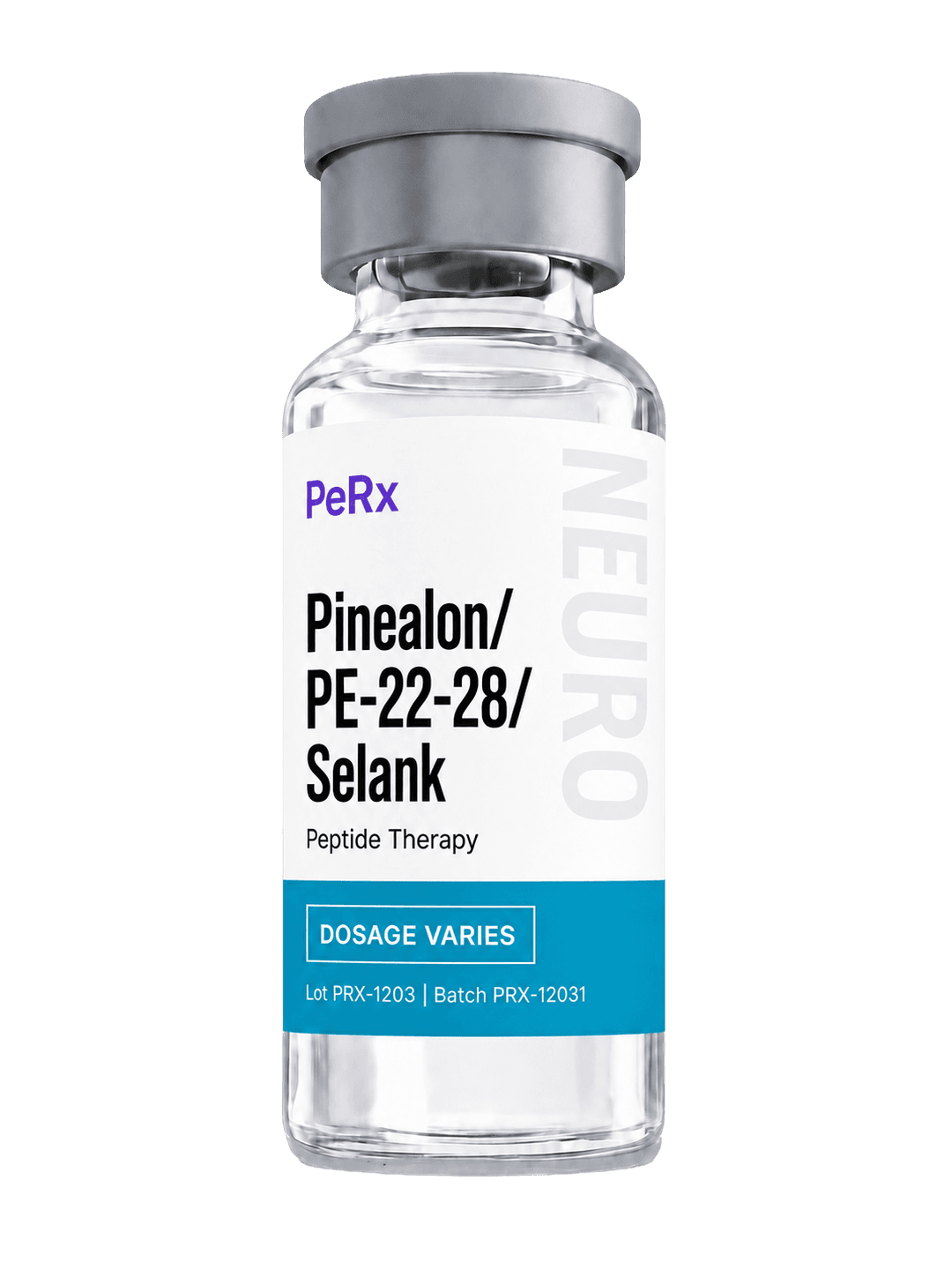
Pinealon/PE-22-28/Selank
The other PeRx vial that contains Selank. Three peptides at 2 mg/mL each, so the same 20-unit draw carries 400 mcg of Selank alongside 400 mcg each of Pinealon and PE-22-28, Monday through Friday, 8 weeks on and 4 off, aimed at sleep and neuroprotection rather than daytime focus.
A provider prescribes one Selank-containing vial or the other, not both. $299 per vial. The Pinealon guide and the blend guide cover its other two components.
If You Miss a Dose
The rule is calendar-based, with one twist for this vial. If you remember on the same day and it is still morning or early afternoon, take the dose. If it is evening, skip it: a late dose of a Semax-containing blend is the one most likely to cost you a night of sleep, and one missed weekday out of forty changes nothing worth correcting. Never draw a double to catch up. Weekends are not missed doses; Saturday and Sunday off is the schedule as written, so Monday is a normal dose, not a make-up. If you stopped for several days because something felt wrong, do not quietly restart; a reaction that made you stop is information the care team should have first, and you can reach them through contact.
FDA Status of Selank, November 2026
FDA status checked November 26, 2026
Selank is not an FDA-approved drug and is not a component of one. Its nomination for the 503A bulks list was withdrawn, and the FDA page that tracks those nominations, current as of April 22, 2026, keeps Selank acetate in its withdrawn table with the note that compounded Selank may carry an immunogenicity risk by some routes and that the agency lacks important information about its safety in humans. Selank was not among the seven peptides the Pharmacy Compounding Advisory Committee reviewed in July 2026, and it is not among the six in the interim enforcement discretion policy HHS announced on October 28, 2026 and published in the Federal Register on October 30. That policy covers Semax only as a single-ingredient product for nasal use, and only products containing one listed peptide, so the subcutaneous Semax/Selank blend sits outside it on both counts. Compounded Selank, in any product, is not FDA approved. Regulatory status can change; the date above is when it was last checked.
None of that is a dosing finding. The FDA has not reviewed a Selank dose, the advisory committee has not discussed one, and the HHS policy sets conditions on sourcing, labeling and reporting rather than on amounts. What the record does say is that the human safety information the agency would want for an injected product does not exist, the same gap this page describes from the dosing side. What the July 2026 votes did and did not change is on the FDA panel results, and the broader question is taken up in is peptide therapy safe.
U.S. Food and Drug Administration. "Certain Bulk Drug Substances for Use in Compounding That May Present Significant Safety Risks." Withdrawn-nominations table, entry for Selank acetate (TP-7). Content current as of April 22, 2026. View study
U.S. Department of Health and Human Services. "Enforcement Discretion Policy Regarding 503A Compounding Using Certain Peptide Bulk Drug Substances." Notice of availability, Federal Register Vol. 91, No. 209, October 30, 2026, FR Doc. 2026-22192, Docket HHS-OASH-2026-0496. View study
Getting Semax/Selank Through a Prescription
The path is short. An eligibility check on the site, then a licensed provider reviews your health history, your medicines and your mental-health history and decides whether the blend is appropriate; the provider may prescribe it, suggest a different peptide, or decline. If approved, a state-licensed 503A pharmacy fills the prescription at the labeled concentration and ships it cold, ready to use with no reconstitution needed, with the prescribed dose on the dosing sheet packed with it. No lab draw is required, and there is a check-in before each renewal, which is where any change to the prescription happens. PeRx prescribes to adults 21 and older. The general process is in how to get peptides prescribed online, and what PeRx carries for focus and stress is on the nootropic peptides page and in nootropic peptides for brain health.
Common Questions
Related Guides
Continue reading about peptides and protocols that pair well with this guide.
Semax vs Selank: Which One Do You Actually Need?
Every page ranking for this question tells you to pick one: Semax for focus, Selank for calm. The split is useful and softer than the marketing admits. Here is what the single human head-to-head found, where the two run on the same machinery, where the FDA record splits them, and why a prescribing clinic puts both in one vial instead of making you choose.
Selank Peptide: What It Is, What It Does & Benefits
Your immune system already makes a molecule that calms anxiety. Soviet scientists found it in the 1970s, reverse-engineered it, and created two peptides: one that quiets anxiety without sedation, and another that sharpens cognition through BDNF. Both have been prescription medications in Russia since 2009. Combined in a single injectable blend, Selank and Semax cover both sides of the equation: calm and sharp at the same time.
Peptides for Perimenopause: Sleep, Joints, Libido
Perimenopause rarely arrives as one problem. It shows up as broken sleep, new joint aches, and a drop in desire, often all at once. This guide maps the symptom cluster to the peptides that target each piece, and explains where peptides fit alongside hormone therapy rather than replacing it.
Ready to get started?
Pharmaceutical-grade Semax/Selank in one vial, prescribed by a licensed provider, compounded at a US-based, state-licensed 503A pharmacy at a labeled 1 mg/mL of each, and shipped to your door ready to use with no reconstitution needed.
Medical Disclaimer
The information provided on this website, including all articles, guides, and educational content, is for informational and educational purposes only and is not intended as medical advice, diagnosis, or treatment. Nothing on this site should be construed as a substitute for professional medical advice from a qualified healthcare provider.
The majority of peptides discussed on this site are not approved by the U.S. Food and Drug Administration (FDA) for the indications described. They are classified as bulk drug substances and are available only through a licensed prescribing provider and compounding pharmacy. All treatments require a valid prescription and provider oversight.
The majority of published research on peptide therapies has been conducted in preclinical (animal) models. While early human data is encouraging, comprehensive clinical trial data remains limited for most peptide compounds. Individual results may vary significantly based on health status, injury type, and other factors. No specific outcomes are guaranteed.
Certain peptides discussed on this site are classified as prohibited substances by the World Anti-Doping Agency (WADA) and are banned by major sports organizations including the NFL, NCAA, UFC, NBA, MLB, NHL, and PGA. If you are subject to anti-doping testing, consult your governing body before considering any peptide therapy.
Statements on this website have not been evaluated by the Food and Drug Administration. Products and therapies discussed are not intended to diagnose, treat, cure, or prevent any disease.
© 2026 Wellness MD Group PC DBA PeRx. All rights reserved.