TB-500 Benefits: Grading the Evidence Claim by Claim
Faster healing, looser tendons, a stronger heart, thicker hair: every TB-500 benefit list makes the same promises in the same order. This page takes each claim and asks what was actually measured, in whom, and whether it was the fragment people inject or the full protein the research mostly studied.

In this article
Key Takeaways
- No human trial of TB-500 has ever been published. The FDA’s own literature search ahead of its July 2026 advisory committee found no article in which TB-500 was given to people. One safety study in adults with heart disease began recruiting in China in 2026.
- The best-supported benefits belong to the full thymosin beta-4 protein, not the fragment: small phase 2 trials of a gel on venous and pressure ulcers and of eye drops for a damaged cornea. Nobody injects TB-500 for either.
- The benefits marketed hardest have the least behind them. Tendon repair rests on two rat studies, one of which is the only animal study of TB-500 itself. Flexibility and range of motion have never been measured in any study, in any species.
- A 2024 laboratory paper found that TB-500 itself did nothing in a wound-closure assay while one of its breakdown products did, which is part of why FDA staff concluded the evidence for wound healing is lacking.
- At PeRx, TB-500 is prescribed only inside BPC/TB-500, BPC/TB-500 Capsules and KLOW, each a compounded product that is not an FDA-approved drug, and it is prohibited at all times under the WADA list.
TB-500 Benefits: Quick Facts
What TB-500 is
A synthetic seven-amino-acid fragment (residues 17 to 23) of thymosin beta-4, a 43-amino-acid protein found in nearly every human cell. The fragment carries the actin-binding region.
Human evidence for TB-500
None published. One phase 1/2 safety study in 80 adults with stable heart disease is recruiting in China (started February 2026).
Best-supported claim
Wound healing, and only for the full protein: phase 2 trials of a thymosin beta-4 gel on venous and pressure ulcers, and eye-drop trials for corneal damage.
Least-supported claims
Flexibility and range of motion (no study in any species), hair growth and heart repair in people (rodent and pig work only).
Direct TB-500 data
A 2026 scoping review of 80 studies found one that tested TB-500 itself. Since then, one rat Achilles tendon study of TB-500 has been published.
At PeRx
Only inside BPC/TB-500 ($299), BPC/TB-500 Capsules ($225) and KLOW ($349), each ready to use and prescribed after a licensed provider reviews your eligibility. No standalone TB-500.
Regulatory status
Not FDA-approved. FDA staff proposed not adding it to the 503A list in May 2026; the advisory committee voted 8 to 6 to recommend it anyway. On the WADA Prohibited List at all times.
How the grades on this page work
A: a human trial of TB-500 itself. None exists, so no claim on this page earns an A. B: a human trial of full-length thymosin beta-4. C: an animal or laboratory study of the fragment. D: an animal or laboratory study of the full protein only. F: no study of any kind. Every grade names the paper behind it, and every PubMed reference was checked against the National Library of Medicine record on November 23, 2026.
TB-500 is sold on the strength of a protein it is not. Thymosin beta-4 is a 43-amino-acid protein that cells use to manage actin, the scaffolding they rebuild when they move, and it has a real research record: wound gels tested in people, eye drops tested in people, mouse hearts, rat ligaments. TB-500 is a seven-amino-acid piece of it, chosen because that piece binds actin, and almost none of that research record was generated with the piece. Our TB-500 explainer covers what the molecule is and how it is supposed to work. This page does the narrower job: it takes the benefits people are promised and grades each one.
The grades matter because the gap is wide. A June 2026 scoping review in Applied Sciences gathered 80 studies on thymosin beta-4 and TB-500 for tissue healing and found that direct evidence on TB-500 was limited to a single included study, with tendon, ligament and muscle evidence described as comparatively sparse. When FDA staff ran their own literature search for the agency’s July 2026 advisory committee, they found no article in which TB-500 had been administered to humans. So when a benefit list says "TB-500 heals tendons," the honest translation is usually "the parent protein did something in a rat ligament, and we are hoping the fragment does too."
Why TB-500 Benefit Lists Need Grades
Three things get blurred in a typical benefit list. The first is the molecule: results on full thymosin beta-4 are reported as if they were results on TB-500. The second is the route: a gel on an ulcer or a drop in an eye is reported as if it told you something about a subcutaneous injection. The third is the species: a mouse heart or a rat tendon is reported as if it were a person. The grading system here keeps those three distinctions in view on every row, because a reader deciding whether to pursue a prescription deserves to know which of the three leaps each claim requires.
TB-500 Benefits at a Glance
| Claimed benefit | What was measured, and in whom | Grade |
|---|---|---|
| Wound and skin healing | Phase 2 trials of a thymosin beta-4 gel in people with venous and pressure ulcers; rat wounds with the protein; one topical mouse study of a non-acetylated fragment | B for the protein, C for the fragment |
| Tendon and ligament repair | A 2026 rat Achilles study of TB-500 itself; a 2013 rat ligament study of the protein. No human study of either | C |
| Muscle recovery | Chronic thymosin beta-4 in a mouse model of muscular dystrophy produced more regenerating fibers and no gain in strength | D |
| Reduced inflammation | Suppressed NF-kB signaling in corneal cells and cultured cells, full protein; no human inflammation trial | D |
| Heart repair | Mouse and pig studies of the protein after induced heart injury; a human IV safety study of the protein in 40 volunteers; a TB-500 safety trial recruiting in 2026 | D, with a safety-only human trial under way |
| Hair growth | Rat and mouse hair follicle study of the protein, 2004. Nothing in people | D |
| Flexibility and range of motion | No study has measured either, in any species, for the fragment or the protein | F |
| Eye surface healing | Randomized trials of thymosin beta-4 eye drops for dry eye and neurotrophic keratopathy; the strongest human data in the file and the least relevant to injection | B |
Wound and skin healing
- What was measured, and in whom
- Phase 2 trials of a thymosin beta-4 gel in people with venous and pressure ulcers; rat wounds with the protein; one topical mouse study of a non-acetylated fragment
- Grade
- B for the protein, C for the fragment
Tendon and ligament repair
- What was measured, and in whom
- A 2026 rat Achilles study of TB-500 itself; a 2013 rat ligament study of the protein. No human study of either
- Grade
- C
Muscle recovery
- What was measured, and in whom
- Chronic thymosin beta-4 in a mouse model of muscular dystrophy produced more regenerating fibers and no gain in strength
- Grade
- D
Reduced inflammation
- What was measured, and in whom
- Suppressed NF-kB signaling in corneal cells and cultured cells, full protein; no human inflammation trial
- Grade
- D
Heart repair
- What was measured, and in whom
- Mouse and pig studies of the protein after induced heart injury; a human IV safety study of the protein in 40 volunteers; a TB-500 safety trial recruiting in 2026
- Grade
- D, with a safety-only human trial under way
Hair growth
- What was measured, and in whom
- Rat and mouse hair follicle study of the protein, 2004. Nothing in people
- Grade
- D
Flexibility and range of motion
- What was measured, and in whom
- No study has measured either, in any species, for the fragment or the protein
- Grade
- F
Eye surface healing
- What was measured, and in whom
- Randomized trials of thymosin beta-4 eye drops for dry eye and neurotrophic keratopathy; the strongest human data in the file and the least relevant to injection
- Grade
- B
Read the grade column top to bottom and the shape is clear: the two B grades are for a gel and an eye drop, the claims people inject TB-500 for sit at C and D, and the claim that sells recovery stacks to desk workers with tight hips, flexibility, is an F. That does not make the C and D claims false. It makes them untested, which is a different thing and the only honest thing to say.
BPC/TB-500: The Only Way TB-500 Is Prescribed at PeRx
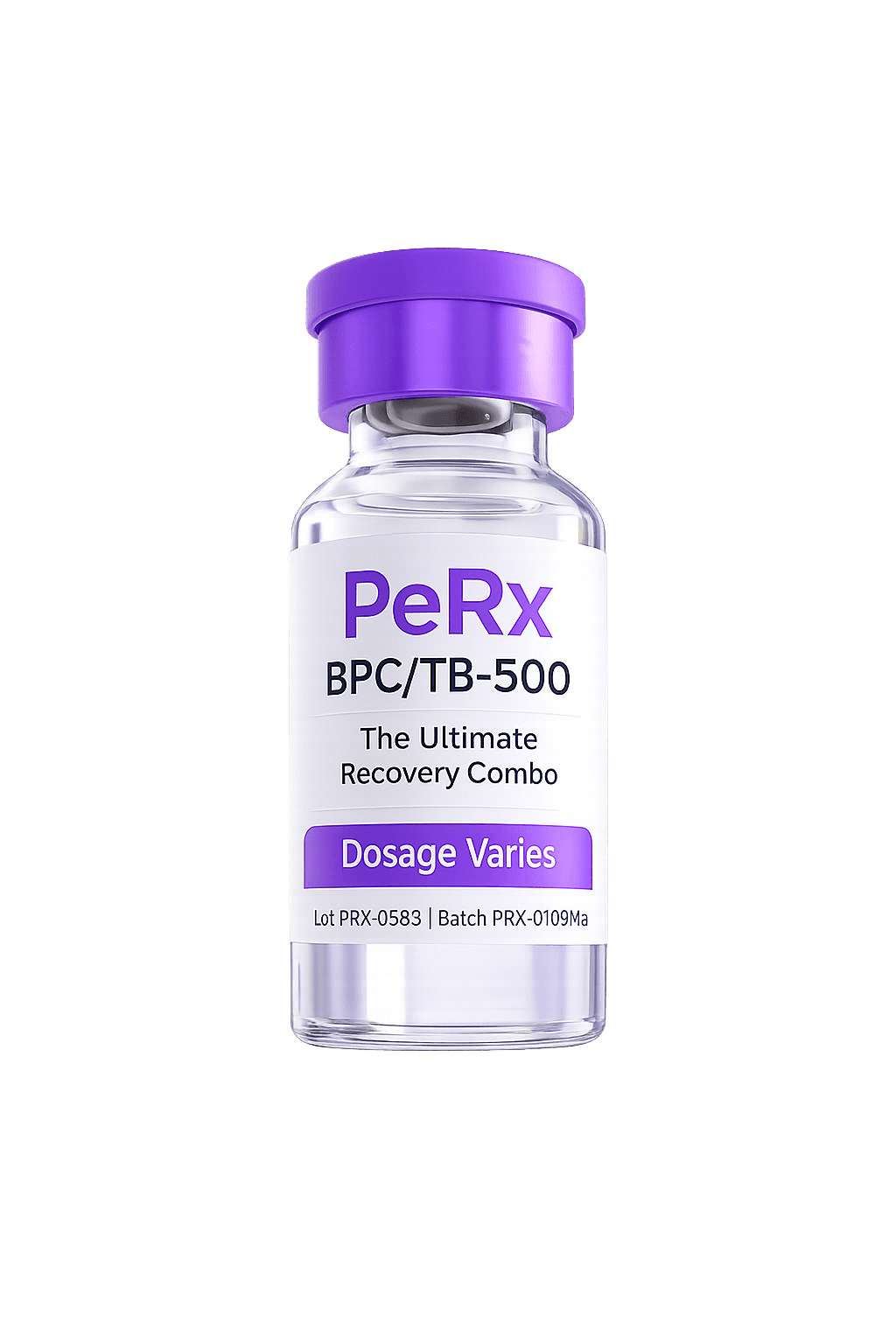
TB-500 does not ship on its own at PeRx. It is prescribed inside BPC/TB-500, a single ready-to-use subcutaneous vial that pairs it with BPC-157, the peptide with the stronger local-repair record; the BPC/TB-500 guide explains the pairing and BPC-157 vs TB-500 compares the two. A capsule version exists for readers who prefer no needle.
It is a compounded product from a state-licensed 503A pharmacy, not an FDA-approved drug, and the studies graded on this page describe single molecules, not the combination. A licensed provider reviews your eligibility before any order.
TB-500 for Wound and Skin Healing
This is the claim with the longest paper trail, and it is worth reading closely because the trail belongs almost entirely to the parent protein applied to the skin. In 1999 Malinda and colleagues showed that thymosin beta-4 sped wound closure in rats. A decade later it reached people: a European phase 2 trial gave a 0.03% thymosin beta-4 gel to 73 patients with venous ulcers, reporting that the dose "may have the potential to accelerate" healing, with roughly a quarter of patients fully healed at three months. Treadwell and colleagues then summarized two phase 2 trials, in stasis and pressure ulcers, and concluded the gel accelerated healing by almost a month in the patients who did heal. Those are modest results, in a gel, on open wounds, and they are the best human evidence anyone can cite for any TB-500 benefit.
What the fragment itself has shown
One study comes close to testing the product people buy. In 2003 Philp and colleagues applied a synthetic seven-amino-acid peptide containing the actin-binding domain, the same sequence as TB-500 without its acetyl cap, to wounds in diabetic and aged mice, and found repair comparable to the parent protein. That is the fragment evidence FDA staff accepted as relevant. It is topical, it is mice, and it is one paper. Against it sits a 2024 laboratory study, covered further down, in which TB-500 itself did nothing in a wound-closure assay. The grade here is C for the fragment and B for the protein, and the distance between the two letters is the distance between what was studied and what is sold.
Guarnera G et al., "The effect of thymosin treatment of venous ulcers," Annals of the New York Academy of Sciences, 2010. Phase 2, 73 patients, 0.03% thymosin beta-4 gel. View study
Treadwell T et al., "The regenerative peptide thymosin β4 accelerates the rate of dermal healing in preclinical animal models and in patients," Annals of the New York Academy of Sciences, 2012. Two phase 2 trials, stasis and pressure ulcers. View study
Philp D et al., "Thymosin beta 4 and a synthetic peptide containing its actin-binding domain promote dermal wound repair in db/db diabetic mice and in aged mice," Wound Repair and Regeneration, 2003. Topical, non-acetylated fragment. View study
Malinda KM et al., "Thymosin beta4 accelerates wound healing," Journal of Investigative Dermatology, 1999. Rat wound model, full protein. View study
TB-500 for Tendon, Ligament and Muscle Recovery
This is the reason most people are reading, and the evidence is two rat studies. The first, from 2013, injected full thymosin beta-4 into rats with a torn medial collateral ligament and reported better healing at four weeks. The second is the more interesting one because it finally tested the fragment: in 2026 Biçer and colleagues gave rats with a cut Achilles tendon TB-500 by daily injection for four weeks and found higher load-to-failure strength and better tissue scores than untreated controls. They also tested BPC-157, and the two together, and reported that the combination added nothing over either alone. That single paper is, as far as the published record goes, the only animal efficacy study of TB-500 itself.
Muscle
For muscle the record is thinner and less flattering. Spurney and colleagues gave thymosin beta-4 for months to mice with a form of muscular dystrophy and saw more regenerating muscle fibers but no improvement in muscle strength. The scoping review found direct muscle evidence limited to a single mixed laboratory and animal study. A 2026 review in the Journal of the American Academy of Orthopaedic Surgeons, written to help surgeons counsel patients who ask about BPC-157 and TB-500, concluded that routine clinical use cannot currently be recommended. Grade C for tendon and ligament, D for muscle, and no human data for any of it. Peptides for arthritis covers the joint-specific question, where the answer is the same.
Biçer O et al., "Effects of BPC-157 and TB-500 on Achilles tendon healing in rats: a histopathological and biomechanical study," Joint Diseases and Related Surgery, 2026. The only in vivo efficacy study of TB-500 itself. View study
Xu B et al., "Thymosin β4 enhances the healing of medial collateral ligament injury in rat," Regulatory Peptides, 2013. Full protein, four weeks. View study
Spurney CF et al., "Evaluation of skeletal and cardiac muscle function after chronic administration of thymosin beta-4 in the dystrophin deficient mouse," PLoS One, 2010. More regenerating fibers, no strength gain. View study
Tham A et al., "Investigational Peptides in Orthopaedic Practice: Evidence, Safety, and Patient Counseling for BPC-157 and TB-500," Journal of the American Academy of Orthopaedic Surgeons, 2026. View study
TB-500 for Inflammation
The anti-inflammatory claim traces to a signaling pathway called NF-kB, which switches on inflammatory genes. Sosne and colleagues showed in 2007 that thymosin beta-4 suppressed NF-kB in corneal cells, and Qiu and colleagues extended that in 2011 to cultured cells stimulated with TNF-alpha, where the protein reduced NF-kB activation and the inflammatory signal IL-8. That is mechanism, in a dish, with the full protein. No study has measured an inflammatory marker in a person given TB-500, and the eye trials below report symptom relief as a secondary outcome rather than inflammation as such. Grade D. For a broader look at what the inflammation research does and does not show across peptides, see peptides for inflammation.
Sosne G et al., "Thymosin beta 4 suppression of corneal NFkappaB: a potential anti-inflammatory pathway," Experimental Eye Research, 2007. View study
Qiu P et al., "Thymosin beta4 inhibits TNF-alpha-induced NF-kappaB activation, IL-8 expression, and the sensitizing effects by its partners PINCH-1 and ILK," FASEB Journal, 2011. Cell culture. View study
TB-500 for the Heart and Blood Vessels
The heart claim comes from a genuinely striking paper. In 2004 Bock-Marquette and colleagues reported in Nature that thymosin beta-4 helped heart muscle cells migrate and survive, and improved cardiac repair in mice after an induced heart attack. Ziegler and colleagues took the idea into pigs in 2018 and found more new blood vessels and better heart function in chronic ischemia. The protein has also been given intravenously to 40 healthy human volunteers in a safety study that reported it was well tolerated across a wide dose range and measured no cardiac benefit, because none was being tested.
Two things make this section different from the others. First, the human cardiac program for the protein stalled, with completed trials that have not published results. Second, as of November 2026 the first human study of TB-500 itself is recruiting: a phase 1/2, placebo-controlled dose-escalation study in 80 adults with stable atherosclerotic cardiovascular disease, run by Hudson Biotech at a hospital in Shenzhen, China, with adverse events as its primary outcomes. It will say whether the fragment is tolerable, not whether it helps a heart. Until it reports, the grade is D, and the one question the next few years may actually answer is a safety question.
Bock-Marquette I et al., "Thymosin beta4 activates integrin-linked kinase and promotes cardiac cell migration, survival and cardiac repair," Nature, 2004. Mouse model. View study
Ziegler T et al., "Tβ4 Increases Neovascularization and Cardiac Function in Chronic Myocardial Ischemia of Normo- and Hypercholesterolemic Pigs," Molecular Therapy, 2018. View study
Ruff D et al., "A randomized, placebo-controlled, single and multiple dose study of intravenous thymosin beta4 in healthy volunteers," Annals of the New York Academy of Sciences, 2010. 40 volunteers, safety only. View study
ClinicalTrials.gov NCT07487363, "A Phase 1/2, Randomized, Double-Blind, Placebo-Controlled, Sequential Dose-Escalation Study of TB-500 (Thymosin Beta 4 17-23 Fragment) in Adults With Stable Atherosclerotic Cardiovascular Disease," Hudson Biotech. Recruiting; started February 5, 2026. Record read November 23, 2026. View study
TB-500 for Hair Growth
One paper, from 2004, in which thymosin beta-4 activated hair follicle stem cells and increased hair growth in rats and mice. It is a real finding about the full protein in rodents, and twenty-two years later there is still nothing in people, with the protein or the fragment. Grade D. Anyone promised hair regrowth from an injected recovery peptide is being sold a mouse result.
Philp D et al., "Thymosin beta4 increases hair growth by activation of hair follicle stem cells," FASEB Journal, 2004. Rat and mouse study. View study
TB-500 for Flexibility and Range of Motion
This claim gets its own section because it is the one with nothing behind it. Searching the medical literature for thymosin beta-4 and flexibility returns protein-chemistry papers about the flexibility of the molecule, not of people. No study, in any species, has measured range of motion, joint laxity or tissue extensibility after TB-500 or thymosin beta-4. The claim appears to have grown from user reports of feeling looser, which may be real and may be expectation, and from the actin mechanism, which describes how cells move and says nothing about how far a hamstring stretches. Grade F. If a vendor page lists flexibility first, that tells you how the rest of the list was written.
Eye Healing: The Strongest Human Data, and Why It Is Not Yours
The best human trials of thymosin beta-4 are eye-drop trials, and they deserve an honest summary because they are often cited as if they proved something about injections. A 2010 case series treated chronic non-healing corneal defects. A 2015 randomized, placebo-controlled phase 2 trial in 72 people with dry eye missed its primary endpoints and reported improvements on secondary measures. A 2022 randomized phase 3 trial in neurotrophic keratopathy, a condition where the corneal surface will not heal, reported complete healing in six of ten treated patients against one of eight on placebo, a difference that did not reach statistical significance in a trial that small. Grade B, for a drop, in an eye. None of it transfers to a subcutaneous fragment, and the people injecting TB-500 are not doing it for their corneas.
Dunn SP et al., "Treatment of chronic nonhealing neurotrophic corneal epithelial defects with thymosin beta 4," Archives of Ophthalmology, 2010. View study
Sosne G, Ousler GW, "Thymosin beta 4 ophthalmic solution for dry eye: a randomized, placebo-controlled, Phase II clinical trial," Clinical Ophthalmology, 2015. 72 subjects. View study
Sosne G et al., "0.1% RGN-259 (Thymosin ß4) Ophthalmic Solution Promotes Healing and Improves Comfort in Neurotrophic Keratopathy Patients in a Randomized, Placebo-Controlled, Double-Masked Phase III Clinical Trial," International Journal of Molecular Sciences, 2022. 18 patients. View study
The Study That Argues Against TB-500
Benefit pages never mention this one. In 2024 Rahaman and colleagues built a method to measure TB-500 and its breakdown products in laboratory experiments and in rats, and along the way ran a standard wound-closure assay on skin fibroblasts. TB-500 itself, the acetylated seven-amino-acid peptide, showed no activity in that assay. A shorter metabolite, the peptide with its last two amino acids clipped off, did. One reading is that TB-500 is a prodrug that works through what the body turns it into; another is that the fragment is not the active piece people assume. FDA staff cited the gap when they wrote, ahead of the July 2026 advisory committee, that nonclinical pharmacological evidence was lacking to support TB-500 for wound healing. Either way, the paper is a reminder that the mechanism story told on vendor sites has not been confirmed for the molecule they sell.
Rahaman KA et al., "Simultaneous quantification of TB-500 and its metabolites in in-vitro experiments and rats by UHPLC-MS/MS," Journal of Chromatography B, 2024. TB-500 inactive in a fibroblast scratch assay; a metabolite active. View study
What Regulators Concluded About TB-500 in 2026
TB-500 is not an FDA-approved drug for any use, and the benefits graded above have never been reviewed by the FDA as evidence of effectiveness. In May 2026 FDA staff evaluated TB-500 free base and TB-500 acetate for the 503A bulks list, reported that their literature search found no article in which TB-500 had been given to humans, concluded that nonclinical evidence for wound healing was lacking, and proposed not adding either form. On July 23, 2026 the Pharmacy Compounding Advisory Committee heard that evaluation and voted 8 to 6 to recommend adding TB-500 anyway, as recorded at the meeting. The vote is advisory; adding a substance to the list requires formal rulemaking, which had not begun when this page was last checked. Our FDA peptide review covers the whole meeting, and is TB-500 FDA approved gives the short answer.
Three other facts belong next to that one. On the FDA’s page of bulk substances that may present significant safety risks, TB-500 appears under the substances nominated but later withdrawn, with a note that compounded products containing it may pose an immunogenicity risk; it is not in the agency’s live category 2 table. On October 30, 2026 the Department of Health and Human Services published an interim enforcement discretion policy that lists TB-500 acetate among six peptides a 503A pharmacy may compound as a single-ingredient injectable under stated conditions while the bulks list is developed; the policy says plainly that it does not grant approval, and its comment period closed on November 13, 2026. And the World Anti-Doping Agency’s 2026 Prohibited List names "Thymosin-ß4 and its derivatives e.g. TB-500" under S2.3, growth factors and growth factor modulators, prohibited at all times, in and out of competition.
FDA compounding status checked on November 23, 2026
Every regulatory statement on this page comes from an FDA, HHS, Federal Register or WADA document read on the date above and cited in the references. Compounding policy is moving in 2026; if you are reading this later, check the linked documents before relying on a status.
U.S. Food and Drug Administration, "TB-500 (free base and acetate): evaluation for the 503A bulks list," briefing document for the Pharmacy Compounding Advisory Committee, memo dated May 15, 2026. View study
U.S. Food and Drug Administration, "July 23-24, 2026: Meeting of the Pharmacy Compounding Advisory Committee," meeting materials. Content current as of August 6, 2026. View study
U.S. Food and Drug Administration, "Certain Bulk Drug Substances for Use in Compounding that May Present Significant Safety Risks." Content current as of April 22, 2026. View study
Department of Health and Human Services, "Enforcement Discretion Policy Regarding 503A Compounding Using Certain Peptide Bulk Drug Substances," notice of availability, 91 FR 68526, October 30, 2026. TB-500 acetate is listed in its Appendix A. View study
World Anti-Doping Agency, "The 2026 Prohibited List," effective January 1, 2026. Section S2.3, Growth Factors and Growth Factor Modulators: "Thymosin-ß4 and its derivatives e.g. TB-500." View study
TB-500 Safety and Who Should Be Careful
With no human trial of the fragment, there is no human safety record to cite, only the FDA’s statement that it found none and its note on immunogenicity risk. The full protein was tolerated in the 40-volunteer intravenous study and in the ulcer and eye trials. Reported effects from people who use TB-500 are injection-site irritation, headache, fatigue and a brief feeling of lightheadedness, none with a rate anyone has measured. Two cautions carry weight beyond the anecdotes. Thymosin beta-4 is involved in cell migration and new blood vessel growth, and a 2017 proteomics study identified a related thymosin as a prognostic marker in head and neck cancer; that is an association in tumor tissue, not evidence that TB-500 causes cancer, but it is why a cancer history is a conversation to have with a provider before any growth-signaling peptide. And athletes subject to anti-doping testing should treat TB-500 as banned, because it is. The TB-500 explainer has the fuller side-effect section and the peptide side effects guide the general one.
Chi LH et al., "Global Proteomics-based Identification and Validation of Thymosin Beta-4 X-Linked as a Prognostic Marker for Head and Neck Squamous Cell Carcinoma," Scientific Reports, 2017. View study
Davison G, "The potential use and abuse of thymosin β-4 in sport and exercise science," Journal of Sports Science, 2013. View study
McGuire F, Hughes E, Maak TG, Cushman DM, "Thymosin Beta-4 and TB-500 in Tissue Healing, Regeneration, and Musculoskeletal Repair: A Scoping Review," Applied Sciences, 2026;16(12):6202. 80 studies; direct TB-500 evidence limited to one. View study
TB-500 at PeRx: Only Inside a Prescribed Combination
PeRx does not sell TB-500 on its own, and the grades above are the reason that is a reasonable position rather than a marketing one. It is prescribed in three products, each compounded by a state-licensed 503A pharmacy and shipped fully reconstituted and ready to use: BPC/TB-500 at $299, the BPC/TB-500 Capsules at $225 for readers who prefer no needle, and KLOW at $349, the four-peptide blend with BPC-157, GHK-Cu and KPV that the KLOW benefits page covers. In each, BPC-157 carries the local repair signal with the stronger animal record and TB-500 is the systemic partner. The rat Achilles study found that the two together did no better than either alone; the pairing rests on different mechanisms, not on a trial of the combination.
A licensed provider reviews your eligibility before the first order, there are no labs to order, a check-in precedes each renewal and any dose step is decided there. The TB-500 dosage page explains how prescribed amounts relate to the research figures. Nothing on this page should be read as a promise that any graded benefit will happen to you; the grades are the reason we say that out loud.
KLOW: The Four-Peptide Repair Stack
TB-500 is one of four peptides in KLOW, alongside BPC-157, GHK-Cu and KPV, in a single ready-to-use subcutaneous vial. It is the component aimed at systemic recovery; the other three carry local repair, connective tissue and inflammatory-signaling roles. The KLOW guide and the GLOW vs KLOW vs Wolverine comparison explain how the blend is built.
KLOW is a compounded product and not an FDA-approved drug, prescribed only after a licensed provider reviews your eligibility. The single-peptide studies graded on this page do not describe what four peptides do together.

Getting BPC/TB-500 Through a Prescription
The path is the same as for every PeRx product. Take the 60-second assessment with your goals, injury history and medications. A licensed provider reviews it and prescribes or declines; your card is saved at checkout and charged only on approval, with no separate consultation fee. The pharmacy compounds and ships the vial fully reconstituted and ready to use, with syringes and swabs, by FedEx Overnight in refrigerated packaging to all 50 states. A check-in precedes each renewal. Getting peptides prescribed online walks through the steps, and what providers review explains what the screening looks for.
Ready to see whether BPC/TB-500 fits?
A licensed provider reviews your history before anything ships. Compounded by a state-licensed 503A pharmacy, lab-tested, ready to use, with no membership and nothing charged until approval.
TB-500 Benefits FAQs
Related Guides
Continue reading about peptides and protocols that pair well with this guide.
TB-500 Peptide: What It Is and How It Works
TB-500 is a lab-made fragment of thymosin beta-4, a protein nearly every cell in your body uses to move repair machinery to where damage is. This guide explains what TB-500 is and the actin mechanism behind it, separates what was studied (the full protein) from what is sold (the fragment), covers side effects, and shows why it reaches patients only inside prescribed combination vials.
Wolverine Stack Dosage Chart: Daily and Weekly Doses
The Wolverine stack is the forum nickname for BPC-157 plus TB-500, and most dosage charts for it assume two gray-market vials and a loading phase. The prescribed version is simpler: one blend vial, 20 units, Monday through Friday. This page puts the circulating protocols and the prescribed numbers side by side, answers the per-day and per-week questions in plain milligrams, and shows why you do not need a calculator for any of it.
Peptide Receptor Desensitization and Cycling
When a growth hormone peptide stops feeling like it used to, the problem is often at the receptor, not the vial. A physician-reviewed look at downregulation, tachyphylaxis, and why scheduled breaks restore sensitivity for some peptide classes but not others.
References and Review
Reviewed by Dr. Cory Mellon, MD. Every PubMed citation on this page was checked against the National Library of Medicine record before publication, the scoping review against its Crossref record, the clinical trial against its ClinicalTrials.gov entry, and every regulatory statement against the FDA, HHS, Federal Register or WADA document it describes, on the date shown in the callout above. Where this page and a regulator’s page disagree, the regulator’s page is more recent.
Goldstein AL, Hannappel E, Kleinman HK, "Thymosin beta4: actin-sequestering protein moonlights to repair injured tissues," Trends in Molecular Medicine, 2005. Review of the parent protein. View study
Ho EN et al., "Doping control analysis of TB-500, a synthetic version of an active region of thymosin β4, in equine urine and plasma by liquid chromatography-mass spectrometry," Journal of Chromatography A, 2012. View study
Medical Disclaimer
The information provided on this website, including all articles, guides, and educational content, is for informational and educational purposes only and is not intended as medical advice, diagnosis, or treatment. Nothing on this site should be construed as a substitute for professional medical advice from a qualified healthcare provider.
The majority of peptides discussed on this site are not approved by the U.S. Food and Drug Administration (FDA) for the indications described. They are classified as bulk drug substances and are available only through a licensed prescribing provider and compounding pharmacy. All treatments require a valid prescription and provider oversight.
The majority of published research on peptide therapies has been conducted in preclinical (animal) models. While early human data is encouraging, comprehensive clinical trial data remains limited for most peptide compounds. Individual results may vary significantly based on health status, injury type, and other factors. No specific outcomes are guaranteed.
Certain peptides discussed on this site are classified as prohibited substances by the World Anti-Doping Agency (WADA) and are banned by major sports organizations including the NFL, NCAA, UFC, NBA, MLB, NHL, and PGA. If you are subject to anti-doping testing, consult your governing body before considering any peptide therapy.
Statements on this website have not been evaluated by the Food and Drug Administration. Products and therapies discussed are not intended to diagnose, treat, cure, or prevent any disease.
© 2026 Wellness MD Group PC DBA PeRx. All rights reserved.