Peptides for Arthritis: What the Research Shows
BPC-157, TB-500 and KPV are discussed for arthritis on a lot of websites. No human trial has tested any of them in arthritis. This page grades what the animal and laboratory research actually shows for joint inflammation, where the small human reports stop, and what to raise with the doctor who manages your arthritis.

In this article
Key Takeaways
- No human trial shows that BPC-157, TB-500 or KPV treats arthritis, improves joint symptoms or protects cartilage. The evidence is animal and laboratory work, plus a handful of small, uncontrolled human reports for BPC-157 in knee pain.
- Osteoarthritis (cartilage wear) and rheumatoid arthritis (an autoimmune disease) are different conditions with different standard care, and no peptide has human data in either one.
- Peptides are not a replacement for NSAIDs, steroid injections, disease-modifying drugs or biologics. Nobody should stop or change an arthritis medicine because of a peptide, and interactions have not been studied.
- None of these peptides is FDA-approved. PeRx prescribes compounded BPC-157, BPC/TB-500 and KLOW for recovery and tissue-repair goals after a licensed provider reviews your history, including any arthritis medication.
Peptides for Arthritis: Quick Facts
Short answer
No human trial shows that any peptide treats arthritis. The research on BPC-157, TB-500 and KPV is almost entirely cell and animal work.
Best human evidence
A 16-patient retrospective phone survey of knee pain after BPC-157 injections, with no control group and no validated outcome measures.
What they do not replace
NSAIDs, corticosteroid injections, disease-modifying drugs, biologics, physical therapy or joint replacement. Never stop an arthritis medicine because of a peptide.
Interactions
Not studied, including with immune-suppressing drugs and blood thinners. A provider reviews your current medicines before any prescription.
FDA status
None of the three is FDA-approved. An FDA advisory committee reviewed all three in July 2026; its votes are advisory and changed nothing about approval.
At PeRx
Compounded BPC-157, BPC/TB-500 and KLOW are prescribed for recovery and tissue-repair goals, by a licensed provider, as ready-to-use vials or capsules.
Here is the fact that governs everything else on this page: no human trial shows that BPC-157, TB-500 or KPV treats arthritis, eases its symptoms or protects a joint. The research people are quoting when they recommend peptides for arthritis is almost entirely animal and laboratory work, with a few small, uncontrolled human reports for BPC-157 in knee pain. None of it replaces arthritis medication or the doctor who manages it.
That does not make the research uninteresting. It means the honest version of this page is an evidence review, not a recommendation. If your question is about an aching knee or a tendon after a long run, our guide to peptides for joint pain covers the collagen-versus-prescription question and the soft-tissue injuries BPC-157 is actually studied for. This page is about arthritis itself: what the studies in rats, mice and cell dishes report, what the human data amount to, and what to ask before anyone adds a peptide to an arthritis plan.
Peptides for Arthritis: Evidence at a Glance
Four peptides come up in arthritis searches, and they are graded here the same way: what mechanism the studies propose, what the best study actually used (a cell line, a rodent, a person), and whether any human arthritis data exist. The grade is the whole story. "Preclinical" means cell and animal work, and a result in a rat does not show a benefit in a person.
| Compound | Proposed mechanism | Best evidence (model) | Human evidence in arthritis | Grade |
|---|---|---|---|---|
| BPC-157 | A 15-amino-acid fragment of a gastric protein. Studied for new blood-vessel growth, collagen activity and inflammatory signaling. | Rat studies of tendon, ligament, muscle and bone injury; one 1997 rat study of adjuvant-induced arthritis. | A 16-patient retrospective survey of knee pain of mixed causes after intra-articular injection. No controlled trial, no arthritis trial. | Preclinical, with anecdotal human reports |
| TB-500 | A synthetic fragment of thymosin beta-4, the actin-binding protein studied in wound and tissue repair. | Animal and cell studies of cell migration and tissue repair; most of the literature is on the full protein, not the fragment. | None. The FDA found no human exposure data for the fragment in its 2026 review. | Preclinical |
| KPV | The last three amino acids of alpha-MSH. Studied for dampening NF-kB inflammatory signaling. | Human gut cells in a dish and two mouse models of induced colitis. | None. No study has looked at KPV in joints. | Preclinical, gut models only |
| GHK-Cu | A copper-binding tripeptide studied for collagen and connective-tissue matrix signaling. | Fibroblast cultures and one 1995 chick-embryo chondrocyte culture; wound studies in animals. | None. No human arthritis trial. | Laboratory |
BPC-157
- Proposed mechanism
- A 15-amino-acid fragment of a gastric protein. Studied for new blood-vessel growth, collagen activity and inflammatory signaling.
- Best evidence (model)
- Rat studies of tendon, ligament, muscle and bone injury; one 1997 rat study of adjuvant-induced arthritis.
- Human evidence in arthritis
- A 16-patient retrospective survey of knee pain of mixed causes after intra-articular injection. No controlled trial, no arthritis trial.
- Grade
- Preclinical, with anecdotal human reports
TB-500
- Proposed mechanism
- A synthetic fragment of thymosin beta-4, the actin-binding protein studied in wound and tissue repair.
- Best evidence (model)
- Animal and cell studies of cell migration and tissue repair; most of the literature is on the full protein, not the fragment.
- Human evidence in arthritis
- None. The FDA found no human exposure data for the fragment in its 2026 review.
- Grade
- Preclinical
KPV
- Proposed mechanism
- The last three amino acids of alpha-MSH. Studied for dampening NF-kB inflammatory signaling.
- Best evidence (model)
- Human gut cells in a dish and two mouse models of induced colitis.
- Human evidence in arthritis
- None. No study has looked at KPV in joints.
- Grade
- Preclinical, gut models only
GHK-Cu
- Proposed mechanism
- A copper-binding tripeptide studied for collagen and connective-tissue matrix signaling.
- Best evidence (model)
- Fibroblast cultures and one 1995 chick-embryo chondrocyte culture; wound studies in animals.
- Human evidence in arthritis
- None. No human arthritis trial.
- Grade
- Laboratory
How to read the grades
Laboratory means cells in a dish. Preclinical means animals. Anecdotal means people, but without a comparison group, a validated measurement or a diagnosis that was checked. None of the four peptides reaches the level that would support a claim about arthritis in people, which is a randomized, controlled trial in patients with a confirmed diagnosis. That trial does not exist for any of them.
Arthritis Basics: Why Joint Inflammation Matters
Arthritis is not one disease. Osteoarthritis is the wear-and-tear kind: cartilage thins, the bone underneath changes shape, and the joint stiffens and hurts, usually after decades of use or after an old injury. Rheumatoid arthritis is an autoimmune disease. The immune system attacks the lining of the joint, which swells, erodes cartilage and bone, and can damage tissue far from the joint. The two share a name and little else, and the standard care differs: NSAIDs and physical therapy for both, corticosteroid injections for flares, disease-modifying drugs and biologics to slow rheumatoid disease, and joint replacement when a joint is beyond repair.
Peptides for joint inflammation get studied at all because animal work on BPC-157, thymosin beta-4 and KPV reports effects on the signals that drive inflammation and on tissue repair. That is a reason to run studies, not a result. Our guide to peptides for inflammation explains where each of those signals sits; the sections below cover what has, and has not, been tested in a joint.
BPC-157 for Arthritis: What the Research Shows
Mechanisms Studied
In animals, BPC-157 has been reported to promote new blood-vessel formation, to raise the activity of collagen-producing cells in healing tendon, and to change the levels of inflammatory messengers such as TNF-alpha and IL-6. Every one of those findings is preclinical. Our BPC-157 guide walks through the tendon and ligament studies that make up most of that literature.
Animal and Joint Studies
The one arthritis study is old and in rats. In 1997 Sikiric and colleagues induced arthritis in rats with Freund's adjuvant and gave BPC-157 either once or daily, for periods from two weeks to a year. They reported that the joint lesions developed less in treated animals and that established arthritis improved after two weeks of daily treatment. The same paper reported less stomach and intestinal damage from NSAIDs given alongside it. Adjuvant arthritis in a rat is a model of inflammatory arthritis, not osteoarthritis, and it is not human disease. No one has repeated this work in people.
Human Data
The human data are thin and need to be described exactly. A 2021 retrospective report from a single Florida clinic reviewed 17 patients who had received BPC-157 injected into the knee, alone or with thymosin beta-4, and reached 16 of them by phone six months to a year later. Fourteen said their pain had improved. The patients had knee pain of mixed causes, including osteoarthritis, meniscus tears and tendinosis; there was no comparison group, no imaging, and the authors state that no validated tools measured function or stiffness. When the FDA summarized the same report in its 2026 briefing document, it listed it as a retrospective chart review of 17 subjects and noted the authors' claim that the peptide was well tolerated. That is the strongest human report that exists. It does not show that BPC-157 improves symptoms, protects a joint, or is safe alongside arthritis drugs, and no randomized trial has tested it in any form of arthritis.
If someone has offered you a cortisone shot and you are weighing BPC-157 against it, our comparison of BPC-157 vs cortisone covers what each one is actually studied for.
TB-500 and Joint Inflammation
TB-500 is a synthetic fragment of thymosin beta-4, a small protein found in nearly every cell that binds actin and is studied for its role in cell migration and tissue repair. Most of the published research is on the full protein, in wound healing, the cornea and the heart, in animals. Claims that TB-500 lowers inflammatory messengers in joints are not backed by a joint study; the paper most often cited for its cytokine effects concerns the eye, not a joint, and this page does not use it. The FDA's 2026 review of TB-500 found no clinical studies and no human exposure data for the fragment at all. No human trial has tested it in arthritis or in any orthopedic condition. The TB-500 guide covers the full-protein research in detail, TB-500 benefits grades each claim by its evidence, and the BPC-157 and TB-500 guide explains why the two are usually prescribed together for recovery goals.
KPV and Joint Inflammation
KPV is a three-amino-acid fragment of alpha-MSH, a natural hormone, studied for its effect on the NF-kB pathway that switches on inflammatory genes. The foundational work used human gut cells in a dish and then two mouse models of induced colitis, where KPV taken up through a gut transporter reduced inflammatory signaling and tissue damage. It is added to some recovery stacks to cover inflammatory signaling, which is the reason it appears on arthritis pages. No study has examined it in a joint, in cartilage or in an animal model of arthritis. Everything known about it is mechanistic and preclinical, and it is gut data. Our explainer on what KPV is covers the colitis studies and the stack it ships in, and KPV peptide benefits grades every claimed benefit against the evidence behind it.
BPC/TB-500: The Recovery Combination
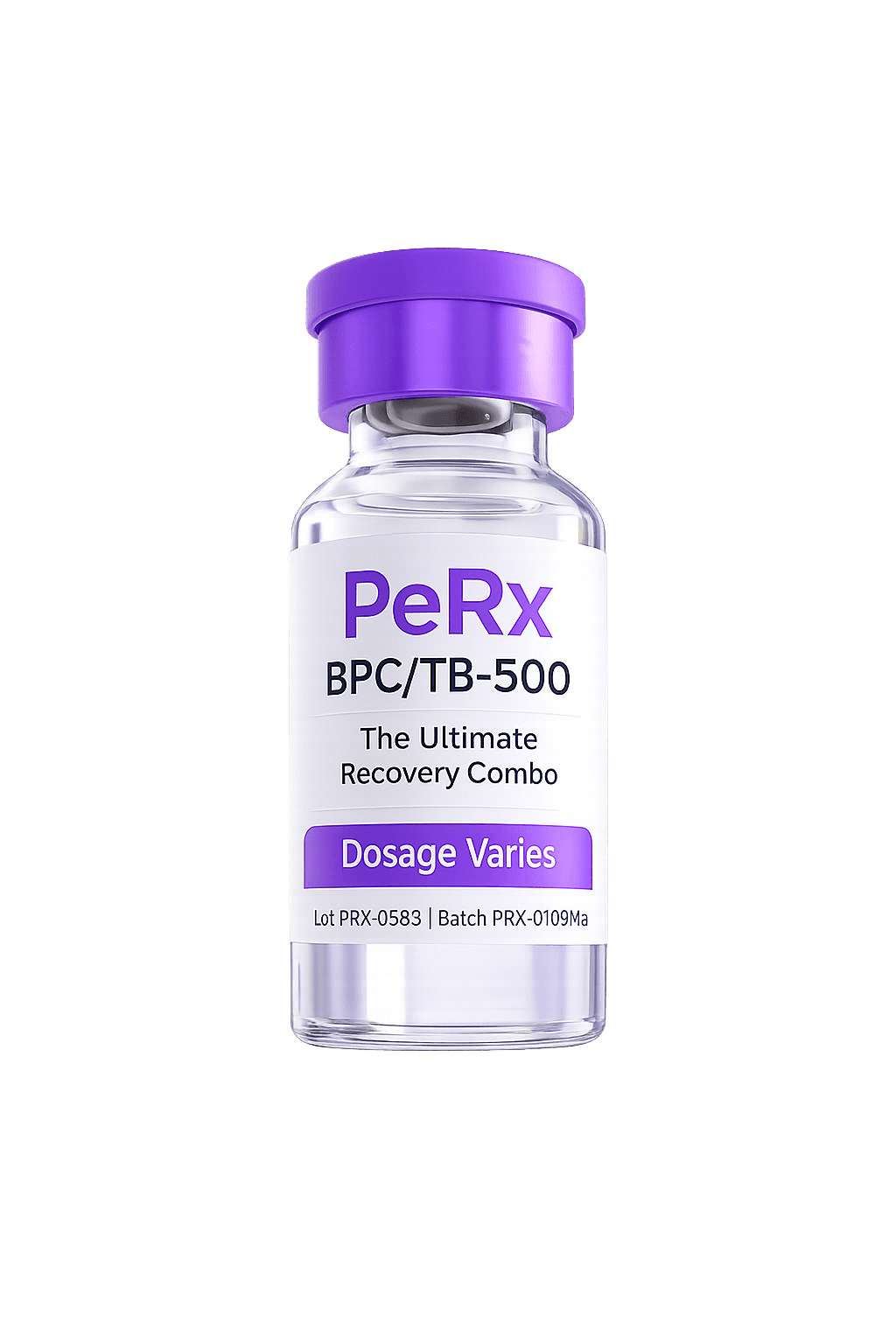
This is the end of the evidence block, and the product most people searching this topic end up asking about. BPC/TB-500 pairs the two peptides above in a single subcutaneous vial that ships fully reconstituted and ready to use. At PeRx it is prescribed for recovery and tissue-repair goals, the uses the tendon and soft-tissue research actually addresses.
It is a compounded product and not an FDA-approved drug, and no human trial has tested it in arthritis. If you take an NSAID, a corticosteroid, a disease-modifying drug or a biologic, say so in the eligibility check; the reviewing provider needs it, and nothing on this page is a reason to change that medicine.
Peptides for Osteoarthritis vs Rheumatoid Arthritis
Osteoarthritis. The peptide discussion here is about cartilage and connective tissue, and the evidence is laboratory and animal. GHK-Cu, the copper-binding peptide inside KLOW, raised collagen synthesis in fibroblast cultures in a 1988 study and stimulated chick-embryo chondrocytes to proliferate and make type II collagen in a 1995 culture study. Those are cells in a dish, and the 1995 work was aimed at growing cartilage implants, not at treating a joint. BPC-157 has the rat arthritis study described above. There is no human osteoarthritis trial of any peptide, and nothing in the literature shows cartilage regrowth or a change in the course of osteoarthritis in a person. Our GHK-Cu guide covers what the copper peptide is actually studied for.
Rheumatoid arthritis. Because it is an immune-driven disease, any therapy would need to show an effect on immune inflammation and on joint protection, not only on tissue repair, and it would need to be shown in patients. No peptide has that evidence. The adjuvant-arthritis rat model is the closest thing in the literature and it is a rat. People with rheumatoid arthritis are often on methotrexate, biologics or other immune-suppressing drugs, and no study has looked at what BPC-157, TB-500 or KPV do alongside them. That makes rheumatoid arthritis the clearest case on this page: the decision belongs with the rheumatology team, and a telehealth peptide prescription should never be made without that team knowing.
Peptides vs NSAIDs, Steroids and Disease-Modifying Drugs
Peptides are not a replacement for NSAIDs, corticosteroid injections, disease-modifying drugs or biologics. Those medicines have decades of trials and are the reason rheumatoid arthritis no longer routinely destroys joints. No one should stop, skip or reduce an arthritis medicine because of a peptide, and a provider who suggests otherwise is not following the evidence. NSAIDs and steroids do carry their own risks, which is why a clinician weighs them: NSAIDs can irritate the stomach lining and strain the kidneys, and repeated corticosteroid injections into the same joint are associated with cartilage changes. The current American College of Rheumatology guidelines for osteoarthritis and for rheumatoid arthritis, cited below, set out how those tradeoffs are handled.
Interactions between BPC-157, TB-500 or KPV and arthritis drugs have not been studied. That includes immune-suppressing drugs, where a peptide that acts on immune signaling is an unknown added to an unknown, and blood thinners, where the FDA has raised theoretical bleeding questions about some compounded peptides. The right sequence is simple: the doctor who manages your arthritis knows first, and the prescribing provider reviews the full medication list. Our page on what providers review before prescribing peptides describes that review.
Safety, Side Effects and Who Should Be Careful
The side effects people report with these peptides are mostly anecdotal: irritation at the injection site, headache, dizziness, nausea and fatigue. No controlled study has measured how often any of them occur, and long-term human safety is unknown for all three. This page does not call any of them safe or well tolerated, because the data to say so do not exist. Our peptide side effects guide covers what is and is not known across the catalog.
Some groups need a clinician's review before any peptide is considered, and for several of them the answer is likely to be no: anyone with autoimmune disease, anyone on immune-suppressing medicines, anyone with a current or past cancer, anyone pregnant or breastfeeding, and anyone with a hot, swollen joint that could be infected, which is an urgent medical problem and not a peptide question. The FDA has also raised concerns about compounded BPC-157 itself: in its 2026 review it could not rule out immune reactions from peptide impurities and aggregates, and it described adverse-event reports involving compounded BPC-157 injections, including one patient who had significant reactions after a BPC-157 and TB-500 product labeled for research use only. Product quality is part of safety, which is why a prescription filled by a state-licensed pharmacy with lot testing matters; our page on whether peptide therapy is safe explains what that testing does and does not establish.
One sentence on before-and-after stories, because arthritis forums are full of them: an anecdote has no confirmed diagnosis, no measurement and no comparison, so it cannot tell you whether the peptide, time, rest or a change in activity did the work.
FDA Status and Where These Peptides Stand
Regulatory status, checked November 23, 2026
BPC-157, TB-500 and KPV are not FDA-approved drugs for any use. On July 23, 2026 the FDA's Pharmacy Compounding Advisory Committee reviewed all three for the 503A bulk drug substances list. As recorded at the meeting, the committee voted to recommend BPC-157 and KPV (8 to 6, with one abstention) and TB-500 (8 to 6); FDA staff evaluations had weighed against all three, and no minutes had been posted when this page was last checked. The votes are advisory. They are not approvals, they did not change what may be compounded, and compounded products remain unapproved drugs.
For the full account of that meeting, including why the FDA's own evaluations and the committee disagreed, see our FDA peptide review, July 2026 and the shorter answer to is BPC-157 FDA approved. For drug-tested athletes, BPC-157 and TB-500 are prohibited under anti-doping rules; our injury recovery peptides page carries the WADA note.
Questions to Ask Your Provider
Bring these to the visit
What type of arthritis do I have, and has it been confirmed? Osteoarthritis and rheumatoid arthritis are managed differently and the evidence for peptides is absent in both.
How would a peptide fit with my NSAID, steroid, DMARD or biologic? The answer should start with "it does not replace them."
What is the evidence level for this compound in my condition? For arthritis, the honest answer is animal and laboratory data.
What would make us stop? New joint swelling, a reaction at the injection site, or anything that changes how my arthritis medicine is working.
How will we judge whether it did anything? Without a measurement agreed in advance, no one will know.
Should my rheumatologist or orthopedist be told? Yes, before the first dose.
Getting Peptides Through a Prescription
At PeRx the path is the same for every product: a short eligibility check, a licensed provider's review of your history and current medicines, including any arthritis drug, and if a prescription is written, a state-licensed 503A pharmacy fills it and ships it ready to use. Dose steps are decided at each renewal check-in. PeRx does not order labs; if a result from your own doctor matters for a particular peptide, the provider will say so. The products below are compounded and not FDA-approved, and they are prescribed for recovery and tissue-repair goals. Our guide to how to get peptides prescribed online covers each step.
KLOW: The Four-Peptide Repair Stack
KLOW combines BPC-157, GHK-Cu, KPV and TB-500 in one ready-to-use subcutaneous vial, which is why it appears on this page: the four compounds graded above are its four ingredients. It is prescribed at PeRx for recovery and tissue-repair goals. The research on each peptide alone does not describe how four act together, and none of it is human arthritis data. Our KLOW guide covers the stack in detail.
Compounded, not an FDA-approved drug. Tell the provider about any arthritis medication during the eligibility check, and keep your rheumatologist or orthopedist informed.

BPC-157 Capsules
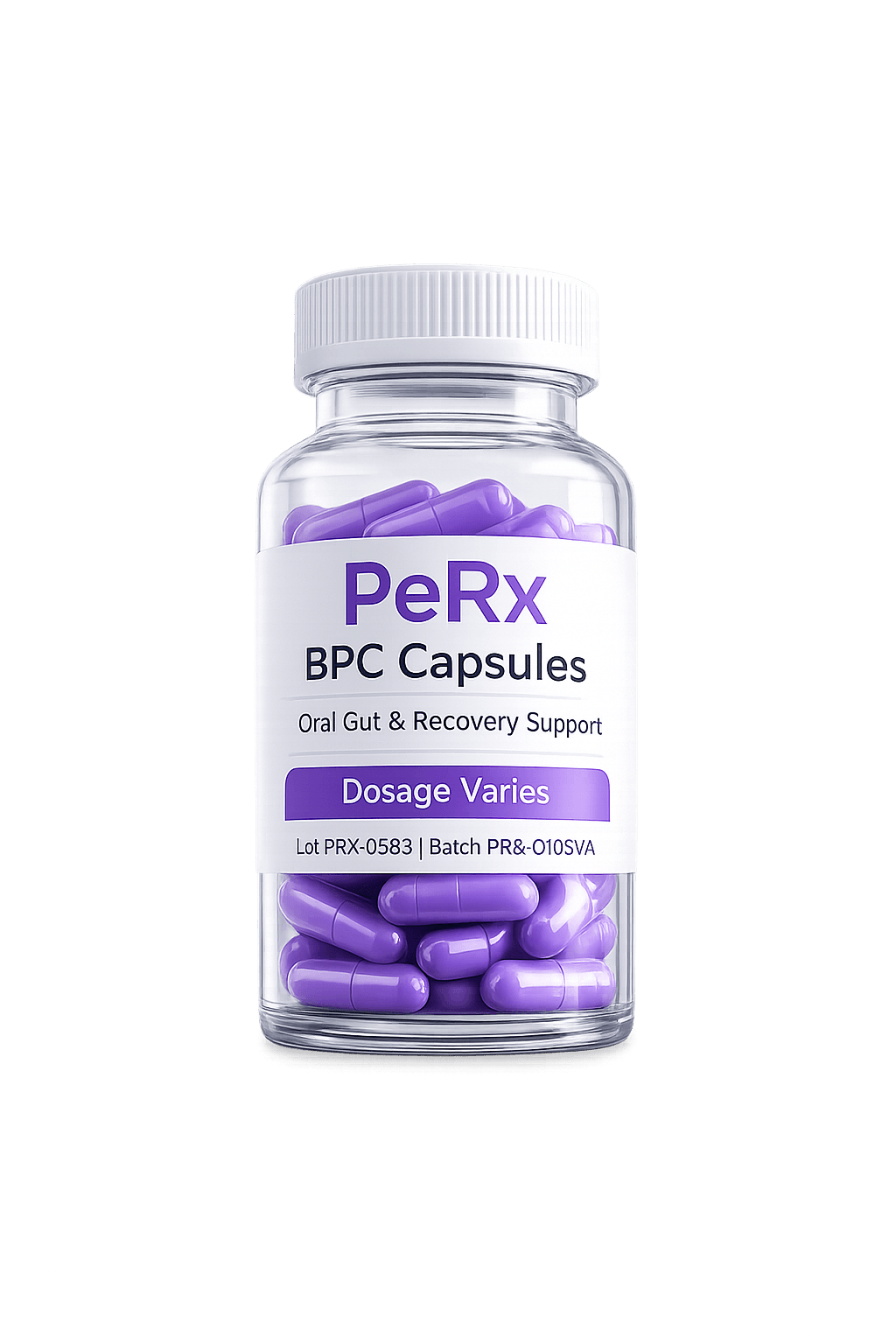
For readers who would rather not inject, BPC-157 capsules are the oral, needle-free form PeRx prescribes for gut and recovery support. Oral BPC-157 has its own bioavailability questions, covered in our BPC-157 capsules guide, and no oral or injectable form has been tested in arthritis.
Compounded, not an FDA-approved drug. Discuss any existing arthritis medication with the reviewing provider. Prescribed by a licensed provider and filled by a state-licensed 503A pharmacy.
Want to know whether a provider would consider a peptide for you?
New to PeRx: the eligibility check takes about a minute, and a licensed provider reviews every order before a pharmacy fills it. Say which arthritis medicines you take. Already a patient: message your care team with questions about your protocol. Browse the recovery peptides PeRx prescribes.
Peptides for Arthritis FAQs
Related Guides
Continue reading about peptides and protocols that pair well with this guide.
TB-500 Peptide: What It Is and How It Works
TB-500 is a lab-made fragment of thymosin beta-4, a protein nearly every cell in your body uses to move repair machinery to where damage is. This guide explains what TB-500 is and the actin mechanism behind it, separates what was studied (the full protein) from what is sold (the fragment), covers side effects, and shows why it reaches patients only inside prescribed combination vials.
TB-500 Dosage: Protocols, Units, Cycle Length
Search for a TB-500 dosage and you get loading phases, maintenance weeks, and milligram figures that no human trial has ever tested. This page lays out where those numbers come from, why the clinical literature cannot settle them, and what the numbers look like when TB-500 arrives as a prescribed blend at a fixed concentration: 20 units on an insulin syringe, Monday through Friday, six weeks on and six off, as of September 8, 2026.
Peptides vs SARMs: The Difference and Why It Matters
They get lumped together in the same forum threads, but peptides and SARMs are not the same category. One is a class of signaling molecules. The other is a class of synthetic androgen-receptor drugs the FDA has flagged for serious harm. The more useful line, though, is not peptide vs SARM. It is prescribed and tested vs unregulated. Here is the honest comparison.
References and Review
Reviewed by Dr. Cory Mellon, MD. Every PubMed reference below was checked against the National Library of Medicine record, and the FDA documents were read in full. FDA status was checked on November 23, 2026 and is re-checked when the page is updated.
Lee E, Padgett B. Intra-articular injection of BPC 157 for multiple types of knee pain. Altern Ther Health Med. 2021;27(4):8-13. PMID: 34324435 View study
Sikiric P, Seiwerth S, Grabarevic Z, et al. Pentadecapeptide BPC 157 positively affects both non-steroidal anti-inflammatory agent-induced gastrointestinal lesions and adjuvant arthritis in rats. J Physiol Paris. 1997;91(3-5):113-122. PMID: 9403784 View study
Goldstein AL, Hannappel E, Kleinman HK. Thymosin beta4: actin-sequestering protein moonlights to repair injured tissues. Trends Mol Med. 2005;11(9):421-429. PMID: 16099219 View study
Dalmasso G, Charrier-Hisamuddin L, Nguyen HT, et al. PepT1-mediated tripeptide KPV uptake reduces intestinal inflammation. Gastroenterology. 2008;134(1):166-178. PMID: 18061177 View study
Maquart FX, Pickart L, Laurent M, et al. Stimulation of collagen synthesis in fibroblast cultures by the tripeptide-copper complex glycyl-L-histidyl-L-lysine-Cu2+. FEBS Lett. 1988;238(2):343-346. PMID: 3169264 View study
Pesakova V, Novotna J, Adam M. Effect of the tripeptide glycyl-L-histidyl-L-lysine on the proliferation and synthetic activity of chick embryo chondrocytes. Biomaterials. 1995;16(12):911-915. PMID: 8562779 View study
Kolasinski SL, Neogi T, Hochberg MC, et al. 2019 American College of Rheumatology/Arthritis Foundation guideline for the management of osteoarthritis of the hand, hip, and knee. Arthritis Rheumatol. 2020;72(2):220-233. PMID: 31908163 View study
Fraenkel L, Bathon JM, England BR, et al. 2021 American College of Rheumatology guideline for the treatment of rheumatoid arthritis. Arthritis Rheumatol. 2021;73(7):1108-1123. PMID: 34101376 View study
U.S. Food and Drug Administration. FDA briefing document for BPC-157-related bulk drug substances, Pharmacy Compounding Advisory Committee meeting of July 23-24, 2026. Dated May 11, 2026. View study
U.S. Food and Drug Administration. FDA briefing document for TB-500-related bulk drug substances, Pharmacy Compounding Advisory Committee meeting of July 23-24, 2026. Dated May 15, 2026. View study
U.S. Food and Drug Administration. FDA briefing document for KPV-related bulk drug substances, Pharmacy Compounding Advisory Committee meeting of July 23-24, 2026. Dated May 12, 2026. View study
U.S. Food and Drug Administration. July 23-24, 2026: Meeting of the Pharmacy Compounding Advisory Committee, meeting materials. Content current as of August 6, 2026. View study
U.S. Food and Drug Administration. Certain bulk drug substances for use in compounding that may present significant safety risks. Content current as of April 22, 2026. View study
Medical Disclaimer
The information provided on this website, including all articles, guides, and educational content, is for informational and educational purposes only and is not intended as medical advice, diagnosis, or treatment. Nothing on this site should be construed as a substitute for professional medical advice from a qualified healthcare provider.
The majority of peptides discussed on this site are not approved by the U.S. Food and Drug Administration (FDA) for the indications described. They are classified as bulk drug substances and are available only through a licensed prescribing provider and compounding pharmacy. All treatments require a valid prescription and provider oversight.
The majority of published research on peptide therapies has been conducted in preclinical (animal) models. While early human data is encouraging, comprehensive clinical trial data remains limited for most peptide compounds. Individual results may vary significantly based on health status, injury type, and other factors. No specific outcomes are guaranteed.
Certain peptides discussed on this site are classified as prohibited substances by the World Anti-Doping Agency (WADA) and are banned by major sports organizations including the NFL, NCAA, UFC, NBA, MLB, NHL, and PGA. If you are subject to anti-doping testing, consult your governing body before considering any peptide therapy.
Statements on this website have not been evaluated by the Food and Drug Administration. Products and therapies discussed are not intended to diagnose, treat, cure, or prevent any disease.
© 2026 Wellness MD Group PC DBA PeRx. All rights reserved.