Wolverine Stack: BPC-157 and TB-500, Explained
The wolverine stack is two peptides, BPC-157 and TB-500, run together for injury recovery. This guide covers where the comic-book name came from, what each peptide contributes, what the research honestly supports, the side effects and open questions, what forum reports get right and wrong, and how the prescribed single-vial version differs from buying two research vials.

In this article
Key Takeaways
- The wolverine stack is a nickname for BPC-157 plus TB-500 run together, named after the comic-book character whose defining power is rapid healing. It is not a drug name, a brand, or a regulated product.
- The pairing logic is local plus systemic: BPC-157 acts at the injury site through blood-vessel growth and growth-factor signaling, while TB-500 supports cell migration body-wide.
- The research is animal-dominant. BPC-157 has hundreds of rodent studies and only small, uncontrolled human reports. The TB-500 fragment itself has no published human dosing data; the human wound-healing trials people cite used the full thymosin beta-4 protein.
- The prescribed version is a single 5 mL vial compounded at 3 mg of each peptide per mL by a US 503A pharmacy. It ships fully reconstituted and ready to use, dosed at 20 units Monday through Friday, 6 weeks on and 6 weeks off.
- Through PeRx the injectable wolverine stack is $299 per month as the BPC/TB-500 combo, with a $225 oral capsule version for people who want the same pair without needles.
Quick Facts
Full Name
Wolverine stack (BPC-157 + TB-500)
Type
Two-peptide recovery combination
Origin of the Name
Mid-2010s forum and podcast nickname, after the Marvel character who heals from anything
Primary Uses
Injury recovery, tendon and ligament support, inflammation
Administration
Subcutaneous injection (oral capsules also available)
Prescribed Form
Single 5 mL vial, 3 mg/mL of each peptide, ready to use
What Is the Wolverine Stack?
The wolverine stack is two peptides taken together: BPC-157 and TB-500. That is the whole recipe. No secret third ingredient, no proprietary ratio, no trademark. It is a nickname that bodybuilding forums and biohacking podcasts attached to the pairing somewhere in the mid-2010s, and it stuck because the reference explains the pitch in one word. Wolverine is the comic-book character whose defining ability is healing from any injury, and the stack is marketed, informally and enthusiastically, as the closest thing peptides offer to that.
It is worth being clear about what kind of thing the name is, because the search results blur it. The wolverine stack is not a drug. It is not a product with a standard formula. It is a meme-era shorthand that different vendors fill with different contents at different concentrations. When a podcast guest, a forum thread, and a research-chemical site all say "wolverine stack," they are describing the same idea and potentially three different vials. The idea itself, though, is consistent: pair the most-studied repair peptide with a systemic recovery peptide and cover more of the healing process than either would alone.
The name has cousins. Add GHK-Cu to the pair and forums call it GLOW; add KPV on top of that and it becomes KLOW. If you are trying to decide between the two-, three-, and four-peptide versions, our GLOW vs KLOW vs wolverine stack comparison breaks them down head to head. This page stays on the original pair: what it is, what it does, and what you can honestly expect from it.
What's Actually in It
Two peptides, two different jobs. The reason this particular pair became the recovery combination, rather than any of the dozens of other possible pairings, is that the mechanisms barely overlap.
BPC-157: the local worker
BPC-157 is a 15-amino-acid peptide derived from a protective protein found in human gastric juice. In animal studies it promotes angiogenesis, the growth of new blood vessels, through the VEGF pathway, and it recruits growth-factor signaling at the site of damage. That matters most for tendons and ligaments, which heal slowly precisely because their blood supply is poor. It is the more studied half of the stack by a wide margin, with a literature spanning three decades, and our complete BPC-157 guide covers it in depth.
Hsieh MJ et al., "Therapeutic potential of pro-angiogenic BPC157 is associated with VEGFR2 activation and up-regulation," Journal of Molecular Medicine, 2017. Cell and rodent models. View study
TB-500: the systemic half
TB-500 is a synthetic fragment of thymosin beta-4, a protein your body uses to regulate actin, the structural scaffolding that lets cells physically move. Where BPC-157 concentrates its effects near where you inject it, thymosin beta-4 circulates and works body-wide, helping repair cells migrate to damaged tissue wherever it is. Our TB-500 guide tells its full story, including the part most sales pages skip: the wound-healing research behind the mechanism was done on the full thymosin beta-4 protein, not on the fragment sold as TB-500.
Malinda KM et al., "Thymosin beta4 accelerates wound healing," Journal of Investigative Dermatology, 1999. Animal models of the full thymosin beta-4 protein. View study
Why these two together
One works at the injury, one works everywhere. One rebuilds blood supply, one moves repair cells. The combination covers the local bottleneck and the systemic environment at the same time, which is a genuinely reasonable division of labor even before you ask what the evidence shows. The full reasoning, including the injuries where one peptide alone is enough, lives in why we pair BPC-157 and TB-500.
Some circles keep adding. GHK-Cu for skin and connective tissue, KPV for inflammation, a growth hormone secretagogue like CJC-1295/Ipamorelin alongside for body composition. Each addition has its own rationale and its own evidence gaps. The two-peptide core is where the recovery case is strongest, and it is what this article means by the wolverine stack from here on.
What the Research Supports
Here is the sentence that should open every honest article on this topic: no clinical trial has ever tested the wolverine stack. Nobody has run BPC-157 plus TB-500 against a placebo, against either peptide alone, or against standard care in humans. Everything claimed about the combination is inference from single-ingredient research, and the two ingredients are not equally supported.
BPC-157 has the deeper bench: over 100 published papers showing consistent healing effects across tendon, ligament, muscle, and gut models. Nearly all of it is rodent work, and much of it comes from a single research group in Zagreb, two facts that deserve more airtime than they get. The human data is thin but not zero. A 2021 report on intra-articular BPC-157 injections for knee pain found that most patients had significant relief lasting months. It was small, uncontrolled, and unblinded, which means it can suggest but not prove.
Lee E, Padgett B, "Intra-Articular Injection of BPC 157 for Multiple Types of Knee Pain," Alternative Therapies in Health and Medicine, 2021. Small human case series, no control group. View study
TB-500 is where the citation game gets slippery. The parent protein, thymosin beta-4, went through preclinical work and early human wound-healing studies, including results summarized by Treadwell and colleagues in 2012 showing accelerated dermal healing in animal models and in patients. Those findings are routinely quoted as evidence for TB-500. They are evidence for thymosin beta-4. The synthetic fragment has no published human dosing data of its own, no pharmacokinetics in people, no safety trial. The mechanism is plausible and the animal work is real, but the human file on the actual molecule in the vial is empty.
Treadwell T et al., "The regenerative peptide thymosin β4 accelerates the rate of dermal healing in preclinical animal models and in patients," Annals of the New York Academy of Sciences, 2012. View study
The Regulatory Picture
Neither BPC-157 nor TB-500 is an FDA-approved drug. Both reach patients as compounded prescriptions. On July 23, 2026, an FDA Pharmacy Compounding Advisory Committee voted 8 to 6 to recommend both peptides for the 503A compounding bulks list, against the agency staff position. The votes are non-binding and no rule has followed as of September 2026. Our write-up of the July FDA panel covers the details.
So what does the research support, stated plainly? A strong mechanistic case and consistent animal results for BPC-157, a plausible mechanism borrowed from a related molecule for TB-500, and a combination rationale that makes biological sense but has never been formally tested. That is more than nothing and less than proof. Anyone telling you otherwise, in either direction, is selling something.
Wolverine Stack Side Effects
The honest framing first: because no controlled safety trial has studied either peptide at recovery doses, side-effect knowledge comes from patient reports and from what is known about the mechanisms. Within those limits, the commonly reported effects are mild.
Injection site reactions top the list: brief redness, a small welt, or soreness where the needle went in, usually gone within a day. Rotating injection spots handles most of it. Brief lightheadedness after a dose shows up often enough in reports that injecting while seated for the first week is a sensible habit. Occasional reports of headache, fatigue, or mild nausea cluster around the first doses and tend to fade as the body adjusts.
The exclusions matter more than the common effects. Both peptides act on growth-factor and cell-migration pathways, which is exactly what you want for a healing tendon and exactly what you do not want near a tumor. Anyone with active cancer or a recent cancer history should not use the wolverine stack without oncologist clearance; this is a precaution based on mechanism rather than observed harm, and it is the responsible position. Pregnancy and breastfeeding are excluded outright because no safety data exists. The deeper unknown is long-term use: nobody has studied years of continuous exposure, which is one reason the prescribed protocol cycles off rather than running indefinitely.
Athletes: This Stack Is Off-Limits
WADA lists BPC-157 as a prohibited S0 substance and prohibits thymosin beta-4 and its fragments, which includes TB-500. TB-500 has a history in sport doping cases, particularly in horse racing, and testing for both compounds exists. Competitive athletes subject to anti-doping rules should treat the wolverine stack as banned, full stop.
Seek immediate care for signs of a serious reaction: swelling of the face or throat, difficulty breathing, or a rapid heartbeat after a dose. For the broader picture of what patients report across peptide therapies and when to call a provider, see our peptide side effects guide.
The Prescription Version
Most wolverine stack content assumes you will buy two vials of powder from a research-chemical site, mix them yourself, and figure out a protocol from forum threads. That version exists, it is cheap, and it is labeled "not for human use" for a reason: no prescription, no screening, no verification of what is actually in the vial, and a concentration that depends on how much liquid you added at your kitchen counter.
The prescribed version replaces all of that with one vial. Through PeRx, the wolverine stack is dispensed as the BPC/TB-500 combo: both peptides compounded together by a licensed US 503A pharmacy at a fixed, matched concentration of 3 mg BPC-157 and 3 mg TB-500 per mL in a 5 mL vial. The 1:1 ratio is identical in every dose because the pharmacy set it, not because you measured carefully. The vial ships fully reconstituted and ready to use, refrigerated, with insulin syringes, alcohol swabs, and an injection guide in the box. Before any of that ships, a licensed provider reviews your health intake, which is where cancer history, pregnancy, and medication conflicts get caught.
Prescribed Wolverine Stack Protocol
Dose
20 units (0.2 mL) on an insulin syringe
Per injection
0.6 mg BPC-157 + 0.6 mg TB-500
Frequency
Once daily, Monday through Friday
Cycle
6 weeks on, 6 weeks off
Placement
Subcutaneous, near the injury when practical, rotating sites
Storage
Refrigerated, 36-46°F. Do not freeze
Your PeRx provider prescribes the protocol, and the label on your vial is the final word. The arithmetic behind those numbers, units to milligrams, weekly totals, vial math, lives in the wolverine stack dosage chart, and the same math for the blend under its pharmacy name is in the BPC-157/TB-500 dosage chart. For how the prescription category differs from research-use products in general, see research peptides vs prescription peptides.
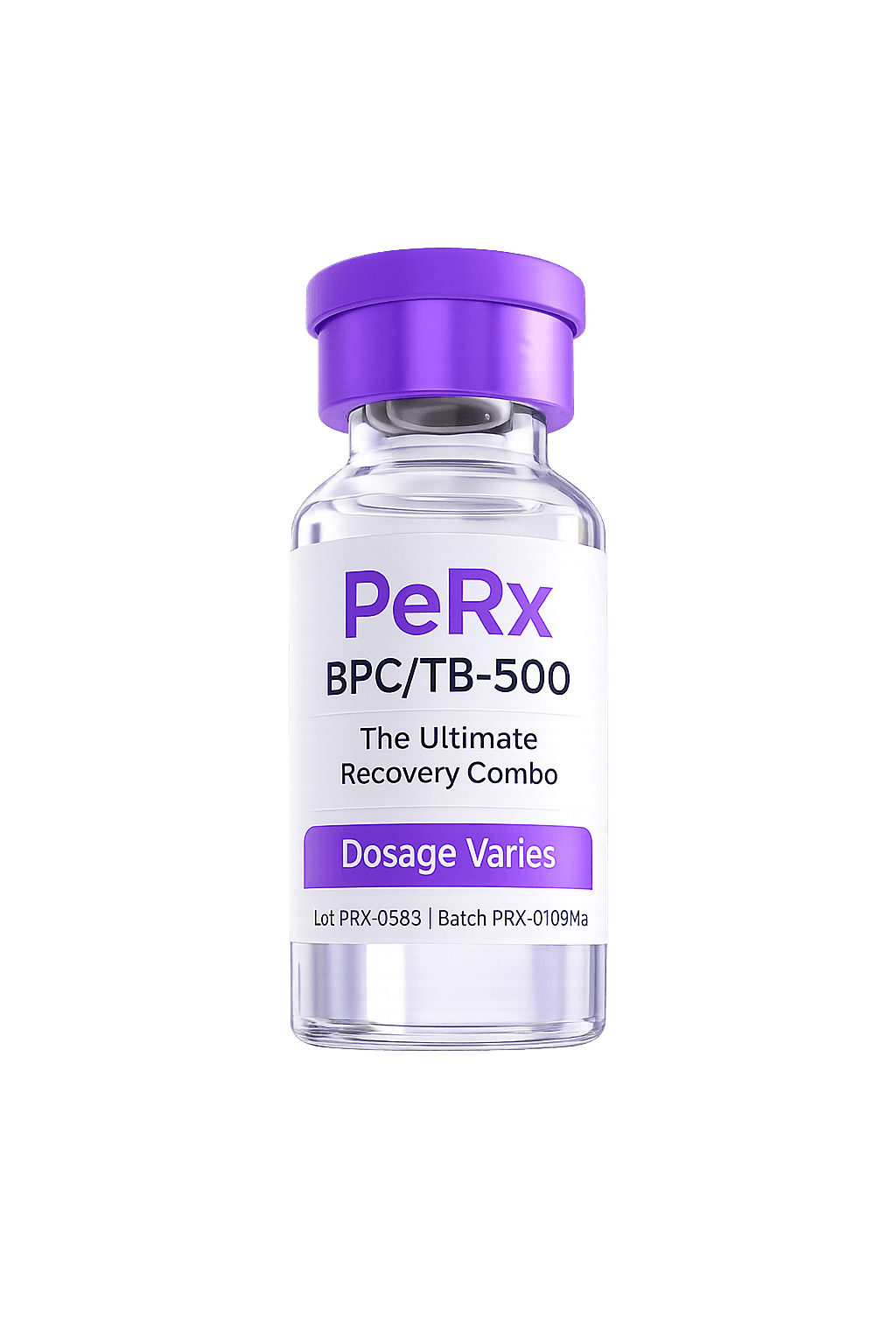
BPC/TB-500 Combo
The prescribed wolverine stack in a single vial: 3 mg/mL of each peptide, matched 1:1 in every dose, compounded by a US 503A pharmacy and third-party tested for purity and sterility. It ships fully reconstituted and ready to use, so there is no mixing, no math, and no guessing what is in the solution.
Prescribed by a licensed provider after a health screening. From $299 per month, syringes and supplies included.
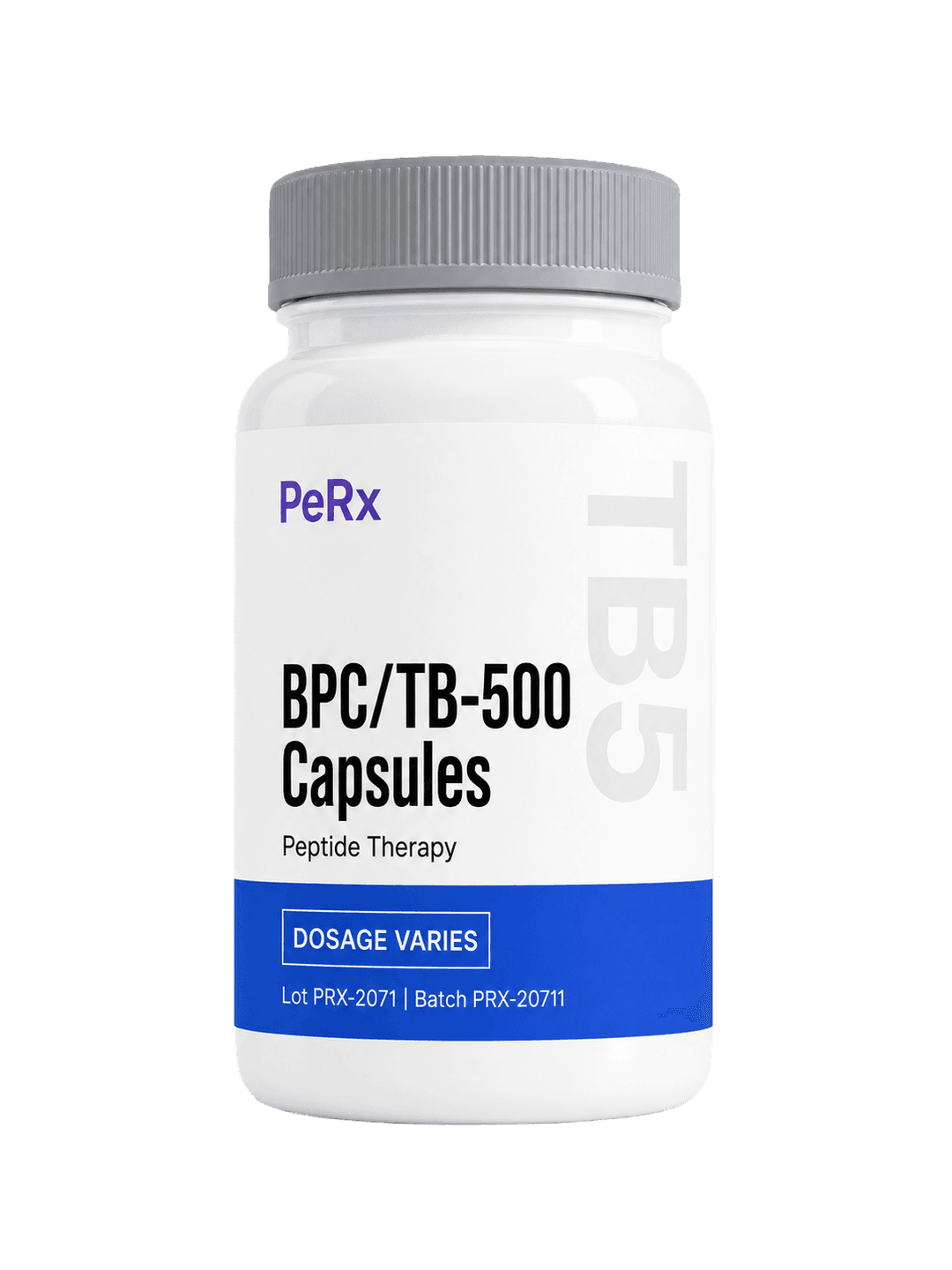
BPC/TB-500 Capsules
The wolverine stack in a capsule. Both peptides in a daily oral dose, no needles, no refrigeration, easy to travel with. Oral delivery suits the gut side of the BPC-157 story especially well, since the peptide was derived from a gastric protein in the first place.
Oral and injected milligrams are not interchangeable, particularly for TB-500, so the capsules are best thought of as a needle-free entry point or a travel companion to the injectable rather than a milligram-for-milligram swap. From $225 for 30 capsules.
Wolverine Stack Before and After: Honest Expectations
Search "wolverine stack before and after" and you will find dramatic recovery stories with no baseline, no imaging, and no way to know what healing would have happened anyway. Set those aside. Nobody has measured the combination in a trial, so nobody can honestly quote a response rate or a timeline with confidence. What follows is the arc most patients describe on the prescribed six-week protocol, offered as orientation rather than prediction.
Week 1-2
Quieter, Not Healed
The earliest change most people notice is subtraction: less morning stiffness, less swelling around the problem area, sometimes calmer digestion from the BPC-157 side. Feeling better this early is inflammation settling, not tissue rebuilt. Do not test the injury yet.
Week 2-4
Function Returns
Range of motion improves and recovery between training sessions shortens. This is the stretch where the blood-vessel and cell-migration mechanisms would be doing their work, and it is when most people decide the protocol is or is not doing something for them.
Week 4-6
Structural Territory
The area starts feeling stable under load rather than merely quiet at rest. Tendon and ligament tissue remodels slowly, so this phase is gradual by nature. The course ends at week six.
Weeks 7-12
The Off Period
Six weeks off is part of the protocol, not an afterthought, because long-term exposure is the least-studied question in the file. Improvement from real tissue repair should hold through the break. If everything reverts the moment you stop, bring that to a provider before running a second cycle.
And the outcome nobody posts about: some people finish a cycle and feel nothing. With no controlled data, no one can say how often that happens. If a full six-week course changes nothing, the answer is not a bigger dose. It is a conversation about whether the injury needs something else entirely, which can include imaging, physical therapy, or a surgeon.
What Reddit Gets Right and Wrong
A large share of wolverine stack searches include the word "reddit," because people sensibly want reports from humans rather than sales pages. Forum threads are genuinely useful for some things and reliably misleading for others, and it is worth knowing which is which.
What the forums get right. The texture of daily use is accurately reported: what injection-site reactions feel like, the lightheadedness some people get, the fact that results build over weeks rather than days. The skepticism about sourcing is also earned. Threads are full of people wondering whether their gray-market vial contained what the label claimed, and independent testing of research-chemical peptides has repeatedly found underdosed and contaminated products, so that anxiety is rational. And the honest threads exist: for every glowing report there is a "ran it for eight weeks, felt nothing" post, which matches what the absence of trial data would predict.
What the forums get wrong. Three things, mostly. First, dosing charts travel without their context: a protocol written for someone's home-mixed 10 mg vial gets applied to a completely different concentration, which is how people end up taking several times the intended amount. Second, survivorship bias runs the discourse. People who recover post enthusiastically, people who felt nothing drift away, and injuries heal on their own timelines anyway, so the visible record skews positive in a way no one can correct for. Third, the evidence gets upgraded in transit: the thymosin beta-4 human wound data becomes "TB-500 is human-tested," rodent tendon studies become "proven for tendons," and by the tenth repost the wolverine stack has a clinical file it does not actually have.
The reasonable takeaway is to read forums for logistics and lived texture, and read the primary literature, or an honest summary of it, for claims about what the peptides do. The two sources answer different questions.
Wolverine Stack: Common Questions
Related Guides
Continue reading about peptides and protocols that pair well with this guide.
Wolverine Stack Dosage Chart: Daily and Weekly Doses
The Wolverine stack is the forum nickname for BPC-157 plus TB-500, and most dosage charts for it assume two gray-market vials and a loading phase. The prescribed version is simpler: one blend vial, 20 units, Monday through Friday. This page puts the circulating protocols and the prescribed numbers side by side, answers the per-day and per-week questions in plain milligrams, and shows why you do not need a calculator for any of it.
BPC-157/TB-500 Dosage Chart: Units, mg, Cycle
The prescribed BPC-157/TB-500 blend has one concentration and one dose, and every number on this page follows from those two facts. Draw 20 units and you get 0.6 mg of each peptide. Here is the full arithmetic: the dosage chart, units on an insulin syringe, per-day and per-week totals, how the capsules dose differently, and what a month actually costs.
Peptides for Autoimmune Patients: Cautions
Autoimmune disease makes every immune-active therapy a shared decision. A physician-reviewed guide to Thymosin Alpha-1 as an immunomodulator (not a booster), what to tell your rheumatologist, and where caution is non-negotiable.
Ready to get started?
The wolverine stack, prescribed: BPC-157 and TB-500 in one ready-to-use vial, delivered to your door with everything you need.
Medical Disclaimer
The information provided on this website, including all articles, guides, and educational content, is for informational and educational purposes only and is not intended as medical advice, diagnosis, or treatment. Nothing on this site should be construed as a substitute for professional medical advice from a qualified healthcare provider.
The majority of peptides discussed on this site are not approved by the U.S. Food and Drug Administration (FDA) for the indications described. They are classified as bulk drug substances and are available only through a licensed prescribing provider and compounding pharmacy. All treatments require a valid prescription and provider oversight.
The majority of published research on peptide therapies has been conducted in preclinical (animal) models. While early human data is encouraging, comprehensive clinical trial data remains limited for most peptide compounds. Individual results may vary significantly based on health status, injury type, and other factors. No specific outcomes are guaranteed.
Certain peptides discussed on this site are classified as prohibited substances by the World Anti-Doping Agency (WADA) and are banned by major sports organizations including the NFL, NCAA, UFC, NBA, MLB, NHL, and PGA. If you are subject to anti-doping testing, consult your governing body before considering any peptide therapy.
Statements on this website have not been evaluated by the Food and Drug Administration. Products and therapies discussed are not intended to diagnose, treat, cure, or prevent any disease.
© 2026 Wellness MD Group PC DBA PeRx. All rights reserved.