GLOW Peptide: What It Is and What Is in the Vial
GLOW is not a peptide. It is a nickname for three of them, GHK-Cu, BPC-157 and TB-500, sold together in one vial, and the name carries no standard recipe. We looked at what the sellers ranking for the term actually list, sorted the claimed benefits by how strong the evidence behind each one is, and laid out what a prescribing clinic dispenses when someone asks for GLOW. Short version: we do not sell it, and you may not need it.

In this article
Key Takeaways
- GLOW peptide is a nickname for a three-peptide blend: GHK-Cu, BPC-157 and TB-500. It is not a drug name, a brand, or a formula any regulator or pharmacopeia has defined.
- The most common research-site vial is 70 mg split 50/10/10, with GHK-Cu making up about 71% of the powder. Some sellers do not publish the split at all, and at least one clinical guide uses the GLOW name for a different mixture of GHK-Cu, glutathione and vitamin C. The name alone tells you nothing reliable about the contents.
- The evidence is uneven. GHK-Cu has human trials, but for creams rather than injections. BPC-157 is mostly rodent research plus a few small, uncontrolled human reports. The TB-500 fragment has no published human studies. Nobody has tested the three together.
- PeRx does not sell GLOW. The prescribed routes to the same three peptides are KLOW ($349), which adds KPV, or the BPC/TB-500 combo ($299) alongside GHK-Cu ($229). If skin is the only goal, GHK-Cu alone is usually the sensible prescription.
- None of the three is FDA-approved. On July 23, 2026 an FDA advisory committee voted 8 to 6 to recommend BPC-157 and TB-500 for the 503A compounding list. The vote is non-binding, no rule has followed as of September 2026, and injectable GHK-Cu is not scheduled for review until a meeting before the end of February 2027.
- A blend containing these peptides is not for anyone with active cancer, Wilson disease or copper sensitivity, anyone pregnant or breastfeeding, or athletes under anti-doping rules.
Quick Facts
Full Name
GLOW blend (GHK-Cu + BPC-157 + TB-500)
Type
Three-peptide blend sold under a nickname, not a standardized drug
Origin
Research-chemical sellers and forums; the name refers to the skin result GHK-Cu is marketed for
Primary Mechanism
Collagen signaling (GHK-Cu), local repair (BPC-157), cell migration (TB-500)
Primary Uses
Sold for skin quality plus injury recovery; studied ingredient by ingredient only
Administration
Subcutaneous injection. Not a PeRx product; nearest prescribed blend is KLOW
What Is the GLOW Peptide?
Despite the singular name, the GLOW peptide is three peptides: GHK-Cu, a copper-binding tripeptide from the skincare world, BPC-157, the repair peptide most injury protocols are built around, and TB-500, a synthetic fragment of the protein thymosin beta-4. Sellers put all three in one vial and gave the vial a name that describes the outcome the copper peptide is marketed for. That is the whole origin story. No chemist named it, no regulator has reviewed it, and no reference book defines what a GLOW vial must contain.
It helps to see the family it belongs to. BPC-157 plus TB-500 alone is what forums call the wolverine stack. Add GHK-Cu and the same sellers call it GLOW. Add a fourth peptide, KPV, and the name becomes KLOW. Each nickname is the previous one with an ingredient bolted on, and our GLOW vs KLOW vs wolverine comparison puts the three side by side if that is the decision you are trying to make.
A note on who is writing this. PeRx is a prescribing clinic, and GLOW is not in our catalog, which leaves us free to describe it plainly. We do prescribe the same three peptides in other forms. That part comes later, after what is in the vial and what the ingredients have actually been shown to do.
What Is Actually in a GLOW Vial?
Because the name has no owner, the only way to answer this is to read listings. In September 2026 we went through the pages ranking on Google for "glow peptide" and wrote down what each says is inside. Seller names are left out on purpose. The pattern is the point.
| Source | What it says is inside | Form | Listed price | Sold as |
|---|---|---|---|---|
| Research storefront A | 70 mg vial: GHK-Cu 50 mg, BPC-157 10 mg, TB-500 10 mg | Freeze-dried powder the buyer mixes | About $67 to $70 on sale, $119 list | "Not for human or animal use" |
| Research storefront B | 70 mg vial naming the same three peptides, with no per-peptide split on the product page | Freeze-dried powder the buyer mixes | $99 on sale, $114 list | "Laboratory research use only" |
| A cosmetic surgeon | Describes a "standard 50/10/10 milligram GLOW blend" filled by a US 503A pharmacy | Compounded prescription | Not published | Prescription for surgical recovery |
| A lab-testing company guide | Defines GLOW as GHK-Cu plus glutathione plus vitamin C, and says the same mixture is also marketed as Klow | Compounded injectable | Not published | Skin-appearance blend |
| PeRx | No GLOW product. KLOW: BPC-157 3 mg, GHK-Cu 10 mg, KPV 3 mg, TB-500 3 mg per mL, 5 mL vial | Ready-to-use solution | $349 per month | Prescription, 503A compounded |
Research storefront A
- What it says is inside
- 70 mg vial: GHK-Cu 50 mg, BPC-157 10 mg, TB-500 10 mg
- Form
- Freeze-dried powder the buyer mixes
- Listed price
- About $67 to $70 on sale, $119 list
- Sold as
- "Not for human or animal use"
Research storefront B
- What it says is inside
- 70 mg vial naming the same three peptides, with no per-peptide split on the product page
- Form
- Freeze-dried powder the buyer mixes
- Listed price
- $99 on sale, $114 list
- Sold as
- "Laboratory research use only"
A cosmetic surgeon
- What it says is inside
- Describes a "standard 50/10/10 milligram GLOW blend" filled by a US 503A pharmacy
- Form
- Compounded prescription
- Listed price
- Not published
- Sold as
- Prescription for surgical recovery
A lab-testing company guide
- What it says is inside
- Defines GLOW as GHK-Cu plus glutathione plus vitamin C, and says the same mixture is also marketed as Klow
- Form
- Compounded injectable
- Listed price
- Not published
- Sold as
- Skin-appearance blend
PeRx
- What it says is inside
- No GLOW product. KLOW: BPC-157 3 mg, GHK-Cu 10 mg, KPV 3 mg, TB-500 3 mg per mL, 5 mL vial
- Form
- Ready-to-use solution
- Listed price
- $349 per month
- Sold as
- Prescription, 503A compounded
Three things fall out of that table. First, the usual ratio is 5 to 1 to 1, so roughly 71% of the powder in a typical GLOW vial is the copper peptide. We could not find a published study that tested that split, or even proposed it. It looks like a convention that spread from seller to seller. Second, one storefront does not publish the split at all, so two "70 mg GLOW" vials can differ in the amounts that matter with no way to tell from the label.
Third, the powder format adds a variable that rarely gets mentioned. The buyer adds sterile liquid at home, and the strength of every dose depends on how much went in. Put 2 mL into a 50/10/10 vial and the solution holds 25 mg of GHK-Cu per mL. Put in 3 mL and it holds under 17. Same vial, same marking on the syringe, and one dose is half again as large as the other.
Same Name, Different Ingredients
The fourth row of the table is not a typo. Some clinics and compounders use "glow" for a skin blend of GHK-Cu, glutathione and vitamin C, with no BPC-157 or TB-500 in it at all, and at least one published guide says that mixture is also sold under the Klow name. If a med spa offers a "glow injection," ask for the ingredient list in milligrams first. At PeRx, KLOW always means the four-peptide blend described on this page.
GLOW Peptide Benefits, Sorted by Evidence
Lists of GLOW peptide benefits tend to run seven or eight bullets long: firmer skin, thicker hair, faster healing, calmer joints, more energy. Every bullet is borrowed from research on a single ingredient, usually in animals, sometimes from a cream rather than an injection. None comes from a study of the blend. The useful question is what each ingredient has been shown to do, and in whom.
GHK-Cu: human data, but for creams
GHK-Cu is the ingredient the name is about, and it has the most human research of the three. The catch is the route. In the placebo-controlled studies summarized by Pickart and colleagues, 71 women with photoaged skin used a GHK-Cu facial cream for 12 weeks and showed better skin density, thickness and laxity along with shallower fine lines. In a separate one-month study on thigh skin, collagen production rose in 70% of women using the GHK-Cu cream, against 50% with vitamin C and 40% with retinoic acid. The same review notes that GHK in plasma falls from about 200 ng/mL at age 20 to about 80 by age 60, which is the rationale for replacing it.
Pickart L, Vasquez-Soltero JM, Margolina A. "GHK Peptide as a Natural Modulator of Multiple Cellular Pathways in Skin Regeneration." BioMed Research International. 2015;2015:648108. Review of topical human studies plus cell and animal work. View study
All of that was applied to the skin surface. For systemic delivery the record is animal work, such as the rat wound-chamber experiments in which the copper complex increased connective-tissue accumulation. No published human trial has tested injected GHK-Cu for any outcome, and the lead author of most GHK-Cu reviews founded a company that sells copper peptide products. Our GHK-Cu guide covers the topical versus injectable gap in full.
Maquart FX, Bellon G, Chaqour B, et al. "In vivo stimulation of connective tissue accumulation by the tripeptide-copper complex glycyl-L-histidyl-L-lysine-Cu2+ in rat experimental wounds." Journal of Clinical Investigation. 1993;92(5):2368-2376. Rat model. View study
BPC-157: deep in rodents, thin in people
BPC-157 supplies the "recovery" half of the pitch. In rat tendon explants and cultured tendon cells it sped up outgrowth, improved survival under oxidative stress, and increased migration, and that direction of effect repeats across dozens of rodent tendon, ligament, muscle and gut studies, many from one research group in Zagreb. Human evidence exists but is small. A 2021 chart review of 17 patients given BPC-157 injections into the knee followed up 16 of them by phone, with no control group and no standardized outcome measure. A 2025 pilot gave intravenous BPC-157 to two adults and found no change in heart, liver, kidney, thyroid or glucose markers. Two people is a note, not a safety record. The BPC-157 guide covers the full literature.
Chang CH, Tsai WC, Lin MS, Hsu YH, Pang JH. "The promoting effect of pentadecapeptide BPC 157 on tendon healing involves tendon outgrowth, cell survival, and cell migration." Journal of Applied Physiology. 2011;110(3):774-780. Rat tendon explants and cultured tendon cells. View study
Lee E, Burgess K. "Safety of Intravenous Infusion of BPC157 in Humans: A Pilot Study." Alternative Therapies in Health and Medicine. 2025;31(5):20-24. Two participants, no control. View study
TB-500: the borrowed file
TB-500 is a short synthetic piece of thymosin beta-4, a 43-amino-acid protein that binds actin and helps cells move toward damaged tissue. In rats, the full protein sped up wound closure and collagen deposition, and it later went into early human wound-healing trials. Those results are what sales pages quote for TB-500. They belong to the parent protein. The fragment sold under the TB-500 name has no published human study of its own, which our TB-500 guide spells out in detail.
Malinda KM, Sidhu GS, Mani H, et al. "Thymosin beta4 accelerates wound healing." Journal of Investigative Dermatology. 1999;113(3):364-368. Rat model of the full thymosin beta-4 protein. View study
Treadwell T, Kleinman HK, Crockford D, Hardy MA, et al. "The regenerative peptide thymosin β4 accelerates the rate of dermal healing in preclinical animal models and in patients." Annals of the New York Academy of Sciences. 2012;1270:37-44. Full thymosin beta-4 protein, not the TB-500 fragment. View study
| Ingredient | What it is sold for | Human trials | Animal and cell data | Biggest gap |
|---|---|---|---|---|
| GHK-Cu | Skin firmness, collagen, hair | Yes, topical creams only (12-week facial studies) | Rat wound models, gene-expression work | No human study of the injected form |
| BPC-157 | Tendon, ligament and gut repair | Small uncontrolled reports only (17-patient chart review, 2-person IV pilot) | Extensive rodent literature, mostly one lab | No randomized controlled trial |
| TB-500 | Systemic recovery, flexibility | None for the fragment; trials used full thymosin beta-4 | Rodent wound and cardiac models of the parent protein | The molecule in the vial has no human data |
| The three combined | "Glow" plus recovery in one injection | None | None | Never studied as a combination |
GHK-Cu
- What it is sold for
- Skin firmness, collagen, hair
- Human trials
- Yes, topical creams only (12-week facial studies)
- Animal and cell data
- Rat wound models, gene-expression work
- Biggest gap
- No human study of the injected form
BPC-157
- What it is sold for
- Tendon, ligament and gut repair
- Human trials
- Small uncontrolled reports only (17-patient chart review, 2-person IV pilot)
- Animal and cell data
- Extensive rodent literature, mostly one lab
- Biggest gap
- No randomized controlled trial
TB-500
- What it is sold for
- Systemic recovery, flexibility
- Human trials
- None for the fragment; trials used full thymosin beta-4
- Animal and cell data
- Rodent wound and cardiac models of the parent protein
- Biggest gap
- The molecule in the vial has no human data
The three combined
- What it is sold for
- "Glow" plus recovery in one injection
- Human trials
- None
- Animal and cell data
- None
- Biggest gap
- Never studied as a combination
Has Anyone Tested the Three Together?
No. We could not find a published trial, in people or in animals, of GHK-Cu, BPC-157 and TB-500 given as a blend. That has practical consequences. Nobody knows whether the three add to each other, overlap, or interfere. Nobody has established a ratio, and nobody has looked at the side effects of the combination as a combination. One of the more careful research-side dosing guides says as much, calling the protocol community-derived.
The logic is reasonable on paper. BPC-157 acts near where it is injected, TB-500 circulates, and GHK-Cu signals for collagen and tissue remodeling, so the three touch different parts of repair. When a page says GLOW "works synergistically," it is describing that idea, not a measurement. The same is true of the four-peptide version we prescribe, and our KLOW guide says so plainly. For that blend, KLOW peptide benefits grades each claim by the evidence underneath it.
GLOW Peptide Side Effects and Who Should Skip It
With no safety trial of the blend, what is known comes from patient reports on the individual peptides. Those reports are mostly mild: redness, a small welt or soreness at the injection site, the brief sting copper solutions are known for, short-lived lightheadedness after a dose, and occasional headache, nausea or a metallic taste in the first week. Most pages stop there. The exclusions matter more than the nuisance effects, and at least one page-one article on GLOW benefits lists none.
Who Should Not Use a GLOW-Type Blend
Active cancer or a recent cancer history. BPC-157 and TB-500 act on blood-vessel growth and cell migration. That is a precaution based on mechanism rather than observed harm, and it is the responsible default.
Wilson disease or copper sensitivity. Every dose carries a copper complex.
Pregnancy or breastfeeding. There is no safety data for any of the three.
Athletes under anti-doping rules. WADA prohibits BPC-157 and thymosin beta-4 derivatives including TB-500.
A gray-market vial adds risks that have nothing to do with the peptides themselves: sterility, endotoxin, and whether the powder is what the label says. The component-by-component picture, including the NSAID rule that comes with BPC-157 blends, is in our KLOW side effects guide. Swelling of the face or throat, trouble breathing, or a racing heartbeat after any injection is an emergency.
GLOW Peptide Before and After: A Realistic Timeline
Before-and-after photos for GLOW are everywhere and prove very little: different lighting, no baseline, and often a retinoid, a laser or a weight change happening at the same time. No study has measured skin outcomes from the injected blend, so nobody can quote a response rate. What follows is orientation, drawn from how slowly collagen turns over, the 12-week horizon the cream trials used, and what patients on prescribed blends containing these peptides tend to describe.
Week 1-2
Nothing to Photograph
Skin does not remodel in days. If anything changes this early it is on the recovery side: a sore joint or tendon that feels a little quieter. That is inflammation settling, not tissue rebuilt, and it is not a reason to load the area.
Week 3-6
Function First, Skin Later
People using a blend for an injury usually decide in this window whether it is doing anything: easier range of motion, shorter recovery between sessions. Those who came for skin sometimes mention texture or hydration changes toward the end of it. Many notice nothing visible yet.
Week 6
The Prescribed Cycle Ends
Prescribed blends containing BPC-157 and TB-500 stop at six weeks and take six weeks off, because long-term exposure is the least-studied question in the file. Vendor protocols often run longer with no such limit.
Week 8-12
The Collagen Horizon
Firmness and fine-line changes in the cream trials were measured at 12 weeks, which is a fair guide to how long skin takes to show structural change by any route. Judging a skin result before then is judging too early.
Some people finish a cycle and see no difference at all, an outcome that rarely gets posted. If the goal was skin and nothing changed, the fix is not a larger dose. It is sunscreen, retinoids and in-office treatments, which have far better evidence. Peptides before and after covers how to read results claims across the category.
What We Prescribe Instead of GLOW
PeRx does not sell a three-peptide GLOW vial. The same three peptides are compounded for our patients in other configurations, each at a concentration fixed on the label, and each ships only after a licensed provider has reviewed a health intake. There are three routes, and which one fits depends on why you were searching for GLOW in the first place.
| Route | What you get | Per 20-unit dose | Monthly price | Fits when |
|---|---|---|---|---|
| KLOW | All three GLOW peptides plus KPV in one vial | 0.6 mg BPC-157, 2.0 mg GHK-Cu, 0.6 mg KPV, 0.6 mg TB-500 | $349 | Recovery is the main goal and you want skin and an inflammation angle included |
| BPC/TB-500 + GHK-Cu | The exact GLOW trio as two vials, no KPV | 0.6 mg BPC-157 and 0.6 mg TB-500 from one vial, 2.0 mg GHK-Cu from the other | $299 + $229 | You want the three without a fourth peptide, or want the copper peptide on its own schedule |
| GHK-Cu alone | The ingredient the name is about, by itself | 2.0 mg GHK-Cu | $229 | Skin, hair or connective tissue is the only goal |
KLOW
- What you get
- All three GLOW peptides plus KPV in one vial
- Per 20-unit dose
- 0.6 mg BPC-157, 2.0 mg GHK-Cu, 0.6 mg KPV, 0.6 mg TB-500
- Monthly price
- $349
- Fits when
- Recovery is the main goal and you want skin and an inflammation angle included
BPC/TB-500 + GHK-Cu
- What you get
- The exact GLOW trio as two vials, no KPV
- Per 20-unit dose
- 0.6 mg BPC-157 and 0.6 mg TB-500 from one vial, 2.0 mg GHK-Cu from the other
- Monthly price
- $299 + $229
- Fits when
- You want the three without a fourth peptide, or want the copper peptide on its own schedule
GHK-Cu alone
- What you get
- The ingredient the name is about, by itself
- Per 20-unit dose
- 2.0 mg GHK-Cu
- Monthly price
- $229
- Fits when
- Skin, hair or connective tissue is the only goal
Ideal for
KLOW tends to fit: - Injury or post-procedure recovery, with skin support as a welcome extra - Several nagging areas at once rather than one clean injury - One injection instead of two GHK-Cu alone tends to fit: - Anyone for whom "glow" meant skin and nothing else - A plan without the six-weeks-off cycle that the BPC-157 and TB-500 blends carry
Consider alternatives if
Start smaller if: - You have one specific injury. BPC-157 alone or the BPC/TB-500 combo is the simpler tool - You have never used a peptide and want to learn what one ingredient does first None of these fit if: - You have Wilson disease, copper sensitivity or active cancer - You are pregnant, breastfeeding or trying to conceive - You compete in a drug-tested sport - You want the three-peptide mixture in a single vial. We do not carry it
KLOW
The closest prescribed relative of GLOW: the same three peptides plus KPV, in a 5 mL vial at 3 mg BPC-157, 10 mg GHK-Cu, 3 mg KPV and 3 mg TB-500 per mL. It ships fully reconstituted and ready to use, refrigerated, with syringes, swabs and an injection guide in the box.
Your PeRx provider will prescribe the protocol after reviewing your intake, and your card is charged only if the prescription is approved. From $349 per month. What is KPV explains the fourth ingredient.

GHK-Cu
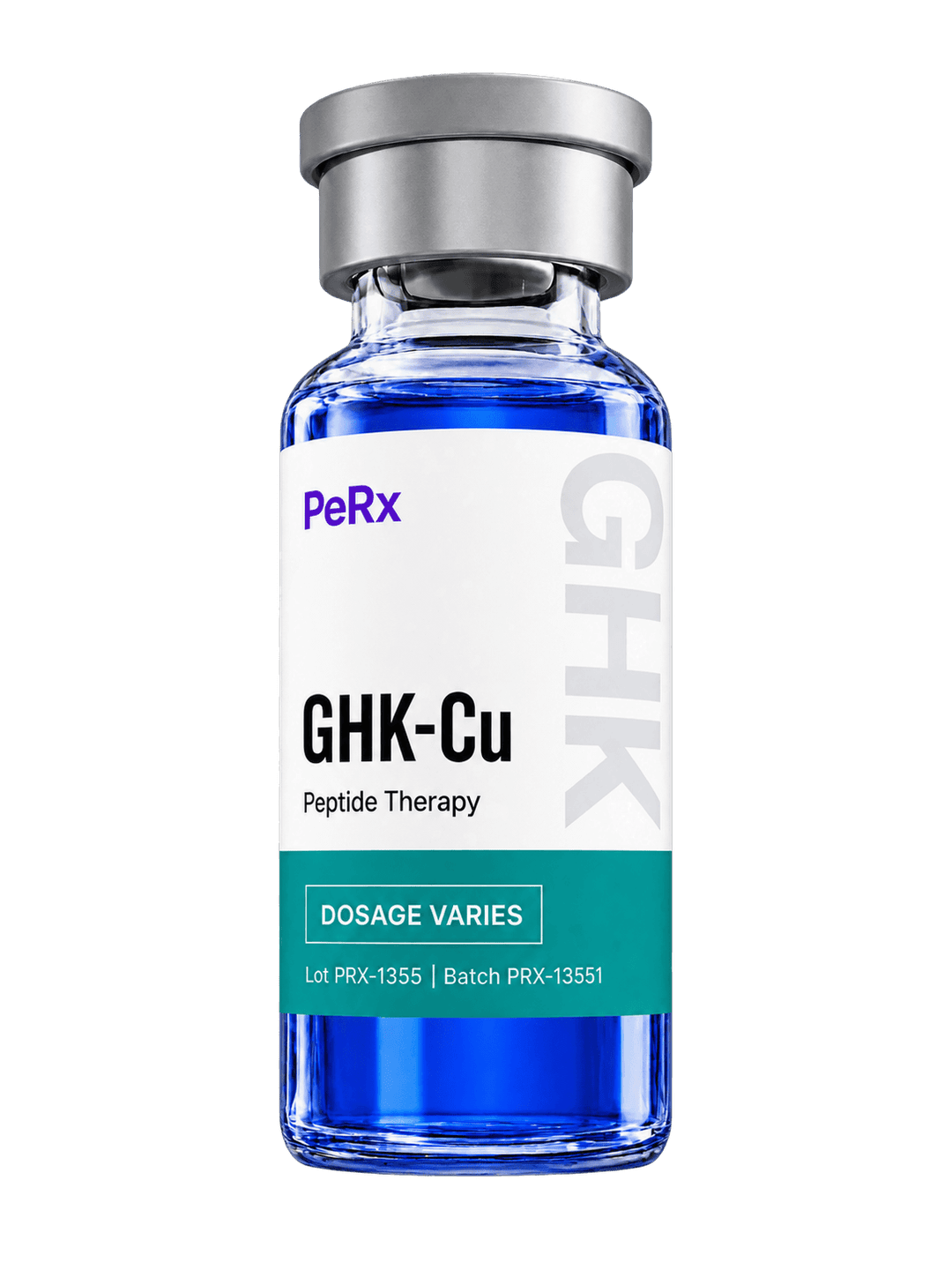
If the skin half of GLOW is what brought you here, this is the ingredient doing that work: a single-peptide vial at 10 mg per mL, the same strength of copper peptide KLOW contains, without the recovery peptides.
Subcutaneous injection, ready to use, from $229 per month. The copper rules that come with it, including keeping vitamin C away from the injection window, are in where to inject GHK-Cu.
A Short Word on Dosage
There is no standard GLOW dose, because there is no standard GLOW. Vendor charts describe one seller's powder at a dilution the chart's author picked, and they do not transfer to a different vial. A prescribed blend removes the arithmetic: the concentration is printed on the label and the dose is a line on an insulin syringe. For KLOW that line is 20 units, Monday through Friday, six weeks on and six weeks off. The KLOW dosage guide has the per-peptide math, and our comparison page has a side-by-side dosing table for GLOW, KLOW and the wolverine pair. The label on your own vial is the final word.
Research Vial vs Compounded Prescription
A $70 vial and a $349 vial invite an obvious comparison, and it is the wrong one. The research vial is an unapproved substance shipped without a prescription under a label that says it is not for human use. That sentence is what lets the seller ship it, and it also means nobody is accountable for identity, potency, sterility or endotoxin. Blend three peptides and each of those questions gets asked three times.
A 503A pharmacy works the other way around. It compounds for a named patient against a prescription, under state board of pharmacy oversight, to a concentration written on the label. That is why KLOW is 3/10/3/3 mg per mL in every vial while GLOW has no fixed recipe: one is a pharmacy formulation and the other is a shelf name. The risk on the research side is not hypothetical either. In July 2026 the former owner of Paradigm Peptides, a large research-peptide storefront, was sentenced to 70 months in federal prison. According to the Department of Justice, the business told customers its products were tested and made in its own US labs while importing untested product from overseas, and sold to more than 54,000 customers.
Where the Regulation Stands
None of the three GLOW peptides is an FDA-approved drug. In April 2026 the FDA removed BPC-157, TB-500 and injectable GHK-Cu from its restricted Category 2 list, which is not the same as approving them or adding them to the 503A compounding list. On July 23, 2026 the Pharmacy Compounding Advisory Committee voted 8 to 6, with one abstention, to recommend BPC-157 and TB-500 for that list, against the FDA staff position. The vote is advisory and no rule has followed as of September 2026. Injectable GHK-Cu is slated for a later meeting before the end of February 2027. Our FDA panel write-up has the vote-by-vote detail, and research peptides vs prescription peptides explains how differently the two channels are regulated.
GLOW Peptide: Common Questions
Related Guides
Continue reading about peptides and protocols that pair well with this guide.
GLOW vs KLOW vs Wolverine Stack: Which One?
Three nicknames, four peptides, one recurring confusion. GLOW is GHK-Cu plus BPC-157 plus TB-500. KLOW is GLOW with KPV added. The Wolverine stack is BPC-157 and TB-500 on their own. Here is what each name actually contains, which goal each one fits, what a prescribing clinic dispenses in their place, and why an $80 research vial and a $349 pharmacy vial are not the same product.
Where to Inject KLOW: Injury Site and Rotation
KLOW carries a placement instruction most peptides do not: the dose goes as close to the injury site as possible. Four peptides share one vial, and you still have to rotate. Here is how those two instructions fit together in practice.
Peptide Therapy in Chicago: Cost and Telehealth
A plain guide to peptide therapy in Chicago: what it costs across local clinics, concierge services, and telehealth, and who tends to use it here. Plus how pharmaceutical-grade peptides reach any Chicago address without a clinic visit.
Ready to get started?
Pharmaceutical-grade KLOW, the GLOW peptides plus KPV in one ready-to-use vial, delivered to your door with everything you need.
Medical Disclaimer
The information provided on this website, including all articles, guides, and educational content, is for informational and educational purposes only and is not intended as medical advice, diagnosis, or treatment. Nothing on this site should be construed as a substitute for professional medical advice from a qualified healthcare provider.
The majority of peptides discussed on this site are not approved by the U.S. Food and Drug Administration (FDA) for the indications described. They are classified as bulk drug substances and are available only through a licensed prescribing provider and compounding pharmacy. All treatments require a valid prescription and provider oversight.
The majority of published research on peptide therapies has been conducted in preclinical (animal) models. While early human data is encouraging, comprehensive clinical trial data remains limited for most peptide compounds. Individual results may vary significantly based on health status, injury type, and other factors. No specific outcomes are guaranteed.
Certain peptides discussed on this site are classified as prohibited substances by the World Anti-Doping Agency (WADA) and are banned by major sports organizations including the NFL, NCAA, UFC, NBA, MLB, NHL, and PGA. If you are subject to anti-doping testing, consult your governing body before considering any peptide therapy.
Statements on this website have not been evaluated by the Food and Drug Administration. Products and therapies discussed are not intended to diagnose, treat, cure, or prevent any disease.
© 2026 Wellness MD Group PC DBA PeRx. All rights reserved.