Peptides vs Ozempic: Which Path Fits Your Goals
Ozempic is a peptide, so "peptides vs Ozempic" is really a choice between a GLP-1 and peptides that do other jobs. What Ozempic is and is not, what the approved GLP-1s showed in their own trials, what tesamorelin, MOTS-c and the growth-hormone peptides can and cannot do, where the FDA and HHS stand as of November 2026, and how a provider decides.
In this article
Key Takeaways
- Ozempic is a peptide. Semaglutide is a modified version of the gut hormone GLP-1, so "peptides vs Ozempic" compares a GLP-1 with peptides that do other jobs, not a drug with a natural alternative.
- Ozempic is approved for blood sugar control in type 2 diabetes and for heart and kidney risk in that group; weight management is Wegovy’s approval. Since 2026 the Ozempic name also covers a daily tablet. This page compares the weekly injection.
- Only the GLP-1 class has large weight-loss trials, and they belong to the brands: about 15 percent over 68 weeks on Wegovy’s label, 15 to 21 percent over 72 weeks on Zepbound’s. Compounded semaglutide and tirzepatide were not in those trials and are not FDA-approved.
- Tesamorelin lowers visceral fat without moving the scale much. MOTS-c, sermorelin, CJC-1295/ipamorelin and BPC-157 have no human weight-loss trial. None lowers appetite, none replaces a GLP-1, and fewer documented side effects means fewer people studied, not a safer drug.
- As of November 2026 no compounded product is FDA-approved. The FDA’s April 2026 statement governs compounded GLP-1s; an October 2026 HHS interim policy covers six single-ingredient peptides, MOTS-c and BPC-157 among them, and no GLP-1. A licensed provider decides which path, if either, fits.
Peptides vs Ozempic at a Glance
Is Ozempic a peptide?
Yes. Ozempic is semaglutide, a lab-modified version of the gut hormone GLP-1, which is itself a peptide
What Ozempic is approved for
Blood sugar control in adults with type 2 diabetes, plus heart and kidney risk reduction in that group. Weight management is Wegovy’s label, not Ozempic’s
The real comparison
GLP-1 peptides (appetite, blood sugar) against peptides that do other jobs (visceral fat, cell energy, growth-hormone pulses, tissue repair)
Weight-loss evidence
Approved GLP-1s: large placebo-controlled trials on their labels. Non-GLP-1 peptides: narrow, indirect, or none
Compounded GLP-1s at PeRx
Semaglutide with B12, $249 a month; tirzepatide with B12, $399 a month. Compounded, not FDA-approved, not Ozempic
Non-GLP-1 options at PeRx
Tesamorelin $229, MOTS-c $229, CJC-1295/ipamorelin $299 per vial, each prescribed for a different goal
Regulatory, November 2026
Compounded drugs are never FDA-approved. The October 2026 HHS interim policy covers six single-ingredient peptides, MOTS-c and BPC-157 among them, and no GLP-1
Who decides
A licensed provider, after screening; dose steps are decided at each renewal check-in
If you are weighing peptides vs Ozempic, start with the fact that reorganizes the question: Ozempic is a peptide. Its active ingredient, semaglutide, is a modified copy of GLP-1, a hormone made of 30 amino acids. So the choice is not between a drug and a natural alternative. It is between a GLP-1 peptide, which lowers appetite and has large trials behind its branded versions, and peptides that do other jobs with far thinner evidence. A provider decides which, if either, fits. PeRx prescribes compounded semaglutide and tirzepatide alongside non-GLP-1 peptides; how we approach weight-loss peptides sets out the thinking behind both.
FDA and HHS status checked on November 28, 2026
Regulatory statements on this page come from FDA pages, the Federal Register and manufacturers’ prescribing information as read on the date above, each cited with the date the source marks it current. Compounding policy changed more than once in 2025 and 2026 and can change again.
Is Ozempic a Peptide?
Yes. A peptide is a short chain of amino acids, shorter than a protein. Insulin is one, so is the collagen in a supplement powder, and so is GLP-1, the hormone your small intestine releases after a meal. Semaglutide is GLP-1 with a few deliberate changes that stop the body from clearing it in minutes and let it last about a week, which is why Ozempic is a once-weekly injection. It binds the same receptors the natural hormone does: appetite falls, the stomach empties more slowly, and the pancreas releases insulin in proportion to blood sugar.
Drucker DJ. "Mechanisms of Action and Therapeutic Application of Glucagon-like Peptide-1." Cell Metabolism. 2018;27(4):740-756. PMID 29617641. View study
Ozempic is a brand name owned by Novo Nordisk, best known as the prefilled pen injected once a week; since January 2026 the name also appears on a daily semaglutide tablet that shares its prescribing information with Rybelsus. This page compares the injection. Wegovy is the same molecule at higher doses, approved for weight management as an injection and, more recently, a tablet. Ozempic itself is approved to improve blood sugar control in adults with type 2 diabetes and to lower heart and kidney risks in that group; weight loss is not on its label. PeRx does not prescribe Ozempic or Wegovy. It prescribes compounded semaglutide, which shares the active ingredient and none of the brand’s approvals.
That is why "peptide therapy" confuses the question. In wellness marketing it means the non-GLP-1 peptides: BPC-157 for recovery, GHK-Cu for skin, tesamorelin for visceral fat, MOTS-c for cell energy, sermorelin or CJC-1295/ipamorelin for growth-hormone pulses. None is an appetite drug, and an honest comparison starts by admitting they are not trying to do the same thing.
Novo Nordisk. Ozempic (semaglutide) injection prescribing information. DailyMed, label revised May 2026. View study
Novo Nordisk. Rybelsus and Ozempic (semaglutide) tablets prescribing information. DailyMed, label revised January 2026. View study
Peptides vs Ozempic: Side by Side
The table puts the four things people actually mean by "peptides vs Ozempic" next to each other. The cells are short on purpose; the sections below carry the detail and the sources.
| Ozempic (brand semaglutide) | Compounded semaglutide (PeRx) | Other approved GLP-1s | Non-GLP-1 peptides | |
|---|---|---|---|---|
| What it is | Novo Nordisk’s FDA-approved semaglutide pen; since 2026 also a daily tablet | Semaglutide with vitamin B12, prepared by a state-licensed 503A pharmacy for one patient in a ready-to-use vial | Wegovy (semaglutide), Zepbound (tirzepatide), Saxenda (liraglutide): approved brands for weight management | Tesamorelin, MOTS-c, sermorelin, CJC-1295/ipamorelin, BPC-157: each with a different job |
| How it works | GLP-1 receptors: less appetite, slower stomach emptying, insulin in proportion to blood sugar | Expected to act like semaglutide; no trial has tested the compounded product | Same GLP-1 pathway; tirzepatide adds a second gut-hormone receptor, GIP | Growth-hormone pulses, mitochondrial signaling or tissue repair; none suppresses appetite |
| FDA status | Approved for type 2 diabetes and related heart and kidney risk; not approved for weight loss | Not FDA-approved; not reviewed before dispensing | Approved for chronic weight management; Zepbound also for obstructive sleep apnea in adults with obesity | Tesamorelin is approved as Egrifta for one HIV-related condition only; the rest are not approved drugs |
| Weight-loss evidence in people | Large trials of the brands; Wegovy’s label reports about 15 percent mean loss at 68 weeks | None for the compounded product itself | Zepbound’s label reports 15 to 21 percent at 72 weeks by dose | Tesamorelin: visceral fat, not scale weight. MOTS-c, GH peptides, BPC-157: no human weight-loss trial |
| Common side effects | Nausea, vomiting, diarrhea, abdominal pain, constipation; boxed warning on thyroid C-cell tumors in rodents | The same semaglutide effects expected; vial dosing errors are an added FDA concern | Same class effects; Zepbound’s label adds injection-site reactions, fatigue and hair loss | Injection-site reactions; tesamorelin’s label adds fluid retention and raised IGF-1; little long-term data |
| Commonly considered for | Blood sugar control in type 2 diabetes, by prescription | Weight management, when a provider decides a compounded product fits | Weight management; Zepbound also sleep apnea with obesity | Body composition, visceral fat, recovery, energy; sometimes alongside a GLP-1 |
What it is
- Ozempic (brand semaglutide)
- Novo Nordisk’s FDA-approved semaglutide pen; since 2026 also a daily tablet
- Compounded semaglutide (PeRx)
- Semaglutide with vitamin B12, prepared by a state-licensed 503A pharmacy for one patient in a ready-to-use vial
- Other approved GLP-1s
- Wegovy (semaglutide), Zepbound (tirzepatide), Saxenda (liraglutide): approved brands for weight management
- Non-GLP-1 peptides
- Tesamorelin, MOTS-c, sermorelin, CJC-1295/ipamorelin, BPC-157: each with a different job
How it works
- Ozempic (brand semaglutide)
- GLP-1 receptors: less appetite, slower stomach emptying, insulin in proportion to blood sugar
- Compounded semaglutide (PeRx)
- Expected to act like semaglutide; no trial has tested the compounded product
- Other approved GLP-1s
- Same GLP-1 pathway; tirzepatide adds a second gut-hormone receptor, GIP
- Non-GLP-1 peptides
- Growth-hormone pulses, mitochondrial signaling or tissue repair; none suppresses appetite
FDA status
- Ozempic (brand semaglutide)
- Approved for type 2 diabetes and related heart and kidney risk; not approved for weight loss
- Compounded semaglutide (PeRx)
- Not FDA-approved; not reviewed before dispensing
- Other approved GLP-1s
- Approved for chronic weight management; Zepbound also for obstructive sleep apnea in adults with obesity
- Non-GLP-1 peptides
- Tesamorelin is approved as Egrifta for one HIV-related condition only; the rest are not approved drugs
Weight-loss evidence in people
- Ozempic (brand semaglutide)
- Large trials of the brands; Wegovy’s label reports about 15 percent mean loss at 68 weeks
- Compounded semaglutide (PeRx)
- None for the compounded product itself
- Other approved GLP-1s
- Zepbound’s label reports 15 to 21 percent at 72 weeks by dose
- Non-GLP-1 peptides
- Tesamorelin: visceral fat, not scale weight. MOTS-c, GH peptides, BPC-157: no human weight-loss trial
Common side effects
- Ozempic (brand semaglutide)
- Nausea, vomiting, diarrhea, abdominal pain, constipation; boxed warning on thyroid C-cell tumors in rodents
- Compounded semaglutide (PeRx)
- The same semaglutide effects expected; vial dosing errors are an added FDA concern
- Other approved GLP-1s
- Same class effects; Zepbound’s label adds injection-site reactions, fatigue and hair loss
- Non-GLP-1 peptides
- Injection-site reactions; tesamorelin’s label adds fluid retention and raised IGF-1; little long-term data
Commonly considered for
- Ozempic (brand semaglutide)
- Blood sugar control in type 2 diabetes, by prescription
- Compounded semaglutide (PeRx)
- Weight management, when a provider decides a compounded product fits
- Other approved GLP-1s
- Weight management; Zepbound also sleep apnea with obesity
- Non-GLP-1 peptides
- Body composition, visceral fat, recovery, energy; sometimes alongside a GLP-1
Semaglutide
Ozempic is semaglutide; PeRx prescribes compounded semaglutide. The PeRx product is semaglutide compounded with vitamin B12 by a US-based, state-licensed 503A pharmacy, prescribed by a licensed provider after an eligibility check, and shipped as one ready-to-use vial per 28 days with syringes and swabs, on a monthly renewal you can cancel. $249 a month on the public pricing page.
It is compounded, not FDA-approved, and it is not Ozempic or Wegovy. No clinical trial has tested it, so nothing on the brand labels transfers to it. The provider decides whether a compounded product is appropriate for you; for some patients an approved product is the better choice.
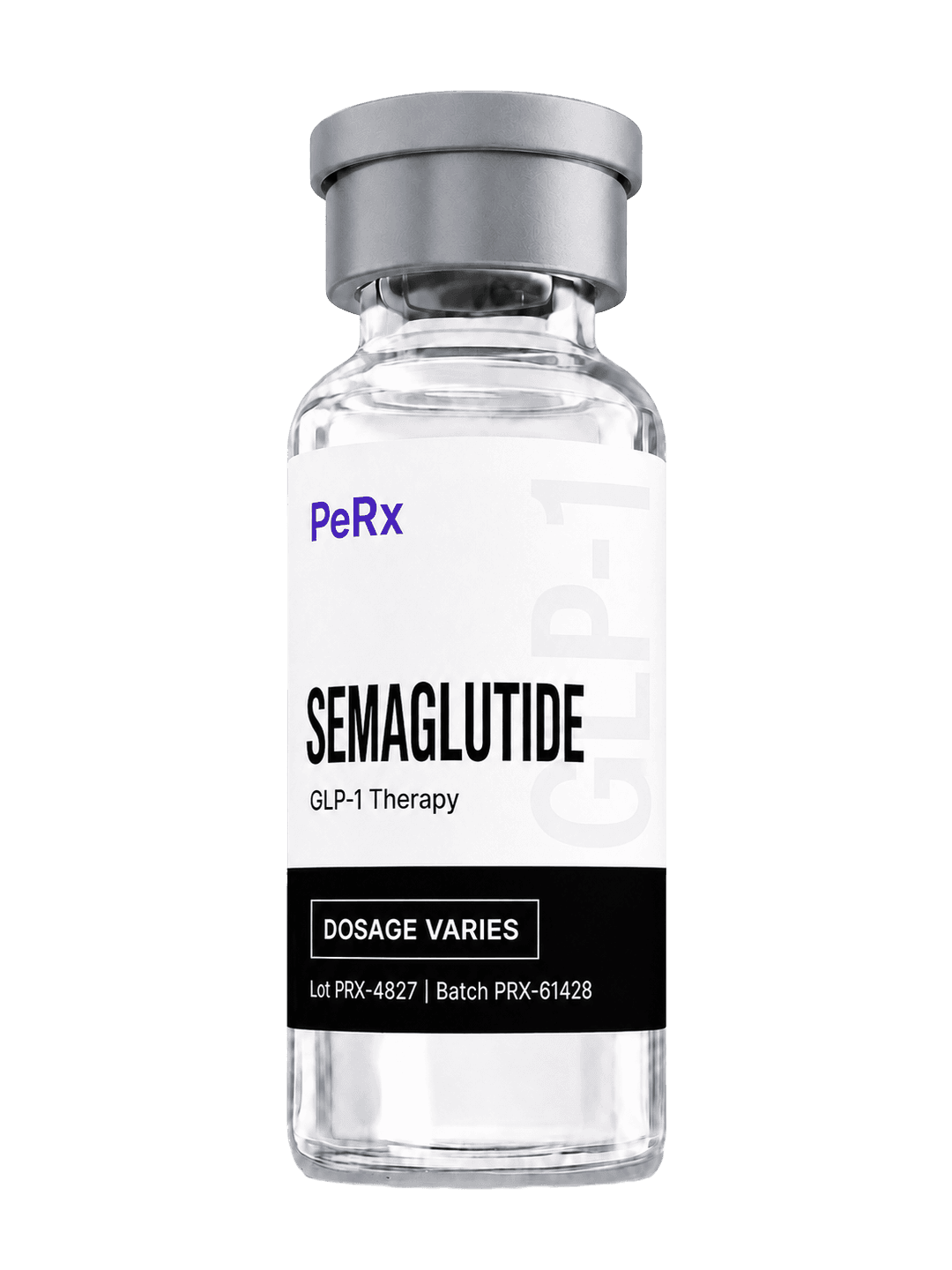
Everything that separates the compounded vial from the branded pen, ingredient form, manufacturing oversight, the FDA’s positions on copies and the cost gap, is laid out in compounded semaglutide vs Ozempic and not repeated here. From here on, "GLP-1" means the drug class and the approved brands unless the compounded product is named.
GLP-1 Peptides: What They Are and What the Evidence Shows
Four GLP-1 peptides are approved for the uses people have in mind, and the labels are specific. Ozempic (semaglutide, Novo Nordisk): blood sugar control in adults with type 2 diabetes, plus heart and kidney risk reduction in those who also have heart or kidney disease. Wegovy (semaglutide, up to 2.4 mg with a 7.2 mg strength): long-term weight reduction, with a reduced-calorie diet and more activity, in adults and adolescents 12 and older with obesity and in adults with overweight plus a weight-related condition, and cardiovascular risk reduction in adults with heart disease and obesity or overweight. Zepbound (tirzepatide, Eli Lilly): weight management plus moderate to severe obstructive sleep apnea in adults with obesity. Saxenda (liraglutide): the older daily injection for weight management.
The evidence sits on those labels. In the 68-week placebo-controlled trial on Wegovy’s label, adults without diabetes on semaglutide 2.4 mg lost a mean of 14.9 percent of body weight against 2.4 percent on placebo, with diet and activity counseling in both groups. Zepbound’s label reports 72-week losses of 15.0, 19.5 and 20.9 percent at 5, 10 and 15 mg against 3.1 percent on placebo. Those numbers belong to the branded products. Compounded semaglutide and tirzepatide were not in those trials, have none of their own, and are not FDA-approved, so the figures describe the drug class under study conditions, not what a compounded vial has been shown to do.
Wilding JPH, Batterham RL, Calanna S, et al. "Once-Weekly Semaglutide in Adults with Overweight or Obesity." New England Journal of Medicine. 2021;384(11):989-1002. PMID 33567185. View study
Jastreboff AM, Aronne LJ, Ahmad NN, et al. "Tirzepatide Once Weekly for the Treatment of Obesity." New England Journal of Medicine. 2022;387(3):205-216. PMID 35658024. View study
Novo Nordisk. Wegovy (semaglutide) injection and tablets prescribing information. DailyMed, label revised June 2026. View study
Eli Lilly and Company. Zepbound (tirzepatide) injection prescribing information. DailyMed, label revised November 2026. View study
Mechanism takes one paragraph because the weight loss peptides page owns it. GLP-1 receptor agonists act on the same receptors as the gut hormone: appetite falls, fullness lasts longer, the stomach empties more slowly, and insulin is released in proportion to blood sugar. Tirzepatide adds a second receptor, GIP; semaglutide vs tirzepatide compares the two compounded options. Retatrutide and other multi-hormone drugs in development are not approved and not prescribed by PeRx; retatrutide vs tirzepatide covers that research.
Non-GLP-1 Peptides for Weight and Metabolic Goals
Here is where "peptides for weight loss vs Ozempic" stops being a fair fight. None of the peptides below lowers appetite, and none has a placebo-controlled trial showing meaningful scale-weight loss in people. What they have are narrower effects, some measured and some assumed from animals, that can matter for body composition, recovery or energy. Best peptides for fat loss ranks them by evidence and do peptides help you lose weight gives the blunt answer. For the same products sorted by the goal behind the search, see peptides for men.
Tesamorelin
Tesamorelin is a growth-hormone-releasing hormone analog and the one peptide here with an FDA approval: as Egrifta, for reducing excess abdominal fat in adults with HIV who have lipodystrophy. Its label says it is not indicated for weight management because its effect on body weight is neutral. In the 26-week phase 3 trial behind the approval, visceral fat measured by CT fell about 15 percent on tesamorelin while rising slightly on placebo, with little change on the scale. Use outside that population is off-label, and the evidence in people without HIV is thin. At PeRx, tesamorelin is $229 for a 3 mg/mL, 5 mL vial, 20 units at bedtime Monday through Friday for three months and then a month off; tesamorelin after a GLP-1 and the tesamorelin cost guide go deeper.
Falutz J, Allas S, Blot K, et al. "Metabolic effects of a growth hormone-releasing factor in patients with HIV." New England Journal of Medicine. 2007;357(23):2359-2370. PMID 18057338. View study
Theratechnologies Inc. Egrifta WR (tesamorelin) for injection prescribing information. DailyMed, label revised March 2025. View study
MOTS-c
MOTS-c is a 16-amino-acid peptide encoded in mitochondrial DNA, described in 2015 by a University of Southern California group that showed it improved insulin sensitivity and prevented diet-induced obesity in mice. Later work found blood levels rise in people after exercise and that giving it to old mice improved their physical capacity. That is where the human record stops: no published trial has given MOTS-c to people and measured weight loss. At PeRx, MOTS-c sits in the energy category for that reason: $229 for a 2 mg/mL, 5 mL vial, 20 units on weekday mornings for eight weeks and then four off. It is not a substitute for a GLP-1; the MOTS-c guide says so at length and MOTS-c and semaglutide covers the pairing.
Lee C, Zeng J, Drew BG, et al. "The mitochondrial-derived peptide MOTS-c promotes metabolic homeostasis and reduces obesity and insulin resistance." Cell Metabolism. 2015;21(3):443-454. PMID 25738459. View study
Reynolds JC, Lai RW, Woodhead JST, et al. "MOTS-c is an exercise-induced mitochondrial-encoded regulator of age-dependent physical decline and muscle homeostasis." Nature Communications. 2021;12(1):470. PMID 33473109. View study
von Walden F, Fernandez-Gonzalo R, Norrbom J, et al. "Acute endurance exercise stimulates circulating levels of mitochondrial-derived peptides in humans." Journal of Applied Physiology. 2021;131(3):1035-1042. PMID 34351816. View study
Growth-Hormone Peptides
Sermorelin and CJC-1295/ipamorelin do not touch appetite. They prompt the pituitary to release growth hormone in pulses, sermorelin and CJC-1295 as growth-hormone-releasing hormone analogs and ipamorelin as a selective secretagogue without the cortisol and prolactin rise older secretagogues caused. In healthy adults a single dose of CJC-1295 raised growth hormone and IGF-1 for days. What that does to body composition in a person already eating less is argued from mechanism more than measured. PeRx prescribes CJC-1295/ipamorelin at $299 and sermorelin at $229, usually at bedtime; sermorelin for weight loss and CJC-1295/ipamorelin with a GLP-1 answer the two questions people bring.
Teichman SL, Neale A, Lawrence B, Gagnon C, Castaigne JP, Frohman LA. "Prolonged stimulation of growth hormone (GH) and insulin-like growth factor I secretion by CJC-1295, a long-acting analog of GH-releasing hormone, in healthy adults." Journal of Clinical Endocrinology and Metabolism. 2006;91(3):799-805. PMID 16352683. View study
Raun K, Hansen BS, Johansen NL, et al. "Ipamorelin, the first selective growth hormone secretagogue." European Journal of Endocrinology. 1998;139(5):552-561. PMID 9849822. View study
BPC-157 and Recovery Peptides
BPC-157 comes up in every peptides-versus-Ozempic thread, and it does not belong in a weight conversation. It is studied for tissue repair, nearly all of it in rodents, and a 2026 systematic review found the human evidence thin. Claims that it improves insulin sensitivity or steadies appetite have no human study behind them. AOD-9604, a growth-hormone fragment marketed for fat loss, is out of stock at PeRx as of November 2026 and is not linked here; AOD-9604 vs semaglutide covers its evidence.
Poolton JT, et al. "Human evidence for BPC-157 in orthopaedic and regenerative medicine: a systematic review of efficacy and safety." Acta Orthopaedica Belgica. 2026;92(3). PMID 42885452. View study
Which Approach Fits Your Goals? A Decision Flow
Peptides vs Ozempic is a decision a provider makes with you, not a menu. The four steps below are how that conversation usually runs at PeRx, written to be taken to any provider.
Four Steps, In Order
First, name the main goal
Substantial weight loss; blood sugar or metabolic concerns; body composition and muscle; recovery or energy. Most people have one that outranks the rest, and that one steers the choice.
Second, check candidacy
PeRx prescribes to adults 21 and older who complete the health assessment. Providers generally consider a GLP-1 at a body mass index of 30 or above, or 27 or above with a weight-related condition such as high blood pressure, high cholesterol or sleep apnea. Hard stops for any GLP-1: a personal or family history of medullary thyroid carcinoma or MEN 2, and pregnancy, breastfeeding or planning a pregnancy. A history of pancreatitis or gallbladder disease needs a conversation first.
Third, match the tool
For substantial weight loss, the GLP-1 class is what providers consider first, because it is the only option here with large trials. Non-GLP-1 peptides are considered for body composition, visceral fat, recovery or energy, or alongside a GLP-1, not instead of one. Someone near a healthy weight chasing the last few pounds is usually told that neither is the right tool.
Fourth, let the provider decide
A licensed provider reviews your history and medication list and prescribes the protocol, or declines. Nothing is charged until that review approves the order. What providers review before prescribing lists what they look at.
Two things this flow does not do. It does not tell you to choose Ozempic, because PeRx does not prescribe it and a compounded product is not the same thing. And it does not tell you to choose peptides over a GLP-1 for weight loss, because the evidence does not support that trade. If substantial weight loss is the goal, the assessment is where the GLP-1 conversation starts.
Can You Combine Peptides With a GLP-1?
The real question under "combining" is muscle. A meaningful share of the weight lost on a GLP-1 is lean mass, and the appetite drop makes it hard to eat enough protein to defend it. The first two answers are not peptides: a protein target and resistance training, which muscle loss on GLP-1s sets out. After those, some providers consider a growth-hormone-axis peptide or MOTS-c with a GLP-1; peptides to take with a GLP-1 sorts those by evidence and the muscle-preservation stack guide explains how one is built.
Be clear about what is known. No randomized trial has tested any of these combinations, so nobody can say that adding a peptide "maximizes fat loss" or protects muscle better than protein and training do; the claim is mechanism, not measurement. Stacking products from different sellers without a prescriber who sees the whole list is a red flag. If you already take a GLP-1 from another source, say so on the intake form.
Side Effects and Safety: GLP-1s vs Other Peptides
The GLP-1 side-effect profile is well documented because the approved drugs were studied in thousands of people. Ozempic’s label lists nausea, vomiting, diarrhea, abdominal pain and constipation as the reactions reported in at least 5 percent of patients; they cluster around dose increases and usually ease. It carries a boxed warning about thyroid C-cell tumors seen in rodents, and warnings for acute pancreatitis, gallbladder disease, kidney injury from dehydration, low blood sugar alongside insulin or sulfonylureas, and worsening diabetic eye disease. Nausea and gut symptoms on a GLP-1 covers what helps. A compounded product carries the same ingredient risks plus the FDA’s compounding-specific concerns: dosing errors from vials, salt-form ingredients, products shipped warm.
The non-GLP-1 peptides look gentler on paper, and the paper is the problem. Tesamorelin’s label lists fluid retention, injection-site reactions, raised IGF-1 and glucose intolerance, from trials in one population. MOTS-c has no human safety trial; CJC-1295 and ipamorelin have small, short studies; BPC-157 has almost nothing in people. Fewer documented side effects means fewer people were studied, not a safer drug. The peptide side effects guide covers what the injectable route shares.
When to stop and get help
On any GLP-1: severe abdominal pain, especially pain that spreads to the back or comes with vomiting; yellowing of the skin or eyes; a lump or swelling in the neck, hoarseness or trouble swallowing; swelling of the face, throat or tongue with difficulty breathing. On any injectable peptide: spreading redness with warmth, pus or fever at the site. Those are emergency-care symptoms. Contact the care team for nausea or vomiting that stops you keeping fluids down, constipation lasting more than a few days, or site irritation that does not resolve within a few days.
U.S. Food and Drug Administration. FDA's concerns with unapproved GLP-1 drugs used for weight loss. Content current as of October 1, 2026. Accessed November 2026. View study
FDA and HHS Status: What Is Approved and What Is Compounded
Plain statuses first, as of November 28, 2026. Ozempic is an FDA-approved drug for type 2 diabetes. Wegovy, Zepbound and Saxenda are FDA-approved for chronic weight management. Compounded semaglutide and tirzepatide are not FDA-approved; no compounded drug is. Tesamorelin is approved as Egrifta for one condition. MOTS-c, BPC-157, sermorelin, CJC-1295 and ipamorelin are not approved drugs; sermorelin was once approved as Geref, discontinued in 2008. FDA-approved peptides keeps the full list.
The compounding picture has two parts. For GLP-1s, the FDA’s statement for compounders, current as of April 1, 2026, records that the semaglutide shortage was declared resolved on February 21, 2025 and the grace periods have ended, so a compounded copy of an approved product may not be made regularly or in inordinate amounts; a semaglutide-plus-B12 product can still count as a copy unless the prescriber documents a significant difference for the individual patient. Compounded semaglutide vs Ozempic walks through what that means for a prescription.
For the non-GLP-1 peptides, the news is the Department of Health and Human Services notice published in the Federal Register on October 30, 2026, announcing a draft interim enforcement discretion policy. Under it, HHS does not intend to take enforcement action against a state-licensed pharmacy, federal facility or licensed physician compounding under section 503A with six peptide bulk substances: BPC-157, TB-500, KPV, MOTS-c, Semax and Epitalon. The published conditions limit each to a single-ingredient product in the dosage forms listed for it, MOTS-c and TB-500 by injection and Semax only as a nasal product that PeRx does not carry, with sourcing, testing and adverse-event reporting requirements. The notice says compounded drugs are not FDA-approved, calls the policy interim until rulemaking settles each substance, and took comments until November 13, 2026. It does not name GLP-1s, tesamorelin, sermorelin, CJC-1295 or ipamorelin, and multi-peptide blends sit outside it. Are peptides legal in 2026, the July 2026 FDA review and is MOTS-c FDA approved carry the background; state rules vary.
U.S. Food and Drug Administration. FDA clarifies policies for compounders as national GLP-1 supply begins to stabilize. Content current as of April 1, 2026. Accessed November 2026. View study
U.S. Department of Health and Human Services. "Enforcement Discretion Policy Regarding 503A Compounding Using Certain Peptide Bulk Drug Substances." Notice of availability, 91 FR 68526, October 30, 2026. Docket HHS-OASH-2026-0496. View study
Cost and Access
Ozempic’s list price is $1,027.51 per pen at every strength on Novo Nordisk’s own list-price page, read in November 2026; what a patient pays depends on insurance, which a diabetes diagnosis may unlock and a weight-loss goal usually does not. PeRx prices are public on the pricing page: compounded semaglutide $249 a month and tirzepatide $399 a month, with the provider review, syringes, swabs and shipping included and no membership fee; tesamorelin and MOTS-c $229 and CJC-1295/ipamorelin $299 per vial, each listed as a one-month supply. Different products with different guarantees, so the price gap is not a measure of value; the peptide therapy cost guide explains what each figure includes.
Novo Nordisk. Ozempic list price and insurance coverage explained. NovoCare. Accessed November 2026. View study
Gray-Market Peptides: Why the Source Matters
Search "peptides vs Ozempic" and half the results sell vials labeled for laboratory research. Those products are not made for people: no prescription, no pharmacist, no required testing, and purity and sterility nobody outside the seller has checked. GLP-1 vials sold that way are often a salt form the FDA says has no lawful basis for use in compounding. A prescription filled by a state-licensed 503A pharmacy that tests each lot for potency and sterility is a different product; PeRx publishes a sample certificate on its quality testing page. Gray-market GLP-1s vs compounded and is it safe to buy peptides online show how to tell them apart.
Getting Started With PeRx
The path is short. Complete the health assessment; a licensed provider reviews it and either prescribes or declines; nothing is charged until approval; a US-based, state-licensed 503A pharmacy fills the prescription and ships it cold, ready to use with no reconstitution needed, with syringes and swabs in the box. A provider reviews again before each renewal, and GLP-1 dose steps are decided at those check-ins. PeRx orders no lab work. Every product PeRx prescribes is compounded, which means none is FDA-approved and none is Ozempic.
Weight loss
GLP-1 path
Tesamorelin
Non-GLP-1 option, visceral fat
MOTS-c
Non-GLP-1 option, cell energy
Ready to get started?
Pharmacy-compounded peptides and GLP-1s, prescribed by a licensed provider who reviews your health history and medication list first. Ships ready to use with no reconstitution needed.
Peptides vs Ozempic FAQs
Related Guides
Continue reading about peptides and protocols that pair well with this guide.
Is Glutathione FDA Approved? Antioxidant Status
Glutathione is the most abundant antioxidant in your body. Oral glutathione supplements are sold everywhere. IV and injectable glutathione are used in clinics worldwide. But the FDA approval picture is more nuanced than you might expect. Here is what glutathione actually is, how different forms are regulated, and what the science supports.
Peptide Stacking 2026: How to Combine Peptides Safely
Stacking means using two or more peptides that target complementary pathways. Done correctly, the combined effect is greater than either peptide alone. Done incorrectly, you waste money on redundant signaling. This guide covers which combinations work, which ones do not, and how to think about building a protocol.
Sermorelin Benefits: What the Research Supports
Search for sermorelin benefits and you will find the same list on every clinic website: sleep, muscle, fat loss, skin, energy. What almost none of those pages tell you is how strong the evidence behind each claim actually is. This guide grades every major benefit against the published human research, names the honest size of each effect, and is just as specific about what sermorelin will not do.
References and Review
Label facts come from each product’s prescribing information on DailyMed, cited above with the revision month; FDA and HHS statements carry the date the source marks them current. The page is reviewed by Dr. Cory Mellon, MD, and the regulatory status is re-checked on the date shown at the top.
Novo Nordisk. Saxenda (liraglutide) injection prescribing information. DailyMed, label revised June 2026. View study
PeRx. Pricing; Quality testing. perxpeptides.com. Accessed November 2026. View study
Medical Disclaimer
The information provided on this website, including all articles, guides, and educational content, is for informational and educational purposes only and is not intended as medical advice, diagnosis, or treatment. Nothing on this site should be construed as a substitute for professional medical advice from a qualified healthcare provider.
The majority of peptides discussed on this site are not approved by the U.S. Food and Drug Administration (FDA) for the indications described. They are classified as bulk drug substances and are available only through a licensed prescribing provider and compounding pharmacy. All treatments require a valid prescription and provider oversight.
The majority of published research on peptide therapies has been conducted in preclinical (animal) models. While early human data is encouraging, comprehensive clinical trial data remains limited for most peptide compounds. Individual results may vary significantly based on health status, injury type, and other factors. No specific outcomes are guaranteed.
Certain peptides discussed on this site are classified as prohibited substances by the World Anti-Doping Agency (WADA) and are banned by major sports organizations including the NFL, NCAA, UFC, NBA, MLB, NHL, and PGA. If you are subject to anti-doping testing, consult your governing body before considering any peptide therapy.
Statements on this website have not been evaluated by the Food and Drug Administration. Products and therapies discussed are not intended to diagnose, treat, cure, or prevent any disease.
© 2026 Wellness MD Group PC DBA PeRx. All rights reserved.