BPC-157 for Gut Health: What the Evidence Shows
BPC-157 was found in the stomach and studied in the gut before anything else, and almost all of that evidence comes from rats and mice. This page sorts the gut research by what each model measured, explains why no controlled human gut trial exists, compares the capsule with the injection, answers the GLP-1 stomach question, and reads the November 2026 regulatory picture.
In this article
Key Takeaways
- Every BPC-157 gut claim traces back to rat and mouse models: lesions after NSAIDs and alcohol, chemical injury to the colon, surgical joins in the intestine, and short bowel after resection. No published controlled trial has given BPC-157 to people for any gut purpose; the mechanisms were shown in rodents and cells.
- Increased intestinal permeability is a laboratory measurement, not a diagnosis, and no human study has measured what BPC-157 does to it. BPC-157 has not been studied at all for the nausea or slowed stomach emptying that GLP-1 medicines cause.
- For a gut-only goal the capsule is the route with an argument, because the peptide is stable in gastric juice and contacts the lining directly; human oral absorption has never been measured. The injection is the route for tendon, ligament and joint goals.
- As of November 2026 BPC-157 is not an FDA-approved drug. An FDA advisory committee recommended it for the 503A bulks list in July 2026, and on October 28, 2026 HHS issued an interim enforcement discretion policy for single-ingredient compounding. Neither is an approval, and the blend products sit outside the policy.
BPC-157 for Gut Health at a Glance
Evidence base
Rat and mouse models since the 1990s; no controlled human gut trial
What the models measured
NSAID and alcohol lesions, chemical colon injury, surgical joins, short bowel
Human gut data
Croatian safety trials in the 1990s; no efficacy results published
Route for a gut-only goal
Oral capsule; absorption in people unmeasured
FDA status, November 2026
Not approved; advisory vote July 2026; HHS interim enforcement policy October 28, 2026
PeRx products
BPC Capsules $200 per 30; BPC-157 injectable $229 per vial; BPC/TB-500 Capsules $225
BPC-157 for Gut Health: The Short Answer
BPC-157 for gut health is the most-searched use of the peptide and the one with the thinnest human record. The animal evidence is real and three decades deep: rats given the peptide healed stomach lesions from aspirin-type painkillers and alcohol, recovered from chemical injury to the colon, held surgical joins in the intestine, and regained weight after most of the small bowel was removed. No published controlled trial has given BPC-157 to people for any of those problems, or for bloating, cramping, irregular bowel habits or the stomach effects of a GLP-1. Gut symptoms that persist need a medical evaluation before any peptide enters the conversation.
The gut is the peptide’s home turf for a reason. BPC-157 is a laboratory-made copy of a 15-amino-acid stretch of a protein that Predrag Sikiric’s group at the University of Zagreb isolated from human gastric juice in the early 1990s, and the Zagreb papers describe it as stable in gastric juice, the one fact that makes an oral form worth discussing. A peptide found in gastric juice has a reason to be tested in the gut, not a proof that it works there in people. PeRx prescribes it as a capsule and as an injection after screening; the wider field is on how we approach gut health peptides, the discovery story is in the BPC-157 guide, and nothing in the table below is a treatment claim.
Sikiric P, Seiwerth S, Rucman R, et al. "Stable gastric pentadecapeptide BPC 157: novel therapy in gastrointestinal tract." Current Pharmaceutical Design. 2011;17(16):1612-1632. PMID 21548867. View study
Sikiric P, Sever M, Krezic I, et al. "New studies with stable gastric pentadecapeptide protecting gastrointestinal tract. Significance of counteraction of vascular and multiorgan failure of occlusion/occlusion-like syndrome in cytoprotection/organoprotection." Inflammopharmacology. 2024;32(5):3119-3161. PMID 38980576. View study
| Question people bring | What the research contains | Human evidence |
|---|---|---|
| Stomach lining after painkillers or alcohol | Rat lesion models; the largest body of work | None published |
| Inflamed or injured colon | Rat chemical-injury models, one independent | Safety trials only; no results published |
| Surgical joins, fistulas, short bowel | Rat surgery models, oral and injected | None published |
| Increased intestinal permeability | Rodent barrier data inside NSAID-injury models | Never measured in people given BPC-157 |
| Bloating, cramping, irregular bowel habits | Rat sphincter and serotonin studies, loosely related | None published |
| GLP-1 nausea or slowed stomach emptying | No study in any species | None |
Stomach lining after painkillers or alcohol
- What the research contains
- Rat lesion models; the largest body of work
- Human evidence
- None published
Inflamed or injured colon
- What the research contains
- Rat chemical-injury models, one independent
- Human evidence
- Safety trials only; no results published
Surgical joins, fistulas, short bowel
- What the research contains
- Rat surgery models, oral and injected
- Human evidence
- None published
Increased intestinal permeability
- What the research contains
- Rodent barrier data inside NSAID-injury models
- Human evidence
- Never measured in people given BPC-157
Bloating, cramping, irregular bowel habits
- What the research contains
- Rat sphincter and serotonin studies, loosely related
- Human evidence
- None published
GLP-1 nausea or slowed stomach emptying
- What the research contains
- No study in any species
- Human evidence
- None
How BPC-157 May Work in the Gut, Labeled by Where It Was Shown
Three mechanisms recur, each with its species label. New blood vessels: a 2017 study from Taiwan found that BPC-157 activated and increased VEGFR2, the main receptor for vascular endothelial growth factor, in endothelial cells and in a rat model; in the gut that reads as faster lesion closure and stronger surgical joins. The gut barrier: a 2020 review by Korean and Croatian authors collects the rodent work in which BPC-157 limited the permeability rise and small-intestinal injury that NSAIDs cause; no human measurement exists. Inflammation and nitric oxide: in the colon-injury experiment below the peptide lowered the neutrophil marker in step with the dose. A mechanism in a dish or a rat is a reason to run a trial, and the trial has not been run; BPC-157 mechanism of action goes through the pathways.
Hsieh MJ, Liu HT, Wang CN, et al. "Therapeutic potential of pro-angiogenic BPC157 is associated with VEGFR2 activation and up-regulation." Journal of Molecular Medicine. 2017;95(3):323-333. PMID 27847966. View study
Park JM, Lee HJ, Sikiric P, Hahm KB. "BPC 157 Rescued NSAID-cytotoxicity Via Stabilizing Intestinal Permeability and Enhancing Cytoprotection." Current Pharmaceutical Design. 2020;26(25):2971-2981. PMID 32445447. View study
What the Animal Models Measured
The oldest work is lesions. In 1997 the Zagreb group reported that BPC-157 reduced the gastrointestinal lesions caused by non-steroidal anti-inflammatory drugs in rats and, in the same study, improved adjuvant arthritis, which is why the peptide is so often called both gut-protective and anti-inflammatory.
Sikiric P, Seiwerth S, Grabarevic Z, et al. "Pentadecapeptide BPC 157 positively affects both non-steroidal anti-inflammatory agent-induced gastrointestinal lesions and adjuvant arthritis in rats." Journal of Physiology, Paris. 1997;91(3-5):113-122. PMID 9403784. View study
The colon work matters because one piece of it is independent. In 1995 a Parke-Davis group in Ann Arbor gave rats trinitrobenzene sulfonic acid in ethanol, which produces necrosis and acute inflammation of the colon, and measured the damage three days later. Injected BPC-157, then called BPC-15, shrank the damaged area and lowered the neutrophil marker in proportion to the dose. That is the design most "BPC-157 for colitis" claims descend from: a healthy rat, a chemical burn, a three-day readout, not a chronic disease in a person.
Veljaca M, Lesch CA, Pllana R, Sanchez B, Chan K, Guglietta A. "BPC-15 reduces trinitrobenzene sulfonic acid-induced colonic damage in rats." Journal of Pharmacology and Experimental Therapeutics. 1995;272(1):417-422. PMID 7815358. View study
Two surgical models round out the picture. In 2007 the Zagreb group reported that BPC-157 improved healing of a join in the rat small intestine, measured by the pressure the join withstood before leaking. In 2009 the same group removed most of the small bowel from rats and gave BPC-157 by injection or in drinking water; treated animals gained weight from the first week while untreated animals wasted. That drinking-water arm is one of the few direct oral-versus-injection tests in a gut model, and both routes worked.
Vuksic T, Zoricic I, Brcic L, et al. "Stable gastric pentadecapeptide BPC 157 in trials for inflammatory bowel disease (PL-10, PLD-116, PL14736, Pliva, Croatia) heals ileoileal anastomosis in the rat." Surgery Today. 2007;37(9):768-777. PMID 17713731. View study
Sever M, Klicek R, Radic B, et al. "Gastric pentadecapeptide BPC 157 and short bowel syndrome in rats." Digestive Diseases and Sciences. 2009;54(10):2070-2083. PMID 19093208. View study
Then the record stops. The Zagreb papers state that BPC-157 was safe in Croatian clinical trials for inflammatory bowel disease run by the company Pliva under the codes PL-10, PLD-116 and PL 14736; those trials are cited for safety only, and no efficacy result from them appears in the peer-reviewed literature. A 2025 systematic review that screened 544 papers found 36 that met its criteria, 35 of them preclinical and one a retrospective clinical series in orthopaedics. Most of it comes from the single Zagreb laboratory, and for the gut the human column is empty.
Vasireddi N, Hahamyan H, Salata MJ, et al. "Emerging Use of BPC-157 in Orthopaedic Sports Medicine: A Systematic Review." HSS Journal. 2025;21(4):485-495. PMID 40756949. View study
The Questions Readers Actually Bring
Bloating, cramping and bowel habits that will not settle
Irritable bowel syndrome is the diagnosis many readers already carry. It is defined by symptom criteria rather than a tissue lesion, and the American College of Gastroenterology’s 2021 guideline manages it through diet, specific medicines and gut-directed behavioral therapy. No human trial has tested BPC-157 for it. The animal findings people cite are indirect: a 2004 McGill study found that the peptide changed serotonin synthesis in regions of the rat brain, and the Zagreb group reports effects on sphincter pressure and motility in rats. That runs from a rat brain autoradiograph to a human symptom with nothing in between, and no peptide is a treatment for the diagnosis.
Lacy BE, Pimentel M, Brenner DM, et al. "ACG Clinical Guideline: Management of Irritable Bowel Syndrome." American Journal of Gastroenterology. 2021;116(1):17-44. PMID 33315591. View study
Tohyama Y, Sikiric P, Diksic M. "Effects of pentadecapeptide BPC157 on regional serotonin synthesis in the rat brain: alpha-methyl-L-tryptophan autoradiographic measurements." Life Sciences. 2004;76(3):345-357. PMID 15531385. View study
Increased intestinal permeability, the thing called leaky gut
Permeability is a measurement: how readily sugar probes or other markers cross the intestinal lining. Mayo Clinic’s Michael Camilleri wrote a 2019 review for clinicians making the point that permeability rises in stress states such as endurance exercise, NSAID use and pregnancy, that it is not a diagnosis, and that "leaky gut" claims need confirmation before anyone changes a diet or buys a supplement to repair it. In rodents BPC-157 limited the permeability rise inside NSAID-injury models; nobody has measured permeability in a person before and after BPC-157. Bloating and food reactions have many causes and are not evidence of a leaky lining. One label note belongs here too: the rodent work on NSAID injury does not change the PeRx prescription, which says not to take NSAIDs while using the peptide; BPC-157 vs cortisone covers anti-inflammatory drugs and healing.
Camilleri M. "Leaky gut: mechanisms, measurement and clinical implications in humans." Gut. 2019;68(8):1516-1526. PMID 31076401. View study
BPC-157 and GLP-1 Stomach Side Effects
Semaglutide and tirzepatide slow stomach emptying and act on nausea signaling in the brain; in a 2018 study of semaglutide in people with obesity, first-hour gastric emptying was measurably delayed. Nausea, constipation and diarrhea are common early and usually ease as the dose settles; nausea and gut issues on GLP-1s covers what helps, and the weight loss peptides page explains the medicines. The compounded semaglutide and tirzepatide PeRx prescribes are not the FDA-approved brand products, and nothing here uses brand trial data to describe them.
Hjerpsted JB, Flint A, Brooks A, Axelsen MB, Kvist T, Blundell J. "Semaglutide improves postprandial glucose and lipid metabolism, and delays first-hour gastric emptying in subjects with obesity." Diabetes, Obesity and Metabolism. 2018;20(3):610-619. PMID 28941314. View study
Nothing is known about BPC-157 for those effects: no trial, case series or animal study has tested it against GLP-1 nausea or delayed emptying. The mismatch is in the mechanism: BPC-157’s gut data is about injured lining healing faster, while a GLP-1 slows an intact stomach on purpose and signals nausea through receptors in the gut and brain stem, so there is no damaged tissue for a repair peptide to act on. The one plausible interaction runs the other way, since a slower stomach changes how a capsule is absorbed, and nobody has studied it; can you take BPC-157 with a GLP-1 and peptides to take with GLP-1 go further. Persistent nausea belongs with whoever prescribed the GLP-1; at PeRx the dose step is decided at each renewal check-in. Repeated vomiting, inability to keep fluids down, or severe abdominal pain need urgent care the same day.
Oral vs Injection BPC-157 for the Gut
Most peptides cannot survive a stomach. BPC-157 is the exception with a defensible oral case, and for a gut-only goal the capsule is the route with the argument: the peptide reaches the lining it was studied on without first circulating through the body. The injection delivers far more of the dose into circulation, which is why it is the route for tendons, ligaments, joints and post-surgical soft tissue. Neither statement rests on a human measurement; no pharmacokinetic study of oral BPC-157 in people has been published.
| Route | Why it is discussed for the gut | What is known | What is unknown |
|---|---|---|---|
| Oral capsule | Direct contact with the lining; stable in gastric juice | Active by mouth in rat gut models, including the short bowel study | Human absorption, how much reaches the lining, whether food timing matters |
| Subcutaneous injection | Where most of the research sits; intact peptide reaches circulation | Active in nearly every rodent model, gut and tissue | Whether a systemic dose does anything specific for an intact human gut |
Oral capsule
- Why it is discussed for the gut
- Direct contact with the lining; stable in gastric juice
- What is known
- Active by mouth in rat gut models, including the short bowel study
- What is unknown
- Human absorption, how much reaches the lining, whether food timing matters
Subcutaneous injection
- Why it is discussed for the gut
- Where most of the research sits; intact peptide reaches circulation
- What is known
- Active in nearly every rodent model, gut and tissue
- What is unknown
- Whether a systemic dose does anything specific for an intact human gut
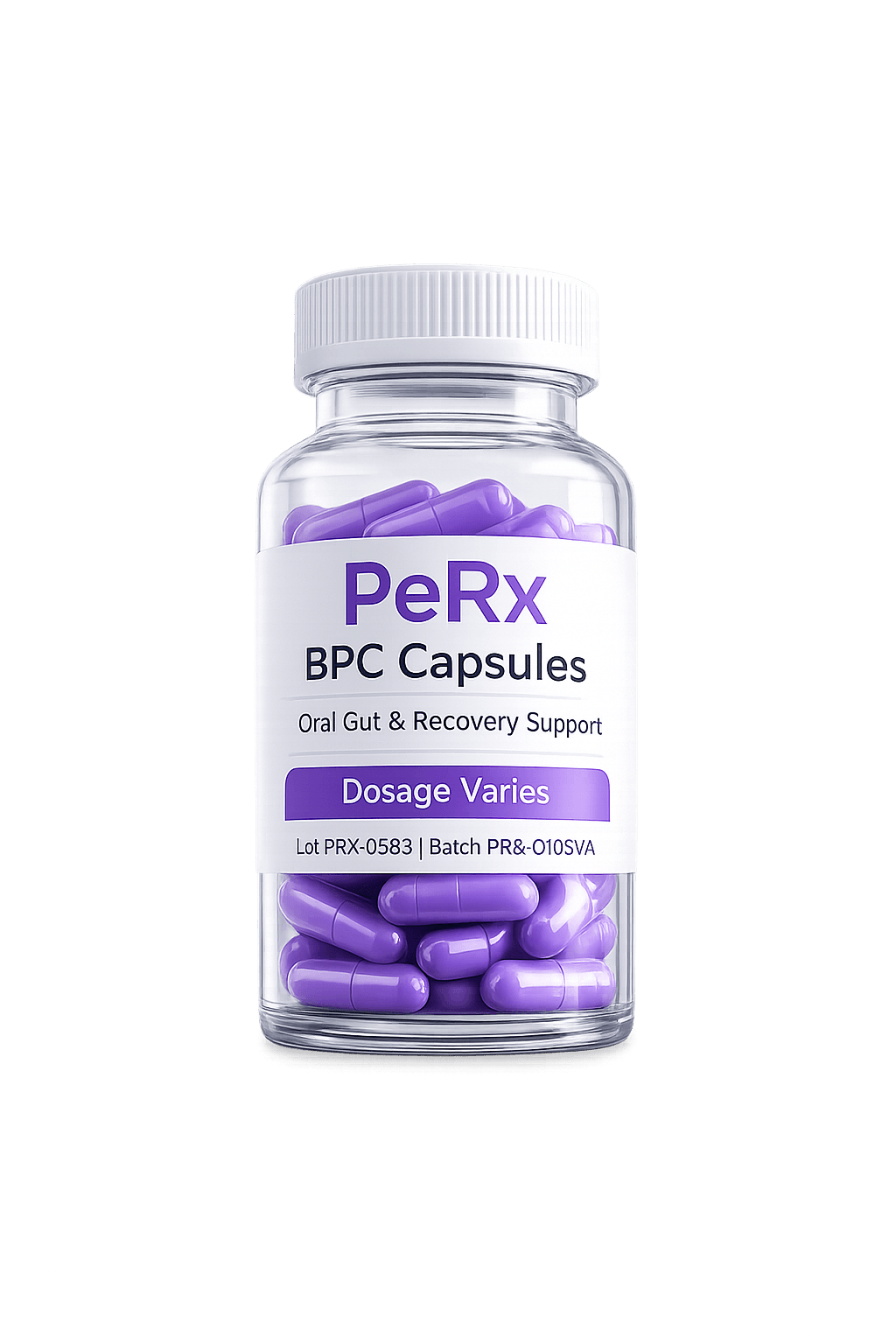
At PeRx, BPC-157 for gut health usually means the capsule: a licensed provider prescribes it after reviewing your history, a US-based, state-licensed 503A pharmacy compounds it, and it ships with the schedule on the label, taken each morning on an empty stomach with water only and nothing else for half an hour. The label sets the course and the break, and dose steps are decided at each renewal check-in. BPC-157 capsules, oral vs injectable BPC-157 and oral vs injectable peptides go deeper.
BPC Capsules
Oral BPC-157 in a daily capsule for a gut-focused goal, or for anyone who would rather not inject. Prescribed by a licensed provider after screening, compounded at a US-based, state-licensed 503A pharmacy, shelf-stable with nothing to mix.
$200 for 30 capsules. The BPC/TB-500 Capsules ($225) add TB-500 for recovery goals beyond the gut.
How BPC-157 Compares With the Other Gut Peptides
Lists of the best peptides for gut health run to six or eight names; the ranking question is answered on the gut health hub, and the short version is that nobody wins, because none has human evidence for a gut condition. KPV, a fragment of the hormone alpha-MSH, has the next-best record: in mice with chemical colitis, oral KPV reduced weight loss, tissue damage and inflammatory markers, and the effect depended on the transporter that carries it into intestinal cells. That is mouse data and nothing in people. PeRx does not sell KPV on its own; it ships inside KLOW, the four-peptide vial with BPC-157, GHK-Cu and TB-500, and KPV peptide benefits goes through the evidence. Where inflammation rather than the gut is the goal, peptides for inflammation compares the options.
Dalmasso G, Charrier-Hisamuddin L, Nguyen HT, Yan Y, Sitaraman S, Merlin D. "PepT1-mediated tripeptide KPV uptake reduces intestinal inflammation." Gastroenterology. 2008;134(1):166-178. PMID 18061177. View study
Safety, Side Effects and Who Is Screened Out
The human safety record is small: one clinical report among the 36 studies in the 2025 systematic review, animal toxicology, and the unpublished Pliva trials. What patients report is mild and anecdotal: on the capsule, a few days of stomach discomfort or a change in bowel habit as the routine starts; on the injection, redness or a small bruise at the site. Long-term human safety has not been studied. BPC-157 side effects and the peptide side effects guide go further.
What the PeRx Label Says to Do
Contact the care team
A mild rash, localized hives, stomach discomfort or site irritation that persists more than a few days.
Seek emergency care
Severe abdominal pain; swelling of the face, throat or tongue; difficulty breathing; rapid heartbeat; dizziness; signs of infection at an injection site.
Painkillers
No NSAIDs (ibuprofen, naproxen, aspirin) during use, capsule or injection.
Course
The label sets the course and the break. Do not use continuously.
Screening exists for the groups the animal data cannot reassure. Active or recent cancer leads the list, because a peptide that increases blood-vessel growth in rodents is the wrong thing to add during cancer treatment without an oncologist; no human case of BPC-157 causing or accelerating a cancer has been documented, and no study has looked. Pregnancy and breastfeeding are exclusions for lack of reproductive data. Blood thinners, a history of clots and upcoming surgery are on the capsule’s exclusion list. A diagnosed inflammatory bowel disease under treatment is a gastroenterologist’s decision first; see peptides for autoimmune patients.
What FDA has said about compounded BPC-157
FDA’s page on compounding substances that may present significant safety risks, current as of April 22, 2026, states that compounded drugs containing BPC-157 "may pose risk for immunogenicity for certain routes of administration and may have complexities with regard to peptide-related impurities and active pharmaceutical ingredient (API) characterization." That is why the source of the raw peptide matters.
U.S. Food and Drug Administration. "Certain Bulk Drug Substances for Use in Compounding That May Present Significant Safety Risks." BPC-157 entry. Content current as of April 22, 2026. View study
Gut Symptoms That Need a Medical Evaluation First
A peptide is the wrong first move for a symptom nobody has evaluated. The irritable bowel guideline lists the features that call for a workup before any symptom-based diagnosis, and they apply to anyone considering BPC-157 for gut health:
Red Flags: See a Clinician Before Any Peptide
Bleeding
Blood in the stool, or black, tarry stool.
Weight and blood count
Unintentional weight loss, or anemia on a blood test.
Pain and fever
Severe or worsening abdominal pain, ongoing fever, or repeated vomiting.
Pattern
Diarrhea that wakes you at night, new symptoms after age 50, trouble swallowing.
Family history
Colorectal cancer, inflammatory bowel disease or celiac disease in a close relative.
A workup may include stool tests, blood tests including celiac antibodies, testing for infection, and endoscopy or colonoscopy depending on age and findings. Four questions worth asking: what diagnosis explains the symptoms, which tests rule out the serious causes, what the first-line approach is, and whether a compounded peptide would interfere with it. Bring the answers to the PeRx intake. What providers review before prescribing describes the screening, lab work before starting peptides explains why PeRx orders no labs and relies on a check-in before each renewal, and peptide safety monitoring covers the long run.
FDA Status of BPC-157, November 2026
BPC-157 is not an FDA-approved drug for any use, and compounded BPC-157 is not FDA approved either; nothing below changes that. The rules moved three times in 2026.
2023
Restricted category
FDA placed BPC-157 on its list of bulk substances that may present significant safety risks.
July 23, 2026
Advisory committee vote
FDA’s Pharmacy Compounding Advisory Committee reviewed BPC-157, with ulcerative colitis as the use FDA evaluated, and recommended it for the 503A bulks list with KPV, TB-500 and MOTS-c; epitalon and Semax followed the next day. The votes are advisory.
April 2026
Removed from the restricted category
FDA removed BPC-157 and eleven other peptides from the list without adding them to the 503A bulks list.
October 28, 2026
HHS interim enforcement policy
The HHS Secretary issued a draft enforcement discretion policy, published in the Federal Register on October 30: no enforcement action against a state-licensed pharmacy or licensed physician compounding with the six peptides in its Appendix A while rulemaking proceeds.
Read the policy for what it is. It covers single-ingredient compounding only, which puts the BPC/TB-500 vial, the combo capsule and KLOW outside it. For BPC-157 it lists subcutaneous, intramuscular, oral and topical dosage forms, of which PeRx carries the injection and the capsule and no topical product, and it asks compounders of oral forms to keep documentation that the formulation is adequately bioavailable in people, the measurement this page keeps noting has never been published. It requires a patient-specific prescription, a raw ingredient from a facility registered with FDA and covered by a certificate of analysis, a compounded-drug label, and reporting of serious adverse events to FDA. It does not add BPC-157 to the 503A bulks list, does not approve anything, creates no rights, and may be revisited if a safety signal appears. FDA’s own scientific staff had recommended against adding these peptides; HHS relied on the committee vote instead.
For a patient the practical change is small: a licensed provider’s prescription filled by a state-licensed 503A pharmacy was the defensible route before the policy and is the route the policy describes, while vials sold online with no prescription are untouched by it. Background is on is BPC-157 FDA approved, the July 2026 FDA review, FDA panel recommends peptides and where to buy peptides legally. For tested athletes, BPC-157 stays prohibited under the World Anti-Doping Agency’s category for non-approved substances, which matters for anyone reading the injury recovery page with a competition calendar. Regulatory status on this page was checked on November 26, 2026.
U.S. Department of Health and Human Services, Office of the Secretary. "Enforcement Discretion Policy Regarding 503A Compounding Using Certain Peptide Bulk Drug Substances." Notice of availability, Docket No. HHS-OASH-2026-0496. Federal Register. 2026;91(209):68526-68527. Published October 30, 2026. View study
U.S. Food and Drug Administration. "July 23-24, 2026: Meeting of the Pharmacy Compounding Advisory Committee." Bulk drug substances considered for the 503A Bulks List, including BPC-157 (free base) and BPC-157 acetate. View study
Getting BPC-157 Through a Prescription
The path is the same for the capsule and the injection: you complete the eligibility check, a licensed provider reviews your health history, digestive history and medication list, and if you are a fit the prescription goes to a US-based, state-licensed 503A pharmacy, which compounds it and ships it. There is no separate consultation fee, no lab order, and a check-in before each renewal. The capsule arrives shelf-stable; the injection ships fully reconstituted and ready to use. Compounded BPC-157 is not FDA approved. How to get peptides prescribed online walks through the process; the recovery peptides page shows the options.
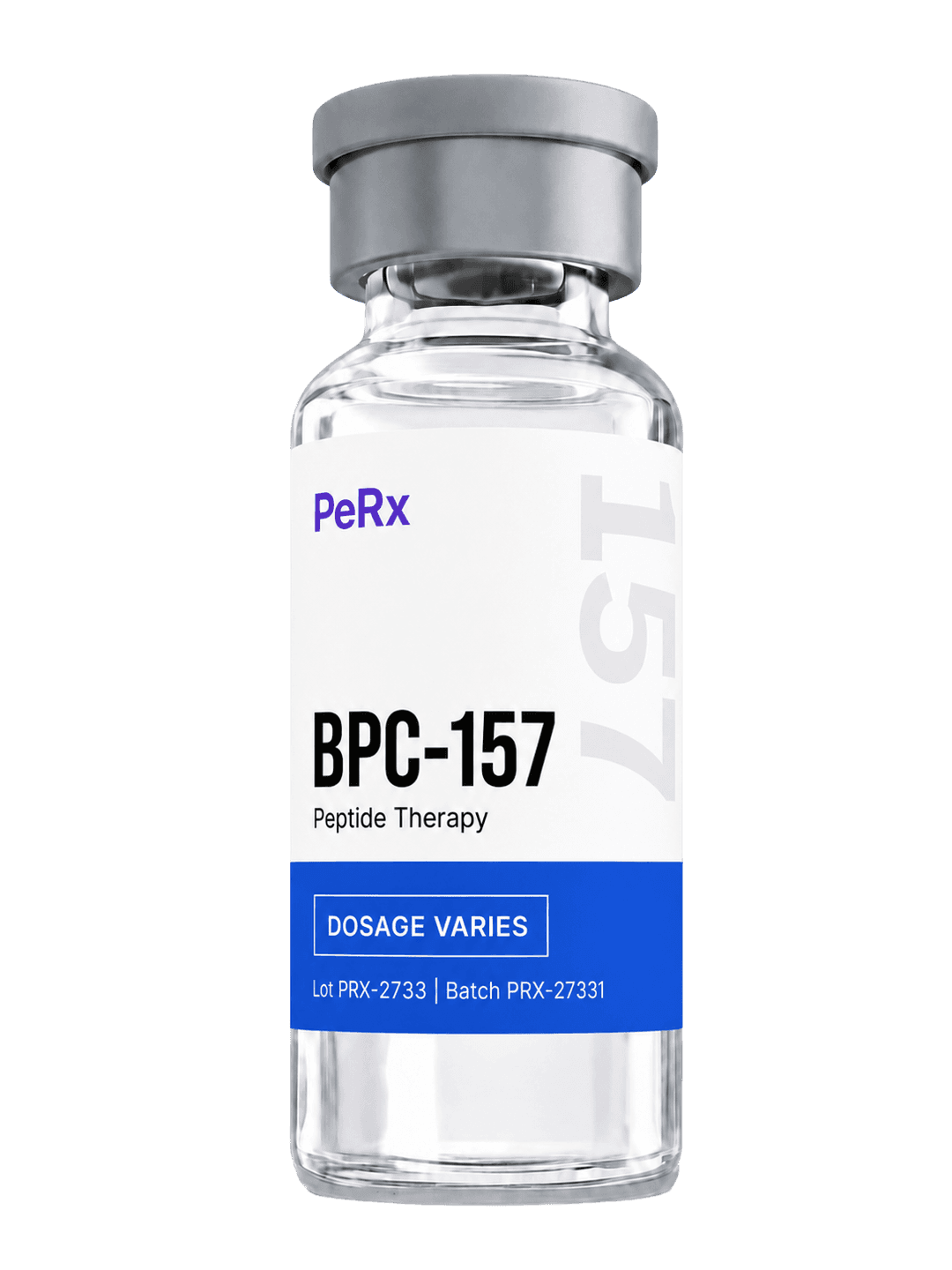
BPC-157 Injectable
For tendon, ligament, joint and post-surgical goals, or a gut goal paired with an injury, the injection is the route where the research sits. Prescribed after screening, compounded at a US-based, state-licensed 503A pharmacy, and ships fully reconstituted and ready to use, with syringes and swabs included.
$229 per vial. For goals that span gut, skin and soft tissue, KLOW ($349) combines BPC-157 with GHK-Cu, KPV and TB-500 in one vial.
BPC-157 for Gut Health: Common Questions
Related Guides
Continue reading about peptides and protocols that pair well with this guide.
Peptides for Gut Health: Evidence, Options and Limits
Two peptides carry almost all of the gut research: BPC-157, a fragment of a protein in human gastric juice, and KPV, a three-amino-acid piece of a melanocortin hormone. Most of what is known about either comes from rat and mouse models, not from trials in people. This guide lays out what those models measured, where the oral capsule fits, who a prescriber screens out, and what PeRx does and does not prescribe for the gut.
Peptides Without Needles: Capsules, Sublingual, Nasal
Yes, some peptides can be taken without a needle. Most cannot, and the ones that can are not the same product in a different package. This page puts every needle-free route side by side, grades the evidence for each, says which ones PeRx actually offers, and explains why a jet injector does not belong on the list at all.
Tirzepatide Dosage Chart: Units, Strengths, Schedule
Every tirzepatide dosage chart online shows the same six numbers, 2.5 mg to 15 mg, because they all come from one FDA label. What none of them shows is how a compounded multi-dose vial carries those numbers. At PeRx the draw never changes: 50 units once a week, every cycle, while the provider changes the strength of the vial. This page lays out the label ladder, the six vial strengths that map onto it, the units arithmetic for any concentration, and the rules for escalation, maintenance and missed doses, as of October 2026.
Ready to get started?
Pharmacy-compounded BPC-157 as a capsule or an injection, prescribed by a licensed provider who reviews your health history, digestive history and medication list first.
Medical Disclaimer
The information provided on this website, including all articles, guides, and educational content, is for informational and educational purposes only and is not intended as medical advice, diagnosis, or treatment. Nothing on this site should be construed as a substitute for professional medical advice from a qualified healthcare provider.
The majority of peptides discussed on this site are not approved by the U.S. Food and Drug Administration (FDA) for the indications described. They are classified as bulk drug substances and are available only through a licensed prescribing provider and compounding pharmacy. All treatments require a valid prescription and provider oversight.
The majority of published research on peptide therapies has been conducted in preclinical (animal) models. While early human data is encouraging, comprehensive clinical trial data remains limited for most peptide compounds. Individual results may vary significantly based on health status, injury type, and other factors. No specific outcomes are guaranteed.
Certain peptides discussed on this site are classified as prohibited substances by the World Anti-Doping Agency (WADA) and are banned by major sports organizations including the NFL, NCAA, UFC, NBA, MLB, NHL, and PGA. If you are subject to anti-doping testing, consult your governing body before considering any peptide therapy.
Statements on this website have not been evaluated by the Food and Drug Administration. Products and therapies discussed are not intended to diagnose, treat, cure, or prevent any disease.
© 2026 Wellness MD Group PC DBA PeRx. All rights reserved.